NetSuite is the best accounting software for most large businesses, with multi-entity books, consolidation and CRM on one database. Sage Intacct suits finance-led teams, while Business Central fits Microsoft shops that want a published price.
How we make this list: we compare pricing pages, product documentation and public user reviews, then re-check every price before each update. No product paid for a place. Disclosure.
NetSuite leads for growing multi-entity groups, with a 4.1 G2 rating from 4,963 reviews and quote-only pricing.
Business Central is the only tool here with a clean published price: Essentials at $80 per user a month, paid yearly.
Sage Intacct holds the highest finance-led rating here at 4.3 out of 5 from 4,521 G2 reviews.
Odoo is the budget route at $31.10 per user a month, with a free single-app tier.
Oracle Fusion lists at $625 per named user a month, the highest published price in this list.
What large-business accounting software should cover
Large-business accounting software keeps the books for a group of legal entities in several currencies, with intercompany accounting, consolidation, approval controls and an audit trail.
The first split is price transparency. Only Business Central, Odoo and Oracle Fusion publish a list price; NetSuite, Sage Intacct, Acumatica, Workday and SAP Business One quote every deal.
The second split is scope. NetSuite, Acumatica and SAP Business One run operations as well as finance, while Sage Intacct and Workday are finance-first systems that connect to operational tools.
Implementation time is part of the price. G2 users report 4 to 9 months for Sage Intacct, Workday, NetSuite, Acumatica and Oracle, so budget for a partner project, not a weekend setup.
The 9 best accounting software tools for large business
01
NetSuite
4.1/5on G2 (4,963 reviews, checked Nov 2026)
PricingCustom/yr
Best accounting software for large business overall
Free planNo, demo only
Entry planCustom quote
EntitiesMulti-entity, multi-currency
G2 rating4.1/5, 4,963 reviews
netsuite.com
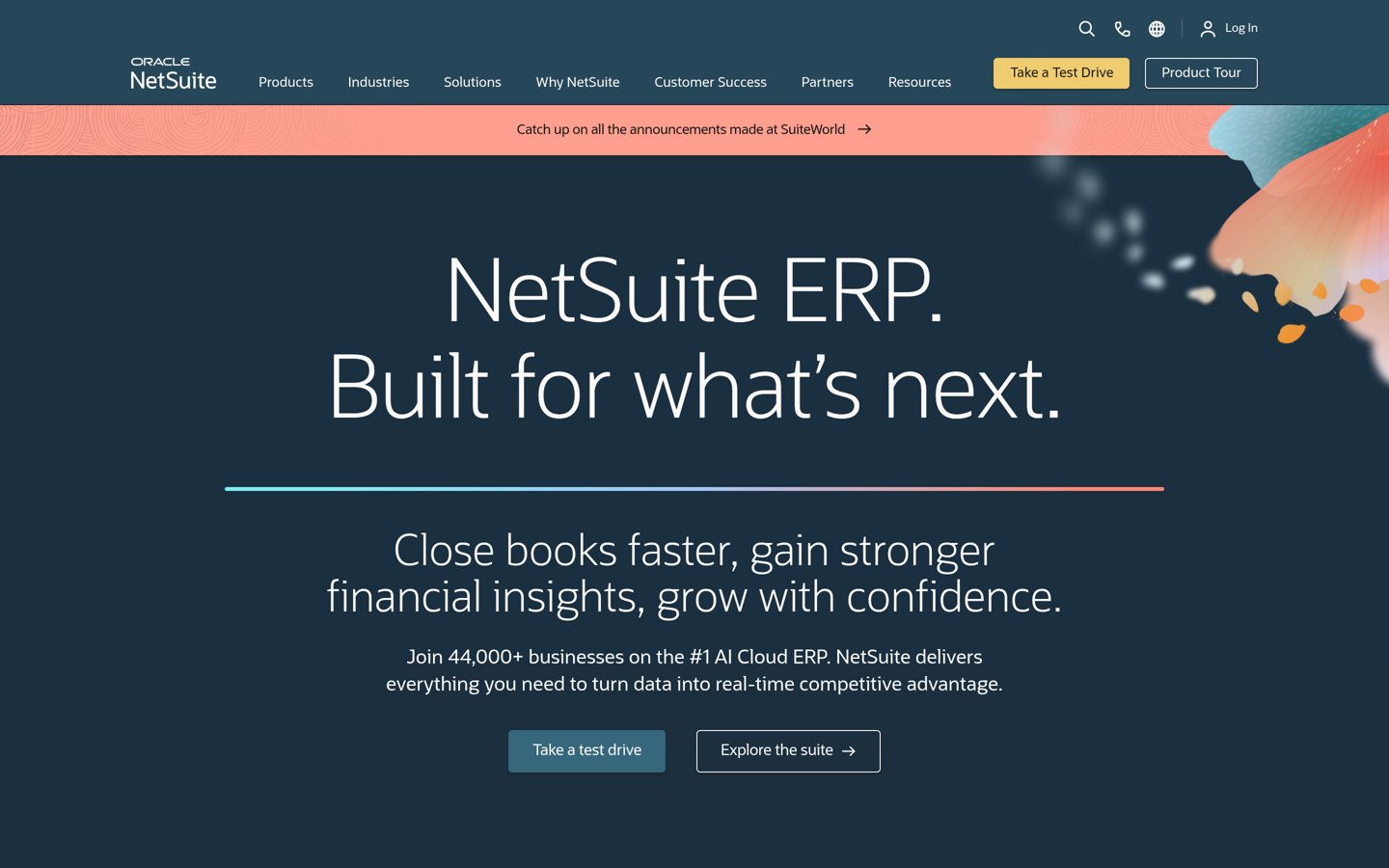
NetSuite homepage, captured Nov 2026.
NetSuite is the system most growing companies end up evaluating when spreadsheets start holding the consolidation together. The general ledger, multi-entity and multi-currency books, Advanced Revenue Management and SuiteAnalytics reporting sit on one database with CRM, inventory and ecommerce, so subsidiaries and intercompany entries all happen in the same place.
The trade off is price and project length. Oracle publishes no price, every deployment is quoted on users, modules and transaction volume, and G2 reports implementations commonly run 6 to 12 months with a partner. It suits growing companies adding entities and currencies.
What we like
Deepest multi-entity and consolidation depth here
Finance, CRM, inventory and ecommerce on one database
Sage Intacct is built for the finance team rather than the whole business. Its strength is reporting: you tag transactions with dimensions such as department, project or location, then slice the numbers without exporting to a spreadsheet. Consolidation, audit controls and multi-entity books sit at the core.
The trade off is transparency. Sage publishes no price list, there is no self-service trial, and partners typically price implementation at roughly one to one-and-a-half times the annual subscription. It suits finance-led companies with several entities.
What we like
Highest G2 rating in this list at 4.3 out of 5
Strongest financial reporting and consolidation
Dimension-based reporting without exports
4.3 out of 5 on G2 from 4,521 reviews
Watch out for
Custom quote only, no published price
No self-service trial
Implementation costs about one year of subscription
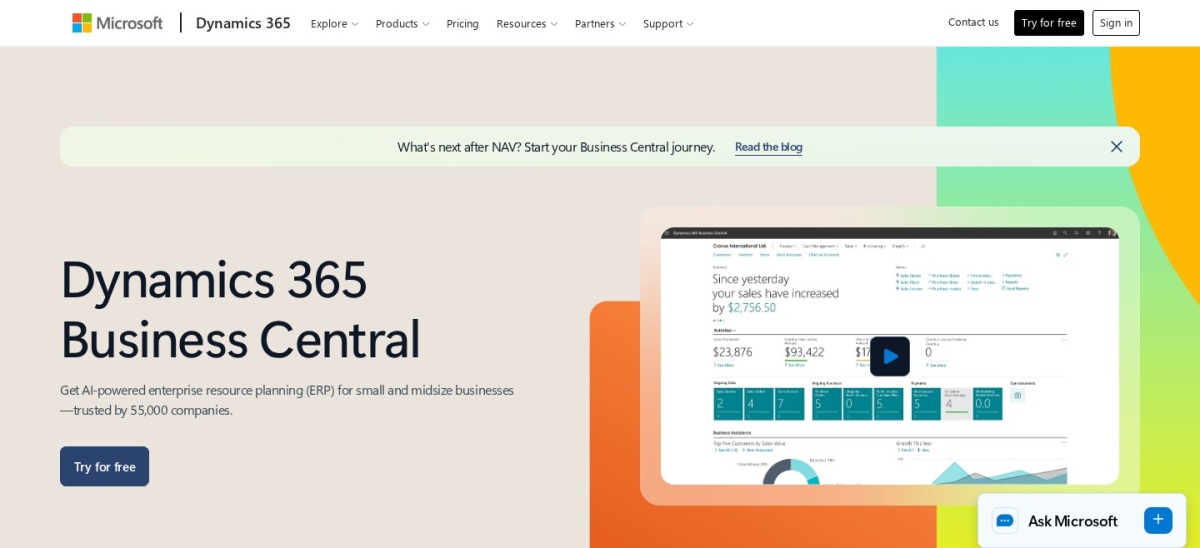
Business Central is the easiest enterprise-grade system to budget for, because Microsoft publishes the price: Essentials costs $80 per user a month and Premium $110, both paid yearly, with a 30-day free trial. It connects finance, sales, service and operations in one system inside Microsoft 365.
The trade off is depth at scale. Business Central fits mid-size companies better than the largest groups, and every full seat is paid, so occasional users add up. It suits Microsoft-centric companies that want a price they can read before a demo.
What we like
Only clean published price in this list
30-day free trial to test the close
Inside Microsoft 365, Outlook and Teams
Team Members access at $8 per user a month
Watch out for
Fits mid-size firms better than the largest groups
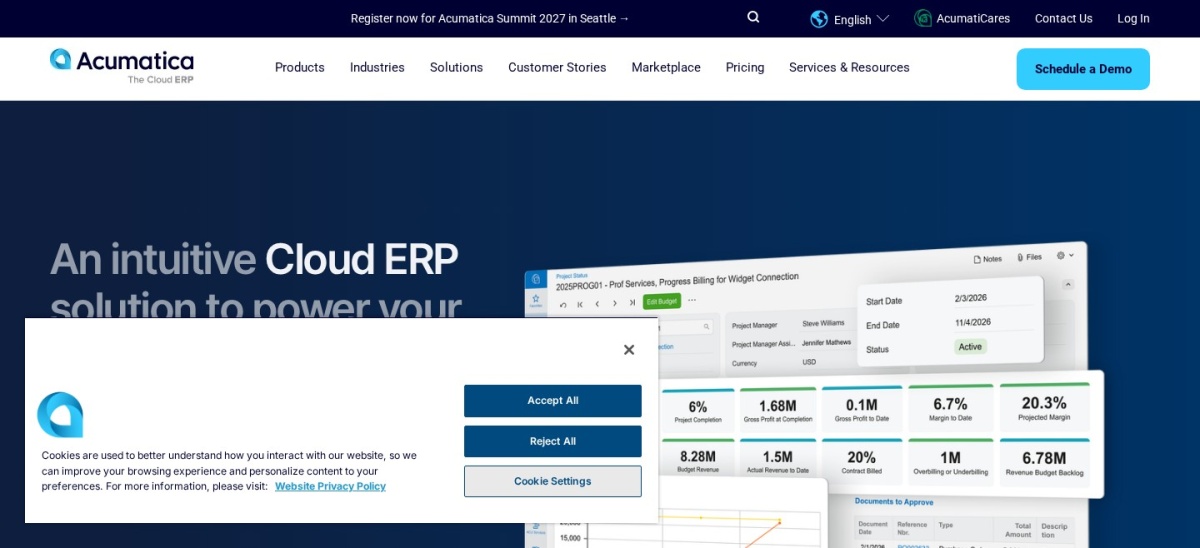
Acumatica is a cloud ERP for distributors, manufacturers and project firms that want unlimited users priced on transaction volume instead of seats. Everyone can log in without a per-user fee, and industry editions cover distribution, manufacturing, construction and retail from one platform.
The trade off is comparability. The quote depends on applications and usage, which is harder to compare across vendors than a per-user price, and implementations need a partner. It suits companies whose headcount will grow faster than revenue.
What we like
Highest G2 rating in this list at 4.4 out of 5
Unlimited users, no seat fees
Industry editions for distribution and manufacturing
Odoo is a modular ERP for cost-conscious mid-size companies that want a published price. Standard costs $31.10 per user a month and includes every app, from accounting and inventory to CRM and projects, and a single app is free. It suits teams willing to manage a partner and customisations.
The trade off is polish. Board-ready reports need partner help, and a first-year price of $24.90 per user a month is also advertised, so confirm whether your quote is the first-year rate or the regular rate. It suits budget-led buyers with technical help.
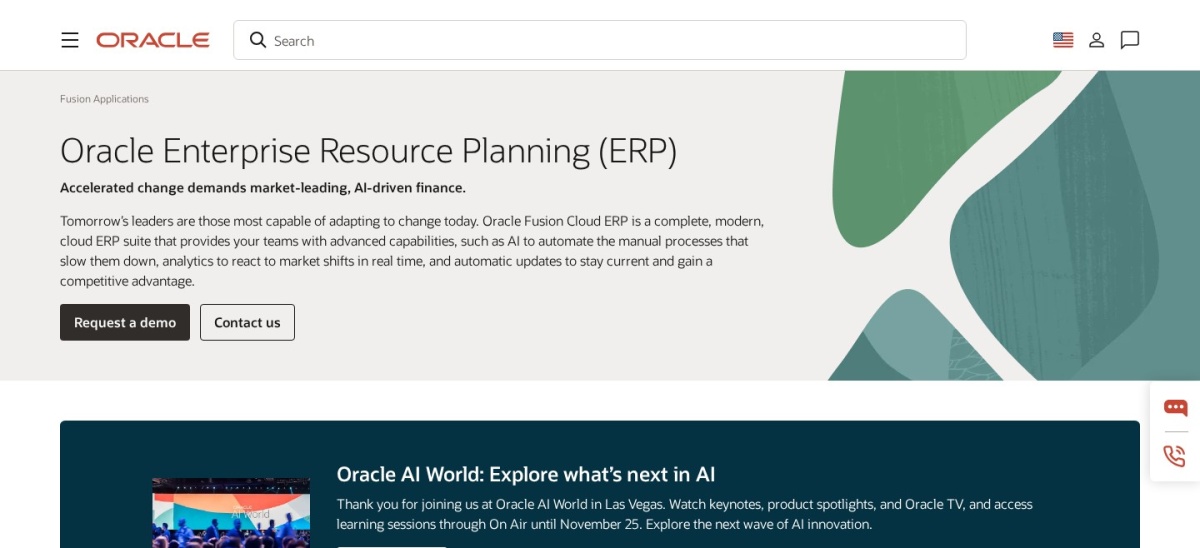
Oracle Fusion Cloud ERP homepage, captured Nov 2026.
Oracle Fusion Cloud ERP is the SaaS successor to E-Business Suite, built for global enterprises deeply invested in Oracle technology. It offers three consolidation methods, elimination entries and a rule that stops a period closing while intercompany items are pending, with a list price of $625 per named user a month.
The trade off is cost and lock-in. The list price carries a 10-user minimum and a three-year standard term, real quotes are negotiated, and implementations average about nine months per G2 users. It suits Oracle-standardised global groups.
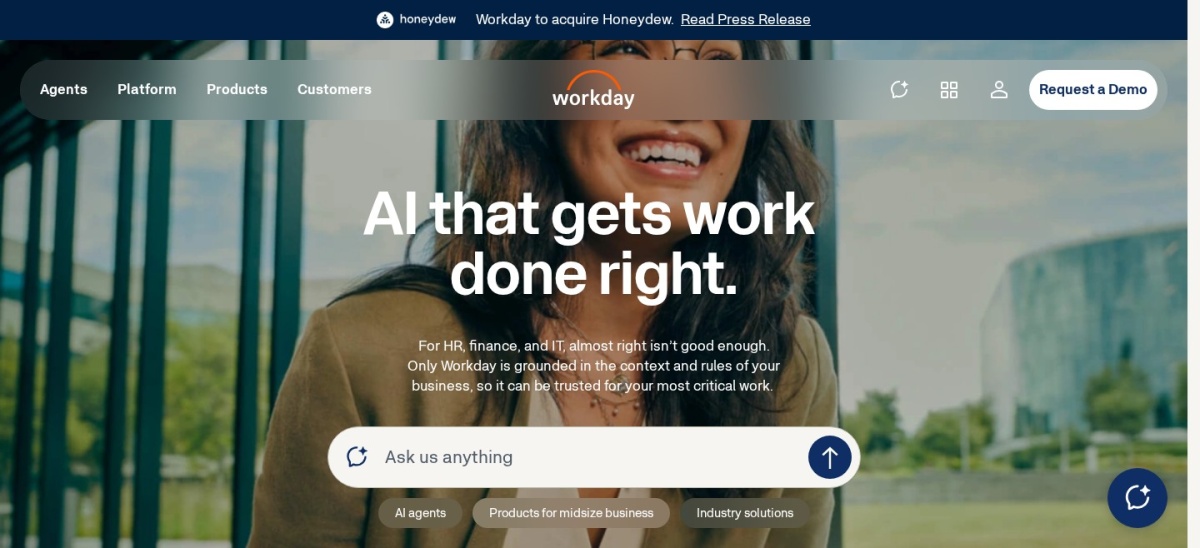
Workday Financial Management homepage, captured Nov 2026.
Workday Financial Management is a cloud system that unifies finance and HR: headcount planning, payroll accounting and project costing flow between systems designed together. Its multibook, multi-entity ledger and consolidation sit in the core, with intercompany settlement and a close hub, and audit trails sit inside every finance process.
The trade off is price transparency. Workday publishes no list prices for Financial Management, and implementations average about five months per G2 users. It suits people-heavy enterprises that run finance and HR together.
SAP Business One is the SAP ERP for product companies with up to about 250 employees, sold and run by a local partner. It covers accounting, inventory, sales and purchasing in one system, and gives smaller companies an SAP path without the S/4HANA project. It holds a 4.3 out of 5 G2 rating from 886 reviews.
The trade off is the partner model. Pricing is quoted through a partner, there is no self-service trial, and larger groups outgrow it and face an S/4HANA migration. It suits product companies that want SAP at mid-market scale.
What we like
SAP path without an S/4HANA project
Partner-led rollout with local support
4.3 out of 5 on G2 from 886 reviews
Accounting, inventory and sales in one system
Watch out for
Custom quote only, via a partner
No self-service trial
Larger groups outgrow it
Custom quote covers licences and partner servicesVisit sap.com
09
QuickBooks Desktop Enterprise
4.3/5on G2 (1,058 reviews, checked Nov 2026)
Starts at$1,873/yr
Best step up from QuickBooks Online
Free planNo, 30-day trial
Entry planFrom $1,873/yr
UsersUp to 40 simultaneous
G2 rating4.3/5, 1,058 reviews
quickbooks.intuit.com
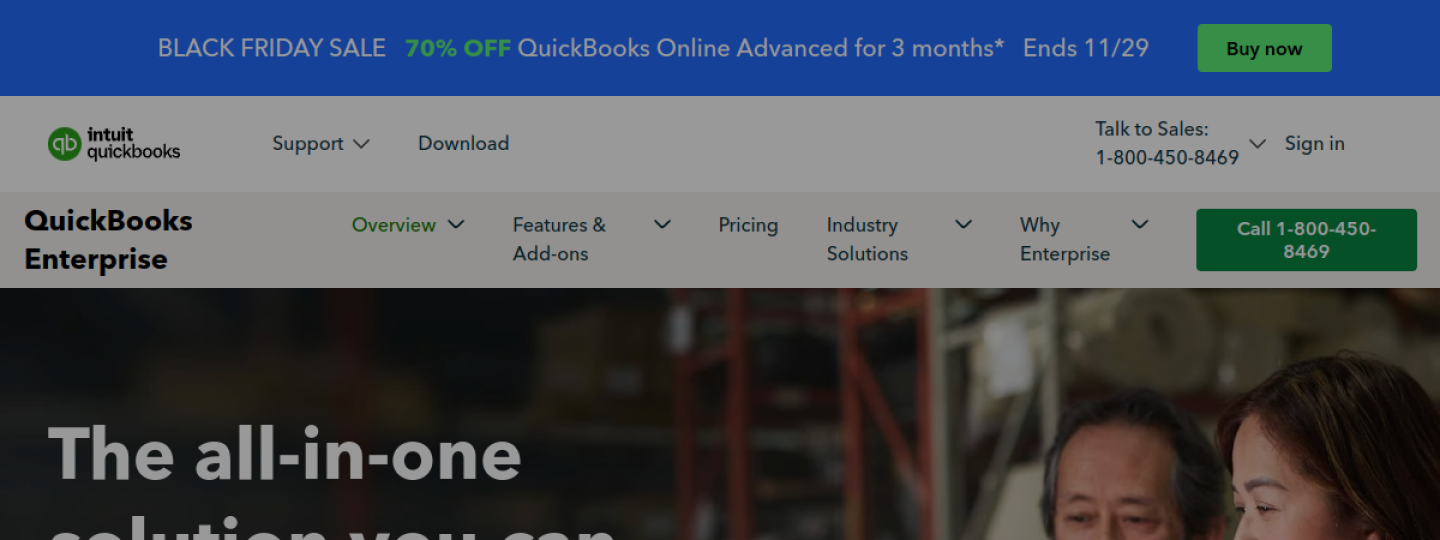
QuickBooks Desktop Enterprise homepage, captured Nov 2026.
QuickBooks Desktop Enterprise is the step up for companies that need heavy inventory and up to 40 simultaneous users on desktop software. It keeps the QuickBooks interface finance teams already know, adds advanced inventory, pricing and reporting, and starts from $1,873 a year with a 30-day trial.
The trade off is scope. It is a larger small-business edition rather than a multi-entity ERP, so groups with several entities outgrow it. It suits single-entity companies that are not ready for an ERP project.
NetSuite publishes no price anywhere on its site. Every deployment is quoted on users, modules and transaction volume, and G2 reports implementations commonly run 6 to 12 months with a partner.
Sage Intacct publishes no price list either, there is no self-service trial, and partners typically price implementation at roughly one to one-and-a-half times the annual subscription.
Acumatica prices by resource consumption instead of seats, so everyone can log in without a per-user fee. The trade off is that the quote depends on transaction volume, which is harder to compare across vendors.
How we chose
We started from the enterprise accounting systems that finance teams shortlist most for multi-entity groups, then kept the nine with a verifiable G2 rating and real accounting at the core.
Prices come from each vendor's pricing page or the vendor's own published list price, checked on 26 November 2026. Ratings come from G2 on the same day. Where a vendor shows a sale, the list shows the regular price.
We left out systems with no verifiable rating and no published price signal. No vendor paid for a place, and we do not claim hands-on testing for this list.
How to choose accounting software for a large business
Start with how many entities you run, then match the system to the close.
Count your entities and currencies first. A single-entity company fits Business Central or QuickBooks Enterprise, while a multi-entity group needs NetSuite, Sage Intacct or Oracle Fusion.
Decide whether you need operations too. NetSuite, Acumatica and SAP Business One run inventory and orders beside finance, while Sage Intacct and Workday stay finance-first.
Get the implementation quote in writing. Partner implementation often costs as much as the first year of subscription, so ask for the full project price before you sign.
Run a real month-end close in the trial. Business Central and Odoo offer trials; for quote-only tools, ask the partner to run your close in a demo environment.
FAQ
What is the best accounting software for a large business?
NetSuite is the strongest all-round pick for growing multi-entity groups, with a 4.1 out of 5 G2 rating from 4,963 reviews. Sage Intacct suits finance-led teams at 4.3 out of 5, and Business Central fits Microsoft shops that want a published price.
How much does enterprise accounting software cost?
Published prices run from $31.10 per user a month for Odoo Standard to $80 for Business Central Essentials and $625 per named user a month for Oracle Fusion. NetSuite, Sage Intacct, Acumatica, Workday and SAP Business One quote every deal.
Is QuickBooks good enough for a large business?
QuickBooks Online Advanced suits single-entity companies with up to 25 finance users, and Desktop Enterprise suits companies needing heavy inventory and up to 40 simultaneous users. Multi-entity groups outgrow both and need NetSuite or Sage Intacct.
What is the difference between NetSuite and Sage Intacct?
NetSuite runs accounting, CRM, inventory and ecommerce on one database, while Sage Intacct is finance-first and connects to operational tools around it. NetSuite fits groups that want one system; Intacct fits finance teams that want the deepest reporting.
How long does it take to implement enterprise accounting software?
G2 users report 4 to 9 months on average for Sage Intacct, Workday, NetSuite, Acumatica and Oracle Fusion, with a partner doing most of the work. Business Central and Odoo are faster, with trials and simpler setups.
Does Odoo really cost $31.10 per user a month?
Odoo Standard lists at $31.10 per user a month, with a free tier for a single app. A first-year price of $24.90 per user a month is also advertised, so confirm whether your quote is the first-year rate or the regular rate.
SaaS SEO and WordPress specialist with about 8 years of experience. Rakib compares WordPress plugins, themes, hosting and software using public pricing, documentation and user reviews. See how we rank.