Best Academic Scheduling Software in 2026: 7 Tools Compared
WLWPLegible EditorsLast verified 24 Nov 2026How we rank6 min read
★ Short answer
Ad Astra is the best academic scheduling software for most universities, with demand-based course planning, certified Banner and Colleague integration, and 4.5 out of 5 from 52 G2 reviews. Coursedog suits schools that also need curriculum and catalog on one platform, while aSc TimeTables is the cheapest at $399 one-time.
How we make this list: we compare pricing pages, product documentation and public user reviews, then re-check every price before each update. No product paid for a place. Disclosure.
Ad Astra leads the higher-ed pack at 4.5 out of 5 from 52 G2 reviews, with certified Banner and Colleague integration.
Coursedog is the only tool here that combines scheduling with curriculum and catalog on one platform.
aSc TimeTables is the cheapest commercial option at $399 one-time, with an unlimited free trial.
Accruent EMS starts at $9,000 a year from its Capterra listing, not the vendor page, and holds the largest review base here at 3.8 from 127 G2 reviews.
TimeEdit is the European pick, priced from SEK 5,000 per user per year, but its Capterra rating rests on a single review from 2018.
What to look for in academic scheduling software
Most academic scheduling vendors hide their prices. Ad Astra, Coursedog, Series25 and Infosilem all sell by quote, so the only published figures in this list are aSc TimeTables at $399 one-time and the directory price for Accruent EMS.
Match the tool to the job, not the category name. Course planning platforms build sections around student demand, room schedulers book space and events, and optimizers solve exam conflicts. A school that buys a room scheduler to plan courses will be disappointed.
Check the student information system integration before anything else. Our guide to project management software covers the planning tools that sit alongside a scheduler in a school's stack.
Implementation takes months, not days. G2 reviewers report about five months for Ad Astra and seven for Accruent EMS, so start the evaluation a full term before you need the schedule live.
K-12 and higher education buy different tools. Abl and aSc TimeTables build school master schedules from student requests, while the higher-ed platforms plan university sections and exams.
Ad Astra is a higher-ed course planning platform that builds class sections around student demand, peer benchmarks and room availability. It integrates two-way with Banner and Colleague, monitors registration as it happens, and reports a $4 million financial impact at Front Range Community College.
The trade off is event scheduling. Capterra reviewers call the event-request screen intimidating and say rooms are hard to find, and there is no documented Workday or PeopleSoft integration. It suits universities on Banner, Colleague or Jenzabar that plan around demand.
What we like
4.5 from 52 G2 reviews
Certified two-way Banner and Colleague integration
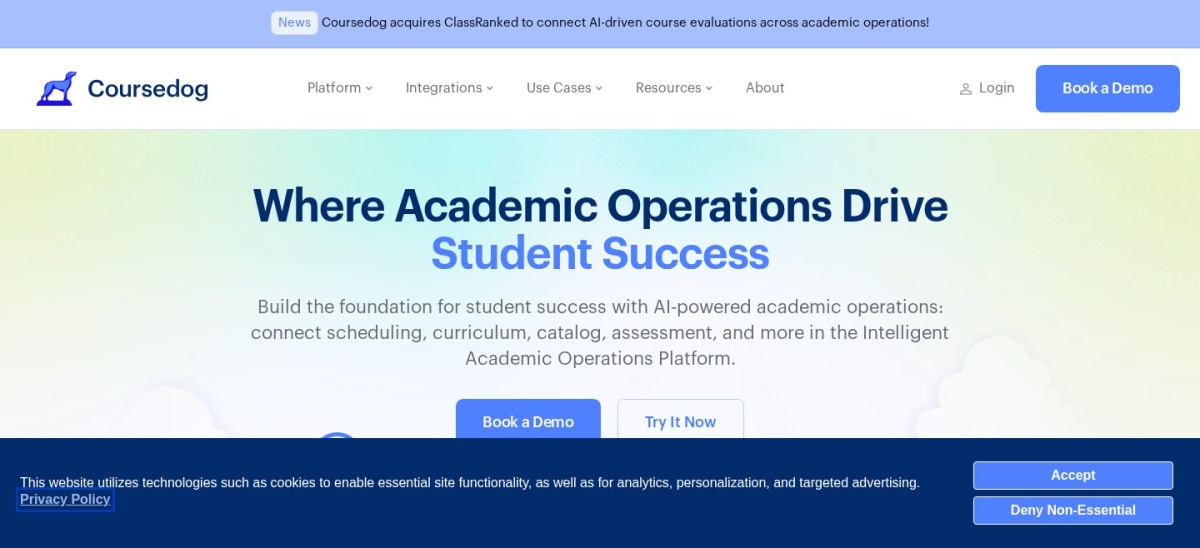
Coursedog is an academic operations platform that combines course scheduling, demand projections, curriculum management and catalog publishing on one shared data platform. Registrars at Norwich and Wilkes universities credit it with fewer scheduling conflicts and double-bookings.
The trade off is implementation weight. One G2 reviewer said rolling out five modules alongside daily work was more taxing than expected, and another reports weaker integration with Colleague SaaS. It suits universities consolidating several legacy systems at once.
What we like
Only tool here with curriculum and catalog
Demand projections built in
Testimonials from registrars at two universities
Free trial available
Watch out for
Multi-module rollout described as taxing
Weaker Colleague SaaS integration reported
Quote-only pricing
Covers scheduling, curriculum, catalog and syllabus in one platformVisit coursedog.com
03
Infosilem
4.6/5on G2 (8 reviews, checked Nov 2026)
PricingCustom/yr
Best exam-focused optimizer
Exam schedulingConflict matrix
Course timetablingStudent-aware
SectioningIncluded
VendorBerger-Levrault
berger-levrault.com
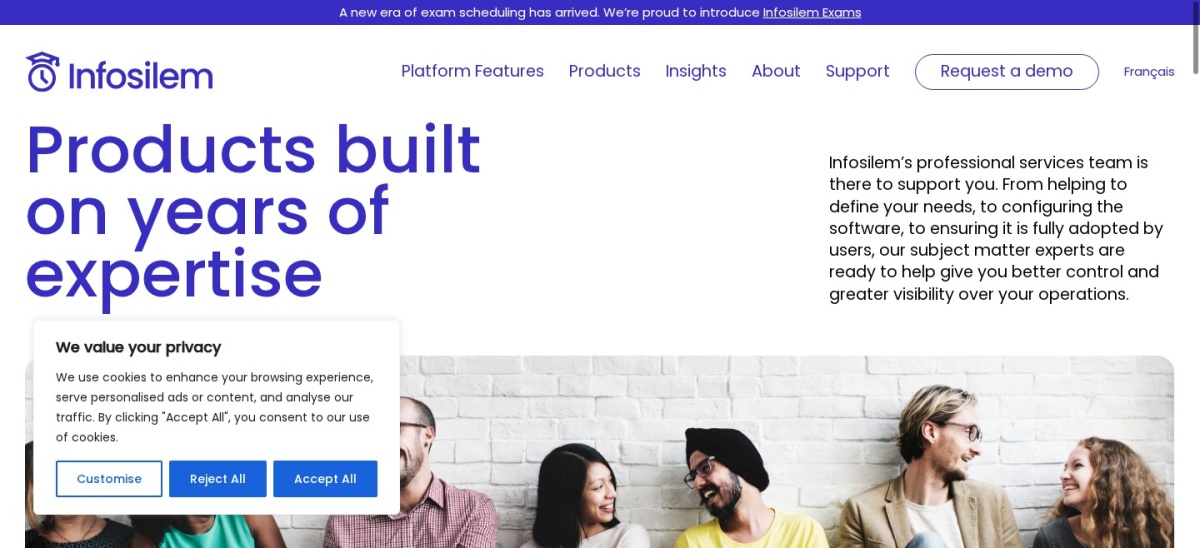
Infosilem homepage, captured Nov 2026.
Infosilem is a student-aware optimization suite from Berger-Levrault that builds university course timetables, final exam schedules and student sectioning from registration data. Its exam module builds a conflict matrix from enrolled students before it places a single exam.
The trade off is a steep learning curve and thin public evidence. Only eight G2 reviews exist, no Capterra data was found, and pricing is by quote. It suits exam-heavy universities that can invest in training.
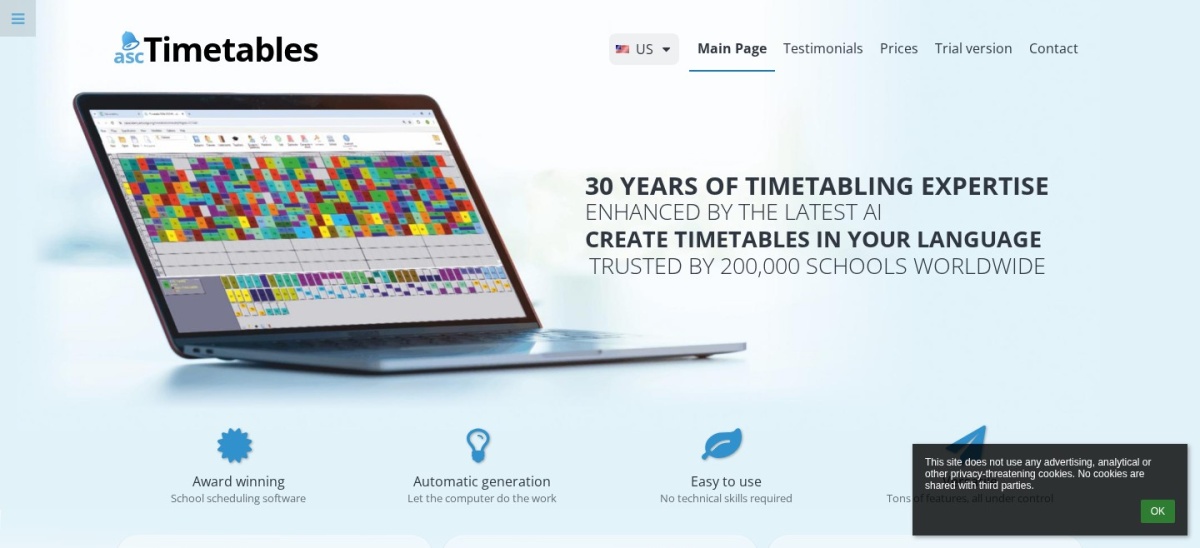
aSc TimeTables is an automatic timetable generator from aSc Applied Software Consultants in Bratislava that builds class timetables with divided classes, alternating weeks, electives and multiple buildings. The vendor says it evaluates more than 5 million possibilities per timetable.
The trade off is exports and integration. The free trial blocks exports, printouts are watermarked, and there is no automatic write-back to a US student information system. It suits small K-12 and international schools on tight budgets.
Accruent EMS is a room booking, desk reservation and event scheduling platform from Accruent that serves higher education and large enterprises. It schedules events across multiple rooms and locations, with a mobile app for on-the-go bookings.
The trade off is age and setup time. G2 reviewers report about seven months to implement, flag a dated interface and weak reporting, and note steep yearly price increases. It suits large campuses that need deep multi-room event scheduling.
CollegeNET Series25 is a unified academic and event scheduling platform that combines 25Live event scheduling, Schedule25 course and exam room optimization, and X25 space analytics. The University of Tennessee, Knoxville reports an 80% cut in administrative time after moving to 25Live.
The trade off is a thin, mixed review record. G2 shows 3.8 out of 5 from 12 reviews for Series25, and Capterra has only two reviews at 3.5. It suits colleges that want academic and event scheduling in one system.
TimeEdit is a scheduling and resource management suite from Sweden that handles campus-wide course scheduling, room booking and event management for universities and colleges. Founded in 2003, it is the market leader in its home region.
The trade off is evidence. Its Capterra rating of 4.0 rests on a single review from 2018, and pricing is quoted in Swedish kronor from SEK 5,000 per user per year. It suits European institutions that want a regional specialist.
Only two tools in this list publish a price. aSc TimeTables sells one-time licences from $399, and TimeEdit's starting price appears on Capterra in Swedish kronor.
The rest sell by quote because the price depends on enrolment, modules and implementation. Ad Astra's only public contract figure is a multi-year deal, and Coursedog's $20,000-per-user figure on Capterra is not confirmed by the vendor.
Budget for implementation as well as the licence. G2 reviewers report five months for Ad Astra and seven for Accruent EMS.
How we chose
We started from every dedicated academic scheduling tool with a public rating on G2, Capterra or Trustpilot, then kept the seven with the clearest fit for course, exam and room scheduling in schools and universities.
Prices were checked on 24 November 2026. Ad Astra, Coursedog, Infosilem and Series25 publish no prices and sell by quote, so they show as Custom. Accruent EMS prices come from Capterra listings, aSc TimeTables from its vendor price page, and TimeEdit from Capterra in Swedish kronor. Ratings and review counts come from G2 and Capterra on the same day.
We left out Abl and UniTime, which have no verifiable rating on G2, Capterra or Trustpilot, and CELCAT, whose only ratings are single reviews on other sites. No vendor paid for a place, and we do not claim hands-on testing for this list.
How to choose academic scheduling software
Start with the job you need done, then check the integration and the quote.
Name the job first. Course planning, exam scheduling and room booking are different jobs. Pick the category that matches your biggest pain before you compare vendors.
Check the SIS integration. Ask exactly which data moves between the scheduler and your student information system, and how often. Banner, Colleague and Workday support varies widely.
Get the quote in writing. Most vendors sell by quote, so ask for implementation, training and renewal costs up front. The first-year price is rarely the total.
Pilot with one term. Run a real term through the tool before you commit. Demand forecasts, room conflicts and exam clashes only show up with real data.
FAQ
What is the best academic scheduling software?
Ad Astra is the best pick for most universities. It plans course sections around student demand, integrates two-way with Banner and Colleague, and has the largest review base in this list at 4.5 out of 5 from 52 G2 reviews.
How much does academic scheduling software cost?
Most vendors sell by quote and publish no prices. The published figures here are aSc TimeTables at $399 one-time and Accruent EMS from $9,000 a year, with TimeEdit from SEK 5,000 per user per year.
What is the difference between Ad Astra and Coursedog?
Ad Astra plans course sections around student demand and benchmarks against peer institutions. Coursedog adds curriculum management and catalog publishing on the same platform, so it suits schools consolidating several systems.
Is there free academic scheduling software?
UniTime is free and open source, but it has no rating on G2, Capterra or Trustpilot, so it is not in this list. aSc TimeTables offers an unlimited free trial, though exports are blocked until you buy.
What software do universities use for exam scheduling?
Infosilem builds final exam schedules from registration data with a conflict matrix, and UniTime covers exam timetabling for free. Series25 handles course and exam room assignments through its Schedule25 module.
How long does it take to implement academic scheduling software?
G2 reviewers report about five months for Ad Astra and seven months for Accruent EMS. Plan for a full term of setup, data migration and training before the first live schedule.