Setup & site building · Info
Is WordPress a Framework? The Short Answer
Short answer
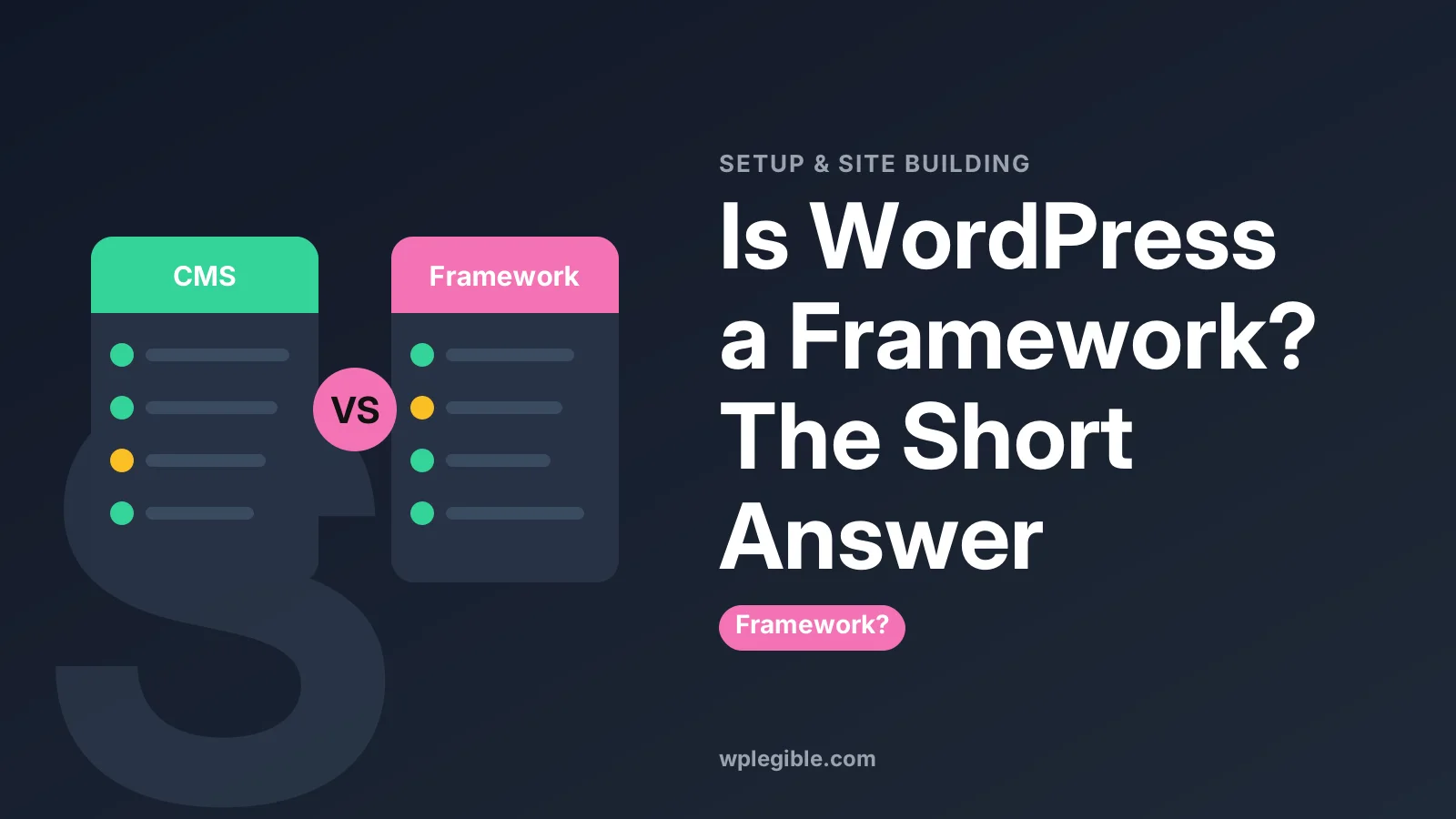
No, WordPress is a content management system rather than a framework. Unlike Laravel or Symfony, it installs as a complete website with an admin area. However, its hooks, REST API, custom post types and other APIs let developers build custom applications on top of it, so it can work like a framework.
Key takeaways
- WordPress is a CMS: it installs as a finished website application.
- Frameworks like Laravel and Symfony are toolkits for building your own app.
- Hooks, the REST API and custom post types let WordPress act like a framework.
- Theme frameworks such as Genesis are a separate meaning of the word.
- Choose WordPress for content-led sites and a framework for complex custom apps.
Is WordPress a framework?
No, WordPress is a content management system, not a framework in the strict sense, but it includes enough developer APIs that many people use it like an application framework.
A framework such as Laravel or Symfony gives you building blocks and leaves the application to you. WordPress ships as a finished application: a working website with an admin area, users, content editing, themes and plugins.
That difference is why most developers call WordPress a CMS. The project itself describes WordPress as open source software for creating websites, blogs and apps on WordPress.org.
Still, the answer has nuance. WordPress has a hooks system, a REST API, custom post types and many other APIs that let developers build far more than blogs.
What is the difference between a CMS and a framework?
A CMS is a ready-made application for managing content that you extend, while a framework is a toolkit of reusable code that you use to build your own application from the ground up.
| CMS (WordPress) | Framework (Laravel, Symfony) | |
|---|---|---|
| Starting point | Working website after install | Empty project structure |
| Admin interface | Included | You build it |
| Main users | Site owners, editors, developers | Developers |
| Data model | Posts, pages, users, taxonomies, meta | Whatever you design |
| Extending | Themes, plugins, hooks | Your own code and packages |
| Architecture | Event-driven hooks, templates | Usually MVC with routing |
| Best for | Content sites, blogs, stores, marketing sites | Custom web applications |
A framework controls less of your project. You decide the database tables, routes and screens. With WordPress, many of those choices are already made for you.
Laravel's documentation shows what a typical PHP framework provides: routing, controllers, an ORM, queues and so on, with no content admin out of the box.
Why do some developers call WordPress a framework?
Developers call WordPress a framework because its hooks, APIs and data structures let them build custom applications on top of it, treating WordPress core as a foundation rather than a finished product.
The key piece is the hooks system. Actions and filters let any plugin run code at specific points or change data as WordPress processes it. The Plugin Handbook's hooks chapter explains how they work.
WordPress also gives developers:
- Custom post types and taxonomies for modelling almost any kind of content
- The REST API for reading and writing data from other apps
- User roles and capabilities for permissions
- Settings, Options and Transients APIs for storing configuration and cached data
- WP-Cron for scheduled tasks
- The Block Editor and Interactivity API for building interfaces
With these, teams have built membership sites, learning platforms, directories and booking systems. Our guide on creating a custom post type shows one of the most common building blocks.
What is a WordPress theme framework?
A theme framework is a parent theme designed as a base for building child themes, providing a solid code structure and hooks so designers do not start every theme from scratch.
This is a different use of the word framework. Genesis, for example, has long been marketed as a theme framework. Other developers use starter themes or frameworks such as Underscores and Sage.
A theme framework sits inside WordPress. It does not turn WordPress into a framework, but it does give theme developers a framework-like layer.
With block themes, much of what theme frameworks used to do is now handled by theme.json and the Site Editor. Our explainer on what a block theme is covers this shift.
Is WordPress built on a framework?
No, WordPress core is not built on an external PHP framework such as Laravel or Symfony; it has its own code base written mainly in PHP, with JavaScript and React used for the block editor.
WordPress started in 2003 as a fork of b2/cafelog, before modern PHP frameworks became popular. Its core code base grew on its own path, and it keeps strong backward compatibility.
The block editor is a different story. It is built with React, a JavaScript library, through WordPress's own wrapper packages. The Block Editor Handbook explains the architecture.
Our guide on whether WordPress is written in PHP covers the language side in more detail.
When should you use WordPress instead of a framework?
Use WordPress when content publishing, SEO, editors and a large plugin ecosystem matter most, and use a framework when you need a highly custom application with complex business logic and data.
WordPress is usually the better fit for:
- Marketing and company websites
- Blogs, magazines and news sites
- Online stores with WooCommerce
- Membership and course sites using established plugins
- Projects where non-developers must edit content
A framework is usually the better fit for:
- SaaS products with custom data models
- Internal business tools and dashboards
- APIs serving mobile apps with complex logic
- Projects where an admin for content is not the main need
Many companies use both. The marketing site runs on WordPress, and the product app runs on a framework. Our comparison of why WordPress is better than other CMS options explains where WordPress shines.
Can WordPress work as a headless backend?
Yes, WordPress can act as a headless CMS, where editors manage content in WordPress and a separate frontend built with a framework such as Next.js fetches it through the REST API or GraphQL.
In this setup, WordPress does what it does best, which is content management. The framework handles the frontend and any app logic.
The core REST API Handbook covers the endpoints you would use. GraphQL support comes from community plugins.
Headless adds complexity, such as separate hosting and losing some plugin features that rely on the theme. Our comparison of headless vs traditional WordPress weighs the trade-offs.
What are the limits of using WordPress like a framework?
WordPress's data model, global functions and backward compatibility can feel restrictive for complex apps, because everything is built around posts, meta and hooks rather than a custom architecture.
Common pain points developers mention:
- Data stored as post meta can be slow to query at scale
- Much of the code relies on global functions and state rather than modern patterns
- There is no built-in ORM, routing system or dependency injection container
- Plugin conflicts can be harder to manage than packages in a framework
Developers work around these with custom database tables, Composer-based setups such as Bedrock, and strict coding standards. Symfony's own explanation of why frameworks exist is a useful contrast to how WordPress organizes code. They remain trade-offs, not deal-breakers.
So what is the short answer?
WordPress is a CMS that can behave like a framework: out of the box it is a complete website application, and with its APIs it becomes a foundation for custom projects.
If someone asks whether to learn WordPress or a framework, the honest answer depends on the goal. To build and run websites quickly, learn WordPress. To build custom software, learn a framework.
Many developers learn both, starting with WordPress because results come quickly. Our guide on how to code in WordPress is a good next step if you want to go beyond the dashboard.
Frequently asked questions
Is WordPress a PHP framework?
No. WordPress is written in PHP, but it is not a PHP framework like Laravel, Symfony or CodeIgniter. It is a complete content management system with its own APIs that developers can extend.
Is WordPress a CMS or a website builder?
WordPress is a CMS. With block themes and the Site Editor it now offers many website builder features, such as visual template editing, but it remains open source software you install and extend with themes and plugins.
Is Gutenberg a framework?
Gutenberg is the project behind the block editor. It is built with React and provides packages that developers use to create blocks and editor interfaces, so it has framework-like parts, but it is part of WordPress rather than a standalone framework.
Should I learn WordPress or Laravel first?
It depends on your goal. If you want to build and manage websites quickly, start with WordPress. If you want to build custom web applications and learn software architecture, start with a framework like Laravel.
Can big applications run on WordPress?
Yes, many large sites run on WordPress, including major publishers and membership platforms. Very complex apps with unusual data needs often need custom tables or a separate framework alongside it.
Sources
- About WordPress WordPress.org
- Hooks (Plugin Handbook) WordPress Developer Resources
- Block Editor Handbook WordPress Developer Resources
- REST API Handbook WordPress Developer Resources
- Laravel Documentation Laravel
Is your product missing, or something out of date?
Tell us what to add or correct. We read every note and reply when we need a source. A message does not buy a ranking.
Thanks — we review requests within 3 business days.
Related guides
About the editors
Researched from the primary sources listed above and checked against our editorial rules before publishing.