Setup & site building · Info
Do People Still Use WordPress in 2026? The Honest Answer
Short answer
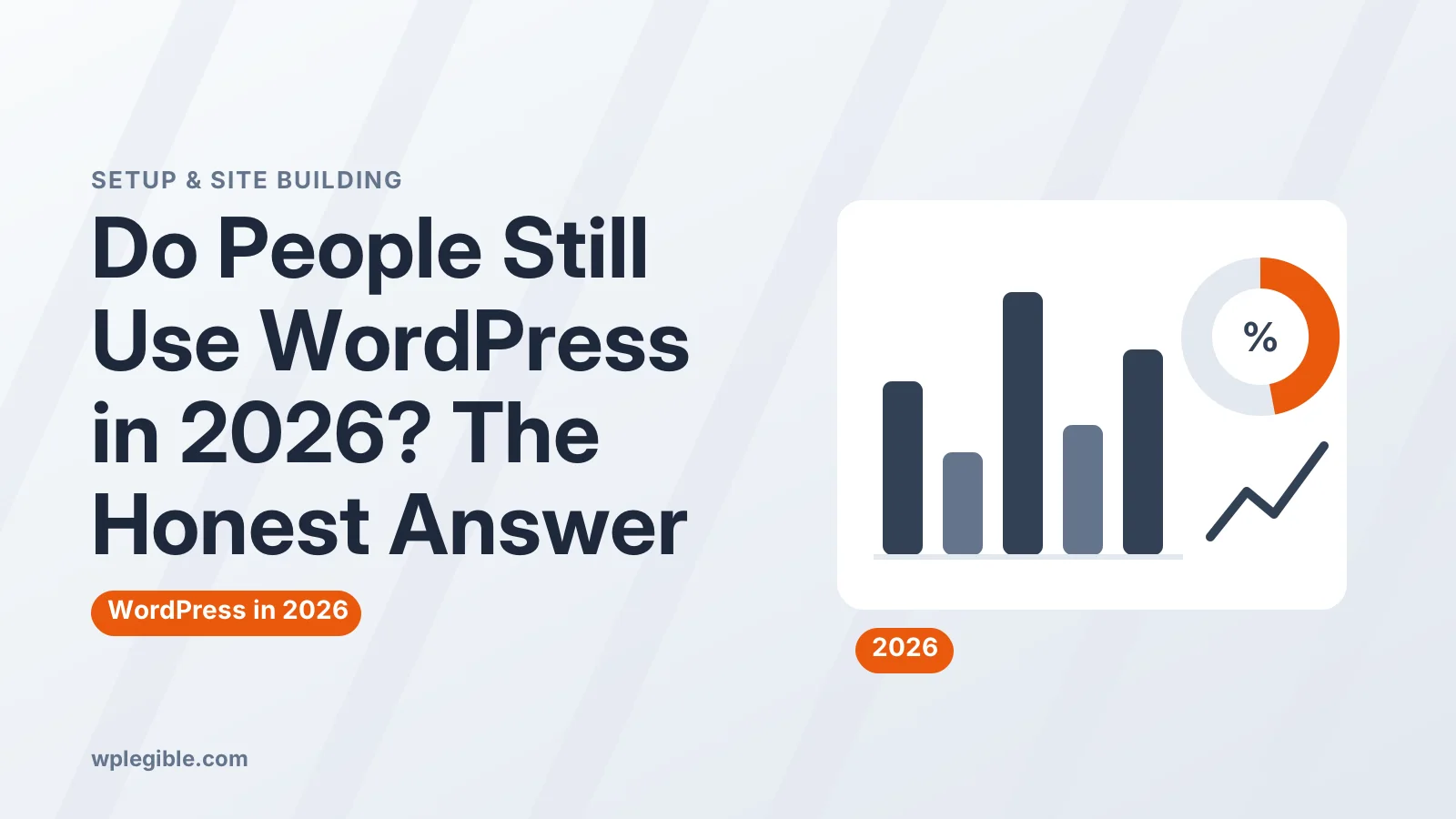
Yes, people still use WordPress widely in 2026. W3Techs reports that WordPress runs 38.5% of all websites and holds 57.4% of the market among sites with a known content management system, far ahead of any other platform. Its share has slipped from its peak as hosted builders grew, but it remains the most used website software by a wide margin.
Key takeaways
- WordPress still powers well over a third of all websites, according to W3Techs.
- Among sites using a known CMS, more than half run WordPress.
- Its overall share has dipped from earlier highs as builders like Wix, Squarespace and Shopify grew.
- WordPress is still actively developed, with three major releases planned in 2026.
- It suits sites that need flexibility, ownership and many integrations; simple sites may prefer an all-in-one builder.
How many websites use WordPress today?
WordPress runs 38.5% of all websites and 57.4% of sites whose CMS is known, according to W3Techs data from November 2026.
Those two numbers measure different things. The first counts every website W3Techs tracks, including hand-coded sites and sites with no detectable CMS. The second looks only at sites that use a content management system.
You can check the latest figures on the W3Techs WordPress usage page, which updates daily. For a full breakdown by year and website size, see our guide on how many websites use WordPress.
No other content management system comes close. Our CMS market share guide compares WordPress with Shopify, Wix, Squarespace and the rest.
Is WordPress losing popularity?
WordPress's share of all websites has slipped from its peak, but it still dominates, and the decline is gradual rather than a collapse.
The main reason is competition from hosted builders, which spend heavily on advertising and target first-time site owners. Wix, Squarespace and Shopify bundle hosting, design and support into one subscription, which appeals to small businesses that want a site without technical choices.
Other factors play a part too:
- Social media and link-in-bio pages replace some small personal sites
- New static and headless tools attract some developers
- Large platforms like Shopify win more online stores than they used to
- Some site owners felt WordPress became harder to learn after the move to blocks
Even so, a small percentage drop of a very large base still leaves WordPress powering many millions of sites. Our guide to WordPress market share tracks the trend over time.
Is WordPress still being actively developed?
Yes, WordPress ships several major releases a year, plus security and maintenance updates, and a large contributor community keeps building it.
In 2026 the project planned three major releases. WordPress 7.0 and 7.1 shipped earlier in the year, and the WordPress 7.2 release schedule targets early December 2026.
Recent work has focused on the block editor, the Site Editor, collaboration features, performance and AI-related tools. The plugin and theme directories also keep growing, with new and updated extensions every day.
Active development matters because it means security fixes, support for new PHP versions and compatibility with modern browsers keep coming.
Who still uses WordPress?
WordPress is used by bloggers, small businesses, publishers, online stores, universities, governments and large media companies, often because it is flexible and they own their data.
The official WordPress Showcase features sites from news outlets, brands and public bodies. Many large publishers run on WordPress because its editor and publishing workflow suit busy newsrooms.
Common reasons people still choose it:
| Reason | Why it matters |
|---|---|
| Ownership | You can move hosts and keep your content and code |
| Flexibility | Plugins add stores, memberships, courses, forums and more |
| Content focus | Strong publishing, categories and SEO tools |
| Cost control | The software is free; you choose hosting and paid extras |
| Talent pool | Many developers, designers and agencies know it |
| Integrations | Most marketing, payment and analytics tools offer WordPress plugins |
WooCommerce, the free store plugin, also keeps WordPress popular for online shops that want more control than hosted platforms allow.
When is WordPress still the right choice?
WordPress is a strong choice when you need a content-rich site, room to grow, custom features, or full control over hosting and data.
It fits especially well for:
- Blogs, magazines and content sites that publish often
- Business sites that may add bookings, memberships or a store later
- Sites that need many integrations with marketing or sales tools
- Projects where you want to own the code and move hosts freely
- Multilingual sites and sites with complex content types
If ease of setup worries you, our guide on whether WordPress is easy to use explains what is simple and what takes practice.
When might another platform suit you better?
A hosted builder may suit you better if you want a small site with almost no maintenance, a fixed monthly cost and one company handling everything.
Good cases for alternatives include a one-page portfolio, a simple event site, or a small store that only needs a few products and standard checkout.
The trade-off is control. Hosted builders limit custom features, and moving your site away later can be hard. WordPress asks for a bit more setup and upkeep in return for freedom.
You can also get much of the convenience of a builder with managed WordPress hosting or WordPress.com, where updates, security and backups are handled for you.
That middle option suits people who want a simple setup without giving up plugins, themes and the freedom to move hosts later. It is worth comparing before you rule WordPress out.
Is WordPress still safe and good for SEO?
Yes, WordPress is secure when kept updated and remains SEO-friendly, though both depend on how well the site is maintained.
Most WordPress security problems come from outdated plugins, weak passwords or poor hosting, not from WordPress core itself. Our guide on whether WordPress is secure covers the real risks.
For search, WordPress produces clean URLs, supports structured data through plugins, and makes it easy to publish and update content. Google does not favour or penalise any CMS; it ranks pages on their content and experience. Its SEO Starter Guide focuses on helpful content, clear site structure and good page experience, all of which you control on WordPress.
WordPress also makes the technical basics easy. Sitemaps are built in, permalinks are readable, and SEO plugins handle titles, canonical tags and structured data without code.
That is why the question is less about whether WordPress is still used, and more about whether it fits the site you want to build.
What does the future of WordPress look like?
WordPress is moving toward full site editing with blocks, better collaboration, stronger performance and built-in AI features, while keeping its open-source model.
The project publishes its plans openly on the Make WordPress Core blog. Upcoming releases continue to replace older admin screens with block-based tools and add features for teams working on the same content.
Because WordPress is open source and so widely used, it is unlikely to disappear soon. No single company controls whether the software keeps existing, and thousands of hosts, agencies and plugin makers depend on it. Its share may keep shifting as the web changes, but the ecosystem of hosts, developers and plugins around it remains huge.
Frequently asked questions
Is WordPress dead in 2026?
No. WordPress still runs more than a third of all websites and more than half of sites with a known CMS, according to W3Techs. It receives several major releases a year and has a large, active developer community.
Why do people still use WordPress?
People use WordPress because it is free, flexible and they own their site. Thousands of plugins and themes add features, many hosts support it, and it is easy to find developers and help when you need them.
Do professional websites still use WordPress?
Yes. Many large publishers, brands, universities and public organizations run WordPress, often on enterprise hosting. Its editing workflow and flexibility suit large content teams as well as small sites.
Is WordPress better than Wix or Squarespace?
It depends on your needs. WordPress offers more control, features and portability. Wix and Squarespace are simpler to set up and maintain but limit customization and make moving away harder.
Is it worth learning WordPress in 2026?
Yes. WordPress skills remain in demand because so many sites run on it. Learning it helps with freelance work, agency jobs and building your own sites, and the basics take only a few days.
Sources
- Usage statistics and market share of WordPress W3Techs
- WordPress 7.2 development cycle Make WordPress Core
- WordPress Showcase WordPress.org
- Make WordPress Core WordPress.org
- SEO Starter Guide Google Search Central
Is your product missing, or something out of date?
Tell us what to add or correct. We read every note and reply when we need a source. A message does not buy a ranking.
Thanks — we review requests within 3 business days.
Related guides
About the editors
Researched from the primary sources listed above and checked against our editorial rules before publishing.