Together AI is the best vLLM alternative for most teams, with serverless inference from $0.30 per 1M input tokens and a 4.3/5 G2 rating from 93 reviews. Pick Fireworks AI for the fastest serverless endpoints, Replicate for one-line model deploys, or Ollama to run models free on your own machine.
How we make this list: we compare pricing pages, product documentation and public user reviews, then re-check every price before each update. No product paid for a place. Disclosure.
Together AI leads with 93 G2 reviews and serverless inference from $0.30 per 1M input tokens.
Fireworks AI starts at $0.05 per 1M input tokens and adds fast LoRA fine-tuning and serving.
Replicate deploys models with one line of code, and Anyscale starts new accounts with $100 in credit.
Modal is the only pick with a flat team plan: $250 a month, with $30 a month of free compute on Starter.
Ollama and Hugging Face are the cheapest ways in: Ollama runs models free locally, Hugging Face Pro is $9 a month.
What should you look for in a vLLM alternative?
vLLM is a serving engine, not a hosting service. It turns a GPU you already rent or own into an OpenAI-compatible API, so every alternative in this list either hosts that step for you or rents you the GPU to run it on.
Price is mostly per token or per GPU hour. Hosted APIs such as Fireworks AI start at $0.05 per 1M input tokens, while rented GPUs start at $0.27 an hour on Runpod, so the cheapest pick depends on whether your traffic is steady or bursty.
An OpenAI-compatible API makes switching cheap. Most of these tools speak the same API shape, so moving from vLLM to a hosted endpoint is often a base URL change, not a rewrite. Our guide on connecting an AI model to WordPress shows the same pattern on the WordPress side.
The best-known engines are missing from this list on purpose. SGLang, TensorRT-LLM and llama.cpp have no public review rating, and Hugging Face TGI is in maintenance mode, so none of them can be scored the same way as the nine tools below.
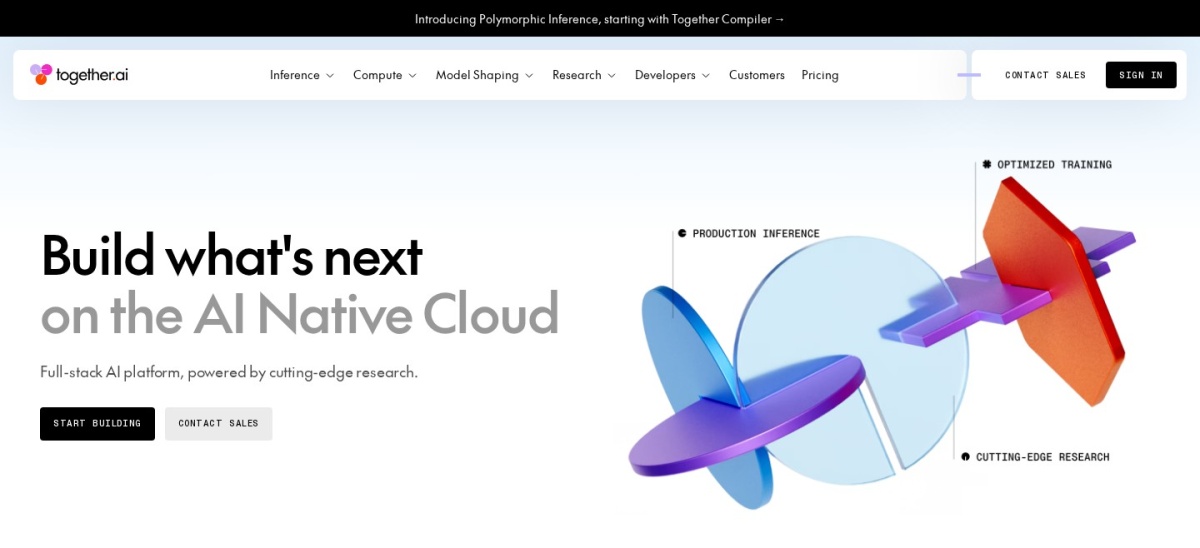
Together AI is a managed inference cloud for open-weight models, with serverless endpoints, batch inference and dedicated GPU clusters. Its pricing page lists DeepSeek V4.1 Flash from $0.30 per 1M input tokens, and some models are free.
The trade off is usage-based billing. There is no flat monthly price, so a busy month costs more than a quiet one, and rates differ by model. It suits teams that want vLLM-style serving without running GPUs themselves.
What we like
Largest review base in this list, with 93 G2 reviews
Wide open-model catalog with serverless and batch options
OpenAI-compatible API for easy switching
Dedicated GPU clusters for steady traffic
Watch out for
No flat-rate plan, so bills vary with traffic
Per-model prices change as new models launch
No self-hosted option
Dedicated clusters add guaranteed capacity for steady trafficVisit together.ai
02
Fireworks AI
4.2/5on G2 (35 reviews, checked Nov 2026)
PricingCustom/yr
Best for fast, cheap serverless inference
Serverless inferenceFrom $0.05 per 1M input
Fine-tuningLoRA, fast deploys
Model catalogOpen-weight models
Free planNo, pay per token
fireworks.ai
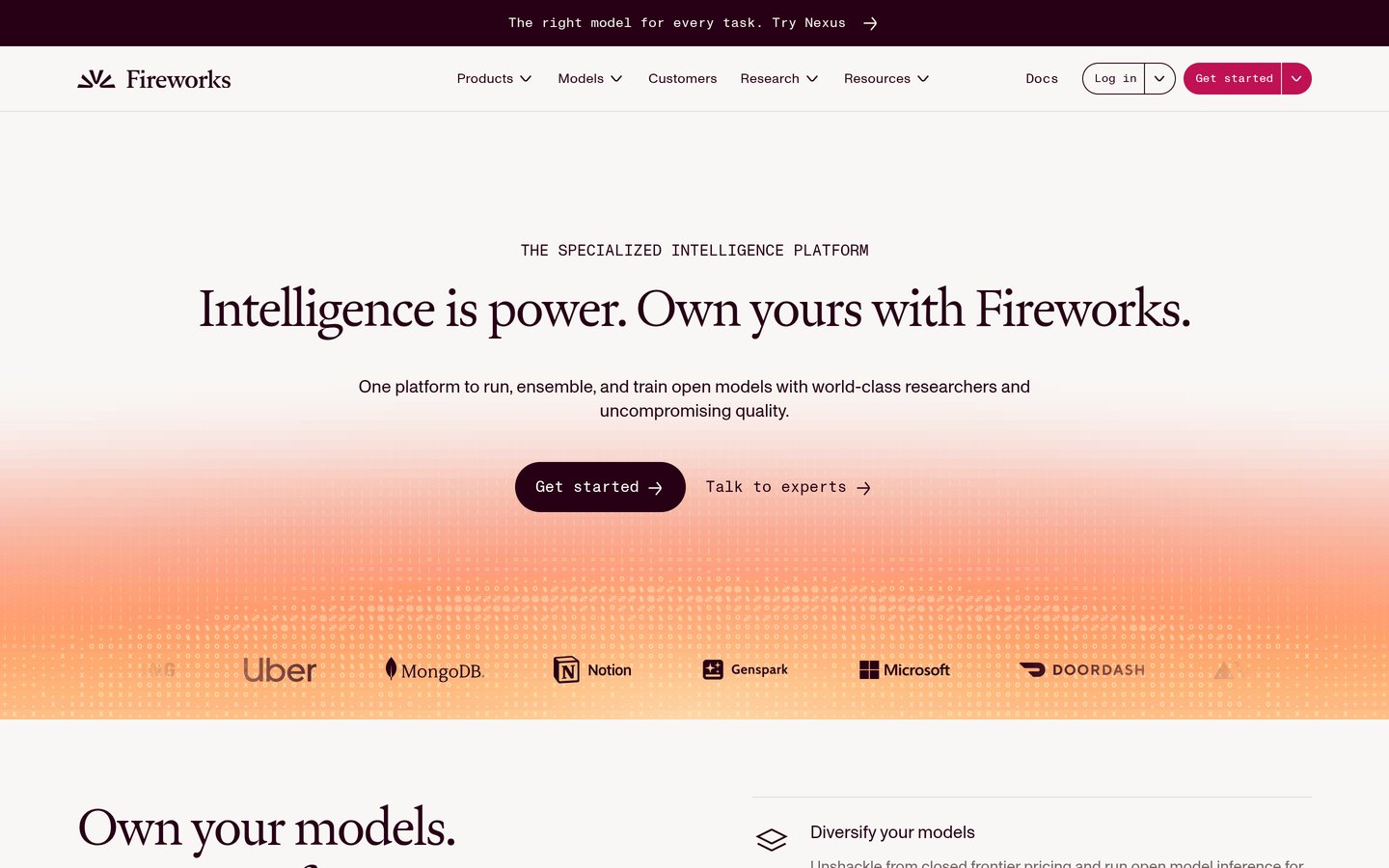
Fireworks AI homepage, captured Nov 2026.
Fireworks AI is a hosted inference platform for open-weight models, built for speed and low cost. Serverless rates start at $0.05 per 1M input tokens, and it serves models through an OpenAI-compatible API with fine-tuning and LoRA support.
The trade off is the learning curve. Reviewers say getting started takes longer than it should, with thin quickstart guides. It suits teams that want fast, cheap inference and will spend an afternoon learning the platform.
What we like
Lowest starting token price in this list
Fast inference with LoRA support
Wide open-model catalog
OpenAI-compatible API
Watch out for
No free plan
Onboarding guides are thin
Pricing varies by model and priority tier
Priority tiers add faster responses at higher per-token ratesVisit fireworks.ai
03
Replicate
4.5/5on G2 (25 reviews, checked Nov 2026)
PricingCustom/yr
Best for one-line model deploys
BillingPay only for what you use
ModelsThousands of open models
Fine-tuningYes, on the platform
Free planNo, usage-based
replicate.com
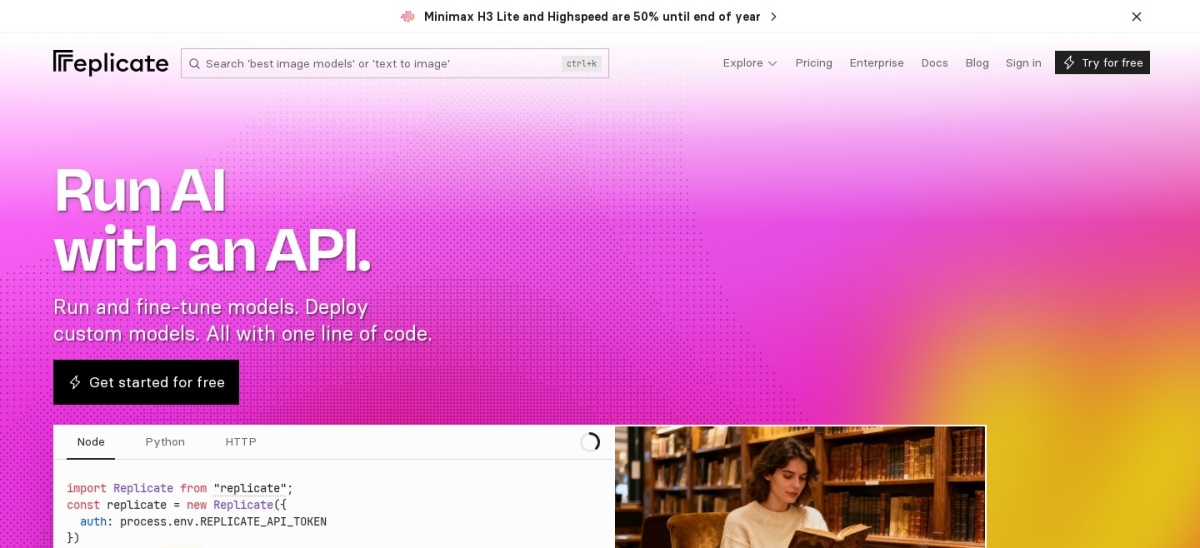
Replicate homepage, captured Nov 2026.
Replicate is a hosted platform for running open models with an API. Its pricing page says you only pay for what you use, billed by hardware and time or by input and output, and models deploy with one line of code.
The trade off is cold starts. Reviewers flag slow cold boot times on some models, and costs are hard to predict before you run a workload. It suits developers who want the shortest path from a model page to a working API.
Anyscale is the managed platform from the creators of Ray for running AI workloads at scale. Its pricing page offers pay-as-you-go billing with no monthly fixed fees, and new accounts start with $100 in credit. It runs distributed training, batch inference and online serving.
The trade off is clarity. Reviewers say the pricing structure is hard to predict and the docs assume Ray experience. It suits ML teams already using Ray who want managed scale without Kubernetes work.
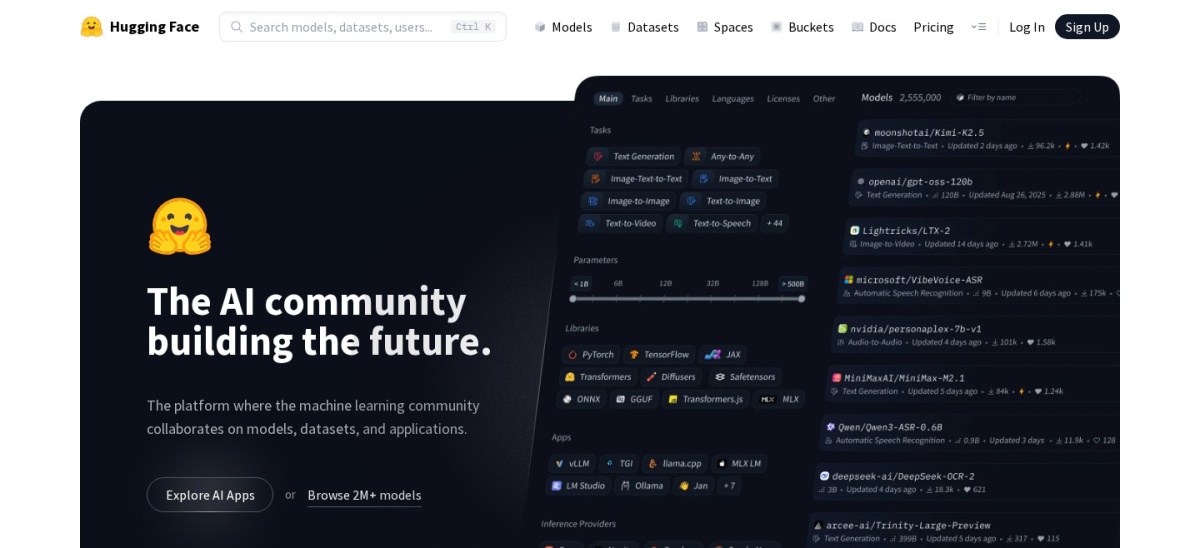
Hugging Face is the model hub where most open-weight models live, with 2.5 million models listed. Its Inference Endpoints deploy a model behind an API without running a server, and Pro costs $9 a month with $2 of inference credits included.
The trade off is that it is a hub first and a host second. Endpoint pricing varies by GPU, and the platform takes learning if you only want a simple API. It suits teams that already find and compare models on the Hub.
What we like
Largest open-model catalog anywhere
Inference Endpoints without server work
Pro is $9 a month
Free account to start
Watch out for
Endpoint costs vary by GPU
The platform is broad and takes learning
No flat-rate inference plan
Pro adds more storage, faster ZeroGPU and $2 of monthly inference creditsVisit huggingface.co
06
Baseten
4.3/5on G2 (16 reviews, checked Nov 2026)
PricingCustom/yr
Best for model file to production API
Model APIsFrom $0.10 per 1M input
Dedicated inferencePer GPU-minute
PackagingTruss
Free planNo, usage-based
baseten.co
Baseten homepage, captured Nov 2026.
Baseten is a managed inference platform for deploying open-source, proprietary and fine-tuned models. Its Model APIs bill per token, with input from $0.10 per 1M tokens, and dedicated inference bills per GPU-minute.
The trade off is review depth. It has 16 G2 reviews, so the public record is thin, and usage billing makes monthly costs hard to predict. It suits teams that want a managed path from a model file to a production API.
What we like
Truss packaging for fast deploys
Per-token and per-GPU-minute billing
Multi-cloud GPU capacity
Managed autoscaling
Watch out for
Thin review record, with 16 G2 reviews
Usage bills vary with traffic
No free plan
Dedicated inference adds reserved GPUs and custom termsVisit baseten.co
07
Modal
4.2/5on G2 (27 reviews, checked Nov 2026)
Paid from$250/mo
Best serverless GPU for Python teams
Team plan$250/mo + compute
Starter$0 + $30/mo credit
BillingPer second, scales to zero
Free planYes, Starter
modal.com
Modal homepage, captured Nov 2026.
Modal is a serverless GPU platform where Python functions run on cloud GPUs with a decorator. Its Starter plan is $0 a month plus compute, with $30 of free credits a month, and the Team plan is $250 a month plus compute. You can run vLLM itself inside a Modal function.
The trade off is that it is code-first and Python-only. There is no point-and-click model deploy, and sustained 24/7 serving costs more than a reserved GPU. It suits Python teams with bursty inference who want no servers at all.
What we like
Per-second billing that scales to zero
$30 a month free compute on Starter
Fast cold starts
Run any engine, including vLLM
Watch out for
Python-only
Flat $250 a month Team plan
Sustained workloads cost more than reserved GPUs
Team adds $100 a month in credits, unlimited seats and static IPsVisit modal.com
08
Ollama
4.3/5on G2 (5 reviews, checked Nov 2026)
Paid from$20/mo
Best for running models free locally
Local useFree, no subscription
Pro plan$20/mo or $200/yr
Installs9M+ a month
Free planYes, local
ollama.com
Ollama homepage, captured Nov 2026.
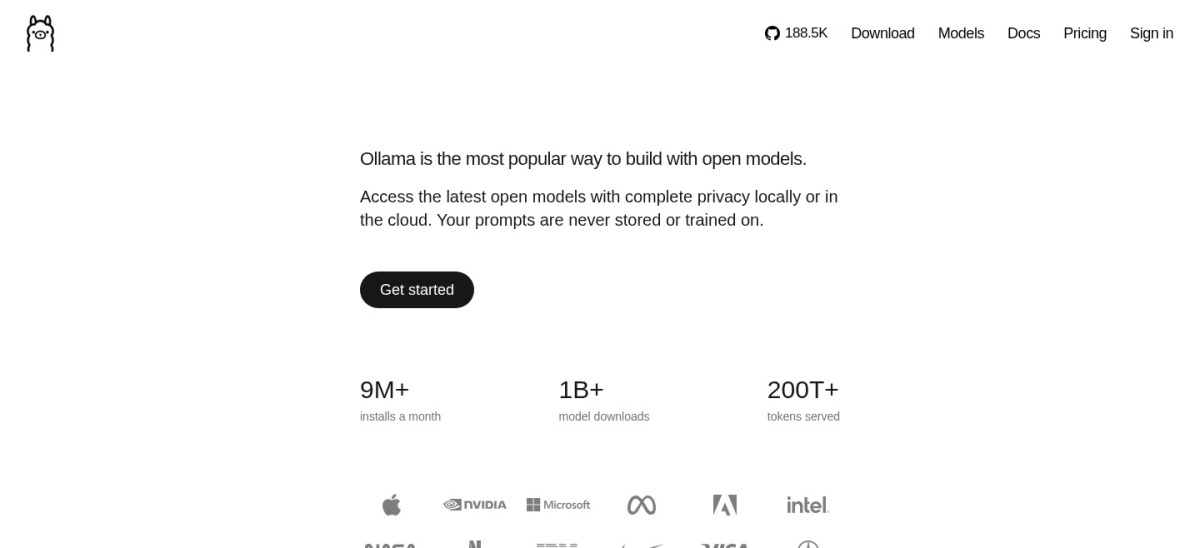
Ollama is the simplest way to run open models on your own machine, with one command to download and serve a model. Local use is free with no subscription, and the homepage reports 9 million installs a month. It also offers a cloud Pro plan at $20 a month.
The trade off is throughput. It is built for local and developer use, not high-volume production serving, and large models need a strong GPU. It suits developers, demos and small teams who want models running locally.
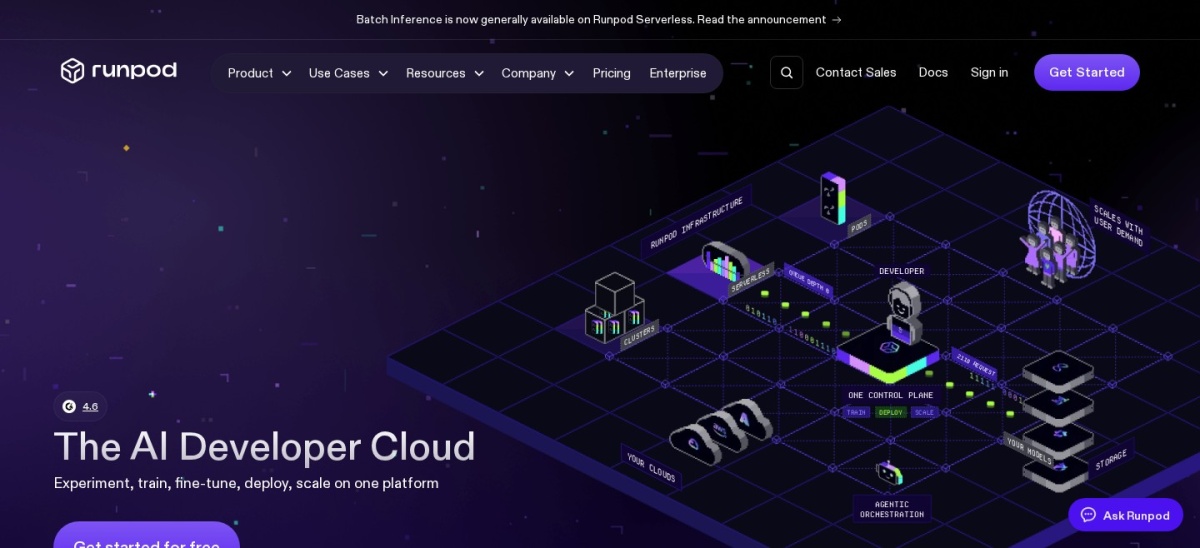
Runpod is a GPU cloud for renting the hardware to run any inference engine, including vLLM. Pods start from $0.27 an hour for an RTX A5000, billed per second, and serverless endpoints scale to zero when idle.
The trade off is that you still run the engine. Runpod rents the GPUs, so setup, scaling and updates are your job unless you use serverless. It suits teams that want cheap GPUs and full control over the serving stack.
What we like
Cheap GPUs from $0.27 an hour
Per-second billing
31 global regions
Run any engine, including vLLM
Watch out for
You manage the serving stack
Support is uneven in reviews
No free plan
Serverless endpoints add autoscaling with no idle costVisit runpod.io
When to keep an engine and when to buy an API
Keep an engine when control matters more than convenience. Running vLLM or SGLang on rented GPUs gives you the model weights, the logs and the exact serving settings, which matters for fine-tuned or regulated workloads.
Buy an API when speed of shipping matters more. A hosted endpoint removes GPU provisioning, scaling and updates, and per-token billing means an idle app costs nothing.
A middle path works for many teams. Prototype on a hosted API such as Together AI, then move steady, high-volume traffic to GPUs you rent on Runpod or Modal once the cost curve favors it.
How we chose
We started from every established vLLM alternative named in current inference-engine comparisons, then kept the nine with a public review rating and a live product.
Prices come from each vendor's pricing page, checked on 29 November 2026. Ratings come from G2 on the same day. Most of these tools bill per token or per GPU-hour, so the list shows Custom where there is no flat plan, and the text gives the verified starting rate.
We left out SGLang, TensorRT-LLM, llama.cpp and TGI: the first three have no public review rating, and TGI is in maintenance mode. No vendor paid for a place, and we do not claim to have used these tools ourselves.
How to choose a vLLM alternative
Start with where the model will run, then match the billing to your traffic.
Decide hosted or self-hosted. If you want no servers, pick a hosted API such as Together AI or Fireworks AI. If you need full control, rent GPUs from Runpod or Modal and run vLLM yourself.
Match the billing to your traffic. Steady traffic suits dedicated GPUs or flat plans; bursty traffic suits per-token or per-second billing that scales to zero.
Check the model list first. Confirm the exact model you need is served before you sign up, since catalogs differ and some models are only on dedicated plans.
Start on a free tier or credit. Use the free models, $30 a month of Modal credit or Anyscale's $100 credit to test latency and cost before committing.
FAQ
What is the best vLLM alternative in 2026?
Together AI is the best vLLM alternative for most teams. It offers serverless inference from $0.30 per 1M input tokens, a wide open-model catalog and a 4.3/5 G2 rating from 93 reviews, the largest review base in this list.
Is there a free vLLM alternative?
Yes. Ollama runs models free on your own machine with no subscription, and Together AI lists some models free. Hugging Face has a free account, and Modal gives $30 of compute credit a month on its Starter plan.
How much does a vLLM alternative cost?
Most charge per token or per GPU-hour, not a flat fee. Fireworks AI starts at $0.05 per 1M input tokens, Runpod GPUs start at $0.27 an hour, and Modal's Team plan is $250 a month plus compute.
Which vLLM alternative is best for beginners?
Replicate is the easiest start: models deploy with one line of code and you only pay for what you use. Ollama is the easiest local option, with one command to download and run a model.
Together AI vs Fireworks AI: which is better?
Together AI has the larger review base, with 93 G2 reviews against 35, and broader managed options including dedicated clusters. Fireworks AI is cheaper per token, from $0.05 per 1M input, and reviewers praise its fast LoRA inference.
Can I still run vLLM on one of these?
Yes. Modal and Runpod rent the GPUs to run vLLM yourself, so you keep the engine and skip buying hardware. The hosted tools in this list replace vLLM with a managed API instead.
SaaS SEO and WordPress specialist with about 8 years of experience. Rakib compares WordPress plugins, themes, hosting and software using public pricing, documentation and user reviews. See how we rank.