TinyMCE is the best of the tiptap alternatives for most teams, with a free Core plan and a 4.5/5 G2 rating from 119 reviews. CKEditor 5 suits products that need live co-editing and track changes, while Quill and Summernote are free picks for simple editing.
How we make this list: we compare pricing pages, product documentation and public user reviews, then re-check every price before each update. No product paid for a place. Disclosure.
TinyMCE is the closest drop-in replacement, with a free Core plan and a 4.5/5 G2 rating from 119 reviews.
CKEditor 5 is the pick when live co-editing matters, but Essential starts at $144 a month.
Froala charges a flat $899 a year with no load metering, and AI and collaboration are included.
Summernote, Quill, ContentTools and Simditor are all free, with G2 ratings from 4.1 to 4.7.
Four of the seven tools are free, so a small project can switch from Tiptap without paying anything.
How do you choose from the tiptap alternatives?
Tiptap is a headless framework, so the first choice is whether you still want to build the interface yourself. Most teams switching away want the opposite: a finished editor with a toolbar, menus and dialogs included.
A finished editor saves build time but adds licence cost. TinyMCE and CKEditor bill by editor load, starting at $79 and $144 a month, while Froala charges a flat $899 a year with no metering, so the cheapest option depends on how often the editor loads.
If your editing happens inside WordPress rather than a custom app, the WordPress block editor may already cover it, and a JavaScript editor is only needed for custom products.
Collaboration is the feature that splits this list. CKEditor and Froala include real-time co-editing, comments and track changes, while the free editors have none, so pick by whether several people edit the same document.
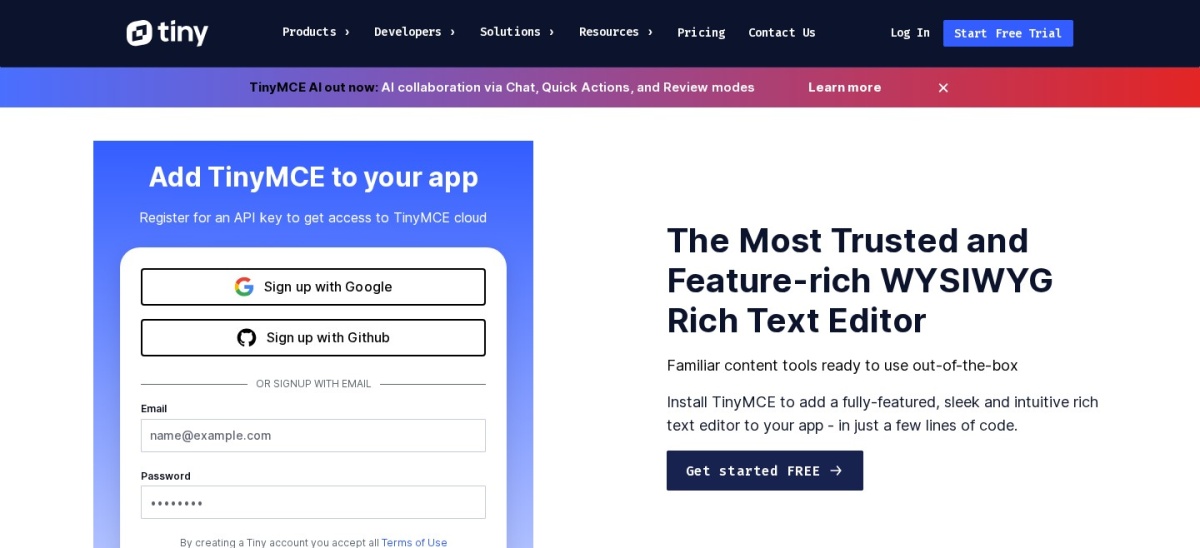
TinyMCE is a complete WYSIWYG editor that ships with a toolbar, menus and dialogs ready to use, so there is no interface to build. The free Core plan is cloud-hosted with 1,000 editor loads a month, and the open-source core is also available under GPLv2+ for self-hosting.
The trade off is metering. Paid plans charge by editor load, and the AI add-on costs $133 a month on Essential, so a busy app pays more as usage grows. It suits teams that want a familiar editor running on day one without building a UI.
What we like
Ready-made UI, no building needed
Free Core plan with 1,000 loads a month
Large plugin library, from PowerPaste to AI
Official wrappers for React, Vue and Angular
Watch out for
Paid plans bill by editor load
Advanced features such as PowerPaste need Professional
AI is a paid add-on, not included
Essential adds a commercial licence and 5,000 loads a monthVisit tiny.cloud
02
CKEditor
4.3/5on G2 (66 reviews, checked Nov 2026)
Paid from$144/mo
Best for live co-editing and track changes
Free planYes, 1,000 loads/mo
Cheapest paidEssential, $144/mo
Editor loads5,000/mo on Essential
CollaborationAdd-on, from $249/mo
ckeditor.com
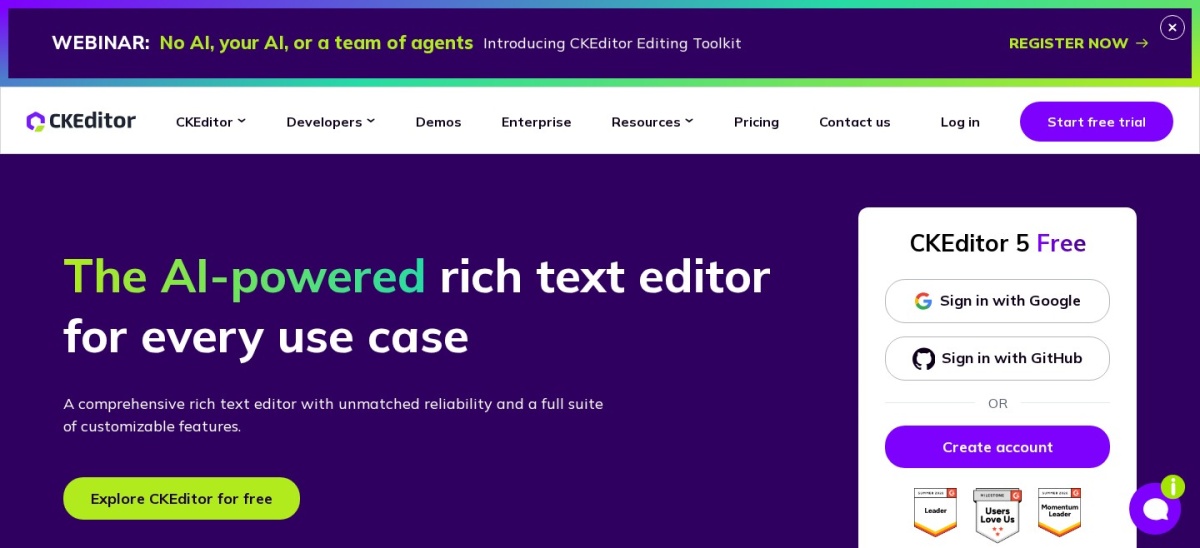
CKEditor homepage, captured Nov 2026.
CKEditor 5 is a modular rich text editor built for document work, with real-time co-editing, comments and track changes as its main strengths. The free tier is cloud-hosted with 1,000 editor loads a month, and it already includes Word and PDF export.
The trade off is price. Essential costs $144 a month billed annually, and the collaboration add-on starts at $249 a month, so the full document workflow is a serious spend. It suits products where several people edit the same document at once.
What we like
Strongest real-time collaboration in this list
Track changes, comments and revision history
Word and PDF export in the free tier
Cloud or self-hosted deployment
Watch out for
Essential is the priciest entry plan here
Collaboration costs extra on top
Free tier shows a Powered by CKEditor watermark
Essential adds professional support and 5,000 loads a monthVisit ckeditor.com
03
Froala
4.4/5on G2 (188 reviews, checked Nov 2026)
Starts at$899/yr
Best flat licence with AI and collaboration included
Free planNo, 30-day trial
Cheapest paidProfessional, $899/yr
Editor loadsUnlimited
CollaborationIncluded, self-hosted
froala.com
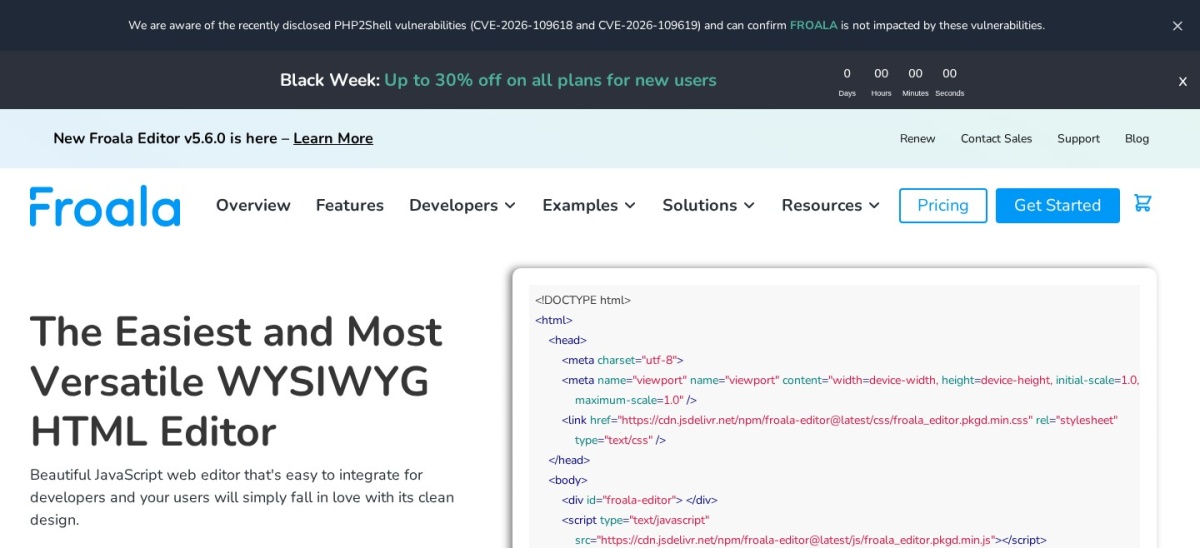
Froala homepage, captured Nov 2026.
Froala is a self-hosted WYSIWYG editor sold on a flat licence, with AI Assist, comments, version history and collaborative editing included in every licence. Professional covers one product on up to three domains, with unlimited editor loads and unlimited users.
The trade off is the licence shape. Professional costs $899 a year and covers internal apps only, so SaaS products need Enterprise, and a Black Week sale was showing $719 when we checked. It suits teams that want predictable pricing without load metering.
What we like
No metering by editor load or user
AI Assist and collaboration included
Clean interface that reviewers praise
Self-hosted, so content stays on your server
Watch out for
No free plan, only a 30-day trial
Professional excludes SaaS and OEM use
Support upgrades cost extra
Enterprise adds SaaS and OEM use on unlimited domainsVisit froala.com
04
Summernote
4.7/5on G2 (39 reviews, checked Nov 2026)
PriceFree
Best free editor for simple pages
Free planYes, MIT licence
Cheapest paidFree
Built onBootstrap and jQuery
GitHub stars11,841 on its homepage
summernote.org
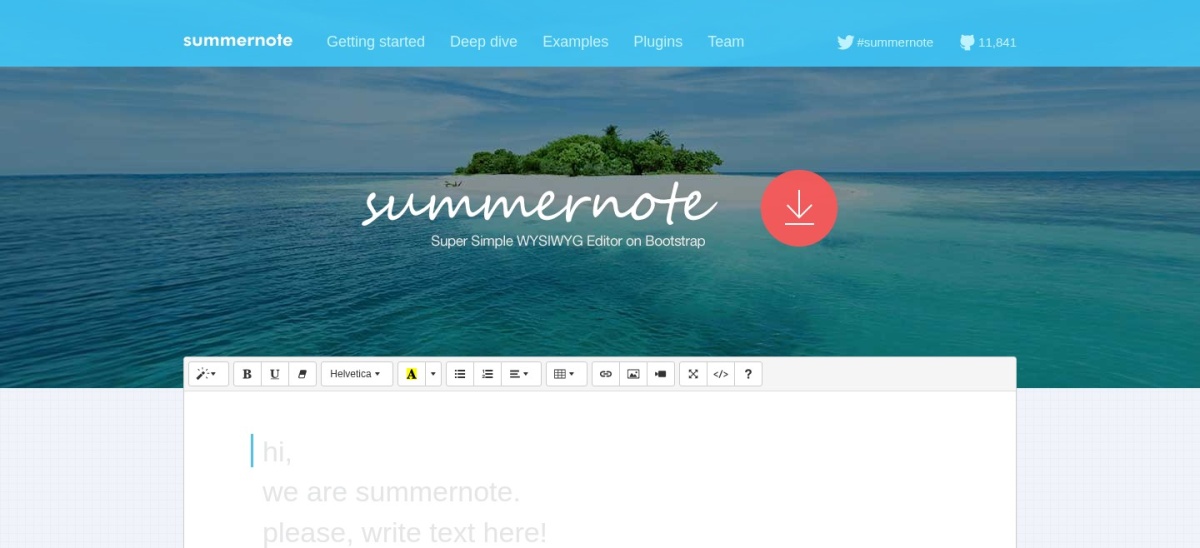
Summernote homepage, captured Nov 2026.
Summernote is a super simple WYSIWYG editor built on Bootstrap, with a small toolbar and a clean editing area that drops into a page fast. It is free under the MIT licence, and its homepage shows more than 11,800 GitHub stars.
The trade off is scope. Summernote covers basic formatting, tables and media, but it has no collaboration, AI or structured content model. It suits simple forms, comments and admin panels where a small editor is enough.
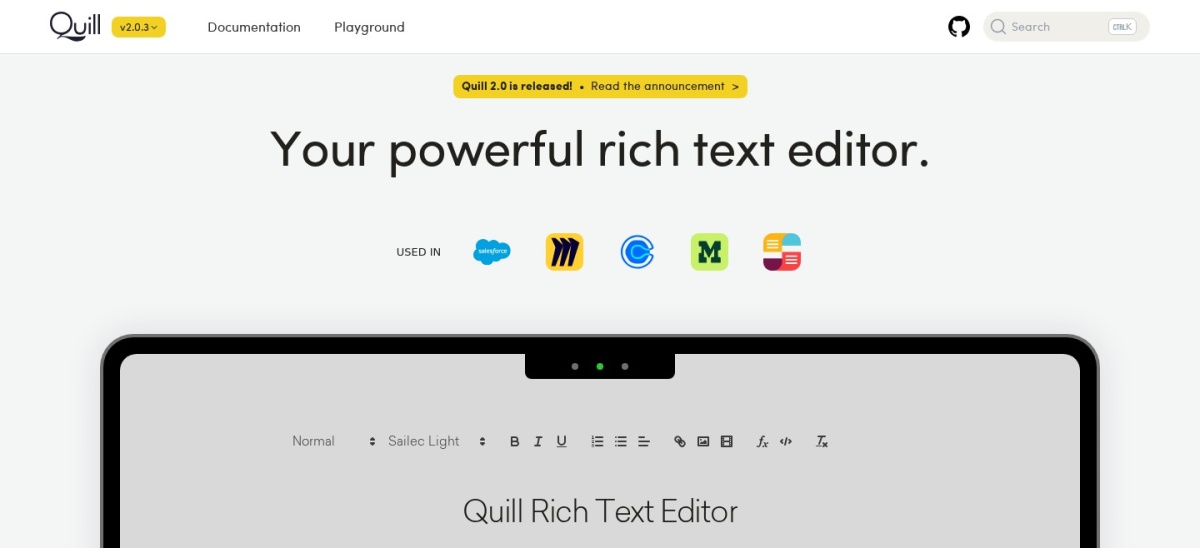
Quill is a free, modular rich text editor that stores content as Delta JSON instead of raw HTML, which keeps documents consistent. Version 2.0.3 is the current release on its homepage, and themes and modules let teams shape the toolbar.
The trade off is depth. Quill handles everyday formatting well but has no built-in collaboration, tables are basic, and complex document features need custom work. It suits apps that need a tidy editor for short text, not a full word processor.
ContentTools is a small, free JavaScript library that turns regions of a live page into editable areas, so editors change text where it appears. It is MIT-licensed, framework agnostic, and includes undo, redo and drag-and-drop image placement.
The trade off is that it is a component, not a product. ContentTools stores nothing and handles no login, so developers must wire up saving and access control. It suits sites that want in-page editing without a heavy editor.
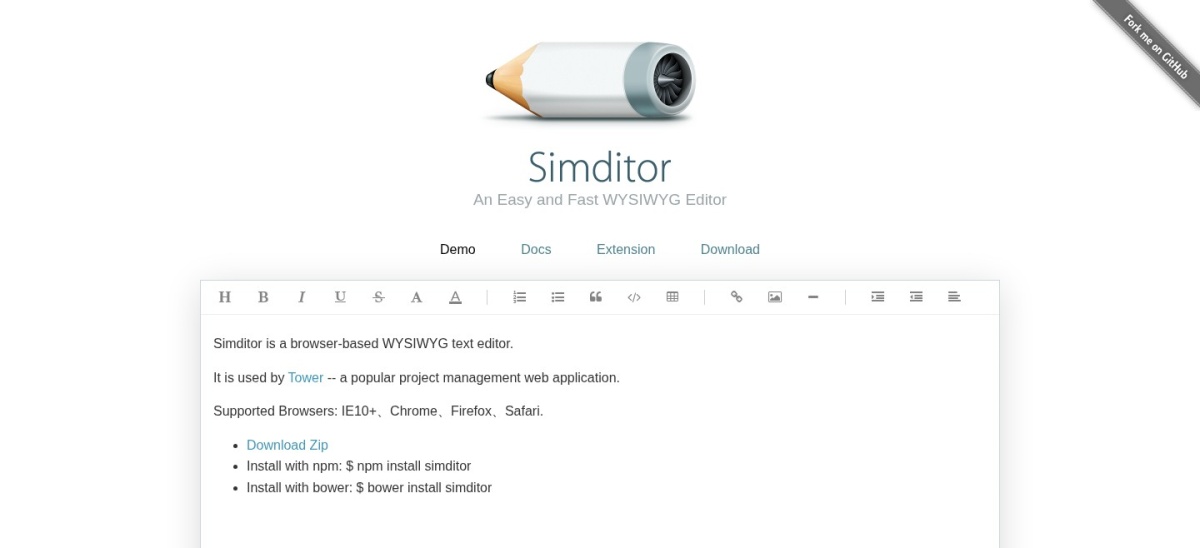
Simditor is an easy and fast WYSIWYG editor from Tower, the team behind a project management app that uses it daily. It is free and open source, with a plain toolbar, drag-and-drop support and free CSS templates for styling.
The trade off is age. Simditor is a small, older project with a thin plugin set and install notes that still mention Bower, so it is not the pick for new frameworks. It suits simple pages that need a light editor with no licence cost.
Tiptap gives you an engine and no interface, which suits teams with a design system and time to build. If that build is the reason you are switching, a finished editor is the point of the move.
A finished editor also changes the content model. Quill stores Delta JSON, ContentTools edits the live page, and the rest return HTML, so check what your app already stores before you pick.
Try the free tier first. TinyMCE, CKEditor, Summernote, Quill, ContentTools and Simditor all cost nothing to start, so a small prototype answers the fit question faster than a pricing page.
How we chose
We started from the editors most often named as Tiptap replacements in 2026 comparisons, then kept the seven with a public rating on G2.
Prices come from each vendor's pricing page, checked on 29 November 2026. Ratings and review counts come from G2 on the same day. Where a vendor shows a sale, the list shows the regular price.
We left out headless frameworks such as Lexical, Slate, ProseMirror, Editor.js and Plate because they have no public rating on G2, Capterra or Trustpilot, so their scores could not be checked. No vendor paid for a place, and we do not claim to have used these tools ourselves.
How to choose a Tiptap alternative
Start with the interface you want, then check the licence and the content format.
Decide headless or finished. If you want a ready toolbar and dialogs, pick TinyMCE, CKEditor or Froala. If you still want to build the UI, the free frameworks need a separate look.
Check the free tier first. TinyMCE and CKEditor give 1,000 free editor loads a month, and Summernote, Quill, ContentTools and Simditor are free outright.
Match the content format. Quill stores Delta JSON, ContentTools edits the page itself, and the rest work in HTML. Pick the one your app already stores.
Price it by usage, not by the headline. Load-based plans grow with traffic, while Froala's flat $899 a year stays the same, so estimate monthly editor loads before you commit.
FAQ
What is the best alternative to Tiptap in 2026?
TinyMCE is the best Tiptap alternative for most teams. Its free Core plan covers 1,000 editor loads a month, it is rated 4.5/5 on G2 from 119 reviews, and it ships a complete editor with no interface to build.
How much do Tiptap alternatives cost?
Four of the seven are free: Summernote, Quill, ContentTools and Simditor cost nothing. TinyMCE starts at $79 a month, CKEditor at $144 a month, and Froala at $899 a year, all billed annually.
Is there a free alternative to Tiptap?
Yes, several. Summernote, Quill, ContentTools and Simditor are all free and open source, and TinyMCE and CKEditor both have free tiers with 1,000 editor loads a month. The free editors cover simple formatting, but none includes collaboration.
Which Tiptap alternative is best for beginners?
Summernote is the easiest starting point. It is free, drops into a page with a small toolbar, and needs no build step or licence key. Quill is the next step up when you want a modular editor with a clean Delta format.
Which Tiptap alternative is best for small teams?
TinyMCE suits most small teams because the free Core plan covers 1,000 editor loads a month and the paid plan starts at $79 a month. Froala suits teams that prefer one flat $899 yearly licence with no load metering.
TinyMCE vs CKEditor: which is better?
TinyMCE is better for most teams because it costs less, starting at $79 a month against $144, and it has a larger plugin library. CKEditor is better when live co-editing, comments and track changes are core to the product.
SaaS SEO and WordPress specialist with about 8 years of experience. Rakib compares WordPress plugins, themes, hosting and software using public pricing, documentation and user reviews. See how we rank.