Workato leads our list of Syncari alternatives with low-code integration, business process automation and a self-service Pro subscription starting at $75 per month. Choose Skyvia for affordable bidirectional data synchronization or Boomi for enterprise integrations that combine application connectivity, master data management and API management.
How we make this list: we compare pricing pages, product documentation and public user reviews, then re-check every price before each update. No product paid for a place. Disclosure.
Workato Pro starts at $75 per month for 2,500 recurring usage credits.
Skyvia offers a free data integration plan covering 10,000 monthly records and has a 4.8/5 G2 rating.
Boomi starts at $99 per month plus $0.05 per message and includes its enterprise platform.
Celigo has a 4.6/5 G2 rating from 1,052 reviews and prices integrations by endpoints and flows.
Hightouch provides 2 active syncs on its free reverse ETL subscription.
Tray.ai Pro costs $500 per month and includes $100 in usage allowances.
How do you choose the right Syncari alternatives for your data stack?
Bidirectional synchronization is central to replacing Syncari. Organizations that maintain customer records across CRM, billing and marketing systems need more than scheduled data exports. They need field mappings, update rules and reliable handling of conflicting records.
Master data management separates enterprise integration platforms from basic automation tools. Boomi combines application integration with a dedicated data hub, while Workato focuses on connecting business processes across applications through automated workflows.
Warehouse-first organizations have different requirements. Hightouch activates existing warehouse data in operational applications, while Hevo Data primarily moves information from source systems into analytical destinations.
Pricing units can change the economics of an integration project. Workato measures usage through credits, Boomi charges for messages, Skyvia measures processed records, and Celigo bases pricing on integration endpoints and flows.
Free plans are useful for evaluating integrations but do not necessarily support sustained production workloads. Workato Free provides a one-time credit allocation, while Skyvia's free data integration plan has recurring record limits.
Best for cross-application business process automation
Entry planWorkato Pro
Monthly credits2,500
Free credit allocation50,000 one-time credits
BillingMonthly
workato.com
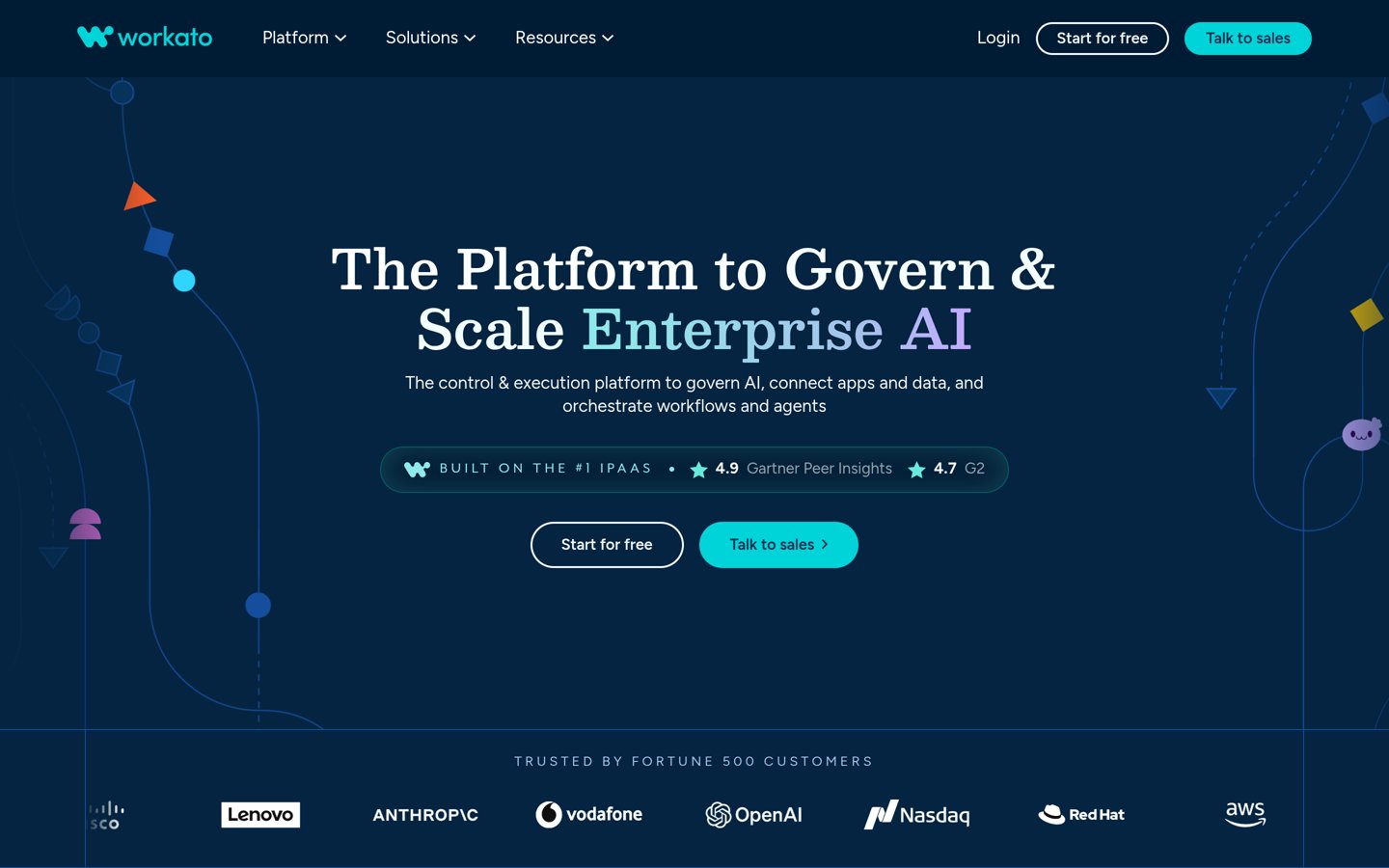
Workato homepage, captured Nov 2026.
Workato is an integration and workflow automation platform that connects business applications through configurable automation recipes. Its self-service Pro subscription includes 2,500 monthly credits that can be used across integration, orchestration and AI capabilities.
The trade off is consumption-based pricing, which requires monitoring workflow activity to avoid purchasing unnecessary capacity. Pro starts at $75 per month, and unused monthly credits expire rather than rolling over. It suits revenue operations and IT teams that want application synchronization alongside business process automation.
What we like
Low-code automation across business applications
Public self-service subscription pricing
Shared credits across platform capabilities
Free initial allocation for evaluating workflows
Strong G2 rating from an established review base
Watch out for
Free credits are a one-time allocation
Unused Pro credits expire monthly
Advanced enterprise requirements need a separate subscription
Pro adds recurring monthly credits for production integrations and automation.Visit workato.com
02
Skyvia
4.8/5on G2 (321 reviews, checked Nov 2026)
Paid from$79/mo
Best for affordable bidirectional data synchronization
Entry integration planBasic
Free monthly records10,000
Basic monthly records5 million
Basic schedulingDaily
skyvia.com
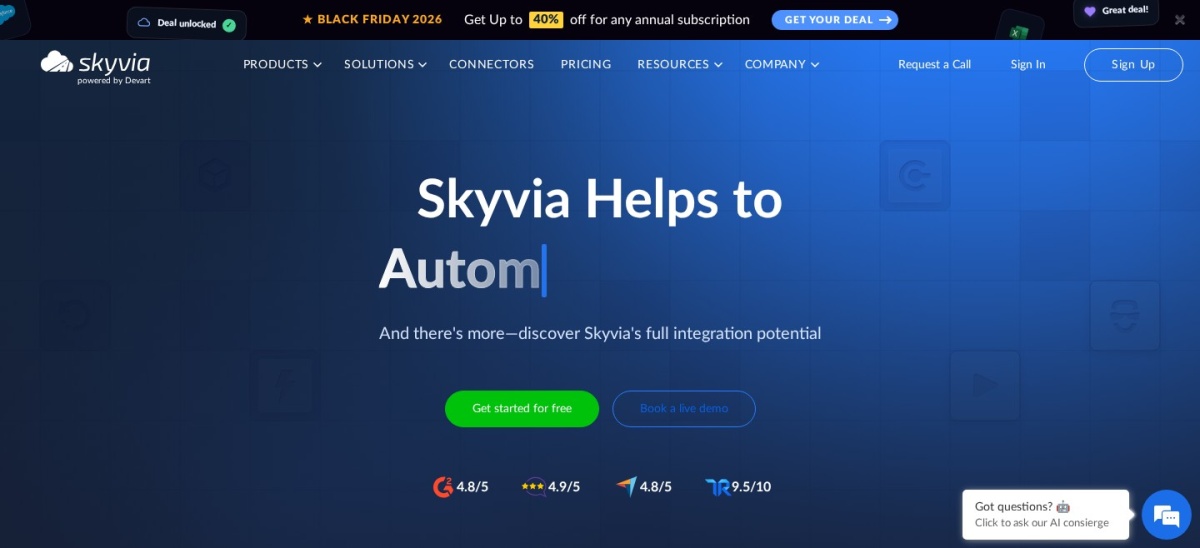
Skyvia homepage, captured Nov 2026.
Skyvia is a cloud data integration platform with import, export, replication and bidirectional synchronization capabilities. Its free integration subscription covers 10,000 monthly records, while Basic supports 5 million records with daily scheduling.
The trade off is synchronization frequency because hourly scheduling and more advanced transformation capabilities require higher plans. Basic costs $79 per month billed annually or $99 with monthly billing, excluding temporary promotions. It suits smaller revenue operations and data teams that need straightforward application and database synchronization.
What we like
No-code bidirectional synchronization
Public subscription prices and record allowances
Recurring free integration allowance
Supports applications and databases
Highest G2 rating in this comparison
Watch out for
Basic scheduling runs daily rather than continuously
Advanced data flows require higher subscriptions
Separate product categories have separate pricing
Basic increases monthly record capacity for scheduled production integrations.Visit skyvia.com
03
Boomi
4.4/5on G2 (506 reviews, checked Nov 2026)
Starts at$99/mo
Best for enterprise integration and master data management
Entry planPay-as-You-Go
Base subscription$99/mo
Usage charge$0.05/message
Master data managementBoomi Hub
boomi.com
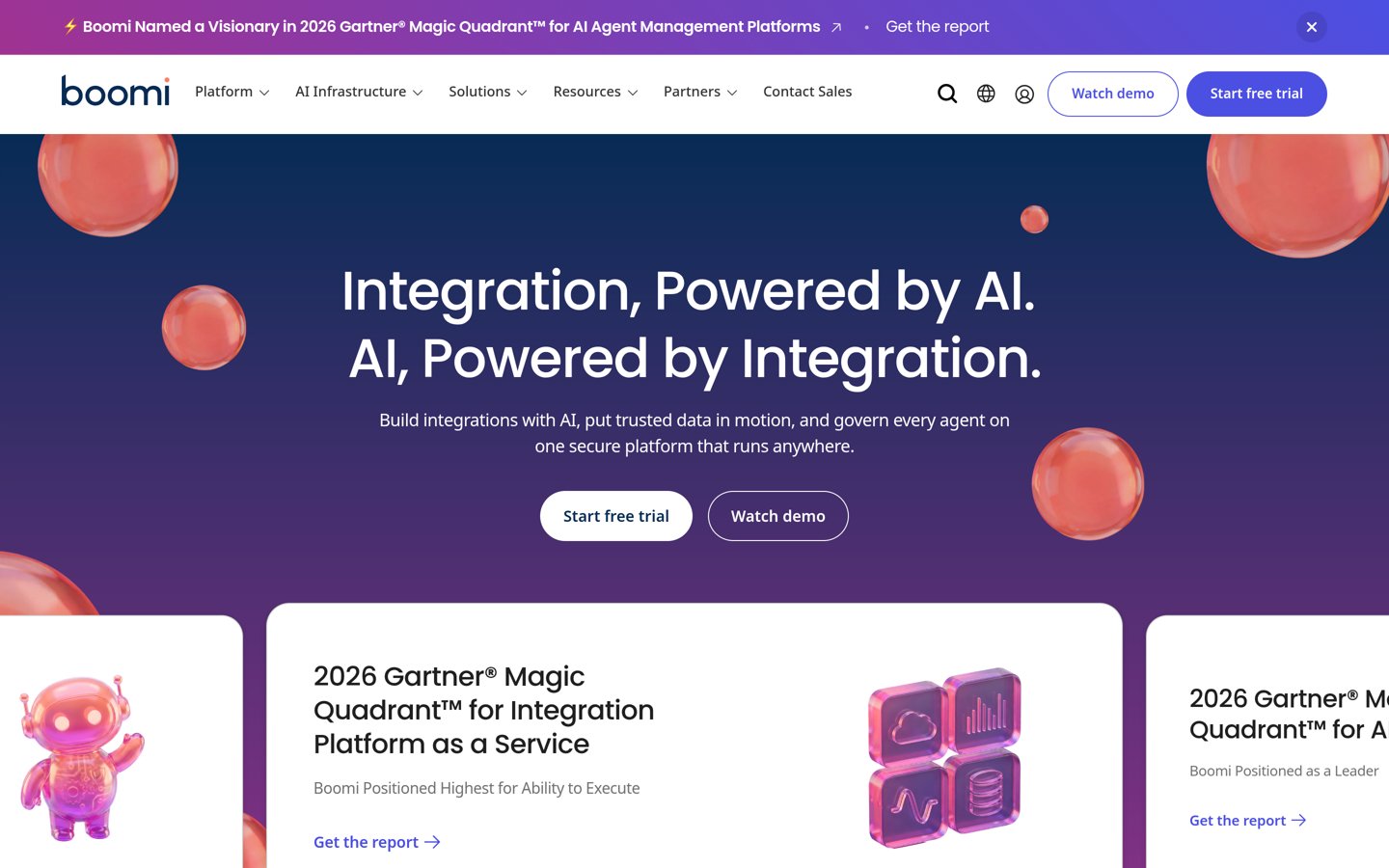
Boomi homepage, captured Nov 2026.
Boomi is an enterprise integration platform that combines application connectivity, API management, data synchronization and workflow development. Its Pay-as-You-Go edition starts at $99 per month and provides access to the enterprise platform with additional message-based charges.
The trade off is that total costs depend on integration traffic rather than the base subscription alone. Boomi charges $0.05 per message, so high-volume synchronization can increase monthly spending substantially. It suits organizations that need shared master records, hybrid integration and application connectivity within a broader enterprise platform.
What we like
Dedicated master data management capabilities
API management and application integration
Supports event-driven integration workflows
Self-service pricing without an annual commitment
Training and community resources included
Watch out for
Additional charges for integration messages
More complex than dedicated synchronization tools
Higher implementation demands for enterprise deployments
Pay-as-You-Go provides enterprise platform access with additional usage charges.Visit boomi.com
04
Celigo
4.6/5on G2 (1,052 reviews, checked Nov 2026)
PricingCustom pricing
Best for ERP and commerce application integration
Pricing modelEndpoints and flows
Integration builderLow-code
ERP integrationSupported
EDI integrationSupported
celigo.com
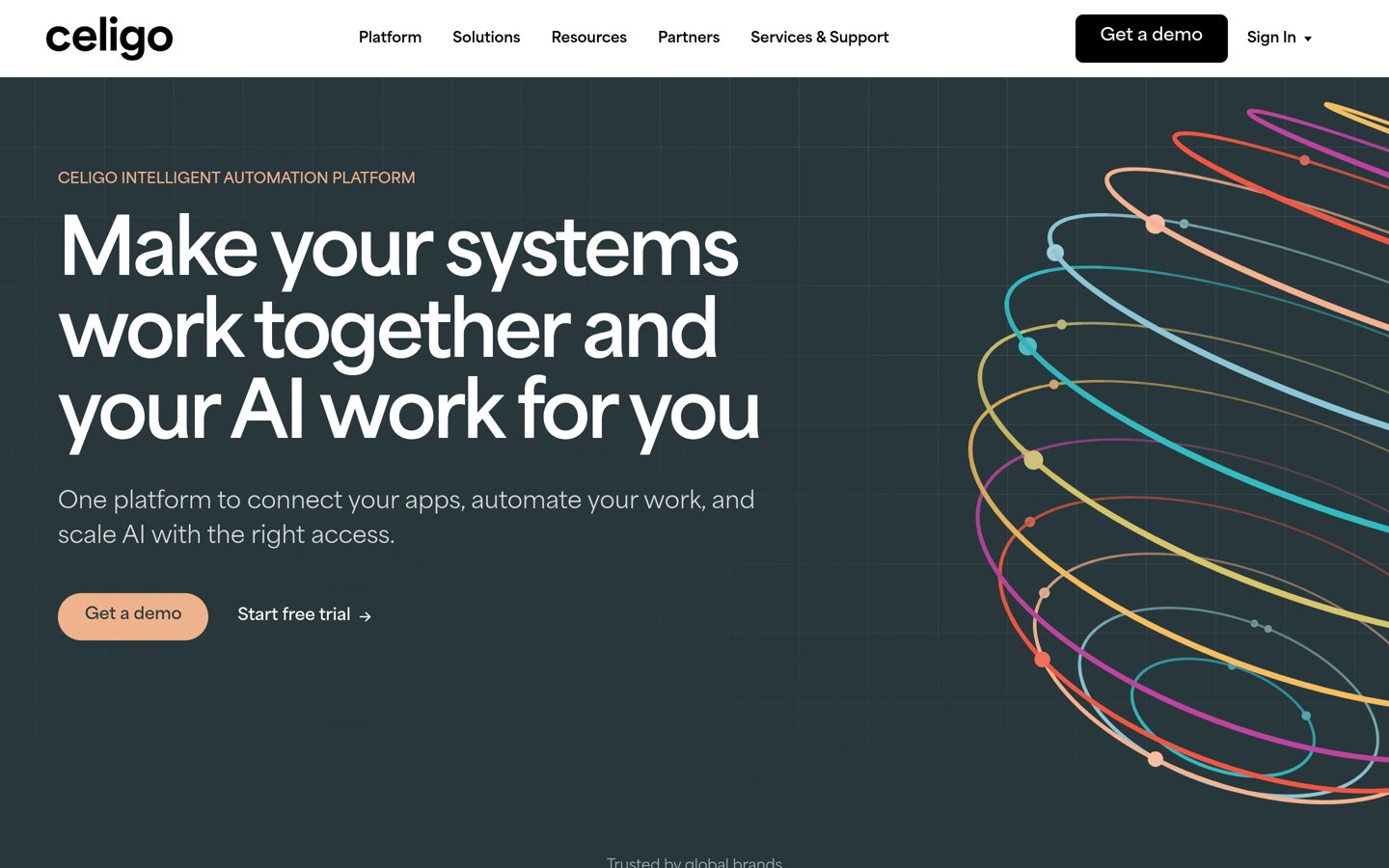
Celigo homepage, captured Nov 2026.
Celigo is a business integration platform focused on connecting operational applications, including ERP, CRM and commerce systems. It has a 4.6/5 G2 rating from 1,052 reviews and offers packaged integration applications alongside configurable data flows.
The trade off is that subscription costs require a sales discussion based on integration endpoints and flows. Buyers cannot calculate an exact annual subscription from public pricing alone. It suits retail, distribution and finance organizations that need to coordinate inventory, orders, customer records and accounting across several applications.
What we like
Prebuilt integrations for common business applications
Suitable for ERP and commerce synchronization
Endpoint-based rather than transaction-based pricing
Supports electronic data interchange workflows
Large independent review sample
Watch out for
No publicly available fixed subscription price
Implementation depends on application complexity
Additional integration flows can affect contract costs
Custom subscriptions provide integration capacity based on required endpoints and flows.Visit celigo.com
05
Hightouch
4.6/5on G2 (426 reviews, checked Nov 2026)
PricingCustom pricing
Best for warehouse-first customer data activation
Free subscriptionBasic Reverse ETL
Free active syncs2
Free destinationsUnlimited count
Free user seatsUnlimited
hightouch.com
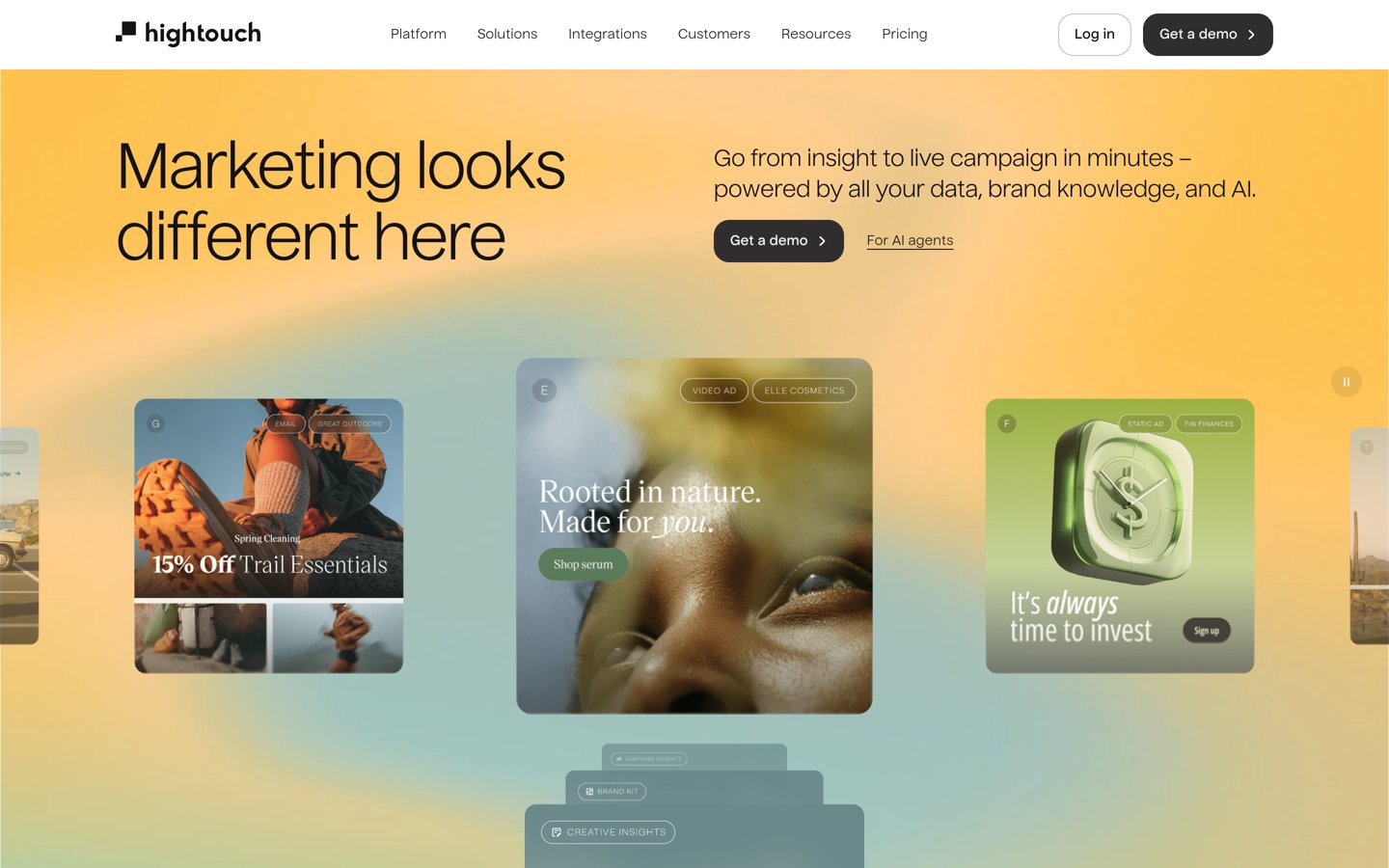
Hightouch homepage, captured Nov 2026.
Hightouch is a warehouse-native data activation platform that sends customer data from analytical storage into operational applications. Its Basic Reverse ETL plan includes 2 active syncs, unlimited destination count and unlimited user seats.
The trade off is architectural because Hightouch works best when reliable customer data already exists in a warehouse. Commercial customer data platform subscriptions use custom usage-based pricing. It suits marketing operations and data teams that want to activate existing customer models without maintaining a separate primary customer database.
What we like
Activates existing warehouse customer data
Free reverse ETL subscription
Audience building and identity resolution options
Supports CRM and marketing destinations
Detailed synchronization monitoring
Watch out for
Free subscription limits active syncs
Full commercial pricing requires a sales discussion
Not a direct replacement for every bidirectional integration workflow
Commercial plans expand data activation, audience management and customer data capabilities.Visit hightouch.com
06
Hevo Data
4.4/5on G2 (283 reviews, checked Nov 2026)
Paid from$299/mo
Best for automated data ingestion into warehouses
Entry planStarter
Free monthly eventsUp to 1 million
Starter sync frequency1 hour
Starter connectorsAll available connectors
hevodata.com
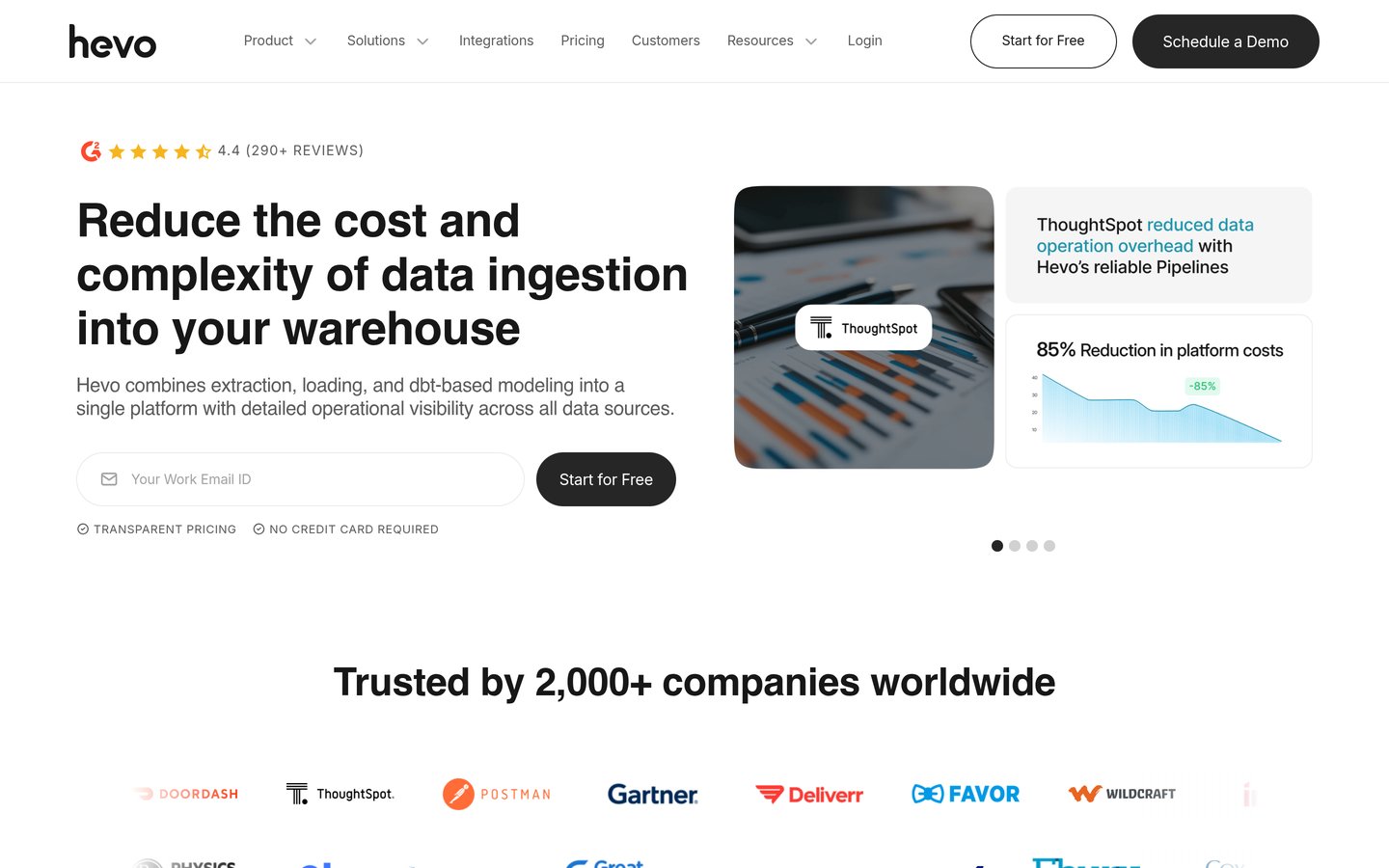
Hevo Data homepage, captured Nov 2026.
Hevo Data is a managed data pipeline platform that transfers information from applications and databases into analytical destinations. Its free subscription supports up to 1 million monthly events with limited connectors, while Starter provides access to all available connectors.
The trade off is that Hevo primarily addresses ingestion and transformation rather than operational master data synchronization between applications. Starter begins at $299 per month under its consumption pricing model. It suits analytics and engineering teams replacing the data consolidation portion of a Syncari deployment.
What we like
Managed data ingestion reduces pipeline maintenance
Free subscription for smaller workloads
Supports multiple analytical destinations
Configurable data transformations
Established G2 review base
Watch out for
Starter synchronization frequency is hourly
Pricing increases with data consumption
Not a full operational master data management replacement
Starter adds full connector access and additional data ingestion capacity.Visit hevodata.com
07
Tray.ai
4.5/5on G2 (158 reviews, checked Nov 2026)
Paid from$500/mo
Best for complex integrations and AI orchestration
Entry planPro
Included Pro usage$100
Free starter credit$100
Free workspaces1
tray.ai
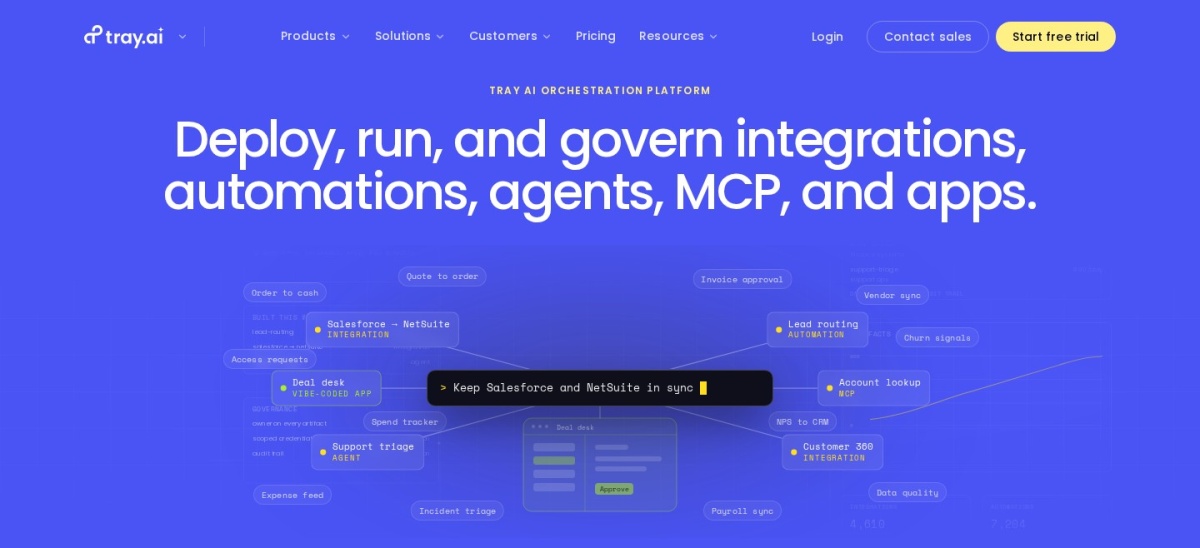
Tray.ai homepage, captured Nov 2026.
Tray.ai is an integration and AI orchestration platform that connects business systems through workflows, custom connectors and programmable automation. Its free subscription provides a $100 starter credit and access to integration, application development and agent capabilities.
The trade off is a higher fixed subscription cost than several competing platforms. Pro costs $500 per month with $100 of included usage, while advanced governance and API management require higher subscriptions. It suits technical operations teams building complex integrations alongside custom internal applications and AI workflows.
What we like
Shared usage balance across platform capabilities
Custom connector development
Supports integrations and AI applications
Free subscription with starter credits
Advanced workflow orchestration
Watch out for
High recurring Pro subscription cost
Additional consumption can increase spending
API management and single sign-on require higher plans
Pro provides recurring usage capacity and standard customer support.Visit tray.ai
Which Syncari alternative matches your existing data architecture?
Application-first integration is appropriate when CRM, billing and ERP systems are the primary operational databases. Workato, Celigo and Skyvia connect these systems directly through configured integration workflows.
Master data management becomes important when several applications contain conflicting customer records. Boomi Hub provides a dedicated approach to maintaining synchronized master data, making it particularly relevant for organizations replacing Syncari's data unification capabilities.
Warehouse-first activation works differently. Hevo Data moves information into analytical destinations, while Hightouch sends curated warehouse data back to operational systems. Together, these approaches can replace portions of Syncari's workflow, but they require additional architectural planning.
Before migrating, document which system owns each important field, how conflicting updates are resolved and what happens when records are deleted or merged. These rules matter more than connector count alone.
How do Syncari alternative pricing models compare?
Workato charges through usage credits, starting at $75 per month for its entry Pro subscription. Teams should estimate how often each integration runs and which operations consume credits.
Boomi combines a $99 monthly platform charge with $0.05 per message. The annual price ladder therefore represents a base subscription rather than the total cost of processing production workloads.
Skyvia measures data integration usage through record allowances and scheduling frequency. Celigo instead structures its commercial pricing around integration endpoints and flows, which may be more appropriate for transaction-heavy businesses.
Custom-priced tools are not free. The zero annual values for Celigo and Hightouch are technical placeholders for quote-based subscriptions and should be excluded from numerical price rankings.
How we chose
We shortlisted established integration, reverse ETL and data management platforms that address Syncari's main use cases. Rankings prioritize operational synchronization, application connectivity, master data capabilities, entry pricing and independent user feedback.
Official pricing documentation and G2 comparison pages were opened on 29 Nov 2026. Annual prices represent regular entry subscription costs before additional consumption charges. G2 ratings and review counts come from the opened comparison pages and may differ from subsequently updated individual product profiles.
We excluded Fivetran from the final ranking because its variable consumption pricing did not establish a comparable fixed paid subscription. Dedicated ingestion products rank below broader operational synchronization platforms because they replace fewer Syncari capabilities. No vendor paid for a place, and we do not claim testing for this list.
How to choose the right Syncari alternative
Map your existing synchronization rules, application dependencies and data governance requirements before comparing integration subscriptions.
Identify your authoritative data sources. Determine whether your CRM, ERP or data warehouse owns customer records. Choose application integration for operational synchronization, a master data platform for record governance or reverse ETL for warehouse activation.
Document synchronization and conflict rules. List the fields that need bidirectional synchronization, required update frequencies and rules for handling conflicting records. Confirm that the shortlisted platform can reproduce these behaviors without excessive custom development.
Estimate costs using actual integration volumes. Calculate expected message traffic, processed records and workflow executions. Compare regular subscription costs with variable consumption charges and additional governance requirements rather than relying exclusively on advertised starting prices.
Plan a controlled migration. Start with a limited integration, reconcile records against existing systems and monitor errors before moving critical production workflows. Establish recovery procedures and record ownership rules before enabling automated updates.
FAQ
What are the best Syncari alternatives in 2026?
Workato, Skyvia and Boomi are the best Syncari alternatives for most operational integration requirements. Workato combines application connectivity and automation, Skyvia provides affordable bidirectional synchronization, and Boomi offers enterprise integration with dedicated master data management capabilities.
What is the cheapest alternative to Syncari?
Workato has the lowest confirmed fixed paid subscription in this comparison, starting at $75 per month for 2,500 credits. Skyvia Basic costs $79 per month with annual billing and may be more economical for record-heavy scheduled synchronization.
Is there a free alternative to Syncari?
Yes. Skyvia offers free integration for up to 10,000 monthly records, while Hightouch provides 2 active reverse ETL syncs. Workato and Tray.ai also provide free access with initial usage allocations, although ongoing production activity may require payment.
Is Workato better than Syncari?
Workato is better suited to organizations that prioritize application integration and automated business processes alongside data synchronization. Syncari is more specifically focused on unified customer records and multidirectional synchronization. The better choice depends on your record governance and automation requirements.
Should I choose Workato or Skyvia?
Choose Workato for complex business automation and application workflows, or Skyvia for scheduled database and application synchronization. Workato starts at $75 monthly with credit-based pricing, while Skyvia Basic costs $79 monthly with annual billing and measures processed records.
Which Syncari alternative supports master data management?
Boomi is the strongest dedicated master data management option in this comparison because Boomi Hub complements its application integration platform. It is particularly relevant when organizations need consistent customer records across CRM, ERP and other operational systems.
Which Syncari alternative is best for Salesforce and ERP integration?
Celigo is a suitable option for connecting CRM and ERP applications, particularly when integrations also involve commerce, order management and accounting. Workato and Boomi are broader alternatives when Salesforce and ERP connectivity forms part of larger enterprise automation requirements.
Can Hightouch replace Syncari?
Hightouch can replace the customer data activation portion of Syncari when an organization already maintains trusted customer records in a data warehouse. It is not necessarily a complete replacement for direct multidirectional application synchronization or operational master data management.
How much does a Syncari replacement cost annually?
Confirmed base subscriptions in this comparison range from $900 annually for Workato to $6,000 annually for Tray.ai Pro. Actual costs can be higher because of consumption charges, increased record allowances, enterprise features and implementation requirements. Custom-priced products require separate quotes.
SaaS SEO and WordPress specialist with about 8 years of experience. Rakib compares WordPress plugins, themes, hosting and software using public pricing, documentation and user reviews. See how we rank.