NinjaOne is the best of the SuperOps alternatives for endpoint depth, rated 4.7 out of 5 on G2 across 5,864 reviews, with patching, remote access and backup in one console. Choose Atera or Syncro instead if you want RMM and PSA together for a flat $129 per technician a month with unlimited endpoints.
How we make this list: we compare pricing pages, product documentation and public user reviews, then re-check every price before each update. No product paid for a place. Disclosure.
NinjaOne leads at 4.7 out of 5 on G2 across 5,864 reviews, the largest review base in this list.
Atera and Syncro both charge $129 per technician a month on annual billing, with unlimited endpoints.
HaloPSA is the deepest PSA here at $99 per agent a month, but it has no RMM of its own.
Action1 is free for your first 200 endpoints, and ManageEngine Endpoint Central has a free edition for 25.
Only four of the nine vendors publish a price; Datto RMM and N-able N-central are quote-only.
What should you look for in SuperOps alternatives?
Pricing model is the first decision. SuperOps now bills per endpoint with a 150-endpoint minimum, so a growing client list raises your bill even when your headcount stays flat.
Per-technician pricing flips that maths. Atera and Syncro charge $129 per technician a month on annual billing and include unlimited endpoints, so adding clients costs nothing extra in licences until you hire.
RMM depth and PSA depth are different strengths. NinjaOne is the strongest pure RMM here, while HaloPSA is the deepest PSA and needs a separate RMM beside it.
Check what your current stack already covers before you switch. Our guide on how to monitor a WordPress site shows how much of the day-to-day monitoring job a lighter tool can already handle.
Review volume matters as much as the score. A 4.6 from 47 reviews is a weaker signal than a 4.6 from 1,291, so weigh the count beside the rating.
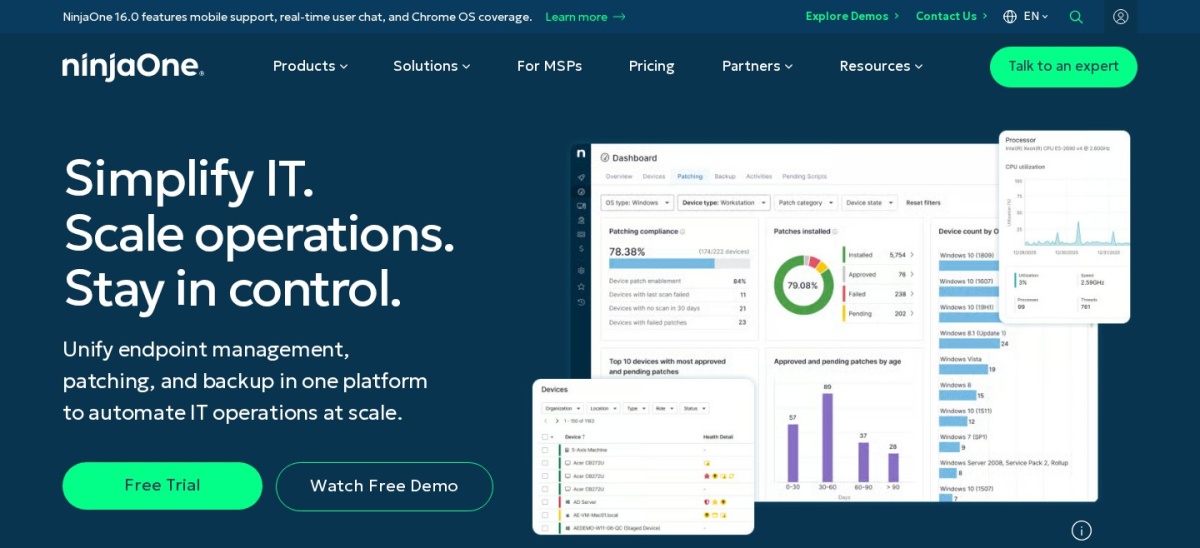
NinjaOne is a cloud RMM that unifies endpoint management, patching and backup in one console. Its patching and endpoint automation are the deepest in this list, the console stays fast at high device counts, and backup and documentation are available as first-party modules.
The trade off is pricing shape and PSA maturity. Pricing is per endpoint and volume-tiered from $1.50 to $3.75 a month, with the final figure by quote, and its PSA module is newer than rivals that were built PSA-first. It suits MSPs whose core work is managing many endpoints and who want the most proven RMM console.
What we like
Highest G2 rating among full RMMs here, across 5,864 reviews
Deepest patching and endpoint automation in this list
Free and unlimited support and training
Watch out for
Per-endpoint pricing rises every time you win a client
Atera is an all-in-one IT management platform that combines RMM, PSA, ticketing, patch management and remote access in one console. Its MSP Pro plan costs $129 per technician a month billed annually, covers unlimited endpoints, and includes the AI Copilot assistant on every plan.
The trade off is the entry tier. Pro covers Windows endpoints only, so macOS and Linux support needs the Growth plan at $159 per technician a month, and network discovery is a paid add-on. It suits small MSPs that want one login for monitoring and tickets at a predictable per-technician price.
What we like
Flat per-technician price with unlimited endpoints
AI Copilot included on every plan
30-day free trial with no credit card
Watch out for
Entry Pro plan covers Windows endpoints only
Network discovery costs extra
PSA is lighter than HaloPSA or Autotask
Growth adds macOS and Linux agents at $159 a monthVisit atera.com
03
Syncro
4.5/5on G2 (571 reviews, checked Nov 2026)
Starts at$129/mo
Best flat-rate RMM and PSA for small MSPs
Pricing modelPer user, unlimited endpoints
Entry planCore, $129/user/mo annual
Free trial14 days, no card
Microsoft 365Team plan only
syncrosecure.com
Syncro homepage, captured Nov 2026.
Syncro is an all-in-one RMM and PSA platform for MSPs that also manages Microsoft 365 tenants. Its Core plan costs $129 per user a month billed annually, includes RMM, PSA, ticketing, invoicing and recurring billing, and covers unlimited endpoints per technician.
The trade off is the Microsoft 365 split. Security baselines, identity management and automated licence billing sit in the Team plan at $179 per user a month, and AI features move to usage-based billing after January 2027. It suits small MSPs that want ticketing and invoicing in the same plan as their RMM.
What we like
RMM, PSA and billing in one flat per-user price
Unlimited endpoints on every plan
Microsoft 365 management built into Team
Watch out for
Microsoft 365 features need the $179 Team plan
AI features become usage-billed after January 2027
HaloPSA is an all-in-one PSA built for MSPs and IT service providers, with a service desk, CRM, sales pipeline, asset management, project management and billing in one price. Its single plan lists at $99 per agent a month billed annually for up to 24 agents, and end users on the portal are free.
The trade off is setup and scope. It has no RMM of its own, so you pair it with a separate RMM, and an onboarding package is required with every purchase at a cost set by scope. It suits MSPs that want the deepest PSA and are happy to run their RMM beside it.
What we like
Every module included in one per-agent price
Deep ticketing, contracts and billing depth
Highly configurable workflows and automation
Watch out for
No RMM included, so you pay for a second tool
Onboarding package required with every purchase
Only 47 G2 reviews, the thinnest base in this list
ManageEngine Endpoint Central homepage, captured Nov 2026.
ManageEngine Endpoint Central is a unified endpoint management platform covering patch management, software deployment, remote control and IT asset management. Its free edition supports up to 25 endpoints, and paid cloud plans start from $1.09 per endpoint a month on the Professional edition.
The trade off is scope and fit. It is an endpoint tool, not a PSA, so ticketing, contracts and billing need another product, and its licensing bands can be confusing at larger counts. It suits patch-led teams and internal IT that want strong endpoint control at the lowest entry price here.
Datto RMM is a cloud RMM for MSPs that monitors, patches and remotely manages endpoints across client sites. It pairs tightly with Datto backup and BCDR products such as SIRIS and ALTO, and with Autotask PSA, both inside the Kaseya stack.
The trade off is price transparency and independence. Datto publishes no price, so budgeting needs a sales quote, and it fits best inside the Kaseya and Datto ecosystem rather than beside a rival PSA. It suits MSPs already invested in Datto backup who want their RMM aligned with it.
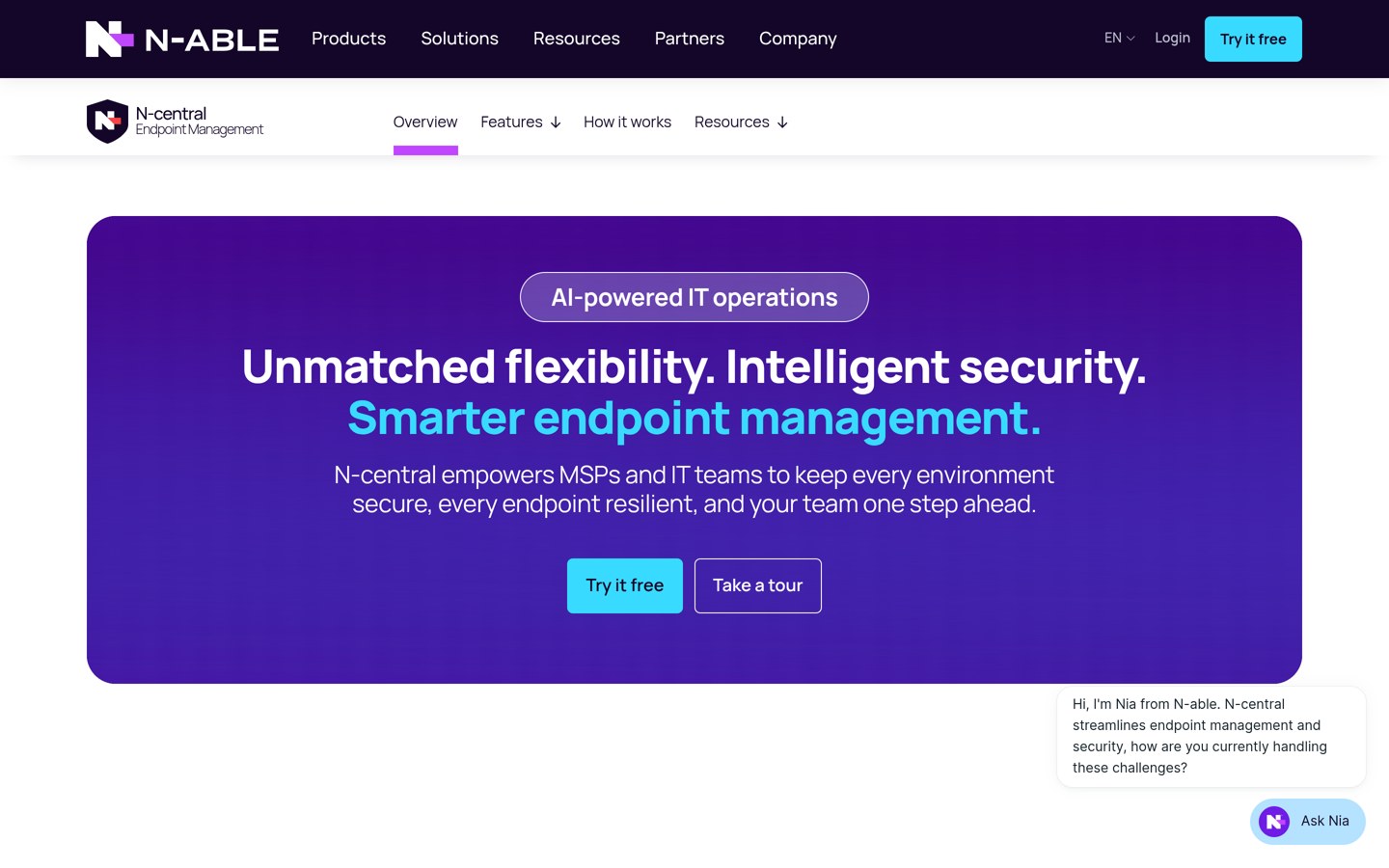
N-able N-central is a multi-tenant RMM built for MSPs managing large, complex environments, with deep automation, cross-platform support and granular policy controls. It is the most automation-heavy RMM in this list, and it scales across many client sites from one console.
The trade off is complexity and price opacity. N-able publishes no price, the learning curve is the steepest here, and there is no built-in PSA, so ticketing comes from a separate product. It suits larger MSPs with dedicated staff who need automation depth more than a quick setup.
Pulseway is a mobile-first RMM built around managing servers, workstations and network devices from a phone or tablet. It covers monitoring, automated patching across the operating system and 200-plus third-party apps, scripting and remote control, starting from $39 a month for at least 20 monitored systems.
The trade off is scope. There is no permanent free plan, security, backup and ticketing arrive as paid add-ons, and there is no full PSA. It suits lean MSP teams and solo admins who want to fix most issues from their phone.
Action1 is a cloud patch management platform that is free forever for the first 200 endpoints, with no feature limits and no credit card required. It covers automated OS and third-party patching plus vulnerability remediation for Windows, macOS and Linux, and the vendor reports a 99% patch success rate.
The trade off is scope. Action1 is patch-first, not a full RMM: monitoring depth and PSA functions are lighter than NinjaOne or N-central, and pricing above 200 endpoints is quote-only. It suits small fleets and patch-first teams that want enterprise patching without a licence bill.
Per-endpoint vs per-technician: the maths that matters
Per-endpoint pricing scales with your clients' device counts. Landing a 400-seat client raises your software bill before the first invoice clears, even though your headcount has not changed.
Per-technician pricing scales with your headcount, which you control. Atera and Syncro charge $129 per technician a month for unlimited endpoints, so growth in clients costs nothing extra in licences until you hire.
Only four of these nine vendors publish a price at all. NinjaOne, Atera, Syncro and Pulseway list figures; Datto RMM and N-able N-central do not, and Action1 only publishes its free tier.
How we chose
We started from the platforms MSPs most often compare against SuperOps: unified PSA and RMM tools, standalone RMMs and PSA-first tools that pair with an RMM.
Prices come from each vendor's pricing page or G2 pricing data, checked on 29 November 2026. Ratings and review counts come from G2 on the same day. Where a vendor shows a sale, the list shows the regular price.
We left out SuperOps itself, since this list is about replacing it, and Kaseya VSA, which has the lowest G2 rating in the niche and is being folded into Kaseya 365 bundles. No vendor paid for a place, and we do not claim to have used these tools ourselves.
How to choose a SuperOps alternative
Start with how you are billed today, then match the tool to the job your team actually does.
Work out which billing model fits your fleet. Count endpoints per technician. A high ratio favours per-technician pricing from Atera or Syncro; a low ratio makes NinjaOne's per-endpoint range competitive.
Decide whether you need a PSA as well. If ticketing, contracts and billing must live in the same product, shortlist Atera, Syncro or HaloPSA. If you already own a PSA, NinjaOne or Datto RMM can slot in beside it.
Check the trial on your own endpoints. Every tool here offers a trial. Run it on a small client site first and check patching, remote access and ticket flow before you commit.
Confirm the full first-year cost. Ask about onboarding, add-ons and minimums in writing. HaloPSA requires onboarding, and several tools charge extra for backup, security or ticketing.
FAQ
What is the best alternative to SuperOps?
NinjaOne is the best SuperOps alternative overall. It is rated 4.7 out of 5 on G2 across 5,864 reviews, the largest review base in this list, and it covers patching, remote access, backup and endpoint automation in one console.
How much do SuperOps alternatives cost?
Published entry prices run from free to $129 a month. Action1 is free for 200 endpoints, Pulseway starts at $39 a month, HaloPSA lists $99 per agent a month, and Atera and Syncro both charge $129 per technician a month. Datto RMM and N-able N-central are quote-only.
Is there a free alternative to SuperOps?
Yes. Action1 is free forever for your first 200 endpoints with no feature limits, and ManageEngine Endpoint Central has a free edition for up to 25 endpoints. Both are patch-first tools rather than full PSA and RMM platforms, so larger MSPs still need a paid RMM beside them.
Which SuperOps alternative is best for a small MSP?
Syncro is the best fit for most small MSPs. Its Core plan costs $129 per user a month on annual billing, includes RMM, PSA, ticketing and invoicing, and covers unlimited endpoints, so your bill only grows when you hire.
NinjaOne vs Atera: which is better as a SuperOps alternative?
NinjaOne wins on endpoint depth and review volume, with a 4.7 G2 rating across 5,864 reviews against Atera's 4.6 across 1,291. Atera wins on billing and breadth: it bundles RMM and PSA for a flat $129 per technician a month with unlimited endpoints, while NinjaOne charges per endpoint.
Do SuperOps alternatives include a PSA?
Some do and some do not. Atera, Syncro and HaloPSA include PSA functions, while NinjaOne, Datto RMM, N-able N-central, Pulseway, ManageEngine Endpoint Central and Action1 are RMM or endpoint tools that need a separate PSA for ticketing, contracts and billing.
Can I migrate from SuperOps to another RMM easily?
Migration is usually straightforward but not instant. Most vendors offer onboarding help and import tools for devices, policies and tickets, but agent rollout across client sites takes planning. Run the new tool beside SuperOps on one small client first, then move the rest in stages.
SaaS SEO and WordPress specialist with about 8 years of experience. Rakib compares WordPress plugins, themes, hosting and software using public pricing, documentation and user reviews. See how we rank.