Supabase is the best SQLite alternative for most apps: it is rated 4.6 out of 5 on G2 and turns Postgres into a hosted backend with auth and APIs from $25 a month. PostgreSQL itself is free and the strongest server-SQL swap, while MongoDB Atlas suits apps that need flexible documents.
How we make this list: we compare pricing pages, product documentation and public user reviews, then re-check every price before each update. No product paid for a place. Disclosure.
Supabase is the top pick at 4.6/5 on G2 from 243 reviews, with a hosted Postgres backend from $25 a month.
PostgreSQL and Firebird cost nothing to run, and MySQL Community is free too.
MongoDB Atlas has the cheapest paid cloud plan here at $8 a month on Flex.
Firebase has no fixed fee: Spark is free and Blaze bills only for usage past the free quotas.
Firebird is the closest match to SQLite itself: a small embeddable SQL engine that also runs as a server.
How do you choose the best SQLite alternative?
The best SQLite alternative depends on what SQLite cannot do for you. If one writer and one file are the limit, a server database such as PostgreSQL or MySQL removes it; if you need sync across devices, Firebase or Couchbase fits better.
Free does not mean the same thing everywhere. PostgreSQL, MySQL Community, MariaDB Community and Firebird cost nothing to run, while managed services charge by the hour or by the month, so a free tier is not the same as a free database.
Ratings in this list come from G2, checked on 29 November 2026. Supabase leads at 4.6 out of 5, and every tool here has at least 24 public reviews, so no pick rests on a single opinion.
Mind the pricing model before you commit. Hourly rates such as MariaDB Cloud at $0.16 an hour look small but pass $1,400 a year on an always-on node, while usage billing on Firebase and Atlas Flex can swing either way with traffic.
Supabase is a hosted Postgres platform that adds authentication, storage, realtime updates, Edge Functions and instant Data APIs to a full PostgreSQL database. The free plan includes two projects with 500 MB databases each, and self-hosting with Docker is free as well.
The trade off is usage billing. Pro costs $25 a month per organisation, and storage, egress and extra compute are charged on top, with spend caps on by default to limit surprises. It suits app builders who want a backend without running a database server.
What we like
Full Postgres plus auth, storage and APIs in one place
Generous free plan with two projects
Spend caps on by default on Pro
Self-hosting option is free
Watch out for
Costs can rise with storage and egress as projects grow
PostgreSQL is the most capable free relational database in this list, with full SQL, JSON support, extensions and a large community behind it. It costs nothing to run, and managed hosting is available from many vendors if you do not want to run it yourself.
The trade off is that you run it yourself. There is no vendor support or hosted console included, so setup, backups and tuning are your job unless you pay a host. It suits teams that want full SQL power and control over their data.
MySQL is the most widely used open-source relational database, rated 4.4 out of 5 on G2 by 1,686 reviewers, and the Community Edition is free under the GPL. It pairs with the free Workbench GUI and runs almost everywhere, from laptops to cloud servers.
The trade off is paid licensing. The Community Edition is free, but Standard costs $2,140 per server a year and Enterprise $5,350, both sold by Oracle as annual subscriptions. It suits teams that want familiar MySQL habits with a huge hiring pool.
MongoDB Atlas is the managed cloud service for MongoDB, a document database that stores flexible JSON-like records instead of fixed tables. The free M0 cluster holds 512 MB, and the Flex tier starts at $8 a month with 5 GB of storage.
The trade off is the step up to production. Flex caps at 500 operations a second, and the smallest dedicated cluster, M10, costs about $57 a month. It suits apps whose data shape changes often and that need to scale without migrations.
Firebase is Google's app backend platform, built around Firestore, a NoSQL database with realtime sync, plus authentication, hosting and Cloud Functions. The free Spark plan covers small apps, and eligible new accounts get $300 of credit on the Blaze plan.
The trade off is usage billing with no fixed fee. Blaze charges only for use past the free quotas, so a quiet app can cost almost nothing while a busy one can climb fast. It suits mobile and web apps that want auth and sync without running a server.
What we like
Realtime sync and offline support built in
Auth, hosting and functions in one place
Spark plan is free with fixed quotas
No fixed monthly fee on Blaze
Watch out for
Costs are hard to predict until you measure traffic
MariaDB is a community fork of MySQL that stays compatible with MySQL apps, drivers and queries, and the Community Server is free. It is rated 4.4 out of 5 on G2 by 226 reviewers, and the managed MariaDB Cloud starts with a free tier.
The trade off is a smaller ecosystem. Fewer hosts, tools and tutorials target MariaDB than MySQL, and the managed Cloud Power tier starts at $0.16 an hour, about $117 a month always on. It suits teams leaving MySQL that want a drop-in swap.
Microsoft SQL Server is the enterprise relational database of the Microsoft world, with deep ties to .NET, Azure, Power BI and Active Directory. The free Express edition covers small databases, and Developer is free for development and testing.
The trade off is licensing cost and complexity. Standard lists at $3,945 per 2-core pack as a one-time license, or $73 per core a month pay-as-you-go through Azure Arc, with a four-core minimum. It suits Microsoft shops that already live in that stack.
Couchbase is an operational NoSQL database that combines document, key-value and search in one engine, with mobile sync that keeps apps working offline. The free Capella tier gives one node with 8 GB, and the paid Basic tier starts at $0.15 per node per hour.
The trade off is hourly node pricing. A single always-on Basic node costs about $110 a month before storage and extras, and multi-node setups multiply that. It suits apps that need offline-first mobile sync or edge data.
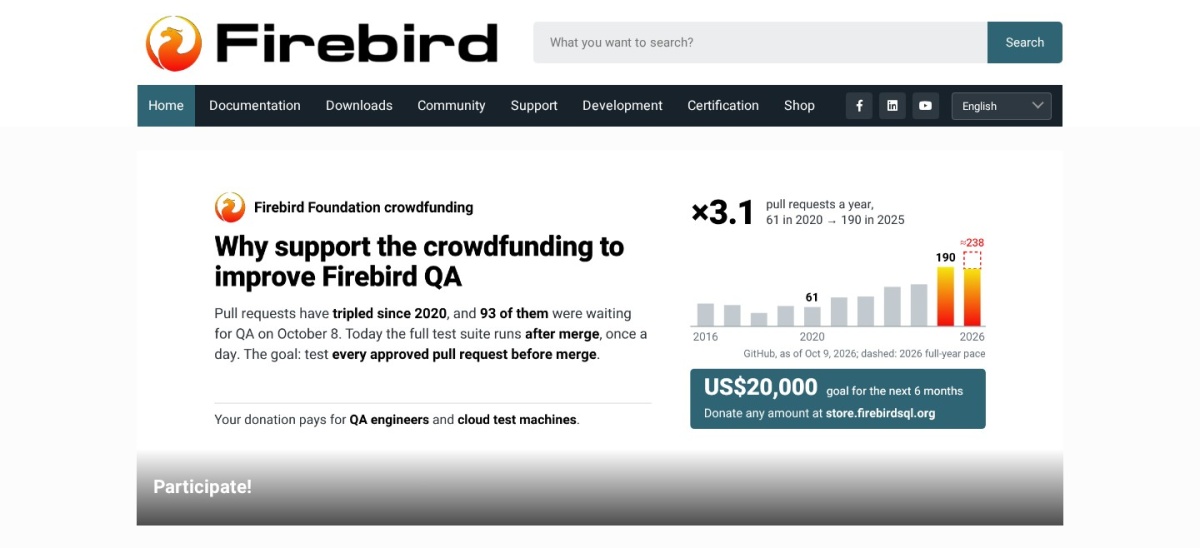
Firebird is a small, free, open-source relational database that runs embedded inside an app or as a server, the closest model to SQLite in this list. It stores data in single files, runs on Windows, Linux and macOS, and needs no licence fee at all.
The trade off is a small community. Firebird has far fewer drivers, tools and tutorials than PostgreSQL or MySQL, and its G2 rating rests on only 24 reviews. It suits desktop apps that have outgrown SQLite but want to stay small and self-contained.
SQLite still wins for single-user apps, local tools and prototypes. It needs no server, no account and no bill, and it reads and writes a single file you can copy anywhere.
Move away when a second writer, a second device or a second server enters the picture. That is the point where PostgreSQL, MySQL or Supabase start to pay for themselves, and the migration is easier before the data grows.
How we chose
We started from the databases G2 reviewers rate most often as SQLite replacements, then kept nine with a public rating, a clear price and an established user base.
Prices come from each vendor's pricing page, checked on 29 November 2026. Ratings and review counts come from G2 on the same day. Where a vendor shows a sale, the list shows the regular price.
We left out tools with no public rating on G2, Capterra or Trustpilot, including DuckDB, Turso, PouchDB and Realm, whose G2 listing covers a different product. No vendor paid for a place, and we do not claim hands-on testing for this list.
How to choose a SQLite alternative
Start with what SQLite cannot do for you, then match the database to that gap.
Decide how many writers you need. SQLite allows one writer at a time, so any app with concurrent writes needs a server database such as PostgreSQL, MySQL or MariaDB.
Choose between SQL and documents. PostgreSQL, MySQL and Firebird keep your SQL habits, while MongoDB Atlas and Couchbase store flexible JSON-like documents.
Price the managed option for a full month. Hourly rates look small, but an always-on node at $0.16 an hour costs about $117 a month, and usage billing rises with traffic.
Check the free tier limits first. Free plans cap storage, projects or operations, so confirm the ceiling covers your app before you build on it.
FAQ
What is the best SQLite alternative in 2026?
Supabase is the best SQLite alternative for most apps. It is rated 4.6 out of 5 by 243 G2 reviewers and turns Postgres into a hosted backend with auth and APIs from $25 a month, while PostgreSQL itself is free for teams that want to self-host.
What is the cheapest SQLite alternative?
PostgreSQL, Firebird and MySQL Community cost nothing to run, with no licence fee at all. Among paid cloud plans, MongoDB Atlas Flex starts at $8 a month, and Firebase Blaze has no fixed fee, billing only for usage past the free quotas.
Is there a free SQLite alternative?
Yes. PostgreSQL, MySQL Community, MariaDB Community and Firebird are all free and open source. Supabase, MongoDB Atlas, Firebase and Couchbase also offer free tiers, though each caps storage, projects or operations.
Which SQLite alternative is closest to SQLite itself?
Firebird is the closest match. Like SQLite it is a small, embeddable SQL engine that stores data in single files and runs without a server, but it also runs as a server and allows more than one writer at a time.
Supabase or PostgreSQL: which should I pick?
Pick Supabase if you want Postgres without running a server, with auth, storage and instant APIs included from $25 a month. Pick PostgreSQL itself if you want the same database free, self-hosted, with full control over backups and tuning.
Can I migrate from SQLite to PostgreSQL easily?
Yes, for most apps. Both speak SQL, and tools such as pgloader move tables and data across, though SQLite's loose typing means some columns need checking by hand. Supabase and managed Postgres hosts document the move step by step.
Is Firebase a good SQLite alternative for mobile apps?
Yes, for apps that need sync across devices. Firestore keeps data in sync in realtime and works offline, with auth and hosting included. The catch is usage billing: costs are hard to predict until you measure real traffic.
SaaS SEO and WordPress specialist with about 8 years of experience. Rakib compares WordPress plugins, themes, hosting and software using public pricing, documentation and user reviews. See how we rank.