Port is the best of the Spotify Backstage alternatives for most teams: it replaces Backstage's catalog, scorecards and self-service actions with a managed product, free for up to 5 seats and $30 per seat a month on Basic. Pick Cortex for scorecard-driven standards, or Qovery when the real gap is deploying code, not cataloging it.
How we make this list: we compare pricing pages, product documentation and public user reviews, then re-check every price before each update. No product paid for a place. Disclosure.
Port is the cheapest way in: free for 5 seats, then $30 per seat a month, rated 4.4/5 from 41 G2 reviews.
Cycloid holds the highest rating here at 4.9/5 from 32 G2 reviews, with a free plan for 5 users.
Cortex, OpsLevel and Harness publish no price at all; all three sell custom quotes, so budget them by sales call.
Qovery starts at $299 a month and deploys into your own cloud account, with preview environments per pull request.
Massdriver starts at $999 a month for 15 seats, the steepest entry here, with no free plan at all.
What should you look for in Spotify Backstage alternatives?
Backstage is a framework, not a finished portal. You stand up the hosting, wire authentication, then install or write a plugin for every capability you want, which is why teams look for a managed replacement.
The first split is portal versus platform. Port, Cortex and OpsLevel give you a catalog, scorecards and self-service without running infrastructure, while Qovery, Encore, Cycloid and Massdriver also provision and deploy what developers request.
Pricing is the second split, and it is wide. Three of the eight tools publish no numeric price, so a 50-developer team cannot budget them from the site, while the cheapest paid seat is Port at $30 a month.
Free plans decide the shortlist for small teams. Five of the eight tools have a free plan, so a small team can run a real catalog before paying anything, and Backstage itself stays free as open source for teams with engineers to run it.
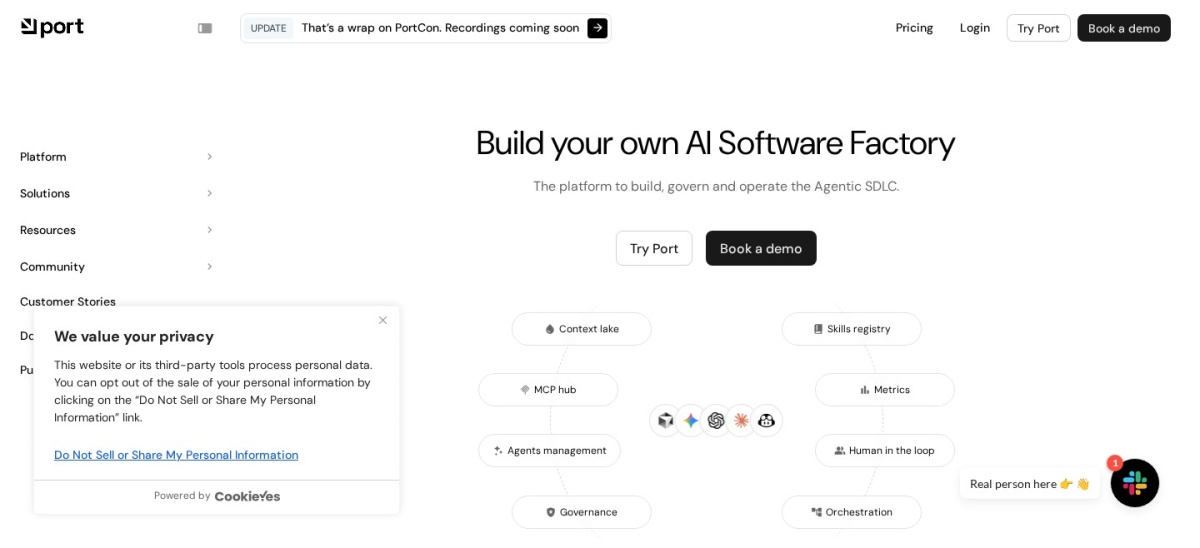
Port is a managed developer portal that replaces Backstage's catalog, scorecards and self-service actions without handing you a codebase to maintain. The free plan covers 5 seats, 10,000 entities and 400 workflow runs, with the full platform included. Its Context Lake models services, infrastructure and teams, and its workflow orchestrator turns requests into governed self-service actions.
The trade off is seat pricing. Basic starts at $30 per seat a month billed annually for up to 50 seats, so a 50-developer team pays $1,500 a month, and the free plan caps at 5 seats. It suits platform teams that want a configurable catalog and published pricing instead of framework maintenance.
What we like
Free plan includes the full platform for 5 seats
Published seat pricing, rare in this category
Flexible data model instead of fixed entity types
800 workflow runs and 99.8% uptime SLA on Basic
Watch out for
Free plan caps at 5 seats and 10k entities
Per-seat cost grows with every developer
Blueprints and mappings have a learning curve
Basic adds commercial support, 50k entities and a 99.8% uptime SLAVisit port.io
02
Cortex
4.4/5on G2 (20 reviews, checked Nov 2026)
PricingCustom/yr
Best for scorecards and engineering standards
Free planNo, custom quote
Integrations50+ native
ScorecardsYes, with CQL
DeploymentCloud-hosted SaaS
cortex.io
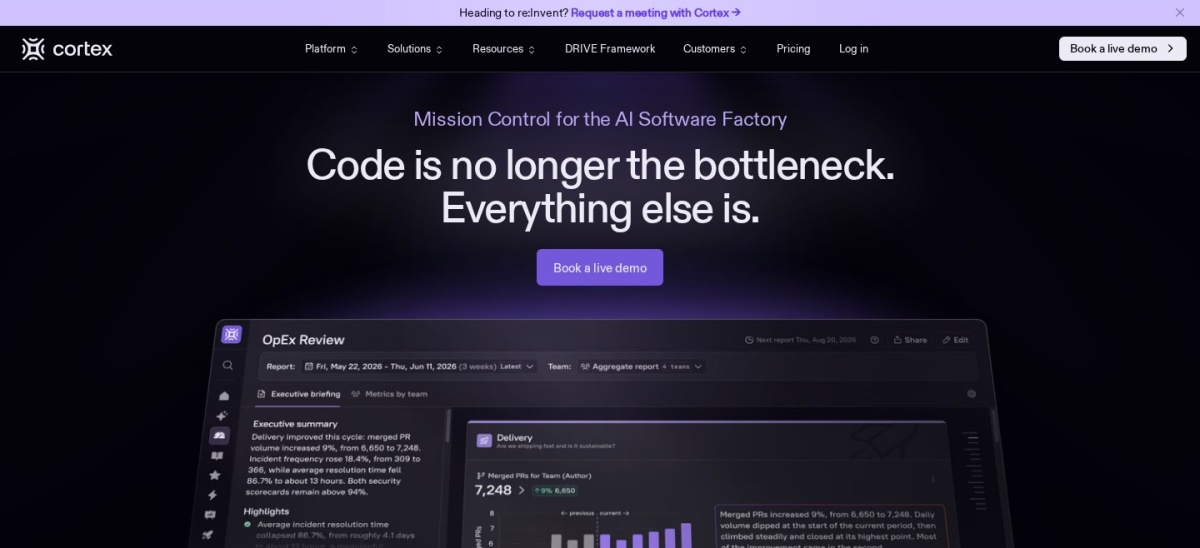
Cortex homepage, captured Nov 2026.
Cortex is an engineering operations platform built around a service catalog, scorecards and self-service workflows. It connects to more than 50 tools, including GitHub, Jira, PagerDuty and Datadog, and maps ownership and dependencies across services automatically. Scorecards use CQL to check production readiness, and the Developer Homepage surfaces each engineer's open work in one place.
The trade off is price opacity. Cortex publishes no numeric price and sells custom per-seat quotes, so small teams cannot budget it from the site, and a dedicated owner is still needed to run the scorecard program. It suits larger teams whose main goal is enforcing engineering standards.
What we like
50+ native integrations across the toolchain
Scorecards with CQL for production readiness
Developer Homepage for each engineer's open work
SOC 2 Type II and ISO 27001 certified
Watch out for
No published price and no free plan
Proprietary data model, hard to migrate away from
Needs a dedicated owner for scorecards
Paid plans add scorecards, initiatives and engineering intelligence by quoteVisit cortex.io
03
OpsLevel
4.3/5on G2 (10 reviews, checked Nov 2026)
PricingCustom/yr
Best for ownership maps and service maturity
Free planNo, demo only
Standard planUp to 50 users
ScorecardsYes, checks and rubrics
Self-serviceYes, actions
opslevel.com
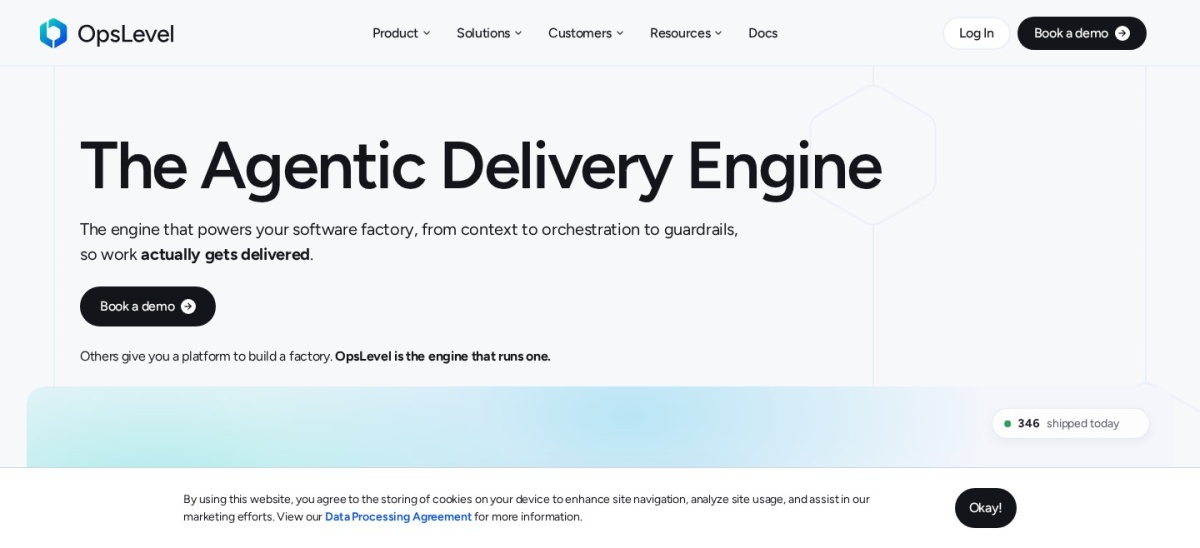
OpsLevel homepage, captured Nov 2026.
OpsLevel is an internal developer portal focused on service ownership, standards and scorecards. It catalogs services and repos, runs checks against each service, and lets developers trigger self-service actions instead of filing tickets. Campaigns chase owners in Slack until every failing service meets the standard.
The trade off is price and scale. OpsLevel publishes no numeric price, sells Standard for up to 50 users and Enterprise for unlimited users by quote, and offers a demo rather than a free trial. It suits teams that mostly need a trustworthy ownership map and maturity scores in a hurry.
What we like
Auto-detects components from your repositories
Campaigns drive standards to zero failing services
Unlimited cataloged components on Standard
Reviewers praise responsive support and onboarding
Watch out for
No published price and no free plan or trial
Standard plan caps at 50 users
Only 10 G2 reviews, the smallest base here
Enterprise adds unlimited users, custom integrations and on-premises optionsVisit opslevel.com
04
Cycloid
4.9/5on G2 (32 reviews, checked Nov 2026)
Paid from$45/user/mo
Best for published per-user pricing
Free planUp to 5 users
Paid planAdvanced, $45/user/mo
IaCTerraform, OpenTofu, Helm
DeploymentSaaS or self-hosted
cycloid.io
Cycloid homepage, captured Nov 2026.
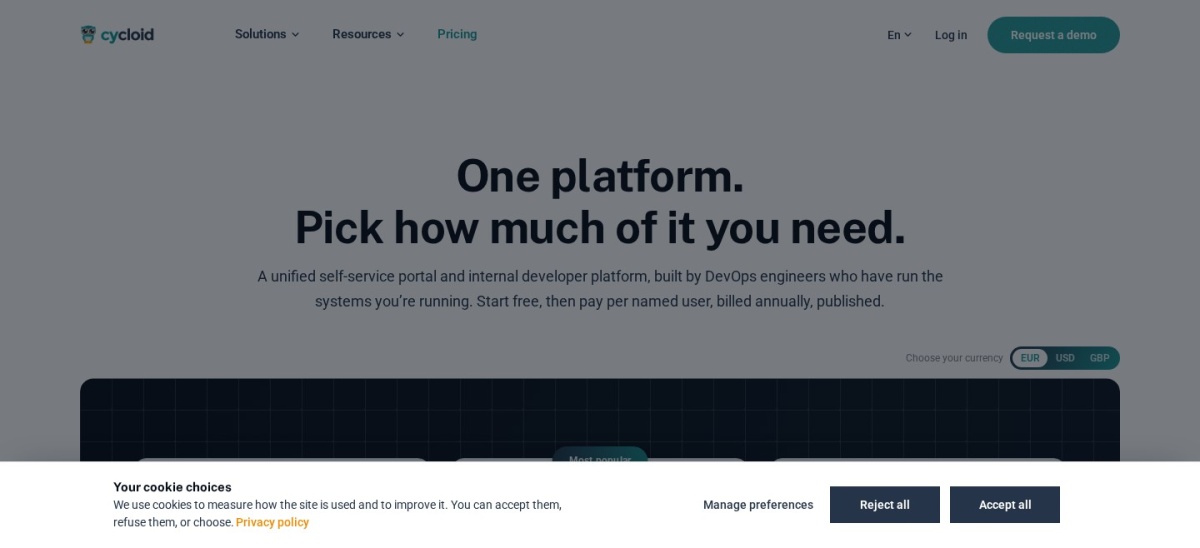
Cycloid is a self-service portal and internal developer platform built around blueprints, environments and scorecards. Blueprints package Terraform, OpenTofu, Ansible and Helm into golden paths, and developers provision through governed forms instead of tickets. The free plan covers up to 5 users, and the platform runs as SaaS or self-hosted.
The trade off is per-user cost. Advanced costs $45 per user a month billed yearly, so a 20-user team pays $900 a month, and Enterprise is custom. It suits platform teams that want published pricing and a portal that also provisions infrastructure.
What we like
Highest rating here at 4.9/5 from 32 G2 reviews
Free plan for up to 5 users
Published per-user pricing, no sales call needed
SaaS, self-hosted or air-gapped deployment
Watch out for
Per-user pricing adds up as teams grow
Enterprise plan is custom priced
Cost and carbon modules need the Advanced tier
Advanced adds unlimited workspaces, scorecards and an AI assistantVisit cycloid.io
05
Qovery
4.7/5on G2 (70 reviews, checked Nov 2026)
Paid from$299/mo
Best for deploying into your own cloud
Free plan3 users, 1 cluster
Paid planStarter, $299/mo
Preview envsYes, per pull request
CloudsAWS, GCP, Azure, Scaleway
qovery.com
Qovery homepage, captured Nov 2026.
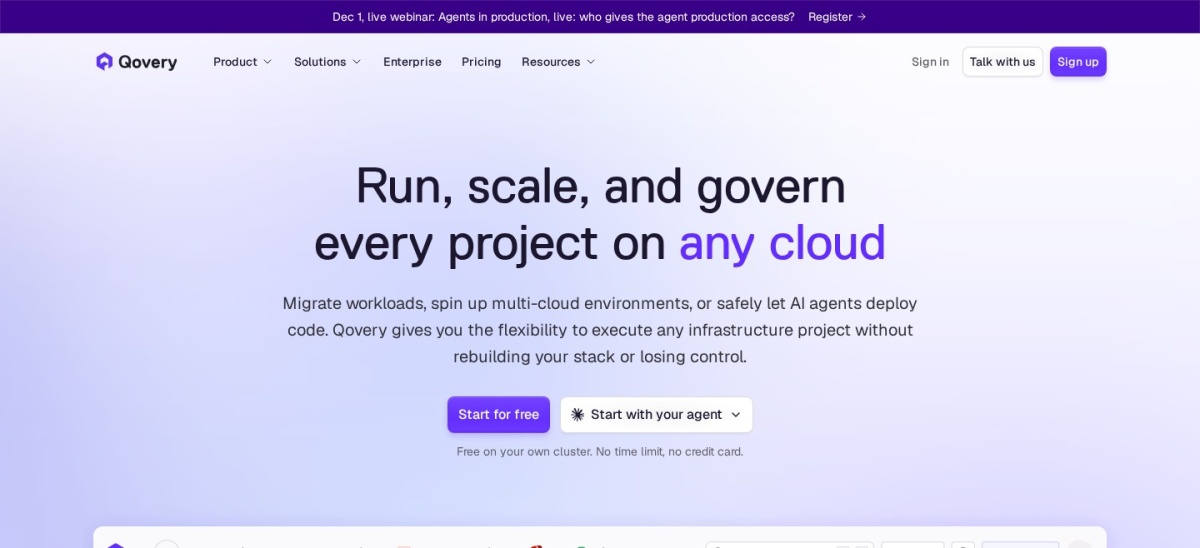
Qovery is a control plane that deploys applications into your own AWS, GCP, Azure or Scaleway account, or a Kubernetes cluster you already run. It gives developers preview environments per pull request, pipelines and a service catalog without handing them cloud consoles. The free plan covers 3 users, 1 cluster and 1,000 deployment minutes a month.
The trade off is price and scope. Paid plans start at $299 a month billed yearly for 3 users and one managed cluster, and Qovery is a delivery tool first, with a thinner catalog than Port or Cortex. It suits teams whose real gap is shipping code, not finding services.
What we like
Apps run in your own cloud account
Preview environments for every pull request
Free plan with no credit card and no time limit
Highest delivery-tool rating here at 4.7/5
Watch out for
$299 a month entry is steep for a small team
Not a catalog-first portal like Port or Cortex
Your cloud bill stays separate from the plan
Starter adds a Qovery-managed cluster and a shared Slack channelVisit qovery.com
06
Encore
4.6/5on G2 (33 reviews, checked Nov 2026)
Paid from$49/member/mo
Best for code-first backend teams
Free planStarter, local dev
Paid planPro, $49/member/mo
LanguagesTypeScript, Go
Preview envsYes, per pull request
encore.dev
Encore homepage, captured Nov 2026.
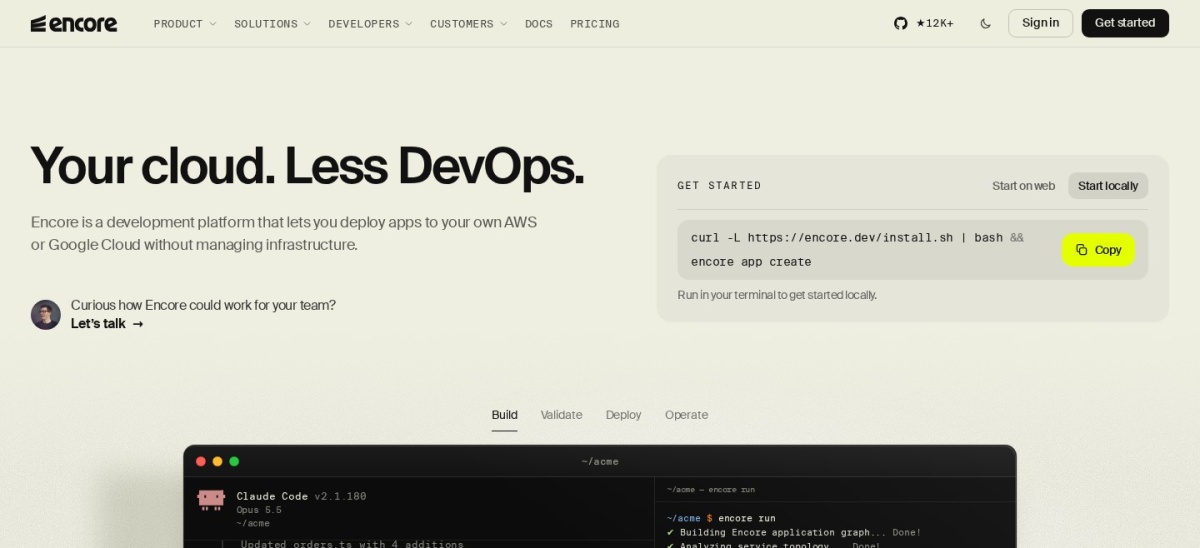
Encore is a code-first backend platform for TypeScript and Go that provisions infrastructure from code instead of Terraform files. Developers declare services, databases and cron jobs in code, and Encore deploys them to your own AWS or GCP account with tracing, metrics and preview environments per pull request. The Starter plan is free for local development.
The trade off is metered billing. Pro costs $49 per member a month plus $99 per cloud environment and $2.50 per resource in each environment, so the bill grows with every environment you run. It suits backend teams that would rather write code than maintain a portal.
What we like
Free Starter plan for local development
No Terraform or YAML to write
Deploys to your own AWS or GCP account
Preview environments per pull request
Watch out for
Environment and resource fees stack on top of seats
TypeScript and Go only for the full feature set
Cloud-provider charges are billed separately
Pro adds cloud deploys, preview environments and 20M tracing events a monthVisit encore.dev
07
Harness
4.6/5on G2 (335 reviews, checked Nov 2026)
PricingCustom/yr
Best for a portal inside a wider DevOps platform
Free planYes, free tier
Paid planCustom, Essentials or Enterprise
PortalIDP module, Backstage-compatible
Other modulesCI, CD, IaC, security
harness.io
Harness homepage, captured Nov 2026.
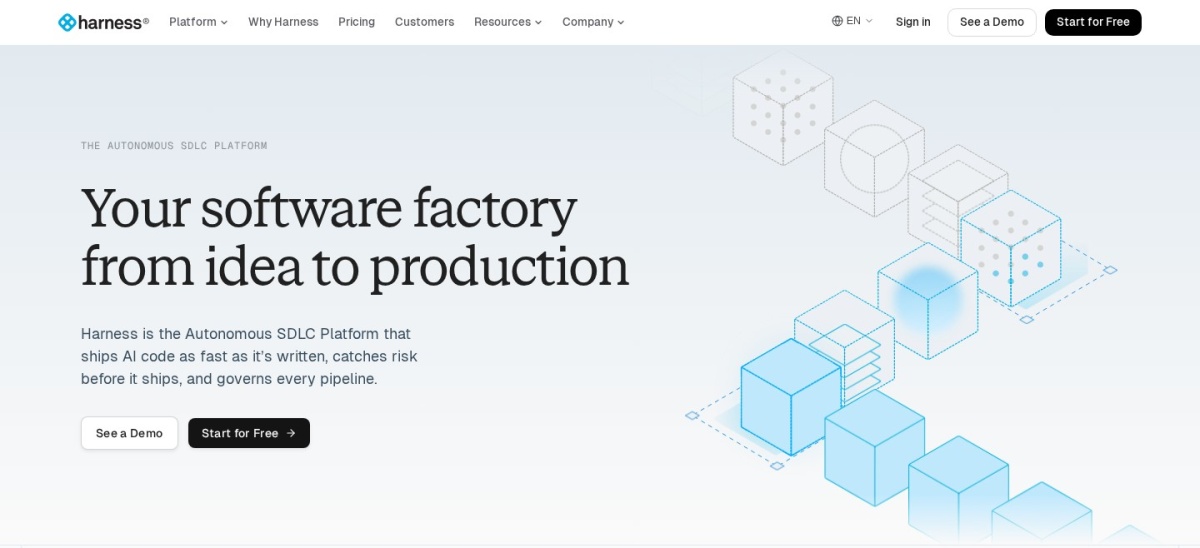
Harness is a wide DevOps platform with an internal developer portal as one module. The portal gives developers a service catalog, software templates and self-service workflows beside CI, CD and infrastructure-as-code tools, and there is a free tier for small teams. Its portal is Backstage-compatible, so existing Backstage templates carry over.
The trade off is size and price opacity. Harness publishes no numeric price for the portal or its Essentials and Enterprise plans, so costs come from a quote, and the platform is large for teams that only need a portal. It suits enterprises standardising delivery across many teams.
What we like
Most reviews here, 335 on G2 at 4.6/5
Free tier with an open-source core
Portal plus CI, CD and IaC in one platform
Backstage-compatible portal templates
Watch out for
No published price for any paid plan
Large platform for portal-only needs
Portal module needs a minimum of 20 developer licences
Essentials and Enterprise add modules, support and history by quoteVisit harness.io
08
Massdriver
4.9/5on G2 (7 reviews, checked Nov 2026)
Starts at$999/mo
Best for Terraform-based self-service
Free planNo, free trial
Paid planBusiness, $999/mo
Seats15 seats on Business
IaCTerraform, OpenTofu, Helm
massdriver.cloud
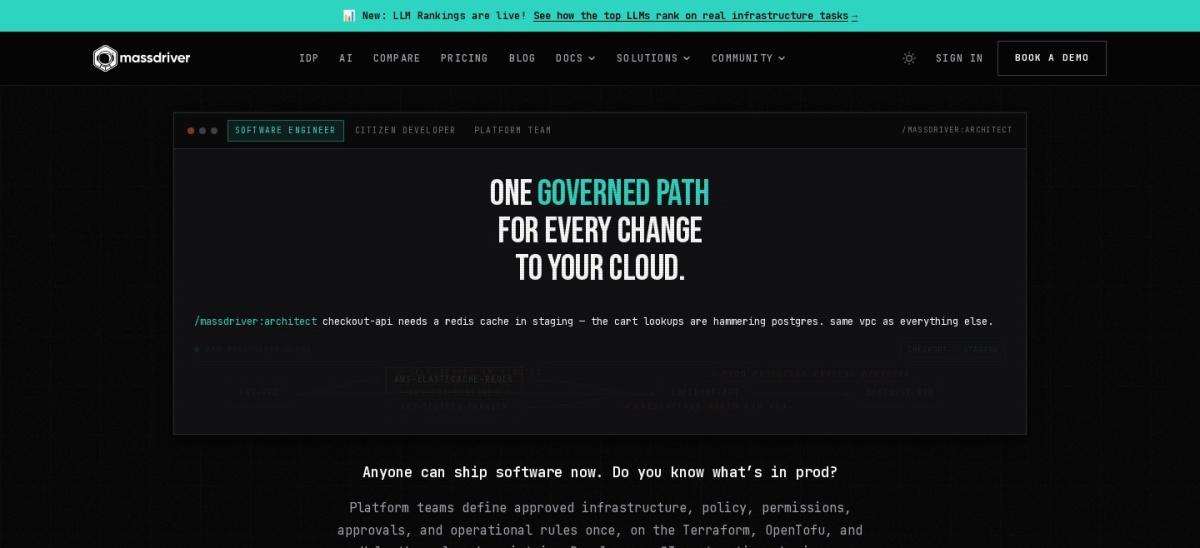
Massdriver homepage, captured Nov 2026.
Massdriver is an internal developer platform and orchestrator that turns Terraform, OpenTofu and Helm modules into a self-service catalog. Developers provision approved infrastructure from the catalog, with policy checks before every deploy, and a live diagram shows how components connect. Bundles are open source, so the catalog stays portable.
The trade off is the entry price. The Business plan costs $999 a month billed yearly for 15 seats, and there is no free plan, only a free trial, so small teams pay a lot for a catalog. It suits platform teams that already standardise on Terraform or OpenTofu.
What we like
Rated 4.9/5 on G2
Open-source bundles keep the catalog portable
Policy checks run before every deploy
Live diagrams show how components connect
Watch out for
$999 a month entry, the steepest here
No free plan, only a free trial
Only 7 G2 reviews so far
Business adds 15 seats, private Slack support and price breaks after 60 seatsVisit massdriver.cloud
What about managed Backstage?
Roadie, Spotify Portal for Backstage and Red Hat Developer Hub keep Backstage itself and take the hosting off your plate. They are the right answer when a team has custom Backstage plugins it cannot rewrite.
None of the three made this list because none has a public numeric rating on G2, Capterra or Trustpilot. Roadie's Teams plan lists at $24 per developer a month, while Spotify Portal and Red Hat Developer Hub are quote-only.
Atlassian Compass is also missing for the same reason: the G2 rating that circulates for Compass belongs to a different product, Acuvate Compass, not Atlassian's. Compass is also being wound down, with Atlassian ending support on 31 December 2027 and moving customers to DX, so a new rollout makes no sense in 2026.
How we chose
We started from the G2 internal developer portals category and the Backstage-alternative roundups, and kept tools with a public G2 rating, a live homepage and a pricing page we could open on 29 November 2026.
Prices come from each vendor's own pricing page and ratings and review counts from G2, both checked on 29 November 2026. Where a vendor publishes no price, the list says so instead of estimating one.
Roadie, Spotify Portal for Backstage, Red Hat Developer Hub, Humanitec and Atlassian Compass were left out because none has a public numeric rating on G2, Capterra or Trustpilot. No vendor paid for a place, and we do not claim hands-on testing for this list.
How to choose a Spotify Backstage alternative
Start from the pain that made you look, then match the tool to it.
Name the gap first. If developers cannot find services or owners, pick a catalog-first portal like Port, Cortex or OpsLevel. If they cannot get environments, pick a platform that provisions, like Qovery, Encore or Cycloid.
Count the seats before the features. Most tools charge per seat or per user, so a 50-developer team pays very differently from a 5-developer team. Port at $30 a seat and Cycloid at $45 a user are the only published per-seat prices here.
Try the free plan on real services. Five of the eight tools have a free plan. Load your actual repos and services, not demo data, and check whether the catalog stays current without manual work.
Check the exit before you sign. Portals with proprietary data models are hard to leave, and Compass is being wound down entirely. Ask each vendor how you export your catalog, scorecards and templates.
FAQ
What is the best Spotify Backstage alternative in 2026?
Port is the best Spotify Backstage alternative for most teams. It replaces Backstage's catalog, scorecards and self-service actions with a managed product, free for up to 5 seats, with Basic at $30 per seat a month and a 4.4/5 G2 rating from 41 reviews.
How much does a Spotify Backstage alternative cost?
Paid plans run from $30 per seat a month for Port to $999 a month for Massdriver's Business plan. Cortex, OpsLevel and Harness publish no price and sell custom quotes, so budget those three by sales call.
Is there a free Spotify Backstage alternative?
Yes. Port, Cycloid, Qovery, Encore and Harness all have free plans, and Backstage itself is free open source for teams with engineers to run it. Massdriver has only a free trial, and Cortex and OpsLevel have no free plan.
What is the best Spotify Backstage alternative for a small team?
Port is the best pick for a small team: the free plan covers 5 seats with the full platform, and Basic costs $30 per seat a month when you outgrow it. Cycloid's free plan for up to 5 users is the other cheap start.
Port vs Cortex: which is better?
Port is better for most teams because it has a flexible catalog, a free plan and published pricing from $30 per seat a month. Cortex is better when scorecard-driven engineering standards are the main goal, but it has no free plan and no published price.
Is Atlassian Compass a good Spotify Backstage alternative?
No, not for a new rollout. Compass is the cheapest paid plan at $7.67 per user a month, but Atlassian is ending support on 31 December 2027 and moving customers to DX, and its scaffolding and templates were deprecated on 1 December 2025.
Do any Spotify Backstage alternatives deploy code too?
Yes. Qovery deploys into your own AWS, GCP, Azure or Scaleway account, Encore deploys backends to your own AWS or GCP, Cycloid provisions through Terraform blueprints, and Massdriver deploys from a Terraform catalog. Port, Cortex and OpsLevel are catalog-first and do not deploy.
What about managed Backstage from Roadie or Spotify?
Roadie and Spotify Portal for Backstage keep Backstage itself and take the hosting off your plate, which suits teams with custom plugins they cannot rewrite. Neither has a public numeric rating on G2, Capterra or Trustpilot, so neither made this list.
SaaS SEO and WordPress specialist with about 8 years of experience. Rakib compares WordPress plugins, themes, hosting and software using public pricing, documentation and user reviews. See how we rank.