Databricks is the best Palantir alternative for most teams, a unified data and AI platform rated 4.6 out of 5 on G2 from 1,360 reviews with pay-as-you-go pricing. Snowflake suits teams that want a cloud warehouse, while Power BI is the cheapest strong pick at $14 per user a month.
How we make this list: we compare pricing pages, product documentation and public user reviews, then re-check every price before each update. No product paid for a place. Disclosure.
Databricks is the closest Palantir match: one platform for data engineering, analytics and AI, rated 4.6/5 from 1,360 G2 reviews.
Snowflake is the simpler warehouse pick at 4.6/5 from 783 reviews, with separate scaling of storage and compute.
Power BI is the cheapest strong option: Pro costs $14 per user a month and it holds 4.5/5 from 1,658 reviews.
Only Power BI, Databricks and Dataiku offer a free way in; the rest start with a trial or a sales quote.
Published prices run from $14 a seat to $300 a month for Qlik, while Databricks, Snowflake, Alteryx, Dataiku and Domo are usage-based or quoted.
What should you look for in Palantir alternatives?
Palantir is bought as one platform, so the replacement has to cover more than dashboards. Look for a tool that joins data engineering, analytics and AI in one place, or be ready to buy two tools.
Pricing is the biggest surprise. Palantir is quoted per deal, and most alternatives are too: Databricks and Snowflake bill by usage, while Power BI and Tableau publish per-seat prices from $14 and $75 a month.
Governance decides whether the switch sticks. Palantir buyers rely on fine-grained access control and audit trails, so check Unity Catalog in Databricks, roles in Snowflake and row-level security in Power BI before you commit.
Start with the team that will use it daily. A warehouse-first pick suits data teams, while a BI-first pick such as Power BI or Tableau reaches business users faster, as our guide on embedding a Tableau dashboard in WordPress shows.
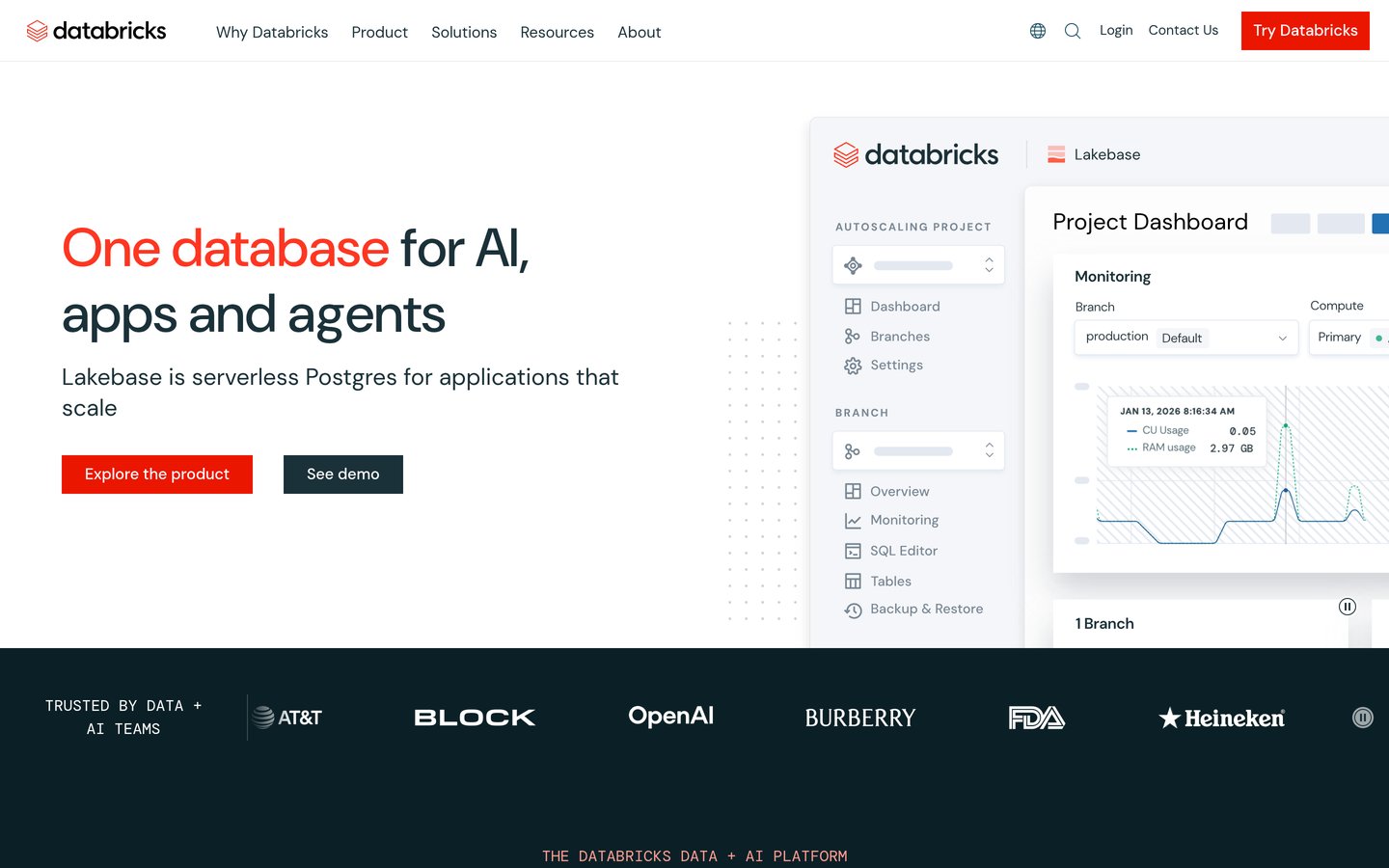
Databricks is a unified data and AI platform that runs data engineering, analytics and machine learning on one lakehouse, with Apache Spark at its core. The pay-as-you-go model has no up-front cost, a free trial is included, and Unity Catalog adds governance, lineage and access control across all data.
The trade off is cost control. Usage-based billing means a badly sized cluster can run up a large bill, and reviewers repeatedly warn that spending needs close monitoring. It suits data and engineering teams that want one platform for pipelines, SQL analytics and AI models.
Snowflake is a cloud data warehouse that separates storage from compute, so teams can scale each side on its own. It stores structured and semi-structured data, shares governed data sets without copying them, and now adds AI features such as Cortex and Streamlit apps.
The trade off is the same usage meter as Databricks. Credits are consumed per second of compute, and reviewers warn that costs can spike if warehouses are left running. It suits teams that want fast SQL analytics without managing infrastructure.
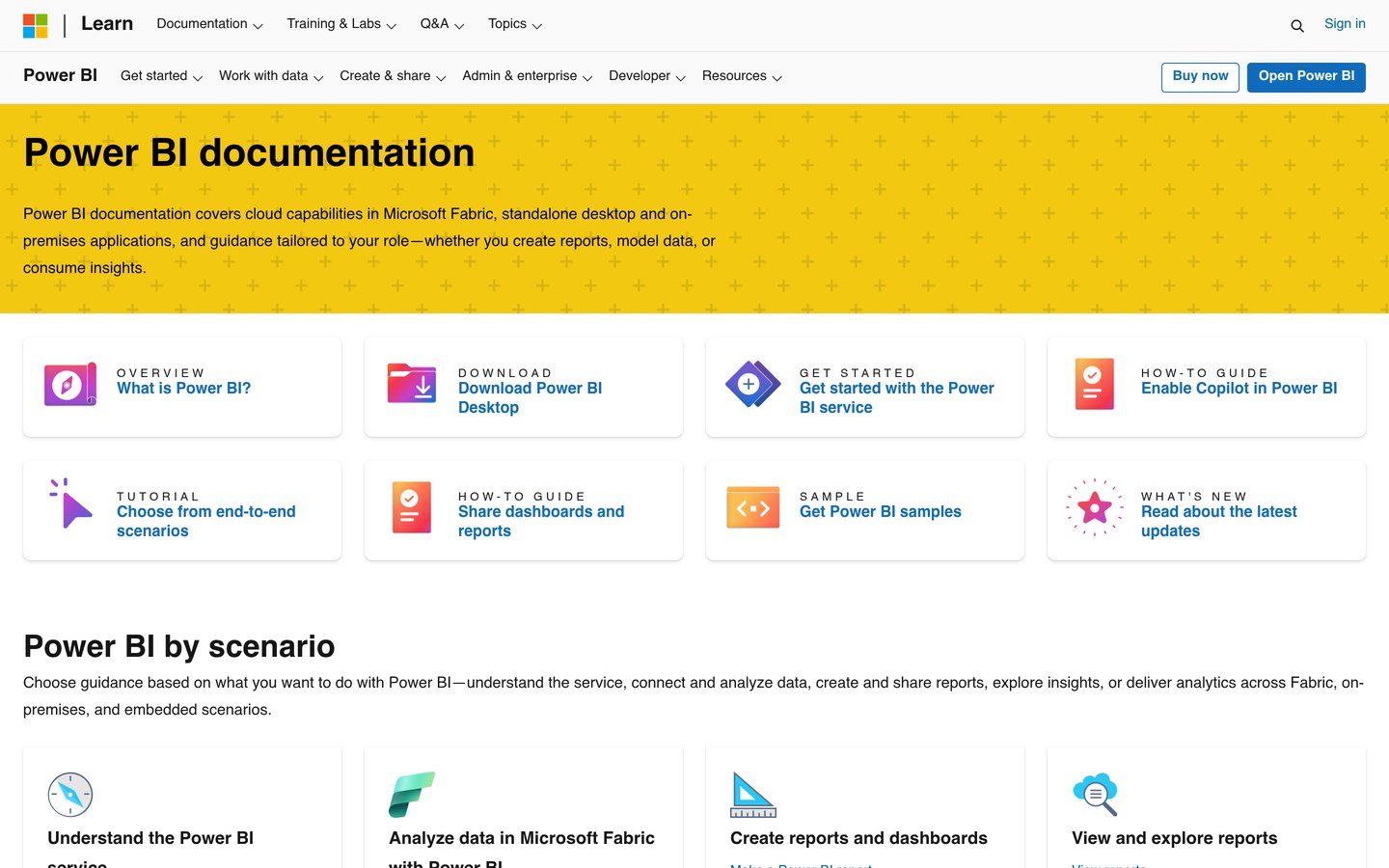
Microsoft Power BI is a self-service business intelligence platform for building and sharing dashboards, and it is the cheapest strong pick in this list. The free account lets you build reports in Power BI Desktop, while Pro at $14 per user a month paid yearly adds publishing, sharing and collaboration.
The trade off is viewer licensing. Everyone who opens a shared report needs a Pro licence, unless the reports sit on Fabric capacity, so the bill grows with every reader. It suits teams already on Microsoft 365 who want low per-seat costs and strong Excel links.
What we like
Lowest per-seat price in this list at $14 a month
Free Desktop for building reports before paying
Strong Excel and Microsoft 365 integration
Rated 4.5/5 from 1,658 G2 reviews
Watch out for
Every viewer of shared reports needs a paid licence
Alteryx is an analytics automation platform that cleans, blends and prepares data through drag-and-drop workflows, without writing code. Designer covers tools for joining, spatial analysis and predictive modelling, and Server schedules those workflows for whole teams.
The trade off is price. Alteryx publishes no prices, and third-party estimates put Designer at about $5,195 per user a year, so small teams should get a quote first. It suits analysts who spend most of their week preparing data rather than building dashboards.
What we like
Fastest data prep in this list, per G2 reviewers
No code needed for most workflows
Rated 4.6/5 from 968 G2 reviews
Strong community and learning resources
Watch out for
No published prices; Designer runs about $5,195 a year
Tableau is a visual analytics platform from Salesforce for exploring data with drag-and-drop charts, maps and dashboards. Creator seats cost $75 a user a month, with Explorer at $42 and Viewer at $15, and it is rated 4.4 out of 5 on G2 from 4,237 reviews.
The trade off is the licence stack. Every deployment needs at least one Creator seat, so a small team pays $900 a year before anyone else can build. It suits analyst-led teams that need the deepest visual exploration and can fund the Creator seats.
What we like
Deepest visual analytics in this list
Huge community and learning resources
Rated 4.4/5 from 4,237 G2 reviews
Strong maps and dashboard interactivity
Watch out for
Creator seats cost $75 a user a month
No free plan beyond Tableau Public
Can be slow on very large data sets
Explorer at $42 and Viewer at $15 cover the rest of the teamVisit tableau.com
06
ThoughtSpot
4.4/5on G2 (340 reviews, checked Nov 2026)
Starts at$25/mo
Best for AI search analytics
Entry planEssentials, $25/user/mo
AI agentSpotter, on Pro
Data limit25M rows, Essentials
Free trialYes, 14 days
thoughtspot.com
ThoughtSpot homepage, captured Nov 2026.
ThoughtSpot is a search-driven analytics platform built around Spotter, its AI agent that answers plain-English questions over cloud warehouse data. Essentials costs $25 per user a month billed annually, covers 5 to 50 users and up to 25 million rows, and includes dashboards and search.
The trade off is that ThoughtSpot stores no data itself, so you also pay for a separate warehouse such as Snowflake or Databricks. Pro rises to $50 per user a month for up to 1,000 users and 250 million rows. It suits business users who want answers without writing SQL.
Dataiku is a collaborative platform where data experts and business teams build analytics, machine learning and AI projects together in one place. The Free Edition covers up to 3 users, while paid plans add governed deployment, monitoring and connections to cloud warehouses.
The trade off is enterprise pricing. Dataiku publishes no fixed prices, third-party research puts Lite at $3,000 a month, and the full platform is quoted per deal. It suits regulated teams that need one governed home for AI work.
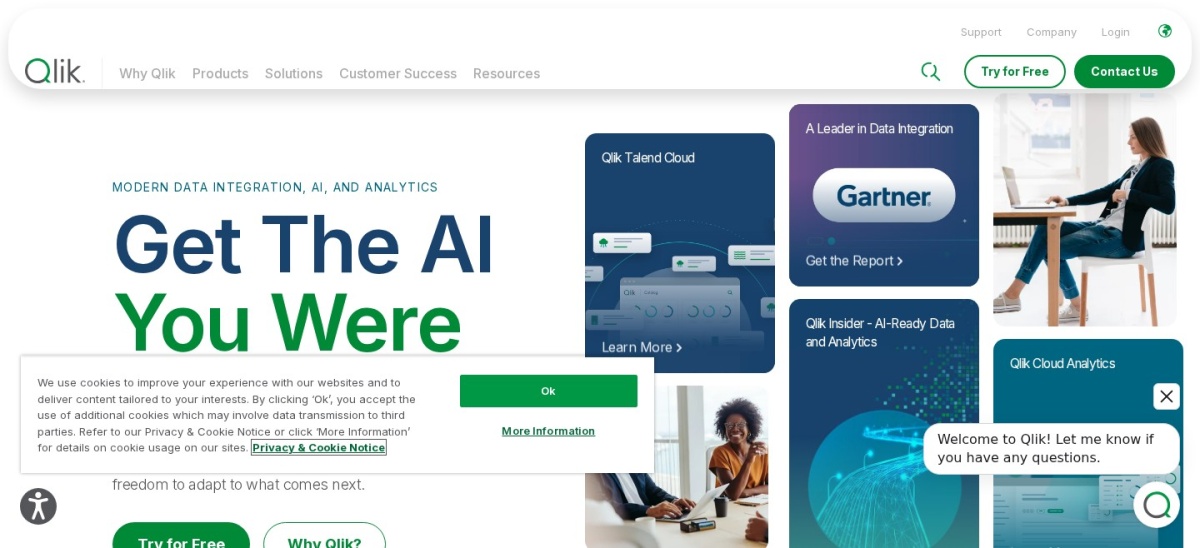
Qlik Sense is a cloud analytics platform sold as Qlik Cloud Analytics, with an associative engine that lets users explore data in any direction. Starter costs $300 a month billed annually for 10 users and 10 GB of data, and it is rated 4.4 out of 5 on G2 from 929 reviews.
The trade off is capacity pricing. Extra data costs more in 25 GB steps on Standard at $825 a month, so the bill grows with data volume rather than headcount. It suits mid-size teams that want many viewers on one fixed fee.
What we like
Associative engine for free-form exploration
Standard adds users at no extra cost
Rated 4.4/5 from 929 G2 reviews
Strong data integration and ETL
Watch out for
Starter data is capped at 10 GB and cannot grow
Standard jumps to $825 a month
No per-seat option for small teams
Standard at $825 a month adds 25 GB and unlimited usersVisit qlik.com
09
Domo
4.3/5on G2 (1,096 reviews, checked Nov 2026)
PricingCustom/yr
Best all-in-one cloud BI
PlatformAll-in-one cloud BI
PricingCredit-based, quoted
Free trialYes, 30 days
G2 rating4.3/5, 1,096 reviews
domo.com
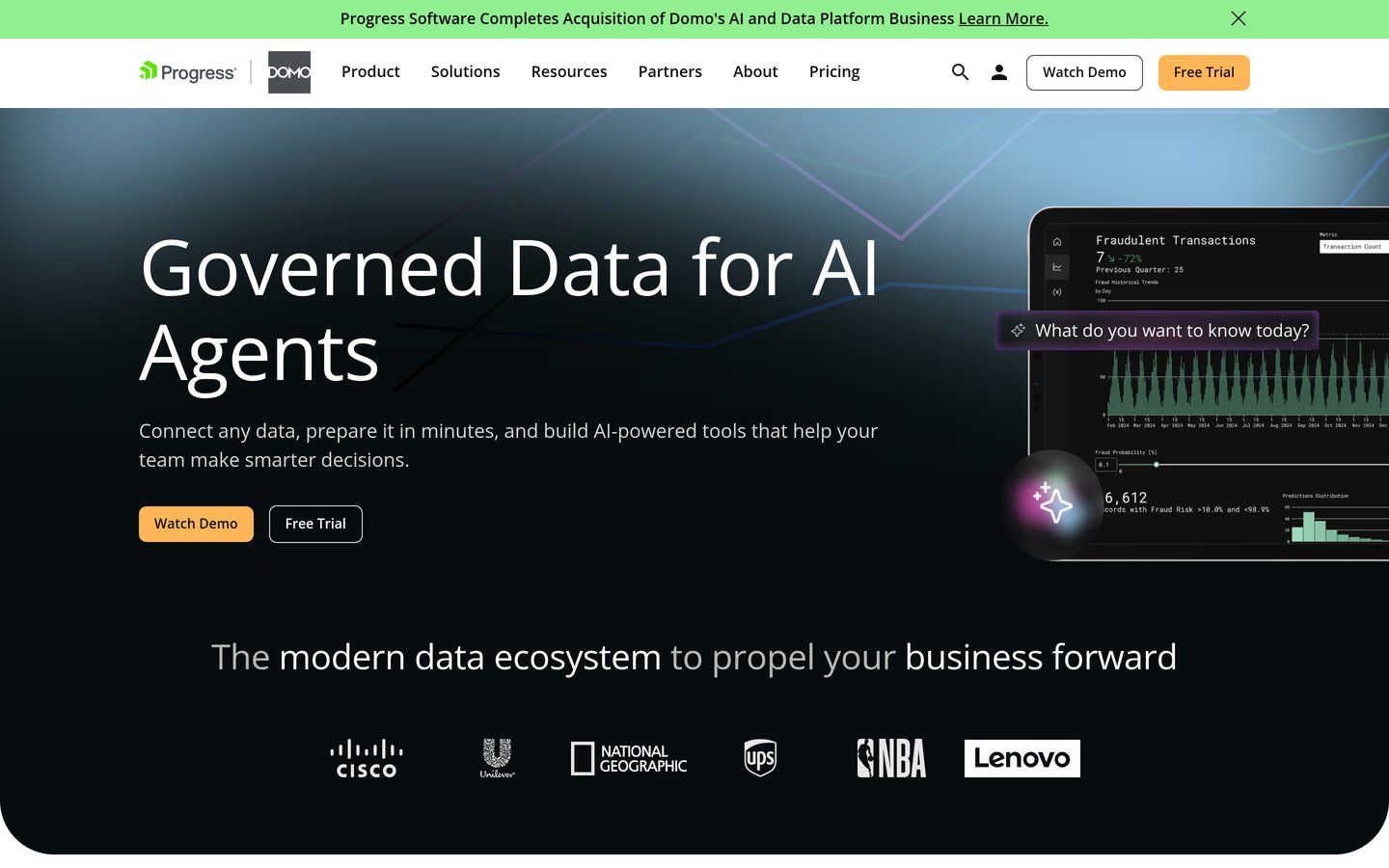
Domo homepage, captured Nov 2026.
Domo is an all-in-one cloud platform that combines data integration, ETL, dashboards and low-code apps in a single product. It connects to hundreds of data sources, and its mobile app puts the same dashboards in the hands of field teams.
The trade off is pricing and ownership. Domo publishes no prices, runs on consumption credits, and Progress Software agreed in July 2026 to buy most of its assets, so ask about the roadmap before signing. It suits large teams that want one vendor for the whole pipeline.
What we like
ETL, dashboards and apps in one product
Rated 4.3/5 from 1,096 G2 reviews
Strong mobile experience
30-day free trial to test it
Watch out for
No published prices; credits make costs hard to forecast
You trade one platform for a stack. Palantir bundles ingestion, modelling, apps and governance, while most alternatives cover two or three of those, so expect to pair a warehouse such as Snowflake with a BI tool such as Power BI.
You gain price transparency at the low end. Power BI, Tableau, ThoughtSpot and Qlik publish starting prices, while Palantir, Databricks and Domo are quoted or metered, so budget the whole stack before you commit.
You lose the operational apps layer. Palantir Foundry and Gotham ship workflow apps for frontline decisions, and only Domo and Dataiku come close with low-code apps, so check whether dashboards alone are enough.
Migration takes months, not weeks. G2 reviewers report about 4 months to implement Databricks and 5 months for Dataiku, so run the new platform beside Palantir until the first use case is live.
How we chose
We started from the platforms most often named as Palantir replacements in G2 comparisons and buyer guides, then kept the nine with a public G2 rating and a real product behind the name.
Prices and ratings were checked on 29 November 2026 against each vendor's pricing page and G2 product profile. Where a vendor shows a sale, the list shows the regular price; where a vendor publishes no price, the list says so instead of guessing.
We left out niche and single-purpose tools that cannot cover Palantir's breadth, and open-source projects without a supported edition. No vendor paid for a place, and we do not claim to have used these tools ourselves.
How to choose a Palantir alternative
Start with the job Palantir does for you today, then match the replacement to that job.
Name the Palantir job first. List the workflows, data sources and decisions Palantir covers, then check each alternative against that list instead of its feature page.
Pick the warehouse before the dashboards. Databricks and Snowflake store and process the data; Power BI, Tableau and ThoughtSpot sit on top. Decide where data lives first.
Price the whole stack, not one seat. Add warehouse usage, BI seats and any AI add-on together, and ask for renewal terms in writing where pricing is quoted.
Run a pilot on one real use case. Rebuild a single Palantir workflow on the shortlisted tool with your own data, and compare the time it takes against the current process.
FAQ
What is the best Palantir alternative in 2026?
Databricks is the best Palantir alternative for most teams. It is the closest match as a unified data and AI platform, rated 4.6 out of 5 on G2 from 1,360 reviews, with pay-as-you-go pricing and governance through Unity Catalog.
What is the cheapest Palantir alternative?
Microsoft Power BI is the cheapest strong Palantir alternative. Pro costs $14 per user a month billed yearly, it holds 4.5 out of 5 on G2 from 1,658 reviews, and the free Desktop app lets you build reports before paying.
Is there a free Palantir alternative?
There is no free tool that matches Palantir, but three picks offer a free way in. Power BI has a free Desktop account, Dataiku has a Free Edition for up to 3 users, and Databricks and Snowflake both offer free trials.
Which Palantir alternative is best for a small team?
Power BI is the best Palantir alternative for a small team. Pro costs $14 per user a month, it needs no warehouse of its own for small data sets, and most teams already know Excel, which shortens the learning curve.
Databricks vs Snowflake: which is the better Palantir alternative?
Databricks is better if you want one platform for pipelines, SQL and AI models, while Snowflake is better if you want a simpler warehouse with fast SQL and governed sharing. Both rate 4.6 out of 5 on G2, and both bill by usage.
Which Palantir alternative is best for dashboards?
Tableau is the best Palantir alternative for dashboards that need deep visual exploration, with Creator seats at $75 a user a month. Power BI is the better pick when budget matters, at $14 a seat with a free Desktop app.
SaaS SEO and WordPress specialist with about 8 years of experience. Rakib compares WordPress plugins, themes, hosting and software using public pricing, documentation and user reviews. See how we rank.