Zoho One leads our odoo alternatives list for most small businesses, with more than forty-five apps in one subscription from thirty-seven dollars an employee a month. ERPNext suits teams that want a free open-source ERP, while Microsoft Dynamics 365 Business Central is the best pick for Microsoft shops.
How we make this list: we compare pricing pages, product documentation and public user reviews, then re-check every price before each update. No product paid for a place. Disclosure.
Zoho One is the cheapest all-in-one at $37 an employee a month, with 45+ apps in one subscription.
ERPNext is the only free ERP here, with no licence fees for self-hosting, but it needs technical staff.
Microsoft raised Business Central Essentials from $70 to $80 a user a month in November 2025, so older guides quote $70.
NetSuite, Acumatica and Sage Intacct publish no price, so buyers need a quote before they can budget.
SAP Business One has conflicting price reports, with a partner listing citing $39 a user a month and others saying quote-only.
How do you choose the best Odoo alternatives?
Odoo is a popular open-source ERP, so its users expect a lot for a low price. The alternatives split into two groups: all-in-one suites like Zoho One and ERPNext, and enterprise ERPs like NetSuite and SAP S/4HANA Cloud.
Per-user pricing is the first filter. Zoho One costs $37 an employee a month, Business Central costs $80 a user, and SAP S/4HANA Cloud starts at $295 a user, so a ten-person team pays from $370 to $2,950 a month before add-ons.
Free and open source is a real option. ERPNext costs nothing to self-host, with the same modules as paid ERPs, but it needs a server and someone to maintain it. Our guide to ERP software compares the free options in more detail.
Quote-only pricing is common at this level. NetSuite, Acumatica, Sage Intacct and SAP Business One publish no price, so the figures in this list for NetSuite and SAP Business One are partner estimates, not vendor list prices.
Implementation is the hidden cost. NetSuite and SAP S/4HANA Cloud take months to set up and need specialists, while Zoho One and ERPNext can run in weeks, so add the setup time to the price before you decide.
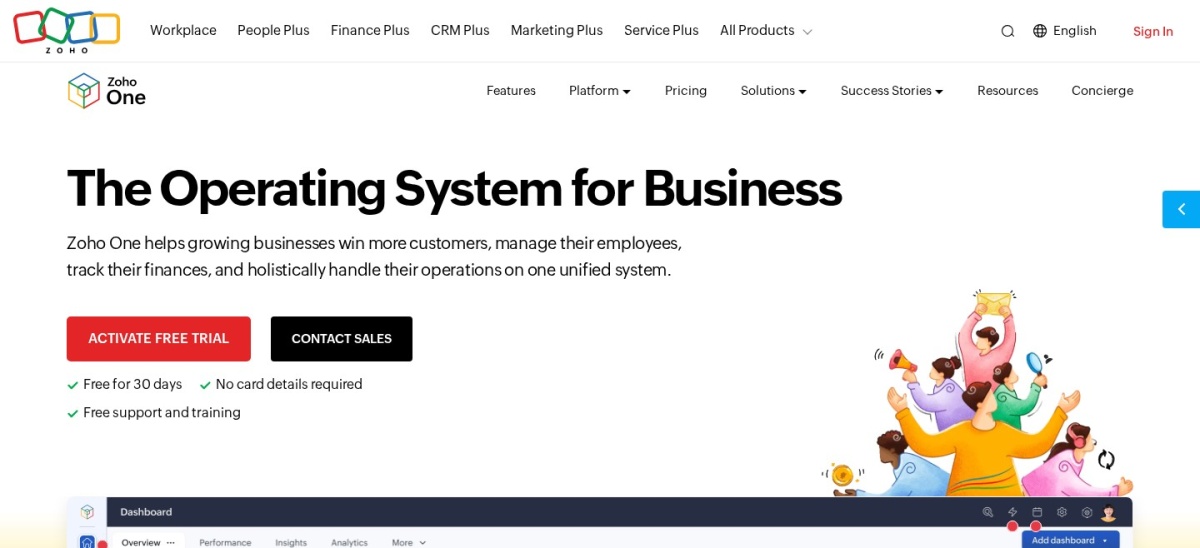
Zoho One is a subscription that bundles more than 45 Zoho apps, including CRM, Books, Desk, Projects, People and Campaigns, under one login and one price. Standard costs $37 an employee a month billed yearly, and every employee gets every app. It is the closest all-in-one match to Odoo in this list.
The trade off is depth per app. Each Zoho app is solid but lighter than a specialist, so finance teams that need deep accounting add Zoho Books separately or look at Sage Intacct. It suits small businesses that want one vendor, one bill and one login for everything.
What we like
45+ apps in one subscription
Lowest all-in-one price here
Rated 4.1 from 2,949 G2 reviews
Watch out for
Each app is lighter than a specialist
Deep accounting needs Zoho Books
Flexible User adds per-user pricing at $90 a monthVisit zoho.com
02
ERPNext
4.2/5on G2 (52 reviews, checked Nov 2026)
Paid from$300/mo
Best free open-source ERP
LicenceOpen source, free
ModulesAccounting to HR
Self-hostYes, $0
Paid planProfessional, $300/site/mo
erpnext.com
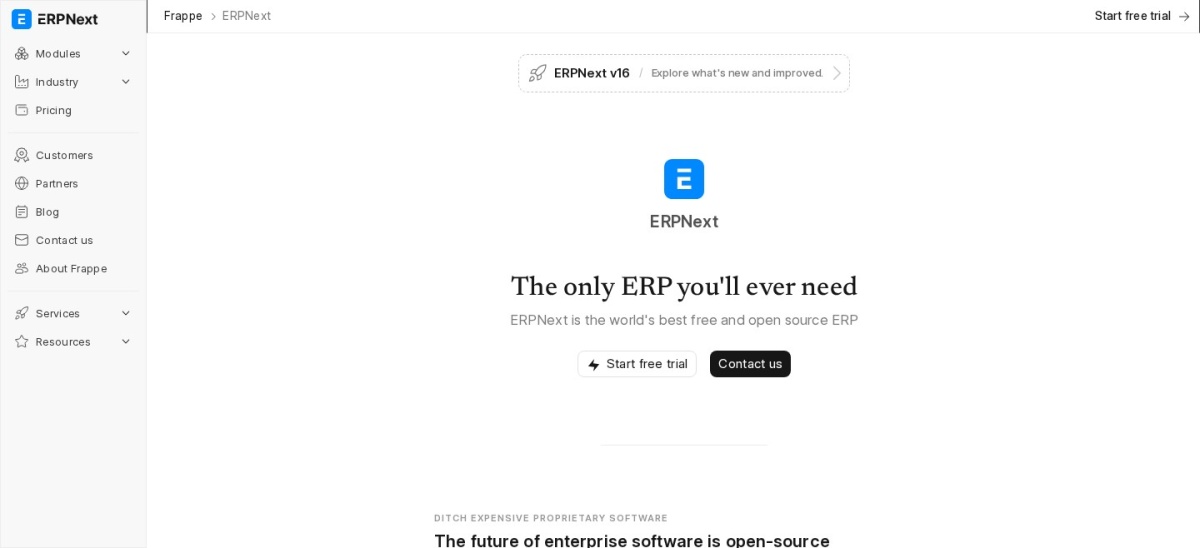
ERPNext homepage, captured Nov 2026.
ERPNext is a free open-source ERP built on the Frappe framework, with accounting, inventory, manufacturing, CRM, HR and project management in one system. The software itself costs nothing to self-host, and the paid Professional Services plan costs $300 a site a month. It is the only fully free ERP in this list.
The trade off is the work involved. Self-hosting needs a server and someone to maintain it, and the paid support and hosting options cost extra. It suits teams with technical staff who want full control and no licence fees, and can run the system themselves.
Dynamics 365 Business Central homepage, captured Nov 2026.
Dynamics 365 Business Central is Microsoft's ERP for small and mid-sized businesses, with finance, inventory, sales, purchasing and project management built in. Essentials costs $80 a user a month billed yearly and works inside Microsoft 365, Outlook and Teams. It is the natural ERP for companies already on Microsoft.
The trade off is the price rise. Microsoft raised Essentials from $70 to $80 a user a month on 1 November 2025, so older guides quote $70, and Premium costs $110. It suits Microsoft shops that want an ERP inside the tools their staff already use every day.
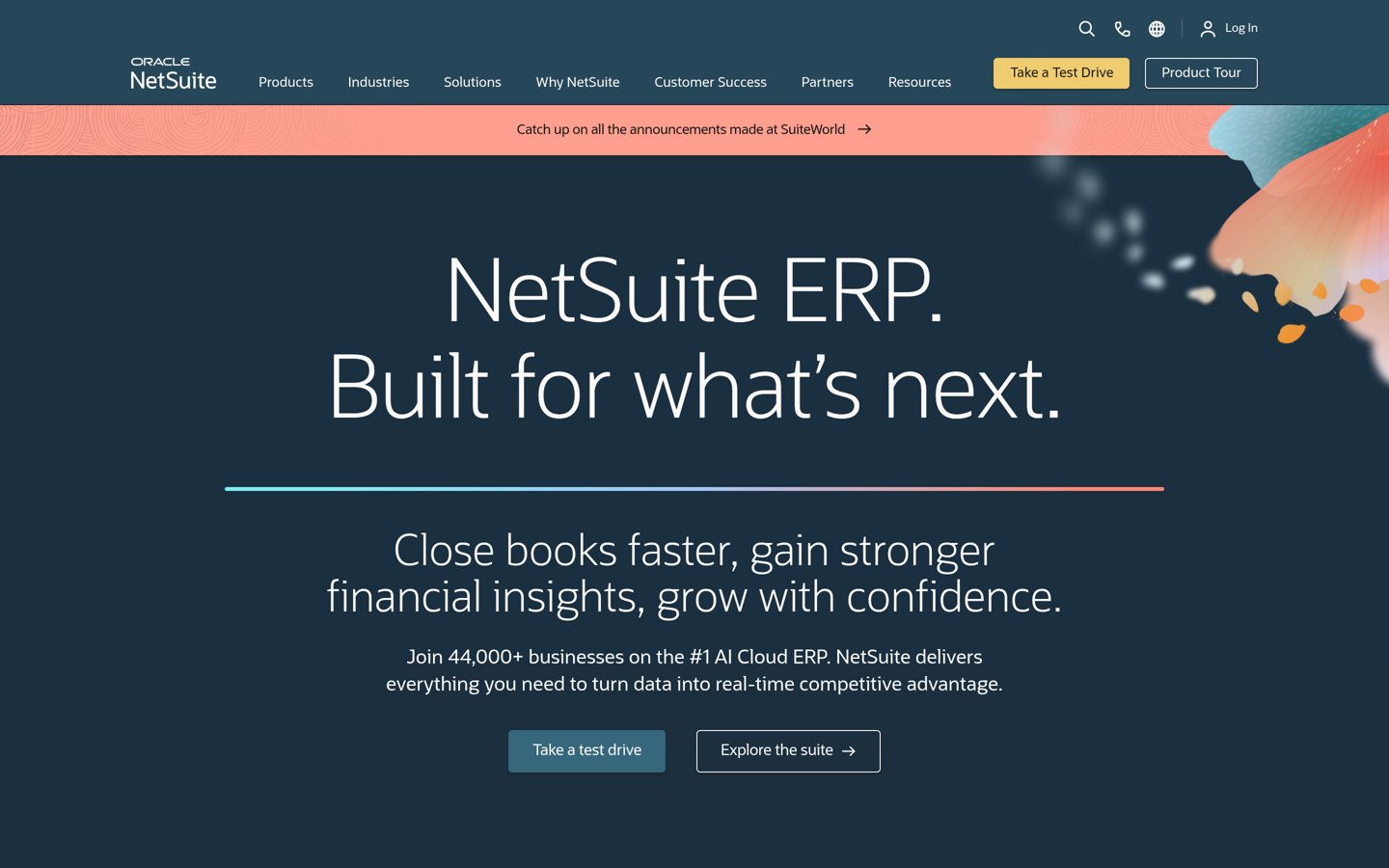
NetSuite is Oracle's cloud ERP for growing companies, with financial management, CRM, inventory, order management and e-commerce in one platform. Oracle publishes no price, so the entry point is a quote, and partner listings put the base fee near $999 a month plus $129 per full user. It is the most complete ERP in this list.
The trade off is cost and setup. Implementation takes months and costs extra, and the quote-only pricing means small teams cannot budget without a sales call. It suits companies outgrowing entry-level accounting that need one system for finance, stock and orders.
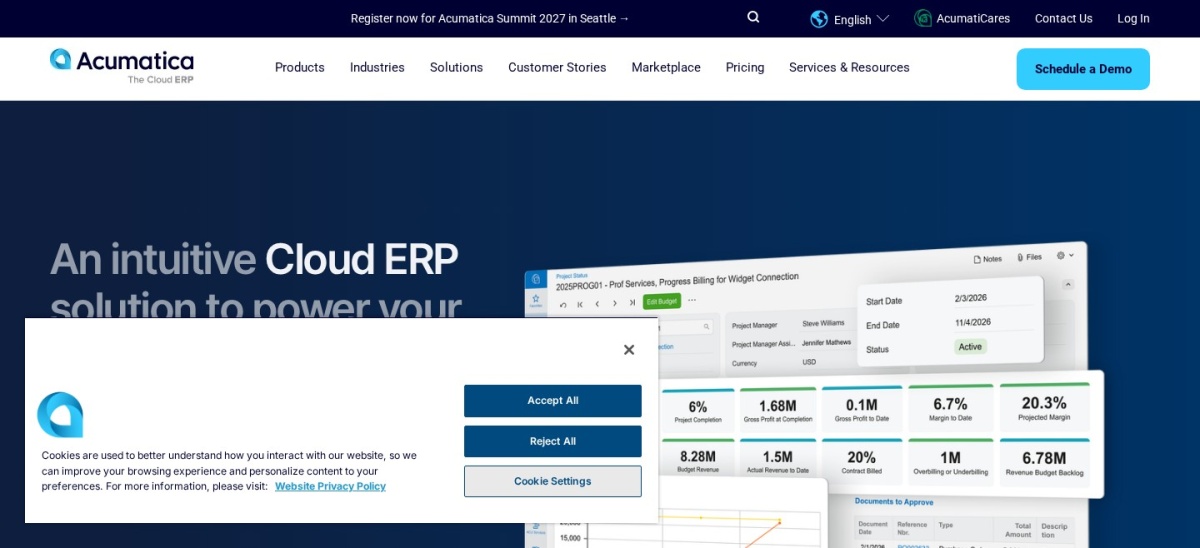
Acumatica is a cloud ERP that charges by the resources you use, not by the number of users, so every employee can log in without a licence fee. It covers finance, distribution, manufacturing, construction and CRM, with unlimited users on every plan. Pricing is custom and quoted per customer.
The trade off is the missing price. There is no published rate, so buyers need a quote and a resource estimate before they can compare it with per-user ERPs. It suits mid-sized companies with many occasional users who would pay too much per seat elsewhere.
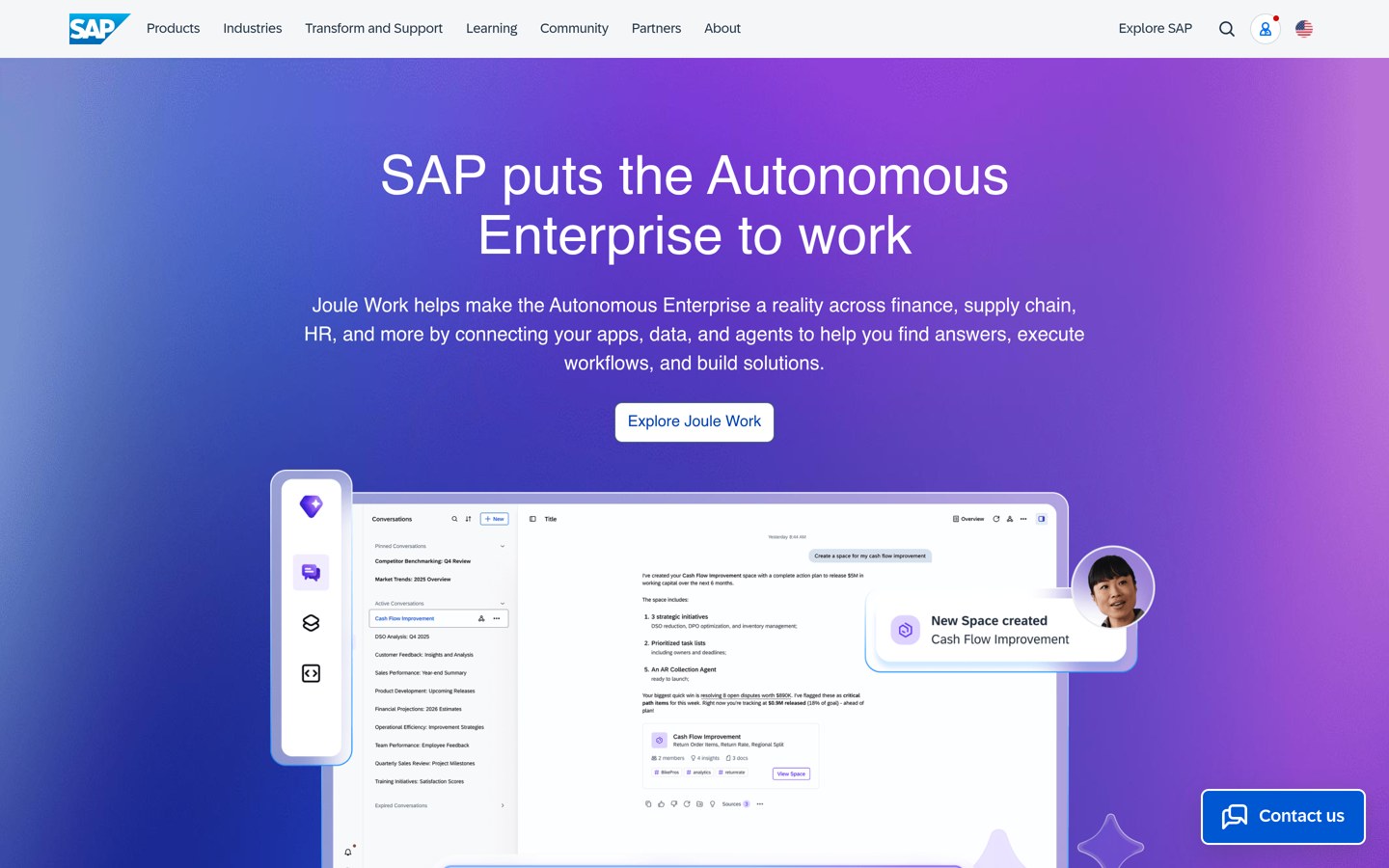
SAP S/4HANA Cloud is SAP's cloud ERP for large enterprises, with finance, procurement, manufacturing, sales and supply chain on one in-memory platform. Public pricing starts at $295 a user a month, and the system is built for companies with complex, multi-country operations. It is the most powerful ERP in this list.
The trade off is scale. It is built for enterprises, so small and mid-sized teams pay for capacity they will not use, and implementation needs SAP specialists. It suits large companies standardising on SAP across countries and business units.
What we like
Most powerful ERP in this list
Best for multi-country operations
Rated 4.4, the joint-highest here
Watch out for
Built for enterprises, not SMBs
Implementation needs SAP specialists
Public edition starts at $295 a user a monthVisit sap.com
07
Sage Intacct
4.3/5on G2 (4,433 reviews, checked Nov 2026)
PricingCustom/yr
Best for finance teams
FocusFinancial management
Multi-entityYes, built in
Free planNo
Paid planCustom quote
sage.com
Sage Intacct homepage, captured Nov 2026.
Sage Intacct is a cloud financial management system for mid-sized companies, with general ledger, accounts payable, budgeting, multi-entity consolidation and revenue recognition. Sage publishes no price, so buyers get a quote based on modules and users. It is the strongest finance-only pick in this list.
The trade off is scope. It is a finance system, not a full ERP, so inventory, manufacturing and CRM need other tools. It suits finance teams that want the best accounting core and can connect the rest around it.
SAP Business One is SAP's ERP for small businesses, with accounting, sales, purchasing, inventory and CRM in one system. It is sold through partners, and SAP publishes no US list price, so buyers get a quote. One partner listing cites a Cloud Starter plan at $39 a user a month, but other sources call it quote-only.
The trade off is the unclear price. A small business cannot budget from a published rate, and partner quotes vary by region and add-ons. It suits small manufacturers and distributors that want SAP branding and a full ERP at a smaller scale than S/4HANA.
Odoo, Zoho One and ERPNext are the three all-in-one picks in this list. Odoo is open source with paid apps, Zoho One is a $37 an employee subscription, and ERPNext is free to self-host.
Zoho One is the easiest switch, with one vendor, one bill and support included. ERPNext is the cheapest, with no licence fees at all, but it needs technical staff to run.
NetSuite, Business Central and SAP S/4HANA Cloud are the enterprise picks. They cost more per user, but they cover finance, inventory and operations at a scale the all-in-one tools do not.
How we chose
We started from the ERPs named most often as Odoo replacements in G2 comparisons and ERP roundups, then kept the eight with a public G2 rating, a published price or a clear quote-only model, and real ERP modules.
Prices come from each vendor's pricing page, checked on 29 November 2026, and show the cheapest paid plan at its regular price. Ratings and review counts come from G2 on the same day, and install figures come from the vendors or are marked as not published.
We left out tools with no verifiable rating and accounting-only tools that are not ERPs. No vendor paid for a place, and we do not claim hands-on testing for this list.
How to choose an Odoo alternative
Start with your team size and your accounting needs, then check the price model.
Count the users who need the ERP. Per-user pricing punishes large teams, while Acumatica charges by resources and Zoho One charges per employee for 45+ apps.
Check if you need full ERP or finance only. Sage Intacct is the best finance core, but it needs other tools for inventory and CRM, while NetSuite and Business Central cover both.
Ask for a quote early on quote-only tools. NetSuite, Acumatica, Sage Intacct and SAP Business One publish no price, so get the quote before you shortlist, not after.
Try the free or trial option first. ERPNext is free to self-host, Zoho One has a trial, and Business Central offers 30 days, so test with your own data before you commit.
FAQ
What is the best Odoo alternative in 2026?
Zoho One is the best pick for most small businesses, with 45+ apps in one subscription from $37 an employee a month. ERPNext suits teams that want a free open-source ERP, and Business Central is the best pick for Microsoft shops.
How much does Zoho One cost?
Zoho One Standard costs $37 an employee a month billed yearly, and every employee gets all 45+ apps. The Flexible User plan costs $90 a user a month for teams that want to pay only for some users.
Is ERPNext really free?
Yes. ERPNext is open-source software, so self-hosting costs nothing in licence fees. The paid Professional Services plan costs $300 a site a month, and managed hosting and support cost extra.
How much does NetSuite cost?
Oracle publishes no NetSuite price, so buyers get a quote. Partner listings put the base fee near $999 a month plus $129 per full user, but the real price depends on modules, users and the implementation scope.
Odoo vs Zoho One: which is better?
Zoho One is better for teams that want one subscription, one bill and 45+ apps from a single vendor. Odoo is better for teams that want open-source control and a community of modules, with ERPNext as the closest free alternative.
Which Odoo alternative is best for small business?
Zoho One is the best small business pick, with 45+ apps from $37 an employee a month. ERPNext is the best free pick for technical teams, and SAP Business One is the best pick for small manufacturers that want SAP.
SaaS SEO and WordPress specialist with about 8 years of experience. Rakib compares WordPress plugins, themes, hosting and software using public pricing, documentation and user reviews. See how we rank.