pnpm is a leading npm alternative for JavaScript teams because its content-addressable store avoids duplicating packages across projects on disk. For specific workflows, Yarn and Bun streamline installs and workspaces, while GitHub Packages, Cloudsmith, Sonatype Nexus Repository, and JFrog Artifactory cover private and enterprise registries.
How we make this list: we compare pricing pages, product documentation and public user reviews, then re-check every price before each update. No product paid for a place. Disclosure.
pnpm has 37,186 GitHub stars and uses a central content-addressable store so shared packages are not duplicated across projects on disk.
Bun holds 96,044 GitHub stars and bundles a JavaScript runtime, package manager, test runner, and bundler with no paid plan.
Yarn has 41,500 GitHub stars on its 1.x line alongside active Berry development, offering offline caching and workspace support.
GitHub Packages starts at $0 on GitHub Free with 500 MB storage and 1 GB monthly transfer, while GitHub Team starts at $4 per user/month ($48/year per user) with a 4.8 rating from 6,215 Capterra reviews.
Cloudsmith starts with a $0 Core plan (500 MB artifact data, 1 GB delivery) and a Pro plan at $149/month (5 GB artifact data, 25 GB delivery), with a 4.5 rating across 45 G2 reviews.
Sonatype Nexus Repository starts at $0 for Community Edition and $7,500/year for Pro Edition (4.5 rating from 23 G2 reviews), while JFrog Artifactory Pro lists at $150/month ($50/month promotional price shown) and scales to Enterprise X at $950/month (4.2 rating from 186 G2 reviews).
How do you choose among npm alternatives?
Package manager choices split between local dependency installers and managed or self-hosted registries. Open-source CLI tools like pnpm, Yarn, and Bun focus on install speed, disk layout, and workspace workflows, while registries like GitHub Packages, Cloudsmith, Sonatype Nexus Repository, and JFrog Artifactory focus on private hosting, access control, and supply-chain governance.
Disk layout and strictness separate modern installers from classic flat node_modules trees. Tools that link from a shared store save local storage across multiple repositories and catch undeclared dependencies earlier in development.
Private registry needs change the cost structure quickly. Local open-source tools cost nothing to run on developer machines, whereas hosted storage, bandwidth, and enterprise security scanning introduce recurring subscriptions or consumption tiers.
4.8/5on GitHub stars (37,186 reviews, checked Nov 2026)
PriceFree
Best for disk-efficient installs and monorepos
GitHub stars37,186
Store modelContent-addressable
WorkspacesBuilt-in monorepo
Paid tierNone listed
pnpm.io
pnpm homepage, captured Nov 2026.
pnpm is a fast, disk-efficient JavaScript package manager that keeps dependencies in a central store and links them into projects. It holds 37,186 GitHub stars and is free with no paid plan.
The trade off is stricter dependency isolation, which can surface implicit phantom imports when moving an existing codebase. It suits teams managing multi-package monorepos and shared local environments.
What we like
Avoids duplicating identical package versions across projects via a content-addressable store
Built-in workspace support for monorepos and shared catalogs
Free open-source tool with zero subscription cost
Watch out for
Strict node_modules layout can flag undeclared dependencies during migration
Requires updating CI and team scripts away from npm commands
4.9/5on GitHub stars (96,044 reviews, checked Nov 2026)
PriceFree
Best for an all-in-one runtime and installer
GitHub stars96,044
ToolkitRuntime, install, test, bundle
LicenseMIT
Paid tierNone listed
bun.sh
Bun homepage, captured Nov 2026.
Bun is an all-in-one JavaScript and TypeScript toolkit that includes a fast package manager alongside a runtime, test runner, and bundler. It holds 96,044 GitHub stars and is free under the MIT license with no paid tier.
The trade off is occasional edge-case differences with packages built around traditional Node behavior. It suits developers who want fewer build and test tools in one binary.
What we like
Combines dependency installation, test running, bundling, and runtime execution
Compatible with standard package.json workflows and the npm registry
Free MIT-licensed tool with no commercial plan
Watch out for
Some Node-specific packages or native add-ons may need extra testing
Replaces multiple existing tools if adopted across the full stack
No paid plan listed; free and open source under the MIT license.Visit bun.sh
03
Yarn
4.5/5on G2 (19 reviews, checked Nov 2026)
PriceFree
Best for offline caching and established workspaces
G2 rating4.5/5 (19 reviews)
GitHub 1.x stars41,500
Install modesnode_modules or PnP
Paid tierNone listed
yarnpkg.com
Yarn homepage, captured Nov 2026.
Yarn is a JavaScript package manager known for offline caching, checksum verification, and workspace management across active Berry and legacy 1.x releases. It holds a 4.5/5 rating across 19 G2 reviews and 41,500 stars on its 1.x repository, with no paid plan.
The trade off is migration friction when switching lockfiles or adopting Plug'n'Play mode on tools that expect node_modules. It suits teams with existing Yarn setups and offline or air-gapped build needs.
What we like
Caches downloaded packages locally for offline and repeatable installs
Supports workspaces and plugin extensions in modern releases
Free open-source tooling with no subscription fee
Watch out for
Migrating projects between package managers can require lockfile and CI updates
Plug'n'Play mode can need extra configuration for third-party tools
4.8/5on Capterra (6,215 reviews, checked Nov 2026)
Paid from$48/yr
Best for private packages inside GitHub
Capterra rating4.8/5 (6,215 reviews)
Free quota500 MB / 1 GB transfer
Team quota2 GB / 10 GB transfer
Entry paid planGitHub Team ($4/user/mo)
github.com
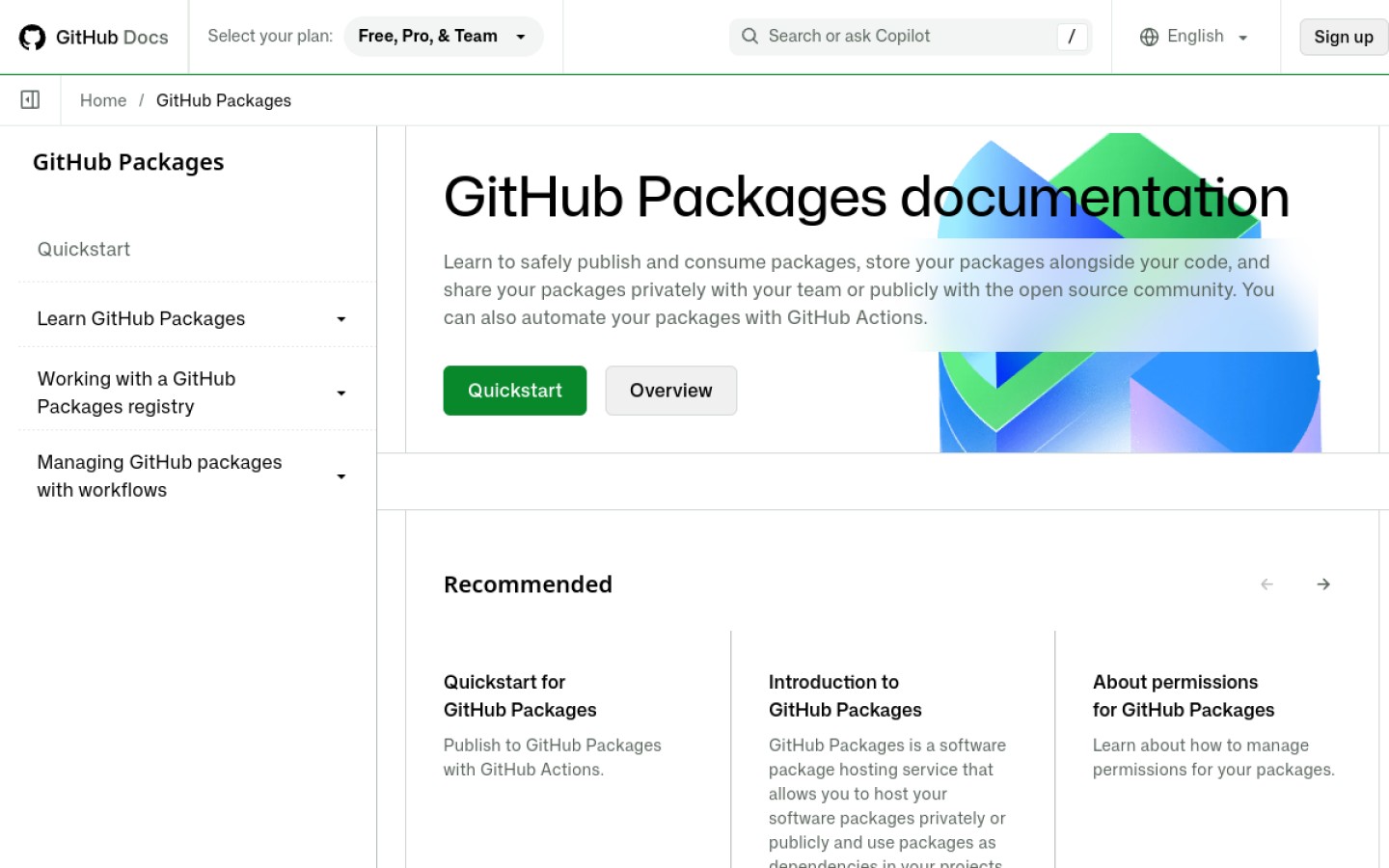
GitHub Packages homepage, captured Nov 2026.
GitHub Packages hosts private and public software packages alongside your GitHub repositories and workflows, carrying a 4.8/5 rating from 6,215 Capterra reviews. GitHub Free includes $0 pricing with 500 MB of storage and 1 GB of monthly transfer.
The trade off is storage and bandwidth caps on private packages plus per-seat pricing starting at $4 per user per month ($48/year per user) on GitHub Team. It suits teams already standardizing code and CI on GitHub.
What we like
Keeps private packages and repository permissions in one GitHub workflow
Includes a $0 free tier with public package hosting
Scales cleanly with GitHub Team at $4 per user per month
Watch out for
Private package storage and outbound data transfer have monthly caps
Adds per-user subscription costs as team headcount grows
GitHub Team starts at $4 per user/month ($48/yr per user) with 2 GB storage and 10 GB transfer.Visit github.com
05
Cloudsmith
4.5/5on G2 (45 reviews, checked Nov 2026)
Paid from$1,788/yr
Best for cloud-native multi-format registries
G2 rating4.5/5 (45 reviews)
Free Core plan$0 (500 MB / 1 GB)
Pro plan$149/mo (5 GB / 25 GB)
Overage rate$1.50/GB on Pro
cloudsmith.com
Cloudsmith homepage, captured Nov 2026.
Cloudsmith is a cloud-native package and artifact repository supporting npm alongside more than 30 formats, with a 4.5/5 rating from 45 G2 reviews. Its Core plan starts at $0/month with 500 MB of artifact data and 1 GB of package delivery.
The trade off is moving to the Pro plan at $149/month ($1,788/year) for 5 GB of artifact data and 25 GB of delivery, with $1.50/GB overages beyond plan limits. It suits teams wanting a hosted registry with upstream caching and access controls.
What we like
Offers a $0 Core plan and an open-source tier for public open-source repositories
Proxies and caches upstream registries with policy and access controls
Supports 30+ package and container formats in one cloud service
Watch out for
Pro plan costs $149/month ($1,788/year) with modest base storage and transfer
Heavy bandwidth or artifact growth adds $1.50/GB overage charges on Pro
Pro plan at $149/month ($1,788/yr) increases allowances to 5 GB artifact data and 25 GB delivery.Visit cloudsmith.com
06
Sonatype Nexus Repository
4.5/5on G2 (23 reviews, checked Nov 2026)
Paid from$7,500/yr
Best for multi-format enterprise repositories
G2 rating4.5/5 (23 reviews)
Free editionCommunity ($0)
Entry paid tierPro from $7,500/yr
Pro allocation50K components / 15M req
sonatype.com
Sonatype Nexus Repository homepage, captured Nov 2026.
Sonatype Nexus Repository manages and proxies software packages across npm and other ecosystems inside your infrastructure, holding a 4.5/5 rating across 23 G2 reviews. It offers a $0 Community Edition for basic repository hosting and CI/CD integration.
The trade off is a steep jump to Pro Edition starting at $7,500/year, plus operational overhead to self-host and maintain. It suits organizations needing one repository system across multiple build formats.
What we like
Offers a $0 Community Edition supporting npm and other package formats
Pro Edition includes 50K components and 15M monthly requests with SSO and HA options
Centralizes artifact storage across build pipelines
Watch out for
Pro Edition starts at $7,500/year, well above small-team budgets
Self-hosted deployment requires server management and maintenance
Pro Edition starts at $7,500/year, adding 50K components, 15M monthly requests, SSO, and HA support.Visit sonatype.com
07
JFrog Artifactory
4.2/5on G2 (186 reviews, checked Nov 2026)
Starts at$150/mo
Best for governed enterprise artifact pipelines
G2 rating4.2/5 (186 reviews)
Entry paid planPro at $150/mo
Annualized entry$1,800/yr regular
Enterprise tierEnterprise X at $950/mo
jfrog.com
JFrog Artifactory homepage, captured Nov 2026.
JFrog Artifactory acts as a centralized registry for npm packages, containers, and other build artifacts across CI/CD pipelines, with a 4.2/5 rating from 186 G2 reviews. Its Pro plan lists at $150/month ($1,800/year), with a $50/month promotional price also displayed on the pricing page.
The trade off is higher ongoing cost and tiered per-GB consumption charges once usage grows beyond included thresholds, plus extra setup complexity. It suits larger engineering organizations standardizing artifact governance.
What we like
Supports npm alongside other binary and container artifact formats in one registry
Integrates with CI/CD pipelines for centralized package distribution
Scales up to Enterprise X ($950/month) and multi-server deployments
Watch out for
No permanent free plan; Pro lists at $150/month ($1,800/year) before usage overages
More complex to configure than lightweight local package managers
Pro lists at $150/month ($1,800/yr) and scales to Enterprise X at $950/month with higher SLAs and consumption tiers.Visit jfrog.com
How we chose
This list focuses on active JavaScript package managers and artifact registries that developers use in place of npm for local installs or private package hosting.
Pricing figures and third-party review ratings were checked on 29 Nov 2026 from vendor pricing pages, GitHub repositories, G2, and Capterra.
Tools without verifiable public ratings or active pricing details in our check were left out. No vendor paid for a place, and we do not claim testing for this list.
How to choose an npm alternative
Follow four practical checks before switching your project or registry:
Match the tool to your bottleneck. Pick a local installer like pnpm, Bun, or Yarn if slow installs or disk space are your main issue, or a registry if you need private hosting.
Check monorepo and workspace behavior. Review how each tool links shared packages across workspaces and whether strict dependency resolution breaks existing imports.
Estimate storage and transfer limits. For hosted registries like GitHub Packages, Cloudsmith, or JFrog Artifactory, check included storage and monthly bandwidth before scaling CI builds.
Standardize across your team and CI. Ensure lockfiles, scripts, and build runners match so contributors do not mix different package managers in the same repository.
FAQ
What are the best npm alternatives in 2026?
pnpm is a top pick for most JavaScript projects due to its content-addressable store, while Bun and Yarn fit fast installs, offline caching, and workspaces. GitHub Packages, Cloudsmith, Sonatype Nexus Repository, and JFrog Artifactory fit teams that need private or enterprise package registries.
Are there free npm alternatives?
Yes. pnpm, Bun, and Yarn are free open-source tools, Sonatype Nexus Repository offers a $0 Community Edition, and GitHub Packages and Cloudsmith include $0 free tiers with storage and transfer limits.
How much do paid npm alternatives cost?
Paid options vary by model: GitHub Team starts at $4 per user per month ($48/year per user), Cloudsmith Pro is $149/month ($1,788/year), JFrog Artifactory Pro lists at $150/month ($1,800/year) with a $50/month promotional rate shown, and Sonatype Nexus Repository Pro starts at $7,500/year.
Which npm alternative is best for monorepos?
pnpm is widely favored for monorepos because its shared store and hard links keep disk usage low while supporting workspace packages cleanly.
pnpm vs Bun: which should you pick?
Choose pnpm if you want a dedicated package manager with a shared store and strict dependency resolution for existing or multi-package projects. Choose Bun if you want a single binary that handles package installs alongside runtime execution, bundling, and testing.
SaaS SEO and WordPress specialist with about 8 years of experience. Rakib compares WordPress plugins, themes, hosting and software using public pricing, documentation and user reviews. See how we rank.