.NET MAUI tops the Xamarin alternatives for C# teams, because Microsoft built it as the direct successor to Xamarin.Forms and it is free, rated 4.3 out of 5 on G2. Choose Flutter for custom interfaces from one Dart codebase, or React Native if your team already builds in JavaScript and React.
How we make this list: we compare pricing pages, product documentation and public user reviews, then re-check every price before each update. No product paid for a place. Disclosure.
Microsoft ended Xamarin support on 1 May 2024, so staying on Xamarin means no more updates or fixes.
.NET MAUI is the direct successor for C# teams: free, rated 4.3 out of 5 on G2, and built on the same language and XAML skills.
Flutter is the strongest move away from C#, rated 4.6 out of 5 on G2 from 73 reviews, and it is free.
React Native is the best pick for JavaScript teams, rated 4.5 out of 5 on G2 from 144 reviews, and it is free.
Seven of the nine tools here are free, and the only paid plans start at $19 a month for Expo and $29 a month billed yearly for FlutterFlow.
How do you choose from the Xamarin alternatives?
Microsoft ended Xamarin support on 1 May 2024, and the company now points Xamarin teams to .NET MAUI. Existing Xamarin apps keep running, but they get no more updates, fixes or support.
Your team's language decides most of the choice. C# teams lose the least by moving to .NET MAUI, while JavaScript teams gain the most from React Native and web teams from Ionic.
Free frameworks cover the code, but the bills hide in the build step. Cloud builds, over-the-air updates and store publishing are where Expo and FlutterFlow charge, so check those prices before you commit.
A shared codebase is only worth it if the interface still feels native. Our guide on optimizing WordPress for mobile speed makes the same point for the web: a slow app loses users, whatever it is built with.
.NET MAUI is Microsoft's free, open-source successor to Xamarin.Forms, built for C# and XAML teams. One shared codebase ships native apps to iOS, Android, macOS and Windows, with a single project, hot reload and the .NET Community Toolkit in the default template.
The trade off is youth. MAUI is younger than Xamarin.Forms was, so some libraries and controls still lag, and the yearly .NET release cycle means regular upgrades. It suits C# teams that want the smallest move from Xamarin and a supported Microsoft stack.
Flutter is Google's free, open-source framework for building apps from one Dart codebase. It ships to iOS, Android, web, Windows, macOS and Linux, with hot reload, a large widget library and the Impeller rendering engine for uniform interfaces on every screen.
The trade off is leaving C# behind. Teams must learn Dart, and Flutter apps carry their own rendering engine, so downloads run larger than native apps. It suits teams that want one codebase, a custom interface and strong performance on both stores.
What we like
One codebase reaches iOS, Android, web and desktop
Rated 4.6 out of 5 on G2 from 73 reviews
Hot reload and a large widget library
Free and open source, with no licence fee
Watch out for
Teams must learn Dart instead of C#
Apps are larger than native apps
Custom interface work can take longer than native UI
React Native is Meta's free, open-source framework for building iOS and Android apps with JavaScript, TypeScript and React. It renders truly native interface components, shares most code between iOS and Android, and offers Fast Refresh to see edits at once.
The trade off is native work. Complex features, upgrades and some libraries still need Swift, Kotlin or Java, and version upgrades can take effort. It suits JavaScript teams that want native performance without learning a second language.
What we like
Largest review base here: 4.5 out of 5 on G2 from 144 reviews
Truly native interface components
Huge community and library ecosystem
Free and open source, from Meta
Watch out for
Some features still need native Swift or Kotlin code
Kotlin Multiplatform is JetBrains' free, open-source way to share code across platforms. It shares business logic, networking and data code in Kotlin, while each platform keeps its own native interface. Compose Multiplatform adds shared interface code for teams that want it.
The trade off is double interface work. Teams still build separate iOS and Android interfaces, and the iOS side needs comfort with Xcode and Swift interop. It suits Android-first teams and firms that refuse to compromise on native interface quality.
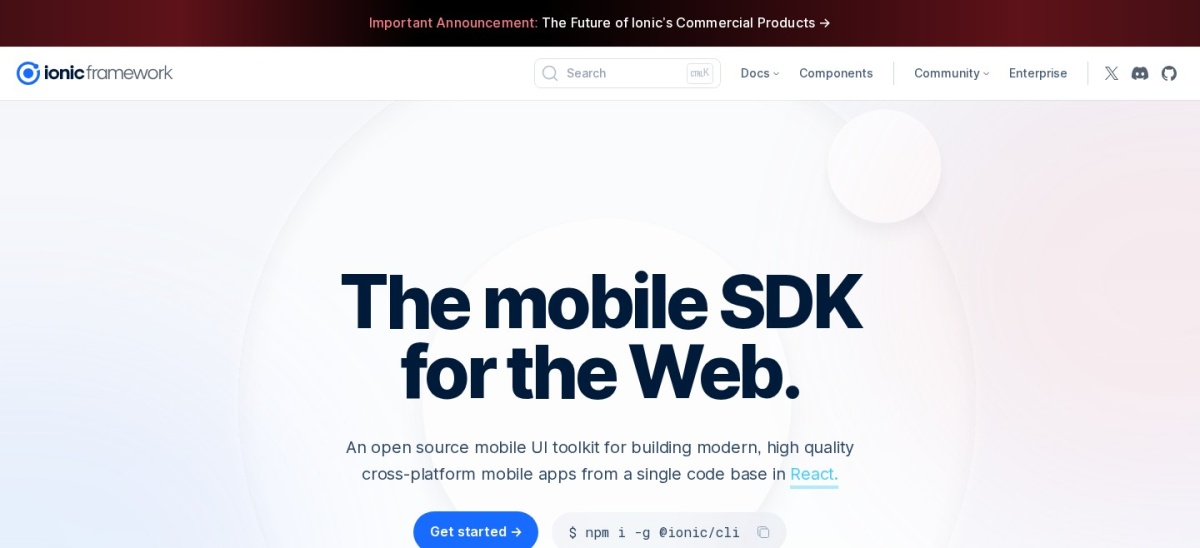
Ionic is a free, open-source framework that builds mobile, desktop and web apps from web technology. It works with Angular, React or Vue, uses Capacitor to reach native device features, and ships one codebase to the App Store, Google Play and the web.
The trade off is the paid cloud layer. Ionic stopped selling Appflow to new customers in February 2025, and existing customers keep access only until 31 December 2027, so teams must plan their own builds. It suits web teams that already know HTML, CSS and JavaScript.
Expo is the managed framework and cloud platform built around React Native, covering builds, store submission and over-the-air updates. Its free tier includes 15 Android and 15 iOS cloud builds a month, 60 CI/CD workflow minutes and updates for up to 1,000 monthly active users.
The trade off is usage-based cloud billing once your team outgrows local builds or free quotas, with the Starter plan at $19 a month plus usage. It suits React Native teams wanting managed cloud builds without maintaining macOS build servers.
What we like
Removes Xcode and Android Studio setup friction
Over-the-air JavaScript updates and store submission
Free tier covers 30 monthly cloud builds
G2 rating of 5.0, from only 2 reviews
Watch out for
Only 2 G2 reviews, so the rating is barely tested
Usage-based billing is hard to predict at scale
Production plan jumps to $199 a month plus usage
Starter ($19/mo) adds build credit and 3K update MAUsVisit expo.dev
07
FlutterFlow
4.5/5on G2 (30 reviews, checked Nov 2026)
Paid from$29/mo
Best visual builder with code export
BuilderVisual, no-code plus code
OutputFlutter and Dart code
Free plan2 projects
Paid planBasic, $29/mo billed yearly
flutterflow.io
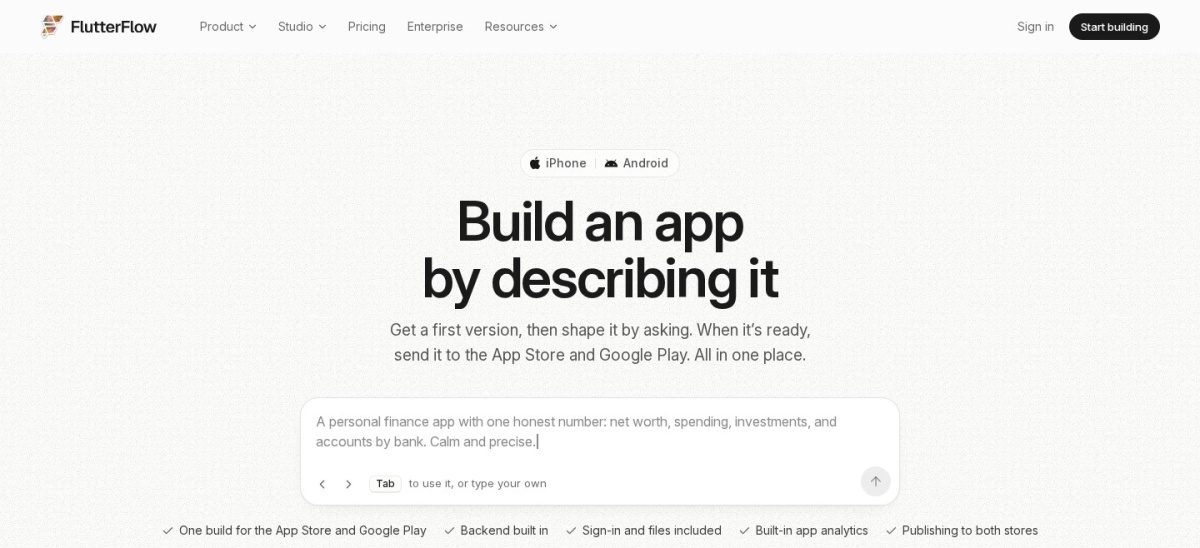
FlutterFlow homepage, captured Nov 2026.
FlutterFlow is a visual builder that creates real Flutter apps without writing code line by line. It offers a drag-and-drop canvas, Firebase and Supabase connections, and code download on paid plans. The free plan covers 2 projects with a free AI allowance.
The trade off is price. Basic costs $29 a month billed yearly, or $39 month to month, and full features such as code download and store deployment need a paid plan. It suits founders and small teams that want a working app fast.
What we like
Generates real Flutter source code you can keep
Rated 4.5 out of 5 on G2 from 30 reviews
Firebase and Supabase built in
One-click deployment to both stores on paid plans
Watch out for
Code download needs a paid plan
Pricing changed recently, so older quotes are stale
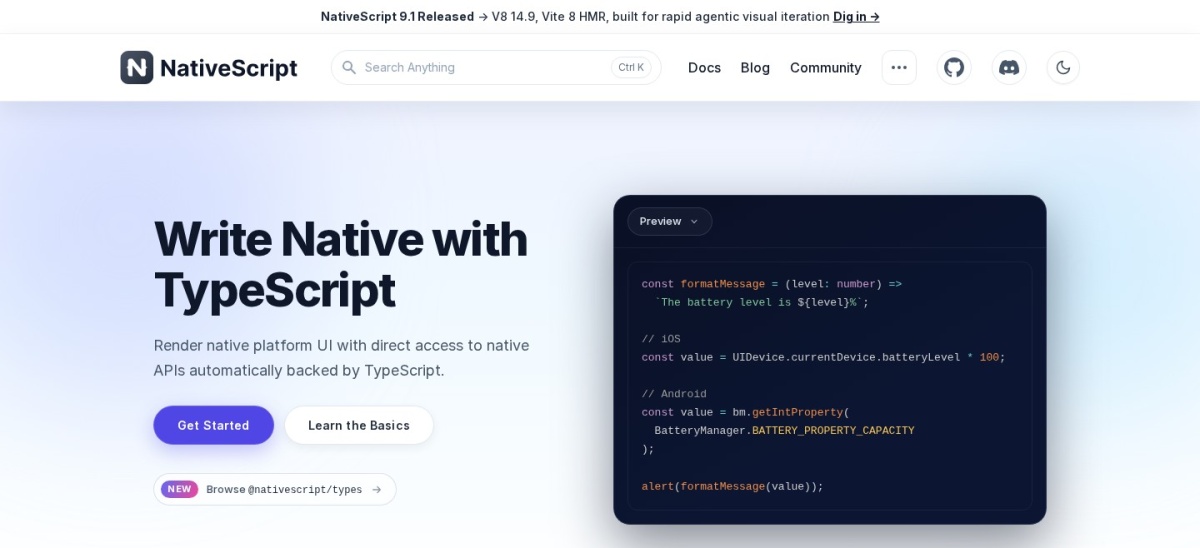
NativeScript is a free, open-source framework for building native mobile apps with JavaScript or TypeScript. It renders native interface elements, gives direct access to native platform APIs without plugins, and version 9.1 adds Vite 8 hot module replacement.
The trade off is a smaller community. NativeScript has far fewer reviews and plugins than Flutter or React Native, so answers and ready-made pieces can be harder to find. It suits TypeScript teams that want direct native API access.
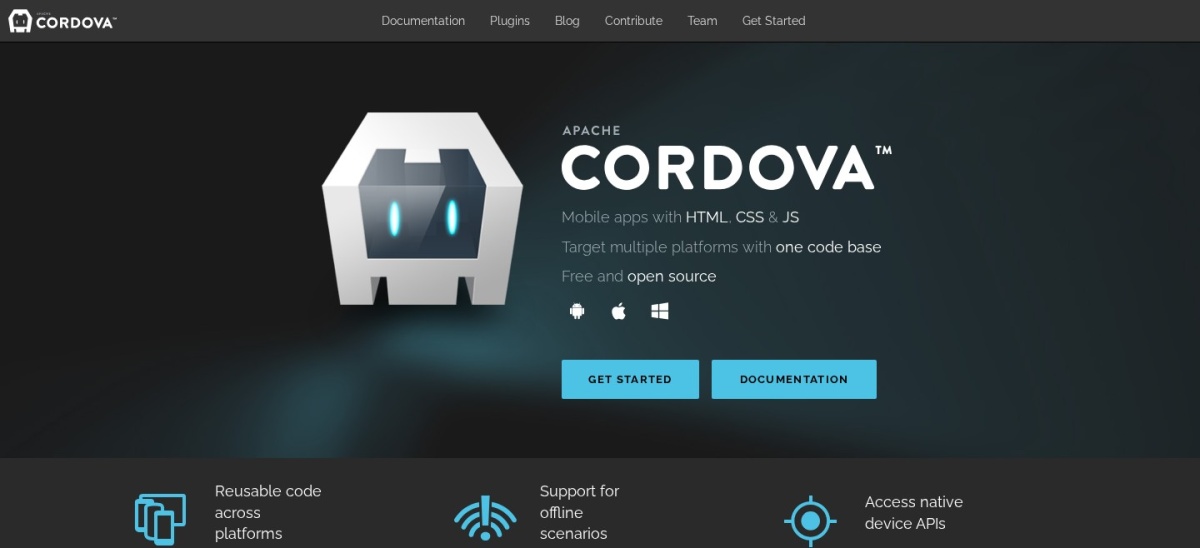
Apache Cordova is a free, open-source framework that wraps HTML, CSS and JavaScript apps in a native container. It targets iOS, Android and more from one codebase and reaches device features through a large plugin system. Cordova is the oldest tool in this list.
The trade off is age. Cordova is mature and little changed, plugin maintenance varies, and newer frameworks offer better performance and tooling. It suits teams keeping an existing web app alive in the stores rather than starting a new app.
Microsoft's migration path keeps your C# business logic and moves the interface to MAUI's single-project layout. Most Xamarin.Forms XAML carries over, but custom renderers become handlers and some APIs change names.
Start with an inventory of your dependencies. Check every plugin and library for a MAUI version before you move, because an unmaintained plugin is the most common blocker in a migration.
Migrate one screen at a time where you can. A full rewrite is rarely needed, but budget time for interface polish, because MAUI controls do not look identical to Xamarin.Forms controls out of the box.
How we chose
We started from the frameworks Microsoft, Google, Meta, JetBrains and the Ionic team point Xamarin teams toward, then kept the nine with a public G2 rating and an active release in 2026.
Prices come from each vendor's pricing page, checked on 29 November 2026. Ratings and review counts come from G2 on the same day. Where a vendor shows a sale, the list shows the regular price.
We left out tools with no public rating and discontinued frameworks such as PhoneGap. No vendor paid for a place, and we do not claim to have used these tools ourselves.
How to choose a Xamarin alternative
Start with your team's language, then check the migration cost before you pick a framework.
Match the framework to your team's language. C# teams should start with .NET MAUI, JavaScript teams with React Native or Expo, and web teams with Ionic.
Check the migration path for your current app. MAUI keeps most Xamarin.Forms code, while Flutter and React Native mean a rewrite. Count the screens and plugins first.
Price the build step, not just the framework. Most frameworks are free, but cloud builds, updates and store publishing add up. Expo starts at $19 a month plus usage.
Build one small screen before you commit. A pilot screen shows whether the interface, plugins and build pipeline fit your team, before the whole app moves.
FAQ
What are the best Xamarin alternatives in 2026?
.NET MAUI is the best Xamarin alternative for most teams, because Microsoft built it as the direct successor to Xamarin.Forms and it is free. Flutter is the strongest choice outside C#, and React Native is the best pick for JavaScript teams.
Is Xamarin still supported?
No. Microsoft ended Xamarin support on 1 May 2024, and Xamarin gets no more updates or fixes. Existing apps keep running, but Microsoft recommends migrating to .NET MAUI, which is the supported successor.
How much do Xamarin alternatives cost?
Seven of the nine alternatives here are completely free, including .NET MAUI, Flutter and React Native. The only paid plans are Expo, from $19 a month plus usage, and FlutterFlow, from $29 a month billed yearly.
Is there a free Xamarin alternative?
Yes. .NET MAUI, Flutter, React Native, Kotlin Multiplatform, Ionic, NativeScript and Apache Cordova are all free and open source. Expo and FlutterFlow also have free plans, with paid plans adding cloud builds, updates and code download.
Which Xamarin alternative is best for beginners or small teams?
FlutterFlow is the easiest start for non-developers, because it builds apps visually and exports real Flutter code. For small coding teams, .NET MAUI is the simplest move if you know C#, and Expo is the simplest move if you know React Native.
Should I choose .NET MAUI or Flutter?
Choose .NET MAUI if your team knows C# and XAML, because it keeps most of your Xamarin skills and code. Choose Flutter if you want the most polished custom interface and do not mind learning Dart, since it is rated higher at 4.6 out of 5 on G2.
How hard is it to migrate from Xamarin to .NET MAUI?
It is the easiest migration on this list, because MAUI is the evolution of Xamarin.Forms and most C# logic carries over. The main work is converting custom renderers to handlers, checking plugins for MAUI versions, and polishing the interface.
SaaS SEO and WordPress specialist with about 8 years of experience. Rakib compares WordPress plugins, themes, hosting and software using public pricing, documentation and user reviews. See how we rank.