NinjaOne is the best Naverisk alternative for most MSPs, rated 4.7 out of 5 on G2 from 5,866 reviews, with monitoring, patching and remote access in one console. Atera and Syncro are the closest all-in-one matches, bundling RMM and PSA at $129 per technician a month.
How we make this list: we compare pricing pages, product documentation and public user reviews, then re-check every price before each update. No product paid for a place. Disclosure.
NinjaOne leads on reviews: 4.7 out of 5 from 5,866 G2 reviews, the largest base here by far.
Atera and Syncro both charge $129 per technician a month billed annually, with unlimited endpoints and PSA included.
ManageEngine Endpoint Central is the only full RMM here with a free edition, for up to 25 endpoints.
Action1 patches the first 200 endpoints free, but it is a patching tool, not a full RMM replacement.
Three of the nine tools are quote-only: Datto RMM, N-central and SuperOps publish no price, and NinjaOne publishes only a $1.50-$3.75 per-device range.
How do you pick the right Naverisk alternative?
Naverisk sells one idea: RMM and PSA in a single account at a simple price. Any replacement should be judged on that same pairing, not on monitoring alone.
The billing unit decides the bill. Per-device pricing, used by NinjaOne, Datto RMM and N-central, grows with every endpoint. Per-technician pricing, used by Atera and Syncro, stays flat no matter how many devices you add.
PSA coverage is the second split. Atera and Syncro include ticketing and billing in the price, while NinjaOne, Datto RMM and N-central need a separate PSA or an integration.
Trials run 14 to 30 days across this list. Use the trial to patch a test group, run a script and open a remote session before you sign a contract.
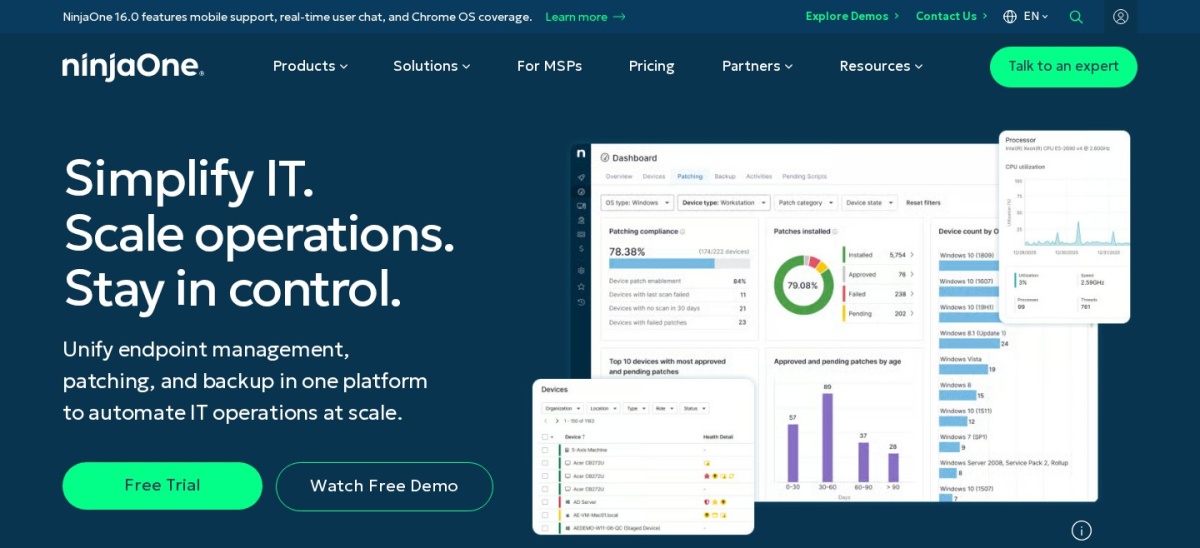
NinjaOne is a cloud RMM platform that covers monitoring, patching, software deployment, backup and remote access in one console. It patches Windows, macOS and Linux plus third-party apps, and it holds the highest G2 rating in this list at 4.7 out of 5 from 5,866 reviews.
The trade off is pricing. NinjaOne publishes a per-device range of $1.50 to $3.75 a month by volume, with the top rate at 50 or fewer endpoints and the exact figure set by quote. It suits teams that want the most proven console and do not mind a sales conversation to confirm the rate.
What we like
Highest G2 rating here, from the largest review base
Patching across Windows, macOS, Linux and third-party apps
Free and unlimited support and training
Fast setup, usually live in under a month
Watch out for
No fixed plan price; the exact rate comes from a quote
Per-device billing grows with every endpoint added
Atera is an all-in-one IT platform that combines RMM, patching, remote access, ticketing and automation, with an AI agent called Robin that handles routine incidents. Pricing is per technician, so one fee covers unlimited endpoints. It is rated 4.6 out of 5 on G2 from 1,291 reviews.
The trade off is the entry price. The Pro plan costs $129 per technician a month billed annually, so a one-person shop pays the full seat price. It suits small MSPs and IT teams with many endpoints per technician.
What we like
One fee covers unlimited endpoints
RMM, ticketing and automation in one platform
30-day trial with no credit card required
AI agent handles routine incidents
Watch out for
$129 a month per technician is a lot for a solo admin
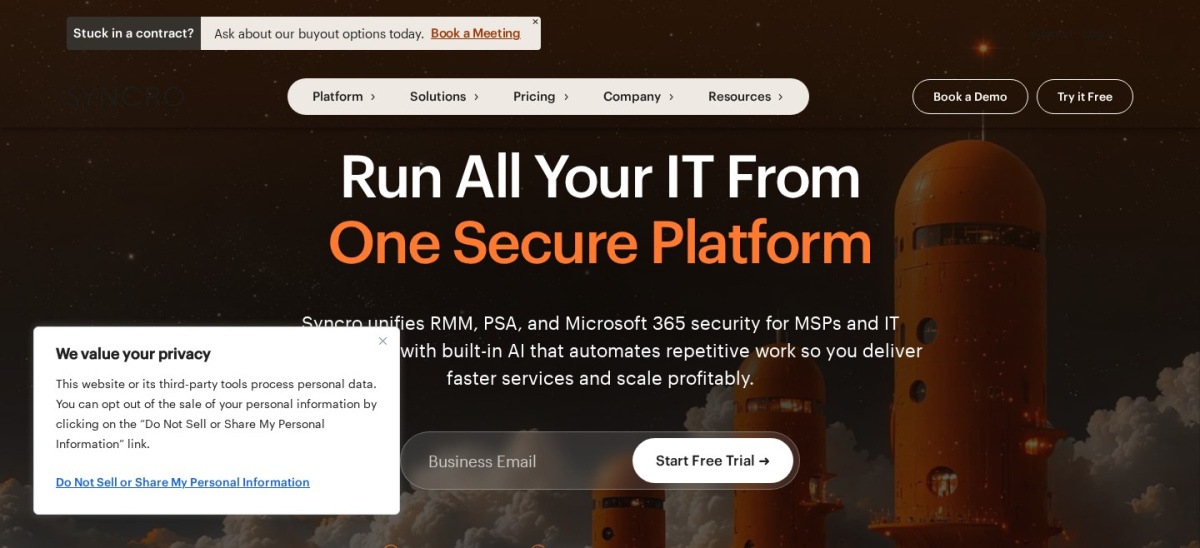
Syncro is an all-in-one platform that pairs RMM with a full PSA, so monitoring, patching, scripting, ticketing, billing and Microsoft 365 management sit in one subscription. Endpoints are unlimited per technician. It is rated 4.5 out of 5 on G2 from 573 reviews.
The trade off is the per-user price. Core costs $129 per user a month billed annually, or $159 month to month, so the bill grows with each technician rather than each device. It suits small MSPs that want RMM, ticketing and billing without buying a separate PSA.
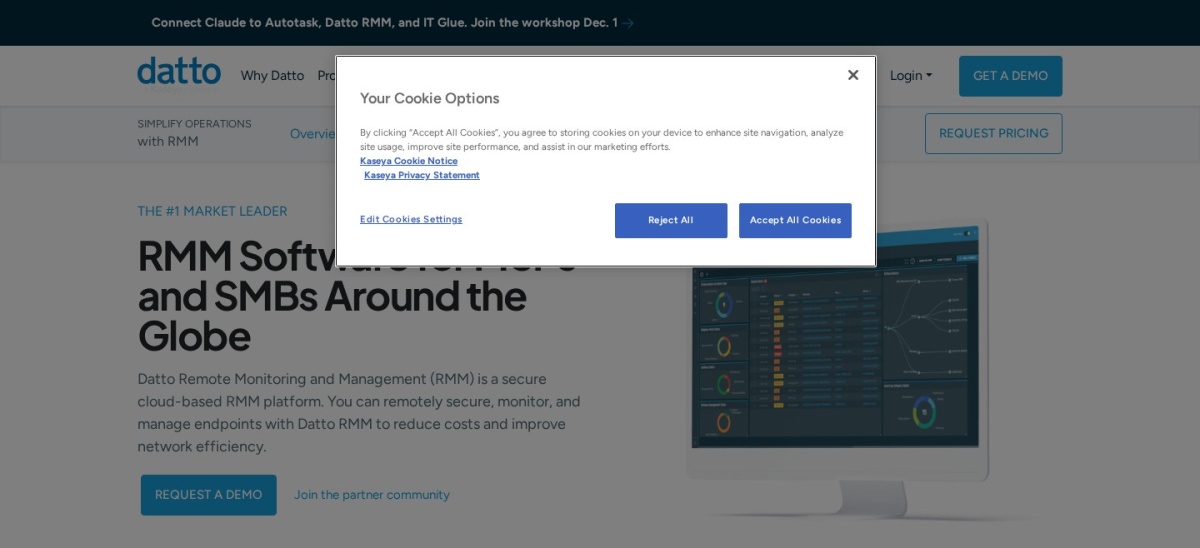
Datto RMM is a cloud RMM platform for MSPs, owned by Kaseya since 2022. It covers monitoring, patching, scripting and remote access across Windows, macOS and Linux, with native ransomware detection and tight links to Autotask PSA and Datto backup products. It is rated 4.5 out of 5 on G2 from 831 reviews.
The trade off is pricing and age. Datto RMM is quote-only per endpoint, and reviewers describe the interface as dated next to NinjaOne, with setup work needed before policies and alerts run smoothly. It suits established MSPs already using Autotask or Datto backup.
What we like
Strong component library and scripting depth
Native links to Autotask PSA and Datto backup
Ransomware detection built in
Lightweight agent across Windows, macOS and Linux
Watch out for
Quote-only pricing with no published figure
Interface feels dated next to newer tools
Third-party patch catalog is Windows-only
Contract terms changed after the Kaseya acquisition
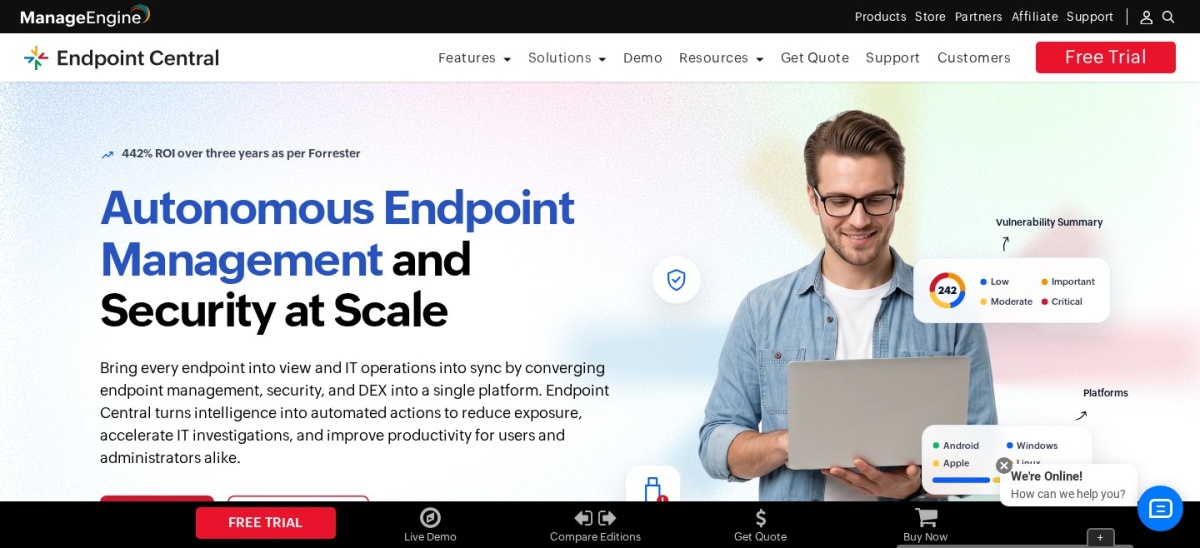
ManageEngine Endpoint Central homepage, captured Nov 2026.
ManageEngine Endpoint Central is an endpoint management platform with patching, software deployment, asset inventory and remote troubleshooting. Its free edition covers up to 25 endpoints with no time limit, which no other full RMM here offers. It is rated 4.5 out of 5 on G2 from 1,131 reviews.
The trade off is pricing clarity. The vendor page prices by configurator, and G2 lists the Professional edition from $1.09 per device a month, with a 50-endpoint minimum on paid tiers. It suits in-house IT teams that manage Windows-heavy fleets and want an on-premises option.
What we like
Only free edition in this list, for up to 25 endpoints
Cloud or on-premises deployment
Wide patching catalog including third-party apps
Lowest published per-device starting price here
Watch out for
No flat price on the vendor page; pricing needs a configurator
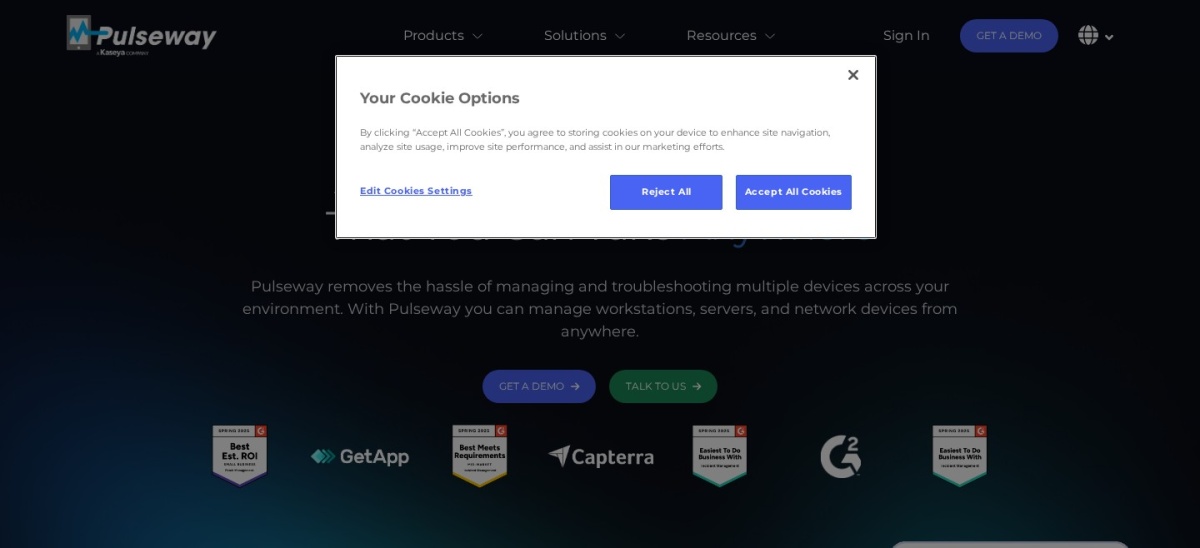
Pulseway is a mobile-first RMM built around managing servers, workstations and network devices from a phone or tablet. It covers monitoring, automated patching across the operating system and 200-plus third-party apps, scripting and remote control. It is rated 4.5 out of 5 on G2 from 125 reviews.
The trade off is pricing shape. The Business tier starts from $39 a month for a minimum of 20 monitored systems, and security, backup and ticketing arrive as paid add-ons. It suits lean teams and solo admins who want to run the fleet from a mobile app.
What we like
Full remote management from the mobile app
Lowest published starting price for a small fleet
Fast setup, often live in under a day
Patching covers 200-plus third-party apps
Watch out for
Smallest review base in this list at 125 reviews
Security, backup and ticketing cost extra as add-ons
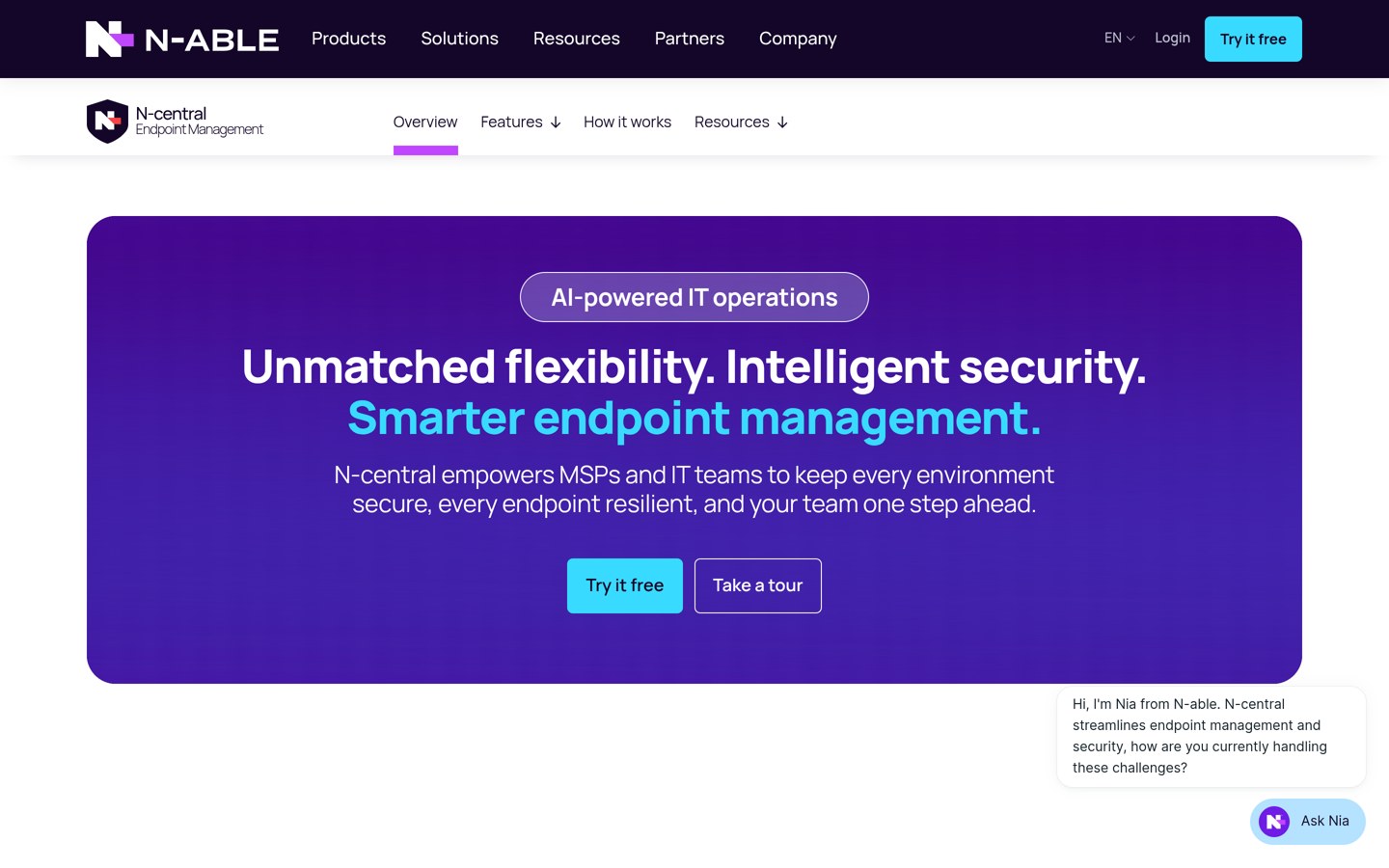
N-able N-central is the heavyweight RMM in N-able's line-up, built for MSPs and IT teams running large, mixed fleets. It offers deep automation, rule-based patching, remote control and vulnerability management, in cloud or self-hosted form. It is rated 4.4 out of 5 on G2 from 577 reviews.
The trade off is complexity and price. N-central is quote-only per device, and patch management, remote control and full automation sit behind the pricier Professional licence. It suits larger MSPs with the staff to run its automation properly.
What we like
Deepest automation rules in this list
Cloud or self-hosted deployment
Strong multi-tenant management for MSPs
Vulnerability management built in
Watch out for
Quote-only pricing with no published figure
Key features need the pricier Professional licence
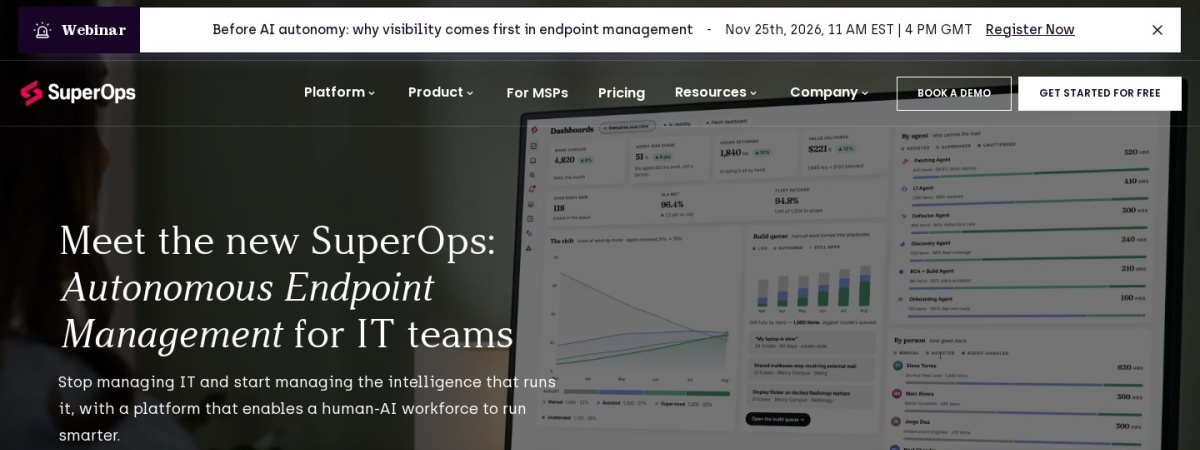
SuperOps is a cloud platform that combines RMM and PSA on one codebase, with ticketing, documentation, projects and AI-assisted triage beside monitoring and patching. Technicians are unlimited on every plan. It is rated 4.4 out of 5 on G2 from 207 reviews.
The trade off is scale and price discovery. Plans start at 150 endpoints and the vendor publishes no price, so small MSPs below that floor need another option. It suits growing MSPs that want a modern interface and one account for RMM and PSA.
Action1 is a cloud-native patch and vulnerability management platform, free for the first 200 endpoints with the full feature set. It patches Windows, macOS and Linux plus third-party apps, and it holds the highest G2 rating in this list at 4.9 out of 5 from 1,174 reviews.
The trade off is scope. Action1 is a patching tool, not a full RMM: it has no PSA, no ticketing and no remote monitoring of the kind Naverisk users expect. It suits teams whose main gap is patching, or as a free companion beside a lighter RMM.
Per-device vs per-technician: run your own numbers
Per-device pricing looks cheap until the fleet grows. NinjaOne charges $3.75 per device a month at 50 or fewer endpoints, so 200 endpoints cost $750 a month before any add-ons.
Per-technician pricing looks dear until the fleet is large. Atera and Syncro charge $129 per technician a month, so one technician covering 200 endpoints pays $129, not $750.
The crossover point depends on your ratio. Count your endpoints, divide by your technicians, and price both models on those real numbers before you choose.
Quote-only tools hide the comparison entirely. Get a written quote for your exact endpoint count from Datto RMM, N-central and SuperOps before you shortlist them.
How we chose
We started from G2's Naverisk alternatives list and the RMM tools MSPs name most often, then kept nine with a public G2 rating and a real pricing page or a confirmed quote-only model.
Prices come from each vendor's pricing page and G2 listings, checked on 29 November 2026. Ratings and review counts come from G2 on the same day. Where a vendor shows a sale, the list shows the regular price.
We left out tools with no public rating and tools that only do one slice of the job, except Action1, which is flagged as patching-only. No vendor paid for a place, and we do not claim hands-on testing for this list.
How to choose a Naverisk alternative
Start with your endpoint-to-technician ratio, then check PSA coverage before you compare features.
Count endpoints per technician. A high ratio favours per-technician pricing from Atera or Syncro; a low ratio favours per-device pricing from NinjaOne or Pulseway.
Decide whether you need a PSA. If billing and ticketing must live in the same account, shortlist Atera, Syncro and SuperOps. The rest need a separate PSA or integration.
Check the patch catalog for your apps. Every tool here patches operating systems, but third-party app coverage differs. Confirm your line-of-business apps are in the catalog.
Trial the top two on a test group. Patch a small group, run a script and open a remote session in each trial. Pick the console your technicians actually enjoy using.
FAQ
What is the best Naverisk alternative in 2026?
NinjaOne is the best Naverisk alternative for most MSPs. It is rated 4.7 out of 5 on G2 from 5,866 reviews, and it covers monitoring, patching, software deployment, backup and remote access in one console.
Which Naverisk alternative includes a PSA?
Atera, Syncro and SuperOps include PSA features in the same account. Atera and Syncro both charge $129 per technician a month billed annually, while SuperOps is quote-only with a 150-endpoint minimum.
Is there a free Naverisk alternative?
Action1 is free for the first 200 endpoints, but it only does patching, not full RMM. ManageEngine Endpoint Central has a free edition for up to 25 endpoints and is a full RMM, though it includes no PSA.
How much does a Naverisk alternative cost?
Published prices start at $0 for Action1's free tier and $1.09 per device a month for Endpoint Central. NinjaOne publishes $1.50 to $3.75 per device a month, while Atera and Syncro charge $129 per technician a month.
NinjaOne or Atera: which is better for a small MSP?
NinjaOne wins on ratings and review volume, at 4.7 out of 5 from 5,866 reviews against Atera's 4.6 from 1,291. Atera wins on billing simplicity for device-heavy teams, since one $129 technician fee covers unlimited endpoints.
Can I switch from Naverisk without losing my PSA data?
Most MSPs export tickets, contracts and client records from Naverisk before the switch, then import them into the new PSA. Atera, Syncro and SuperOps all offer onboarding help, so ask for a migration plan in the trial.
SaaS SEO and WordPress specialist with about 8 years of experience. Rakib compares WordPress plugins, themes, hosting and software using public pricing, documentation and user reviews. See how we rank.