Clio is the best legal timekeeping software for mid size law firms, with timers, billing and trust accounting from 49 dollars per user a month. TimeSolv suits firms that only need time and billing, while PracticePanther adds matter workflows at the same starting price.
How we make this list: we compare pricing pages, product documentation and public user reviews, then re-check every price before each update. No product paid for a place. Disclosure.
Clio leads for mid-size firms, with timers, billing and trust accounting from 49 dollars per user a month.
TimeSolv is the billing-only pick: no suite bloat, with batch invoicing and flexible rates from 49 dollars.
PracticePanther ties timesheet approvals into matter workflows, but full trust accounting needs Business Pro.
Bill4Time is the cheapest full billing tool at 39 dollars per user a month, with the highest Capterra rating here.
Smokeball's AutoTime recovers hours no one logged, but the vendor publishes no prices at all.
Five of the nine tools start at 49 or 50 dollars per user a month, so the choice is features, not price.
What should a mid-size law firm look for in legal timekeeping software?
Start with the leak you are trying to close. Most mid-size firms lose billable hours to forgotten timers and unlogged work, not to slow invoicing.
Check trust accounting before you buy. A mid-size firm needs three-way reconciliation and LEDES billing, and not every plan includes them.
Price per user multiplies fast. At 49 dollars per user a month, a 20-lawyer firm pays close to 12,000 dollars a year, so volume discounts and quote-only tiers matter.
Pick the suite or the specialist deliberately. Full suites cover matters and documents, while TimeSolv, Bill4Time and LeanLaw do time and billing only and sit beside another tool.
The 9 best legal timekeeping software tools for mid-size firms
01
Clio
4.6/5on G2 (1,161 reviews, checked Nov 2026)
Starts at$49/mo
Best legal timekeeping software overall
Cheapest planStarter, $49/user/mo
Time captureTimers, mobile, Outlook sync
Trust accountingYes, on every plan
Users400,000+ legal professionals
clio.com
Clio homepage, captured Nov 2026.
Clio is the most widely used law practice platform in this list, covering matters, documents, calendars, time tracking, billing, payments and legal accounting in one system. The Starter plan at 49 dollars per user a month includes time and expense tracking, online payments, unlimited document storage and trust reconciliation.
The trade off is tier opacity. Only the Starter price is published, and Core, Signature and Elite are quote-only, so a mid-size firm pays more than the headline once it needs automation and reporting. It suits firms that want the largest integration ecosystem and one system for everything.
What we like
Largest user base and integration ecosystem in this list
Legal accounting and trust reconciliation on every plan
Clio Timekeeping drafts entries from Outlook and files
Unlimited document storage on Starter
Watch out for
Only Starter carries a published price
7-day trial is short for testing firm workflows
AI features sit on higher tiers
Core adds AI-drafted bills and a client portalVisit clio.com
02
TimeSolv
4.5/5on G2 (429 reviews, checked Nov 2026)
Starts at$49/mo
Best dedicated time and billing tool
Starting priceFrom $49/user/mo
Time captureTimers, mobile app, batch entry
Trust accountingYes, on Legal plan
LEDES billingYes, on Legal plan
timesolv.com
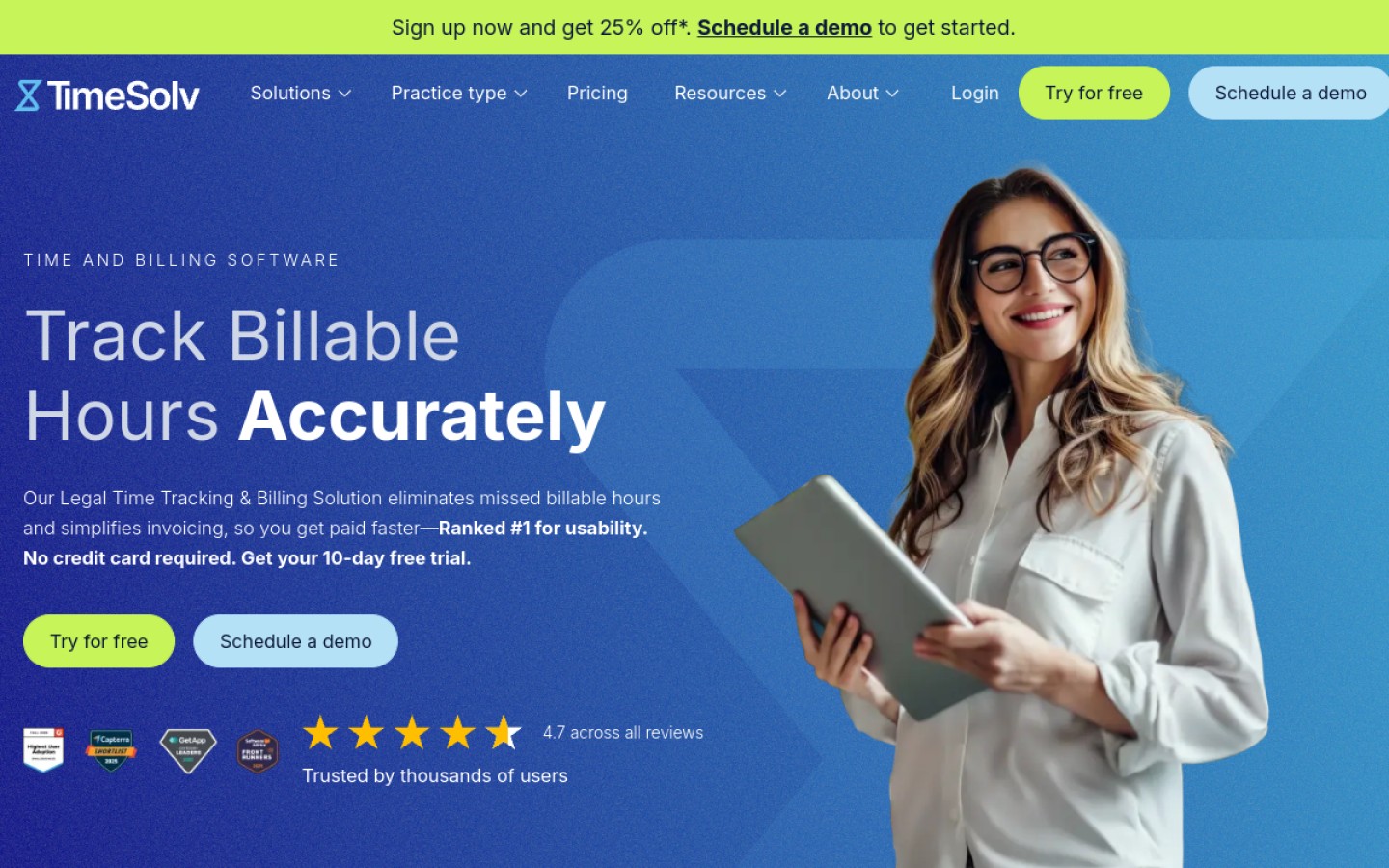
TimeSolv homepage, captured Nov 2026.
TimeSolv is a dedicated legal time and billing system rather than a full practice suite, built for firms that already have case management and only need time capture and billing done well. It covers timers, expenses, batch invoicing, flexible billing rates and recurring billing, with a 10-day free trial and no credit card required.
The trade off is scope. TimeSolv does not manage cases, documents or intake, so a firm needs another tool beside it, and trust accounting and LEDES billing wait for the Legal plan. It suits mid-size firms that want billing focus without paying for a full suite.
What we like
Focused on time and billing, with no suite bloat
Flexible rates, batch invoicing and recurring billing
Volume discounts for larger firms
10-day trial with no credit card
Watch out for
No case or document management
Trust accounting and LEDES need the Legal plan
Plan prices are not shown on the pricing page itself
PracticePanther is a full practice suite with matter management, calendaring, client communication, billing and payments in one system. The Solo plan at 49 dollars per user a month billed yearly covers matters, time tracking, document templates, task workflows and PantherPayments, with trust ledgers on every plan.
The trade off is that full trust accounting waits for the top tier. Three-way reconciliation and a general ledger sit in Business Pro at 114 dollars per user a month, so mid-size firms that need real accounting pay more than the entry price. It suits firms that want workflows and billing in one place.
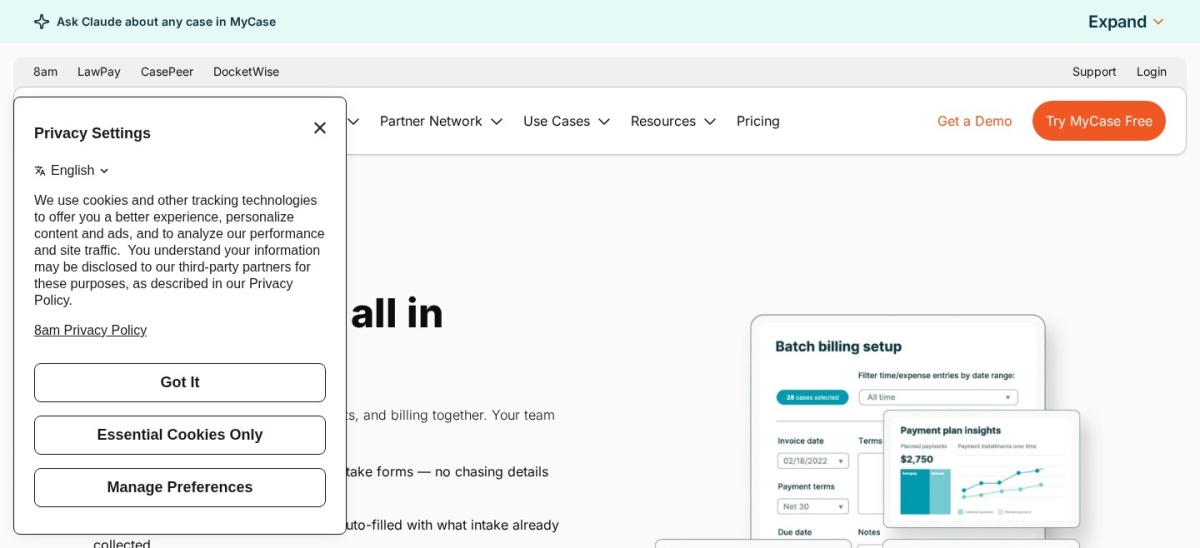
MyCase is a practice management system, now sold as 8am MyCase, covering cases, contacts, documents, billing and trust accounting in one login. Basic costs 50 dollars per user a month billed yearly and includes time entry, invoicing, online payments, unlimited document storage and a limited client portal, with a 10-day free trial.
The trade off is the step up. Smart Time Finder, which finds billable time you missed, waits for the 100-dollar Pro plan, and the full client portal needs Pro too. It suits firms that want one login for cases, billing and payments without a separate ledger.
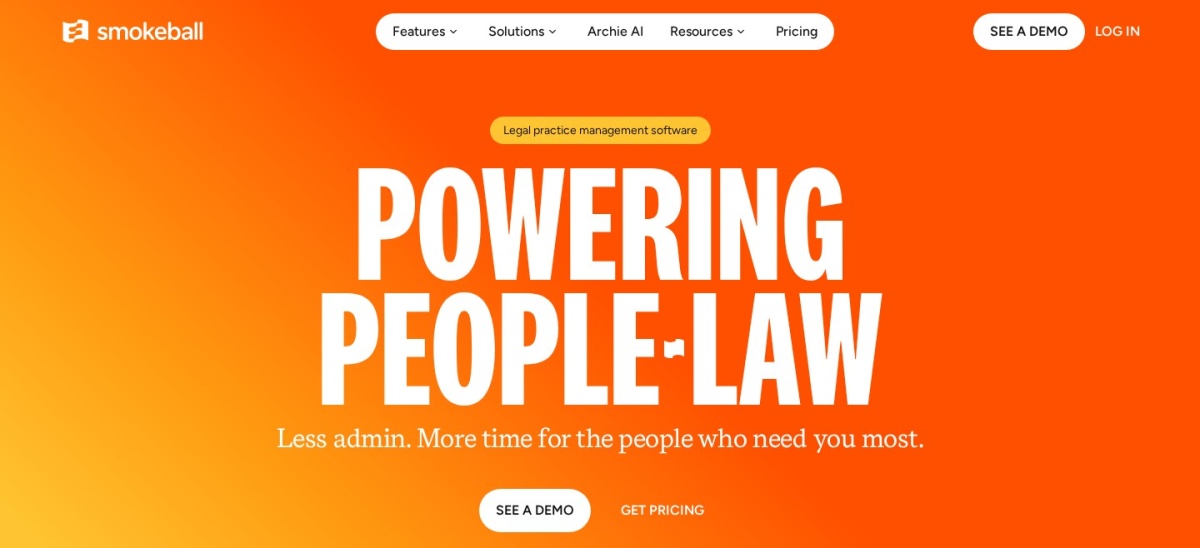
Smokeball is a practice management platform combining matter and document management with automatic time and activity tracking, document automation, pre-automated court forms, trust accounting and the Archie AI assistant. Its AutoTime feature records activity in Word and Outlook automatically, recovering billable hours that never had a timer running.
The trade off is pricing. The vendor website shows no per-user prices and asks firms to get a quote, so the 49-dollar entry price here comes from G2's vendor-supplied listing for the Bill plan. It suits firms whose biggest leak is unbilled time.
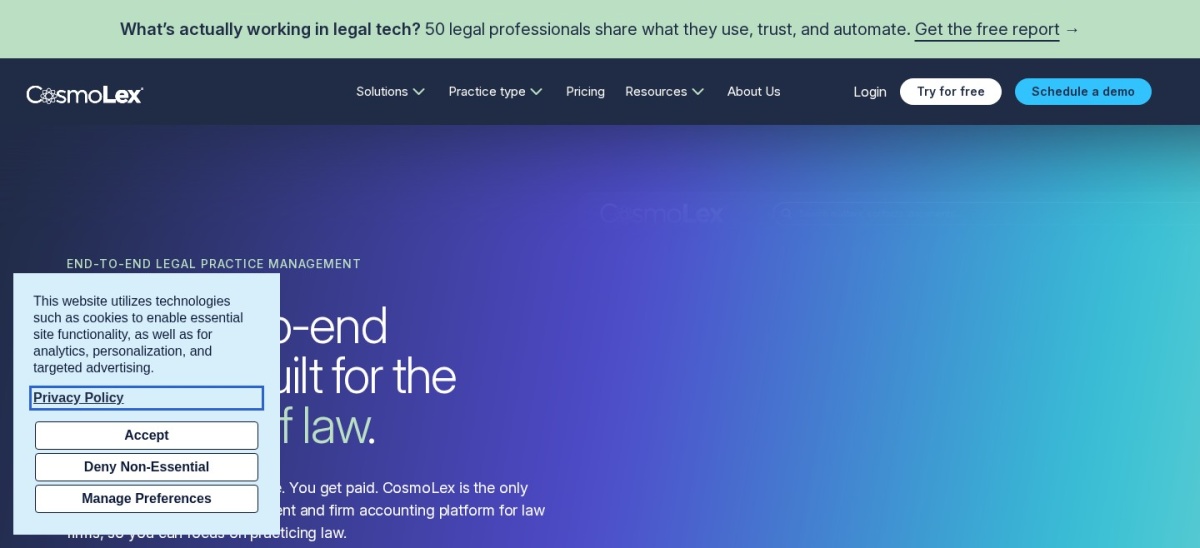
CosmoLex is a practice management platform combining built-in business accounting and trust accounting with matter management in a single system, which is its main draw for small and mid-size firms. The Launch plan starts at 49 dollars per user a month on annual billing, with Core at 99 and Pro at 129 dollars.
The trade off is the learning curve. Built-in accounting replaces QuickBooks, which saves a subscription but asks the firm to run its books inside CosmoLex. It suits firms that want matters, billing and the ledger in one place.
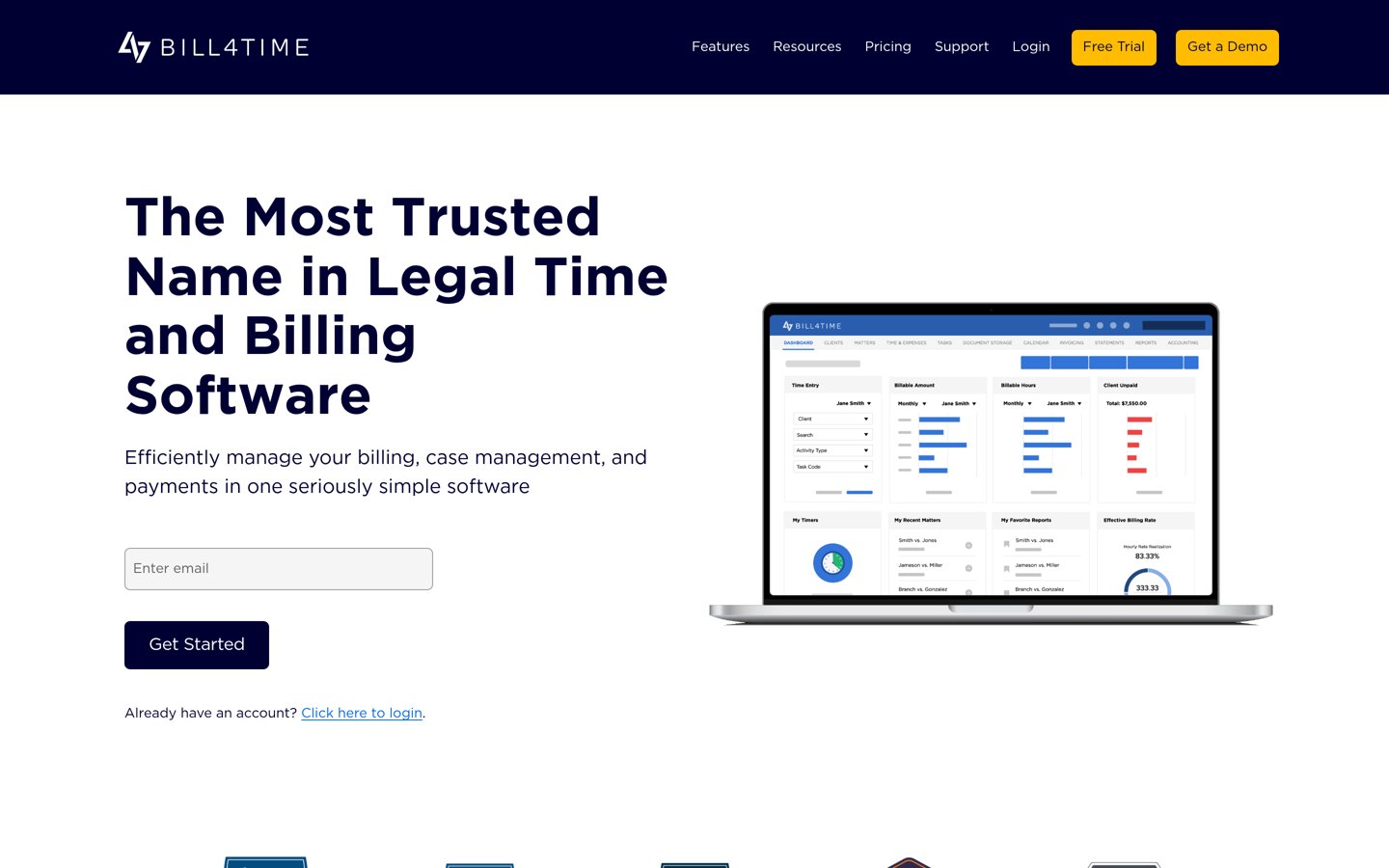
Bill4Time is a billing-first tool for law firms and professional service firms, built around time tracking, expenses, invoicing and reporting. It starts at 39 dollars per user a month billed yearly, making it the cheapest full time and billing option in this list, with a 14-day free trial.
The trade off is scope. Bill4Time covers time and billing well but is not a full practice suite, so matters, documents and intake live elsewhere. It suits firms that already have case management and want the cheapest dedicated billing tool.
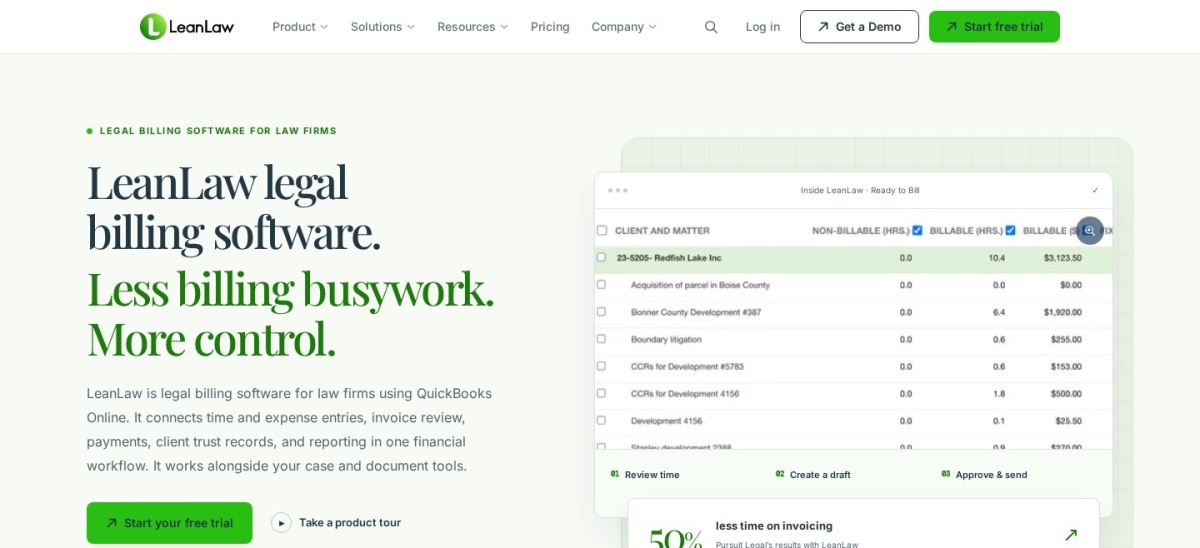
LeanLaw is a legal billing platform that runs as the financial layer on top of QuickBooks Online, syncing time, expenses, invoices and trust transactions two ways. The Core plan starts at 55 dollars per user a month and covers hourly, fixed-fee and contingency billing with real-time reporting.
The trade off is dependence on QuickBooks Online, which is an extra subscription on top of LeanLaw, and the higher Contingency and Elite tiers are quote-only. It suits firms that already run their books in QuickBooks and want billing to live there too.
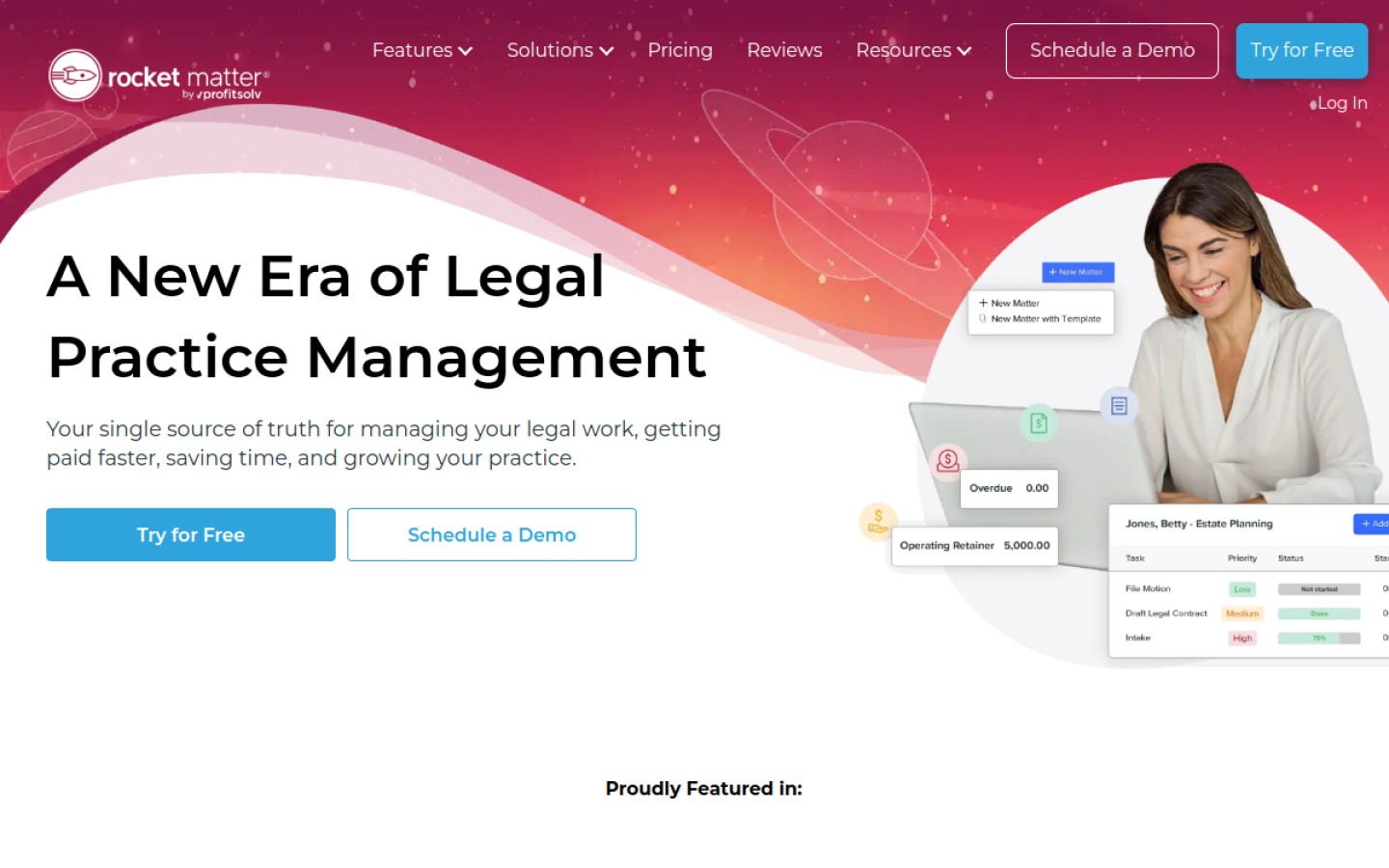
Rocket Matter is a cloud practice management platform built around time tracking, batch billing and trust accounting for small to mid-size firms. Essentials costs 59 dollars per user a month billed yearly and covers matters, calendars, documents, workflows and Kanban boards, with native IOLTA trust accounting.
The trade off is the price spread. The vendor page also states plans start at 49 dollars per user a month, so the entry price sits in a 49 to 59 dollar range, and intake CRM is a paid add-on. It suits firms that live in their invoices and want billing first.
Full suites such as Clio, MyCase and PracticePanther cover the whole matter lifecycle, while specialists such as TimeSolv and LeanLaw focus on time and billing and sit beside other tools.
A specialist is cheaper when the firm already has case management. TimeSolv and Bill4Time cost less than most suites and do one job well.
A suite wins when the firm wants one login. Matters, documents, time, billing and trust accounting share one record, so nothing is re-entered.
How we chose
We started from the legal timekeeping tools with a published user rating on G2 or Capterra and a public price, then kept the nine that fit a mid-size firm of 10 to 50 lawyers.
Prices come from each vendor's pricing page, checked on 30 November 2026. Ratings and review counts come from G2 and Capterra on the same day. Where a vendor shows a monthly and an annual price, the list shows the annual rate.
We left out tools with no aggregator rating and quote-only suites with no published entry price. No vendor paid for a place, and we do not claim hands-on testing for this list.
How to choose legal timekeeping software for a mid-size firm
Price it for the whole firm, then check trust accounting on the tier you would actually buy.
Count the hours you lose now. Ask each lawyer how many billable hours go unlogged each week. If the answer is more than two, automatic capture tools like Smokeball pay for themselves.
Check trust accounting on the plan you would buy. Three-way reconciliation and LEDES billing sit on higher tiers at TimeSolv, PracticePanther and Bill4Time, so confirm the tier before you sign.
Price it for the whole firm. Multiply the per-user price by every lawyer and paralegal who will log time. A 20-person firm at 49 dollars a user pays close to 12,000 dollars a year.
Trial it on a real matter. Run one live matter through the trial, from timer to invoice, and check the invoice against the firm's billing rules before you commit.
FAQ
What is the best legal timekeeping software for mid size law firms?
Clio is the best legal timekeeping software for mid size law firms. It covers timers, billing, payments and trust accounting from 49 dollars per user a month, with the largest integration ecosystem and a 4.6 out of 5 G2 rating from more than 1,100 reviews.
How much does legal timekeeping software cost?
Most tools in this list start at 39 to 59 dollars per user a month on annual billing. A 20-lawyer firm pays roughly 9,400 to 14,200 dollars a year at those rates, before volume discounts or quote-only tiers.
Is there a free legal timekeeping software for law firms?
No tool in this list has a free plan. Every one offers a free trial of 7 to 14 days instead, and CaseFox, which we left out, is the only one with a free tier for solo lawyers.
What is automatic time capture, and is it worth it?
Automatic time capture records work in Word, Outlook and other apps without a running timer. Smokeball's AutoTime does this, and it suits firms that lose billable hours to forgotten timers, though it needs the top Prosper+ plan.
Is Clio or TimeSolv better for a mid-size firm?
Clio is better for firms that want one system for matters, documents, billing and trust accounting. TimeSolv is better for firms that already have case management and only need time capture and billing done well, at the same starting price.
Do these tools support LEDES billing?
Yes, most do. Clio, PracticePanther, CosmoLex, TimeSolv, Bill4Time and Rocket Matter all support LEDES or UTBMS billing, though at TimeSolv and PracticePanther it sits on a higher tier, so check the plan before you buy.
SaaS SEO and WordPress specialist with about 8 years of experience. Rakib compares WordPress plugins, themes, hosting and software using public pricing, documentation and user reviews. See how we rank.