Procore is the best ERP software for the construction industry, with project, financial and field tools on one platform for large general contractors. Acumatica suits cloud-first mid-market firms, while Sage Intacct fits finance-led teams that keep a separate project tool.
How we make this list: we compare pricing pages, product documentation and public user reviews, then re-check every price before each update. No product paid for a place. Disclosure.
Procore leads for large general contractors, with the biggest G2 review base here and unlimited users priced on construction volume.
Acumatica is the best cloud-first mid-market pick, with unlimited named users and consumption-based pricing.
Sage Intacct fits finance-led firms that want strong multi-entity accounting and keep a separate project tool.
Premier Construction Software is the best fit for growing general contractors that want ledger and project in one cloud system.
Business Central is the only published price here, with Essentials at $70 a user a month.
How do you choose ERP software for the construction industry?
Construction ERP is different from general ERP. Job costing, progress billing, certified payroll and subcontractor management sit at the centre, not at the edge.
The general ledger is the first test. A platform without a real ledger, like Procore on its own, still needs an accounting system beside it, which changes the true cost.
Implementation time is the second test. Enterprise construction platforms commonly take 6 to 18 months to go live, while cloud mid-market tools can start in weeks.
Almost nothing here publishes a price. Business Central is the exception at $70 a user a month, so every other figure in this list is a quote to request against your annual construction volume.
The 9 best ERP software for the construction industry
01
Procore
4.6/5on G2 (3,954 reviews, checked Nov 2026)
PricingCustom/yr
Best ERP software for large general contractors
Pricing modelAnnual construction volume
UsersUnlimited
General ledgerNo, needs accounting beside it
Free planNo
procore.com
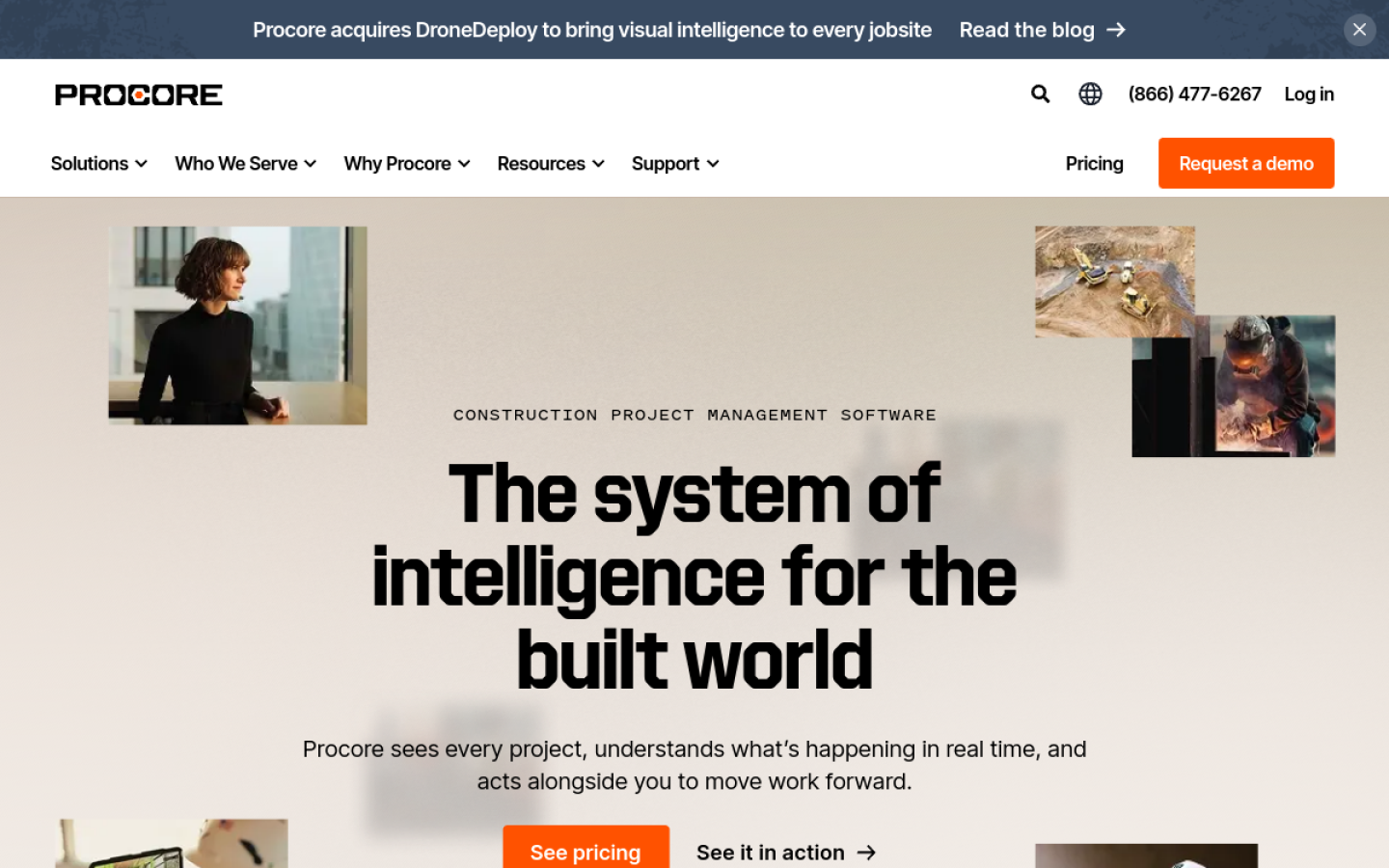
Procore homepage, captured Nov 2026.
Procore is the best-known construction management platform, covering project management, documents, RFIs, submittals, quality, safety and financials. It has more than 17,850 customer companies and a 4.6 rating on G2, with unlimited users included in the subscription.
The trade off is price and the ledger. Procore charges an annual fee per product based on annual construction volume, with no published rates, and it has no general ledger, so accounting stays in a separate system. It suits large general contractors running 30 or more concurrent projects.
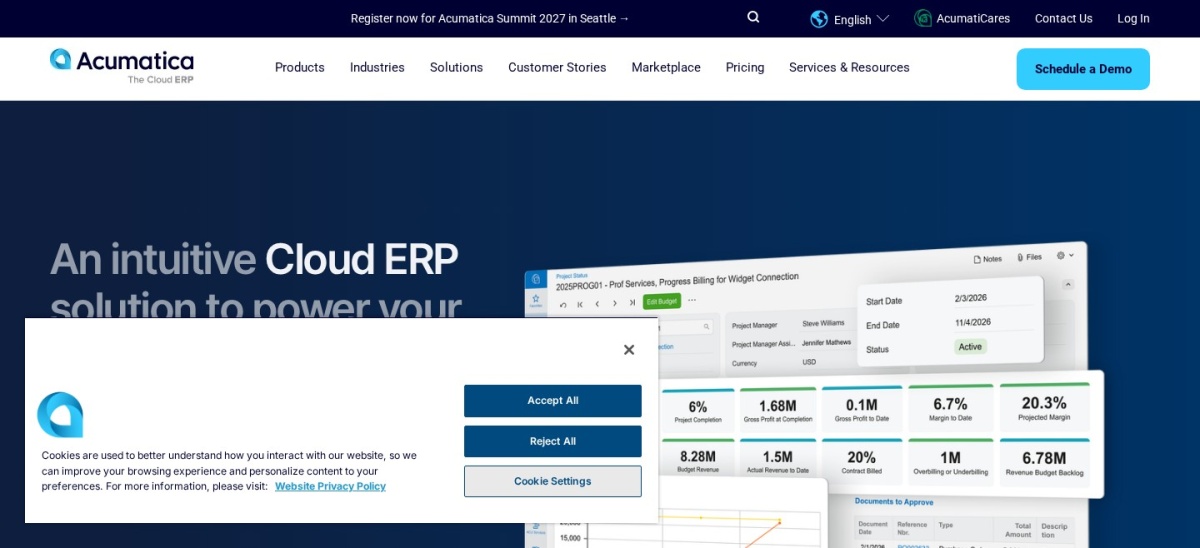
Acumatica is a cloud ERP for contractors that want a full ledger with construction depth and unlimited named users. It covers financials, project accounting, payroll integration and field service, with consumption-based licensing instead of per-seat fees.
The trade off is construction depth. Some construction features depend on the partner build, and the quote is custom, with total costs commonly reported from $75,000 to $350,000. It suits cloud-first mid-market contractors that want to add users without adding licence fees.
Sage Intacct is a cloud accounting platform for finance-led firms that want dimensional accounting and consolidated reporting across entities. It handles job costing, budgets, billing and multi-entity consolidation, and pairs with a separate project management tool for field work.
The trade off is the field gap. It is an accounting platform first, so drawings, RFIs and daily logs live elsewhere, and pricing runs through partners by quote. It suits firms whose main problem is financial consolidation, not field coordination.
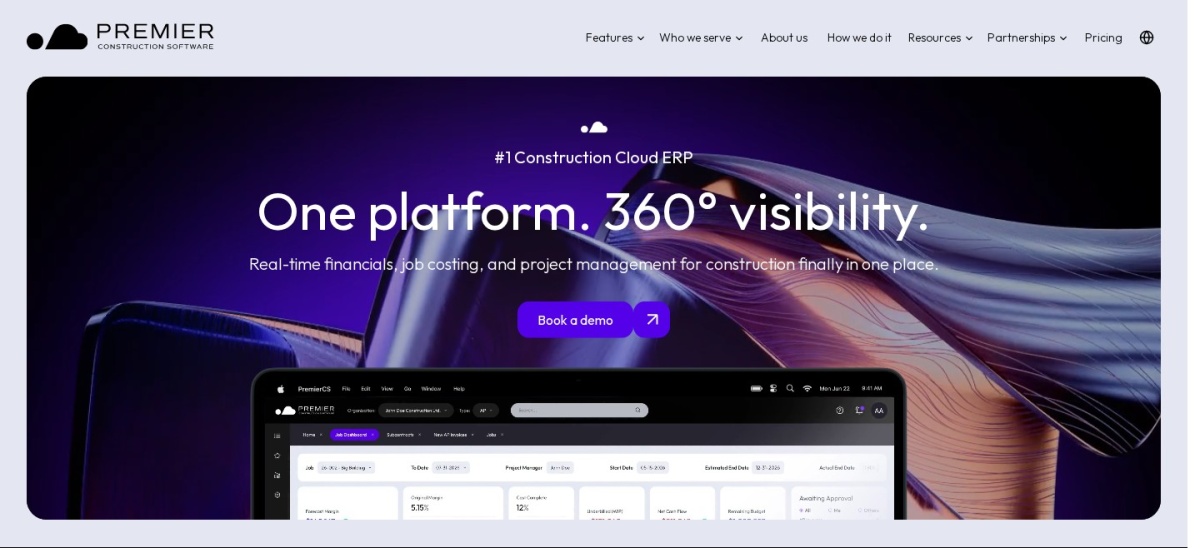
Premier Construction is a cloud construction ERP built around construction accounting, with project management and field tools in the same database. It targets general contractors and developers that want the ledger and the project in one place, with a quote builder on the vendor site.
The trade off is estimating. There is no native estimating module, and payroll runs through an integration, so firms with heavy estimating needs should check that first. It suits growing mid-market contractors moving off desktop accounting.
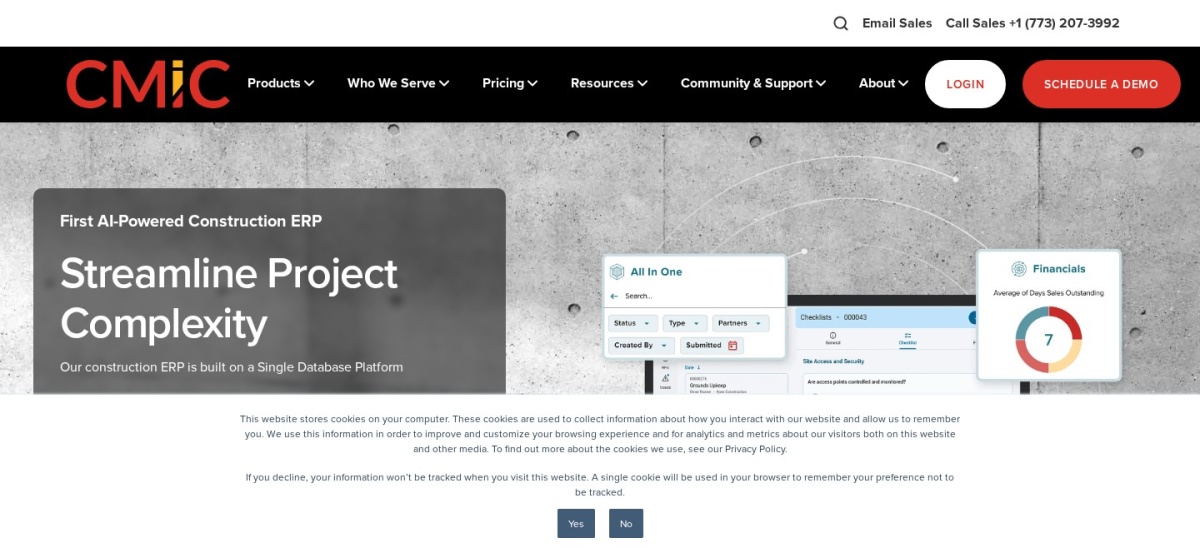
CMiC is an enterprise construction ERP that runs financials, project management, payroll and HR on a single database. It is common among the largest North American contractors, and it is the product people mean when they say full ERP in a boardroom.
The trade off is time and cost. Implementations commonly run 6 to 18 months, pricing is a custom quote, and typical annual costs run from $50,000 to $150,000. It suits ENR-scale contractors standardising on one enterprise stack.
What we like
Financials, projects, payroll and HR in one database
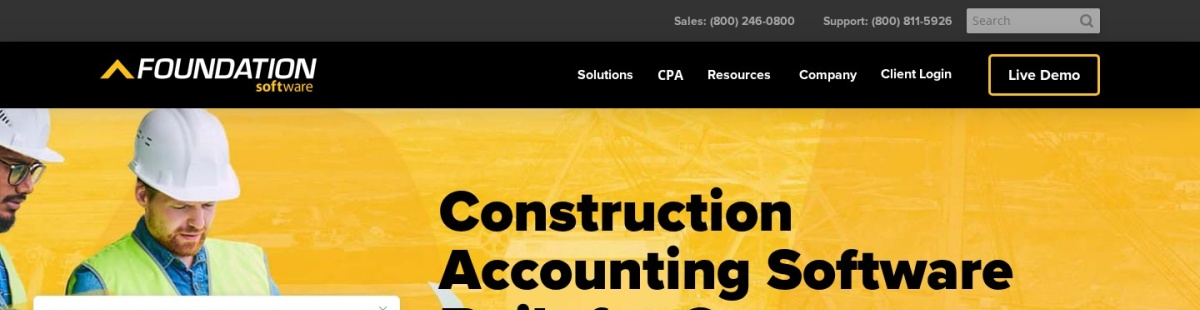
Foundation Software is a US construction accounting platform for general and specialty contractors focused on job cost and certified payroll. It covers job costing, payroll, project management and accounting in one system built for American contractors.
The trade off is breadth. Multi-entity and multi-currency handling are weak, so firms with overseas work need another tool for that. It suits US contractors whose daily problem is job cost and prevailing-wage payroll.
Sage 300 CRE is an established on-premise construction accounting system for firms with heavy union and prevailing-wage payroll. It covers job costing, payroll, billing and project management, and has served US contractors for decades.
The trade off is age. The interface and architecture show their age next to cloud tools, and it is primarily on-premise or hosted rather than true cloud. It suits established firms that want proven construction payroll and are not chasing a modern interface.
Trimble Viewpoint Vista homepage, captured Nov 2026.
Trimble Viewpoint Vista is a construction ERP for large self-perform contractors with in-house IT, covering project accounting, payroll, equipment costing and multi-entity controls. It is strongest where equipment fleets and heavy civil work drive the cost picture.
The trade off is reporting. Reporting needs a specialist to build, and pricing is quoted per deal on users, modules and migration scope. It suits established mid-to-large contractors with the IT staff to run it.
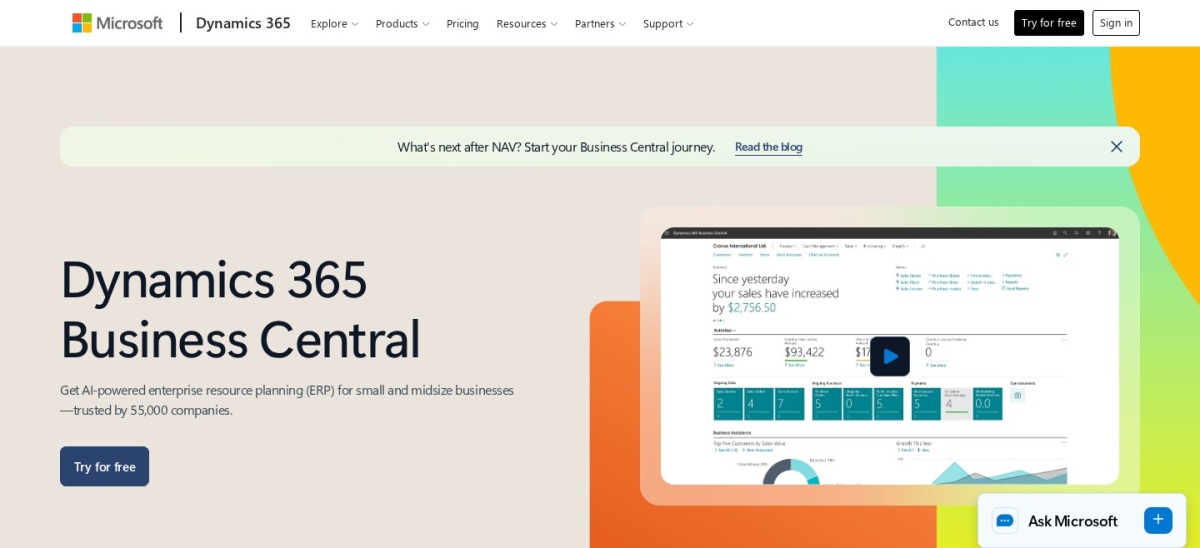
Business Central is a general cloud ERP with construction extensions, and it is the only tool here with a published price. Essentials costs $70 a user a month and covers financials, sales, purchasing, inventory, jobs and warehousing, with Premium at $100 adding manufacturing and service management.
The trade off is construction depth. It is a general ERP, so construction-specific workflows come from partner extensions, and implementation plus extensions can cost $10,000 to $25,000 for a single entity. It suits Microsoft-centric firms that want a real ledger at a known price.
What a construction ERP must do that a normal ERP does not
Job costing is the core. Every hour, machine and material must land on a cost code, or the project margin is a guess.
Progress billing follows the job, not the calendar. Retention, change orders and billed-to-date figures need to live with the project record.
Payroll is rarely simple. Union rates, prevailing wage and certified payroll reports are daily work for many US contractors.
Field data must flow back the same day. Daily logs, RFIs and submittals from the site should reach the office without retyping.
How we chose
We started from construction ERP platforms with a live G2 or Capterra rating and a construction-specific ledger, job costing or project module.
Prices come from each vendor pricing page or G2 vendor-supplied pricing, checked on 30 November 2026. Procore, Acumatica, Sage Intacct, CMiC, Premier, Foundation, Sage 300 and Viewpoint all sell by quote. Business Central Essentials is $70 a user a month.
We left out tools with no aggregator rating. No vendor paid for a place, and we do not claim hands-on testing for this list.
How to choose ERP software for the construction industry
Start with your job costing and payroll needs, then test the ledger before the field tools.
List your must-have ledger features. Job costing, progress billing and certified payroll decide the shortlist, so write them down before any demo.
Check the implementation timeline. Ask for a written go-live date and cost, since enterprise platforms commonly take 6 to 18 months.
Test a real job from bid to billing. Run one finished project through the demo, from estimate to final invoice, and watch where the data stalls.
Get the full quote, not just the licence. Ask for licence, implementation, training and renewal uplifts in one written quote, since most tools here publish no prices.
FAQ
What is the best ERP software for the construction industry?
Procore is the best pick for large general contractors, with field, project and financial tools on one platform and the largest G2 review base here. Acumatica is the better buy for cloud-first mid-market firms that want unlimited users.
How much does ERP software for construction cost?
Almost every platform here sells by custom quote, priced on users, modules and implementation scope. Reported starting points run from about $4,500 a year for small Procore deals to six figures for enterprise CMiC or SAP rollouts, plus implementation.
Is there a construction ERP with a published price?
Yes. Microsoft Dynamics 365 Business Central publishes Essentials at $70 a user a month, with Premium at $100. Every other tool in this list quotes, so ask for a written quote that includes implementation.
Which construction ERP is best for small contractors?
Premier Construction Software fits growing general contractors best, with cloud accounting and project management in one system and a quote builder on the vendor site. Business Central is the best value if you already run Microsoft 365.
Procore vs Acumatica for construction: which is better?
Procore is better when field coordination and subcontractor management are the main problem, with unlimited users priced on construction volume. Acumatica is better when you want a full cloud ERP ledger with unlimited named users and consumption-based pricing.
Does construction ERP include payroll?
Some do and some do not. CMiC, Sage 300 and Foundation Software run payroll natively, including certified payroll. Procore and Acumatica handle payroll through partners or integrations, so confirm it before you sign.
SaaS SEO and WordPress specialist with about 8 years of experience. Rakib compares WordPress plugins, themes, hosting and software using public pricing, documentation and user reviews. See how we rank.