Clinicea leads our dialysis center management software list at $59 a user a month, with the highest user rating of the seven tools here. Most dialysis vendors sell by quote only, so shortlist on dialysis workflows, machine data capture and billing before you book demos.
How we make this list: we compare pricing pages, product documentation and public user reviews, then re-check every price before each update. No product paid for a place. Disclosure.
Clinicea leads for small and mid-size centers, with the highest rating here at 4.8 out of 5 and a published price of $59 a practitioner a month.
Epic is the deepest EHR in the list, with MyChart and more than 3,700 connected apps, but it needs a 9-month implementation.
eClinicalWorks and AdvancedMD are the only other tools with published prices, at $499 and from $429 a provider a month.
athenaOne and NextGen bring AI scribes, with athenaOne billing as a percentage of collections.
Renvio, RenalGenie and CyberREN are dialysis-specific but have no public G2 or Capterra rating, so they are not ranked.
Most dialysis vendors sell by quote only, so get implementation and interface costs in writing before you budget.
How do you choose dialysis center management software?
Dialysis software is mostly the record that follows a patient through treatment. It has to join scheduling, chair assignments, machine data, labs, medications and billing into one chart, because a missed lab or a wrong dialyzer setting is a safety issue, not an admin one.
Most dialysis vendors sell by quote only. Four of the seven tools in this list publish no price, so the buying conversation starts with a demo and a written quote, and implementation and interface work usually costs more than the licence itself.
The dialysis-specific tools have almost no public review base. Renvio, RenalGenie and CyberREN publish no G2 or Capterra rating, so this list ranks the rated systems dialysis centers actually run on: one cloud clinic platform and six EHRs with dialysis workflows. Our hospital software guide covers the same EHRs in a hospital setting.
Ask for a demo built around your own shifts. Run a full treatment day through the system: chair scheduling, machine data capture, Kt/V adequacy reporting, lab results and billing, plus how the system shares data with the hospital or nephrology practice.
The 7 best dialysis center management software tools
01
Clinicea
4.8/5on Capterra (47 reviews, checked Nov 2026)
Starts at$59/mo
Best for small dialysis centers that want a cloud system
Cheapest planStarter, $59 a practitioner a month
Free trial14 days
Dialysis workflowsScheduling, charting, billing
Specialties40 across 5 continents
clinicea.com
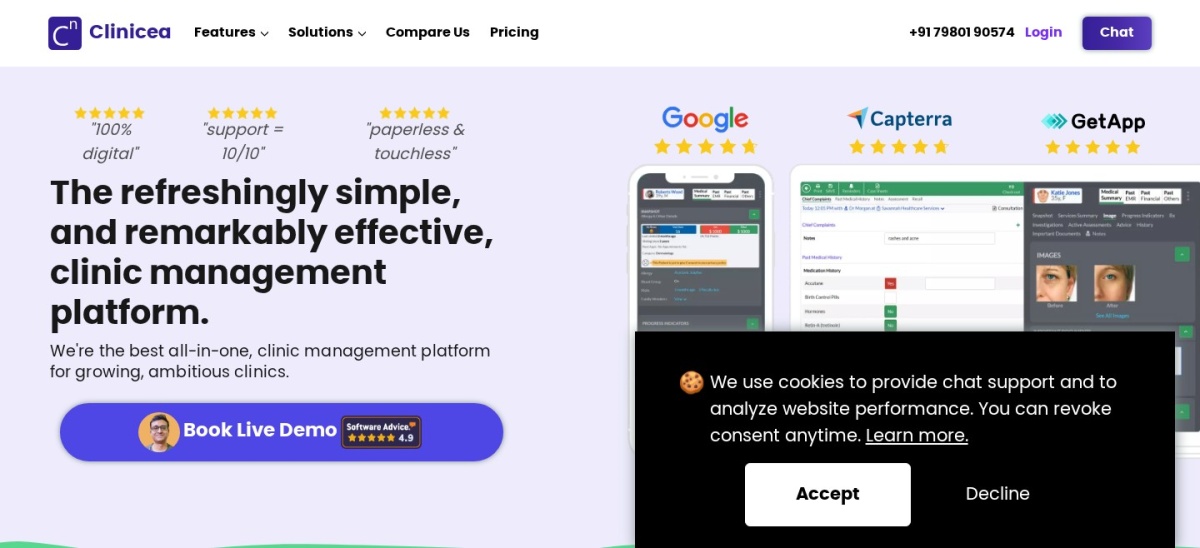
Clinicea homepage, captured Nov 2026.
Clinicea is a cloud clinic management platform used across 40 specialties on five continents, and it is the only system in this list built for smaller clinics rather than hospitals. Its custom EMR recreates a clinic's paper forms digitally, and it covers scheduling, charting, billing, inventory and a patient portal, with a 14-day free trial. The Starter plan costs $59 a practitioner a month.
The trade off is dialysis depth. Clinicea is a general clinic platform, not a dialysis-only record, so centers that need direct dialysis machine data capture or renal-specific adequacy reporting should check those workflows in the trial. It suits small and mid-size dialysis centers that want one cloud system for scheduling, notes and billing without a hospital-sized rollout.
What we like
Highest rating here at 4.8 out of 5 on Capterra
Only published starting price under $100 a month here
Scheduling, charting, billing and a patient portal in one system
Epic is the electronic health record used by large hospitals and health systems, covering inpatient care, emergency, surgery, pharmacy and billing in one record. Its MyChart portal lets patients view results, message care teams and manage appointments, and Epic lists more than 3,700 apps connected to its platform. Dialysis groups inside a hospital system can run treatment schedules and labs on the same record as the rest of the patient's care.
The trade off is scale and cost. G2 reviewers report an average implementation time of 9 months, and pricing is by quote only, so smaller centers face a long, expensive rollout. It suits large dialysis groups and hospital-owned centers that need deep inpatient coverage and can staff the project.
What we like
Deepest inpatient and clinical coverage here
MyChart is the best-known patient portal
More than 3,700 connected apps
Highest G2 rating here from 942 reviews
Watch out for
Quote-only pricing with no published starting price
Best for dialysis centers that want billing handled
Network180,000-plus clinicians
BillingPercentage of collections
Ambient scribeIncluded
Implementation2 months on average
athenahealth.com
athenaOne homepage, captured Nov 2026.
athenaOne is a cloud EHR, billing and patient engagement platform from athenahealth, used by more than 180,000 clinicians. It combines charting, scheduling, claims and an embedded ambient scribe, and it won Best in KLAS 2026 for practices with 11 to 75 physicians. Dialysis centers that bill insurers for recurring treatments get charting and revenue cycle work from one vendor.
The trade off is price opacity. Pricing is a percentage of collections with no published rate, so the bill grows as the center's revenue grows, and G2 reviewers report rising costs after the first period. It suits dialysis centers that want billing and EHR from one vendor and a 2-month average implementation.
What we like
EHR, billing and engagement in one platform
More than 180,000 clinicians on the network
Embedded ambient scribe for notes
Fastest average implementation here at 2 months
Best in KLAS 2026 for 11 to 75 physician practices
Watch out for
Quote-only pricing with no published rate
Billing is a percentage of collections, so costs grow with revenue
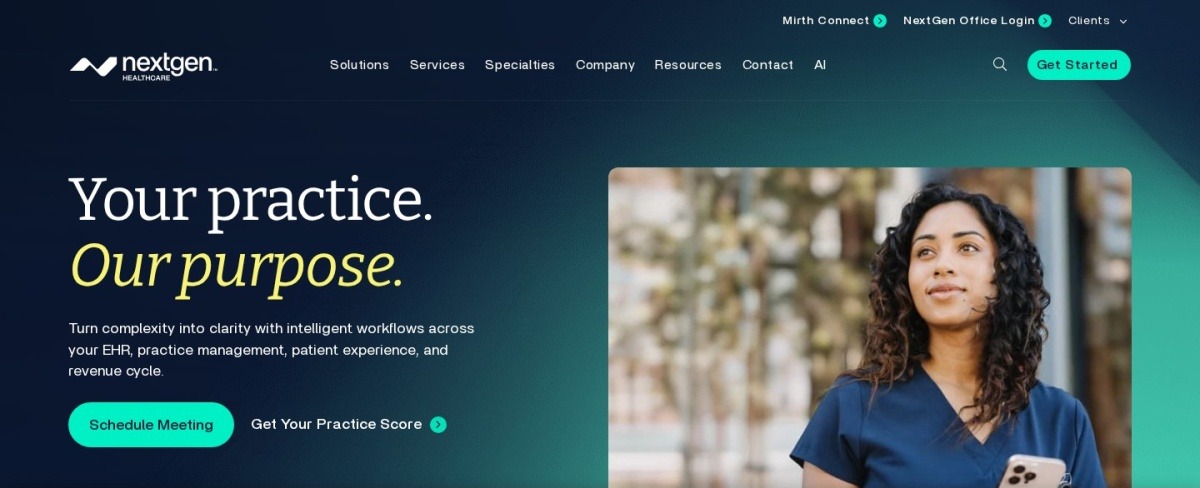
NextGen Healthcare is an EHR vendor selling its system in two editions: NextGen Office for smaller practices and NextGen Enterprise for larger groups. Both cover charting, scheduling, billing and patient engagement, with a mobile EHR, Ambient Assist for AI notes, and reminders in more than 33 languages. A dialysis group can start on Office and move to Enterprise without changing vendors.
The trade off is quote-only pricing and a long rollout. G2 reviewers report an average implementation of 4 months, and third-party estimates put NextGen Office at $299 to $549 per provider per month, which NextGen does not publish. It suits groups that may grow into an enterprise system.
What we like
Two editions that scale with group size
Mobile EHR with notes flowing to the chart
Ambient Assist AI scribe
Reminders in more than 33 languages
Watch out for
Quote-only pricing with no published starting price
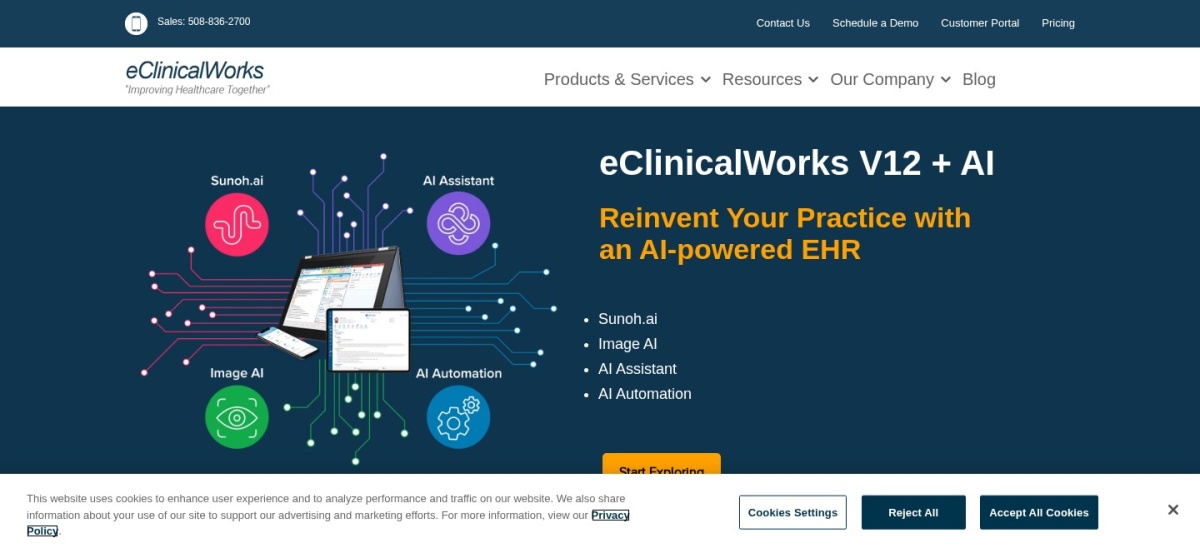
eClinicalWorks is a cloud EHR used by more than 180,000 physicians and nurse practitioners across 110,000 facilities. Version 12 adds AI tools including Sunoh.ai, an AI scribe, healow Genie for patient calls, and Image AI, alongside e-prescribing, telehealth and practice management. EHR only starts at $499 per provider per month, or $599 with practice management.
The trade off is the per-provider price. EHR only starts at $499 per provider per month, and revenue cycle services cost 2.9% of collections, so a center with many chairs and shifts should model the full seat count first. It suits clinics that want a published price and a large, established user base.
Best for dialysis centers that want bundled billing
Starting price$429 a provider a month
BundlesUp to 40% off bundled
Revenue cycle4 to 8% of collections
OnboardingAbout 90 days
advancedmd.com
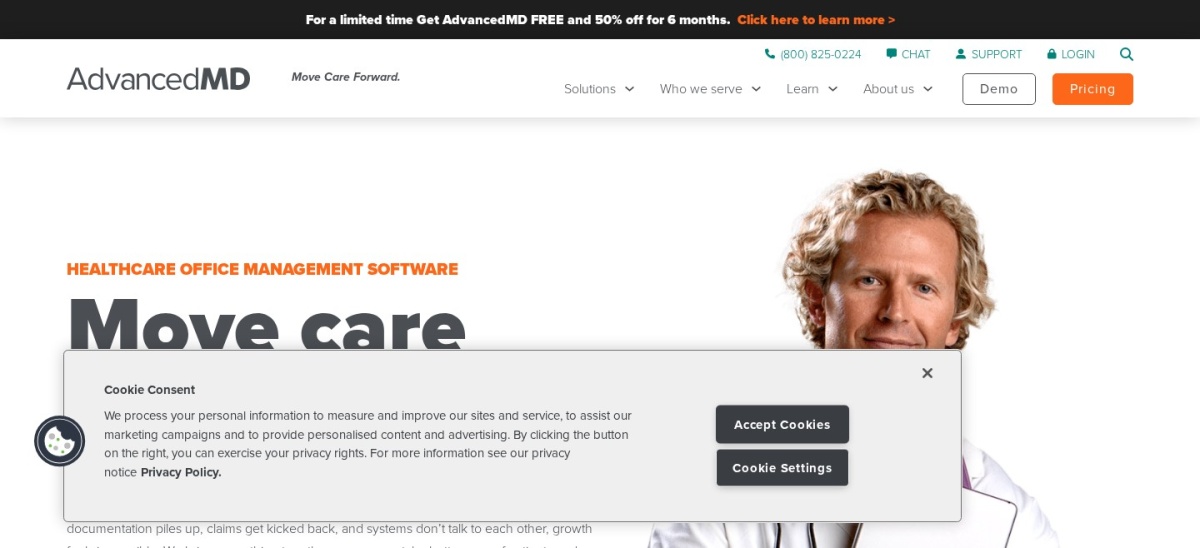
AdvancedMD homepage, captured Nov 2026.
AdvancedMD is a cloud EHR, practice management and billing platform for independent practices, priced per provider per month. Its medical-specialty plans start at $429 a provider a month, with bundles of EHR, practice management and patient engagement saving up to 40% against buying each product alone. Encounter-based pricing from $0.87 per claim suits centers with low claim volumes.
The trade off is the entry cost for a specialty practice. Medical-specialty pricing starts at $429 a provider a month, and setup fees can reach $6,000 for complex migrations, while the AI Clinical Assistant costs $100 a provider a month extra. It suits dialysis centers that want one vendor for charting, billing and engagement with published prices.
What we like
Specialty pricing published per provider
Bundles save up to 40% against buying each product alone
Encounter-based pricing for low-volume centers
RCM service includes the core software at no extra charge
Watch out for
Medical-specialty pricing starts at $429 a provider a month
Setup fees can reach $6,000 for complex migrations
MEDITECH Expanse is an EHR built for independent and community hospitals, covering inpatient, emergency, ambulatory and ancillary care in one record. It adds AI-driven insights for clinicians and leaders, plus Traverse Exchange, its network for sharing patient data with other organisations. A hospital-owned dialysis unit runs on the same record as the wards and the lab.
The trade off is reviewer satisfaction. Expanse is rated 3.1 out of 5 on G2 from 116 reviews, the lowest score in this list, with reviewers citing an older interface and limited customisation. It suits independent hospitals that want one system for the whole hospital at a price reviewers describe as affordable for most facilities.
What we like
Built for independent and community hospitals
One record across inpatient and ambulatory care
Traverse Exchange for sharing patient data
Reviewers describe it as affordable for most facilities
A dialysis record must track the treatment itself, not just the visit. Chair and shift scheduling, dialyzer and machine settings, blood flow and ultrafiltration rates, and adequacy measures such as Kt/V belong in the chart, or staff end up keeping a second record on paper.
Machine data capture is the gap to check first. Some systems pull readings straight from the dialysis machine, while others need manual entry, and that difference decides how much time nurses spend typing instead of watching patients.
Billing is the other half of the decision. Dialysis centers bill per treatment with complex payer rules, so the system should handle recurring treatment billing, lab ordering and claims without a separate billing tool.
How we chose
We started from every dialysis-specific system and every EHR dialysis centers run on, then kept the seven with a real user rating on G2 or Capterra. Clinicea is the only smaller cloud system with a review base; the rest are EHRs used by dialysis centers inside hospitals and larger practices.
Prices come from each vendor's pricing page, checked on 30 November 2026. Clinicea publishes $59 a practitioner a month and AdvancedMD publishes specialty pricing from $429 a provider a month; where a vendor publishes no price, the list says so instead of guessing.
We left out dialysis-specific systems with no public rating, including Renvio, RenalGenie and CyberREN, because their quality cannot be checked against a review base. No vendor paid for a place, and we do not claim hands-on testing for this list.
How to choose dialysis center management software
Start with a full treatment day, then match the record to your shifts and machines.
Map a full treatment day. Chair scheduling, machine settings, labs, medications and billing all belong in the record, so check the tool covers each one.
Check machine data capture. Some systems pull readings straight from the dialysis machine and others need manual entry, so see it working in a demo.
Confirm the total price. Most vendors quote, so get the licence, implementation and interface costs in writing before you budget.
Run a trial with your own shifts. Use real schedules and patient flows in the trial, and see whether nurses spend less time typing and more time with patients.
FAQ
What is the best dialysis center management software?
Clinicea is the best pick for small and mid-size centers. It starts at $59 a practitioner a month, holds a 4.8 out of 5 rating on Capterra from 47 reviews, and covers scheduling, charting, billing and a patient portal in one cloud system. Larger hospital-owned units should look at Epic or MEDITECH Expanse instead.
How much does dialysis center management software cost?
Most dialysis vendors sell by quote only, so there is no published price to compare. The exceptions here are Clinicea at $59 a practitioner a month, eClinicalWorks at $499 a provider a month, and AdvancedMD from $429 a provider a month for medical specialties. Budget for implementation and machine interfaces on top of the licence.
Is there a free dialysis center management software?
No tool in this list has a free plan. Clinicea offers a 14-day free trial, and RenalGenie offers a one-month free trial after a demo, but RenalGenie has no public G2 or Capterra rating, so it is not ranked here. Every other system in this list needs a paid plan or a quote.
Which dialysis software captures data from the machines?
Renvio Dialysis Manager and CyberREN are built around machine data capture, but neither has a public G2 or Capterra rating, so they are not ranked here. RenalGenie states it is not currently integrated with dialysis machines. Ask any vendor to show machine capture live in a demo before you buy.
Can a dialysis center use Epic or athenaOne?
Yes, if the center sits inside a hospital or a larger practice. Epic suits large hospital-owned dialysis units, and athenaOne suits centers that want charting and billing from one vendor. Standalone centers usually find a smaller cloud system such as Clinicea faster to roll out.
Why are Renvio and RenalGenie not in this list?
Both are dialysis-specific systems, but neither has a public rating on G2, Capterra or Trustpilot, and this list only ranks tools with a verifiable user rating. Renvio is a dialysis-only cloud record from Renesan and Visonex, and RenalGenie is a cloud EHR from RenalWorks with a one-month trial.
SaaS SEO and WordPress specialist with about 8 years of experience. Rakib compares WordPress plugins, themes, hosting and software using public pricing, documentation and user reviews. See how we rank.