CrowdStrike Falcon leads for cross-domain detection with a 4.7/5 G2 rating across 688 reviews and entry plans starting at $59.99/yr per device. Hexnode XDR fits device-focused teams at $5.50/mo per device, while TEHTRIS XDR Platform starts at $3/mo per user on Capterra.
How we make this list: we compare pricing pages, product documentation and public user reviews, then re-check every price before each update. No product paid for a place. Disclosure.
CrowdStrike Falcon holds a 4.7/5 rating from 688 G2 reviews with Falcon Go listed at $59.99/yr per device.
TEHTRIS XDR Platform lists a $3/mo per user starting price on Capterra with a 4.3/5 score across 3 reviews.
Hexnode XDR lists $5.50/mo per device on its official pricing page and holds a 70-review Capterra XDR feature benchmark.
SentinelOne Singularity Endpoint holds a 4.8/5 rating across 117 Capterra reviews and lists $179.99/mo usage-based pricing.
Microsoft Defender XDR rates 4.5/5 across 62 Capterra reviews and bundles into Microsoft 365 plans.
What to look for in an XDR platform
Extended detection and response (XDR) platforms correlate telemetry across endpoints, networks, identities, and cloud workloads instead of isolating alerts inside single tools. Strong correlation helps security teams spot multi-stage attacks earlier and group related events into one incident timeline.
Pricing models vary sharply across vendors, ranging from per-device annual licenses and per-user monthly rates to usage-based or quote-driven enterprise contracts. Promotional discounts and add-on modules such as extended data retention or managed response can change first-year totals.
Agent footprint, deployment speed, and existing stack fit also shape day-to-day operations. Teams should check whether a platform requires full replacement of current security tools or integrates with existing identity, email, and firewall systems.
For enterprise correlation across endpoint, network, and cloud
Custom/yr
No free plan
4.5/5
Price ladder: cheapest paid plan per year
List prices, USD, checked Nov 2026
CynetCustom
Cortex XDRCustom
TEHTRIS XDR$36
Defender XDR$36
CrowdStrike$60
Hexnode XDR$66
SentinelOne$2,160
The 7 best xdr platform
01
CrowdStrike Falcon
4.7/5on G2 (688 reviews, checked Nov 2026)
Starts at$59.99/yr
Best for broad threat detection and lightweight agent scale
Entry planFalcon Go ($59.99/yr)
Monthly option$7.99/mo per device
Device capUp to 100 on Go
G2 score4.7/5 (688 reviews)
crowdstrike.com
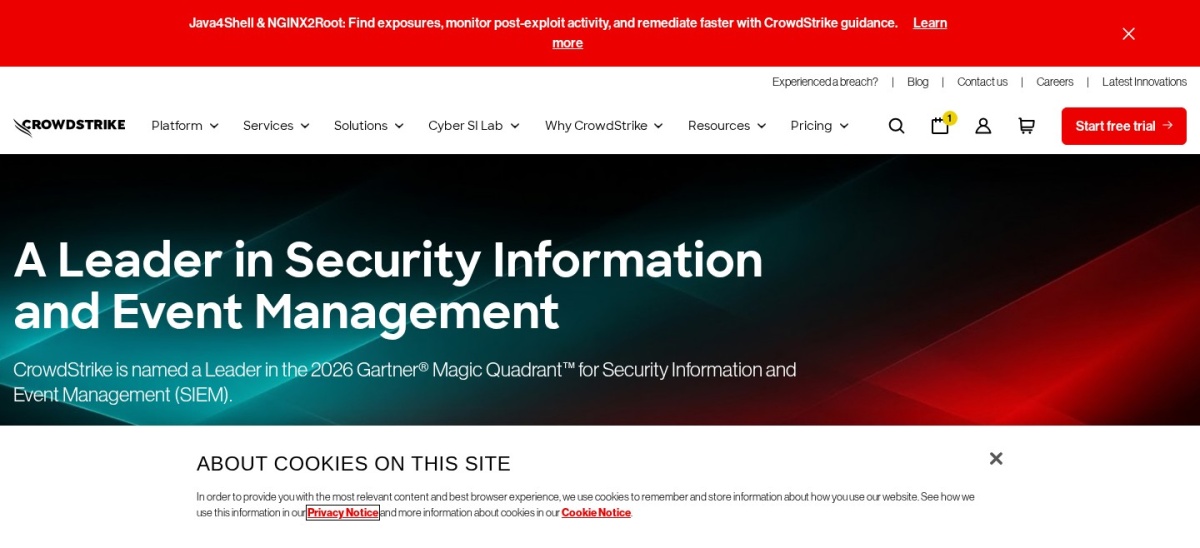
CrowdStrike Falcon homepage, captured Nov 2026.
CrowdStrike Falcon is a cloud-native security platform combining next-gen antivirus, endpoint protection, and threat intelligence. Its Falcon Go plan lists at $59.99 per device billed annually, or $7.99 per device billed monthly.
The trade off is that Falcon Go is capped at 100 devices and excludes full EDR, while Falcon Enterprise lists at $184.99 per device per year. It suits teams wanting a lightweight agent and clear published entry pricing.
What we like
Published annual pricing starting at $59.99 per device on Falcon Go
Strong 4.7/5 rating across 688 G2 reviews
Includes device control and mobile device protection on entry tier
Offers a 15-day free trial and 30-day cancellation refund policy
Watch out for
Falcon Go limits purchases to 100 devices maximum
Full EDR and threat hunting require higher tiers such as Falcon Enterprise
Add-on modules and higher tiers can raise total costs
Falcon Go covers up to 100 devices; Falcon Pro ($99.99/yr) adds firewall management and Falcon Enterprise ($184.99/yr) adds EDR and threat hunting.Visit crowdstrike.com
02
TEHTRIS XDR Platform
4.3/5on Capterra (3 reviews, checked Nov 2026)
Starts at$3/mo
Best for low starting per-user pricing and broad OS support
Capterra start$3/mo per user
DeploymentCloud or on-prem
Capterra rating4.3/5 (3 reviews)
IntegrationsEmail and web APIs
tehtris.com
TEHTRIS XDR Platform homepage, captured Nov 2026.
TEHTRIS XDR Platform is a detection and response platform available in cloud or on-premises deployments with API connectors for third-party security tools. Capterra lists its starting price at $3 per user per month, equal to $36 per user per year.
The trade off is a small public review count on Capterra and custom quote requirements for tailored deployments. It suits organizations that want cloud or on-premises flexibility and a low starting per-user rate.
What we like
Low $3/mo per user starting price listed on Capterra
Supports both cloud and on-premises deployment options
Integrates with third-party security tools via catalog connectors and APIs
Watch out for
Based on only 3 reviews on Capterra
Custom enterprise scope and features can require direct vendor quotes
Additional modules, deployment options, and user counts scale beyond the $3/mo per user starting figure.Visit tehtris.com
03
Hexnode XDR
4.5/5on Capterra (70 reviews, checked Nov 2026)
Starts at$5.50/mo
Best for per-device XDR paired with unified endpoint management
Published price$5.50/mo per device
Annualized rate$66/yr per device
PlatformsWindows and macOS
Capterra XDR pool70 XDR reviews
hexnode.com
Hexnode XDR homepage, captured Nov 2026.
Hexnode XDR is an endpoint threat detection and response plan designed for IT administrators and security teams managing Windows and macOS fleets. Its pricing page lists $5.50 per device per month, or $66 per device per year.
The trade off is a narrower focus on endpoint threat detection and device management compared with full multi-domain SOC suites. It suits IT teams that want transparent per-device XDR pricing alongside endpoint management.
What we like
Clear published rate of $5.50 per device per month
Built for Windows and macOS endpoint environments
Can combine with Hexnode UEM and IdP in a unified suite
Watch out for
Focused on endpoint threat detection rather than broad multi-tool SIEM correlation
Larger fleets or bundled suite configurations may require a custom quote
Bundling with Hexnode UEM and IdP expands device management and identity controls beyond standalone endpoint threat detection.Visit hexnode.com
04
Microsoft Defender XDR
4.5/5on Capterra (62 reviews, checked Nov 2026)
Starts at$36/yr
Best for organizations already invested in Microsoft 365
Entry benchmark$3/user/mo ($36/yr)
Capterra rating4.5/5 (62 reviews)
G2 rating4.5/5 (289 reviews)
Core focusEndpoints, identity, apps
microsoft.com
Microsoft Defender XDR homepage, captured Nov 2026.
Microsoft Defender XDR is a cross-domain security platform that correlates signals across endpoints, identities, email, and cloud apps. Market benchmarks list Microsoft Defender for Business from $3 per user per month ($36 per year), with broader suites available in higher Microsoft 365 plans.
The trade off is that non-Microsoft environments can feel less native and higher-tier capabilities require broader Microsoft 365 licensing. It suits teams already running Windows and Microsoft 365 that want native integration.
What we like
4.5/5 rating across 62 Capterra reviews and 289 G2 reviews
Low $3/user/mo entry benchmark for Microsoft Defender for Business
Native fit with Windows and Microsoft 365 environments
Watch out for
Advanced features and broader suites require higher-tier Microsoft 365 plans
Management console and licensing tiers can feel complex for smaller teams
Higher Microsoft 365 tiers such as Business Premium or E5 expand cross-domain coverage and enterprise security controls.Visit microsoft.com
05
Cynet
4.7/5on G2 (260 reviews, checked Nov 2026)
PricingCustom/yr
Best for consolidated all-in-one security in lean IT teams
G2 rating4.7/5 (260 reviews)
Pricing modelCustom quote
Free accessFree trial available
Core modulesEDR, NDR, SIEM, UEBA
cynet.com
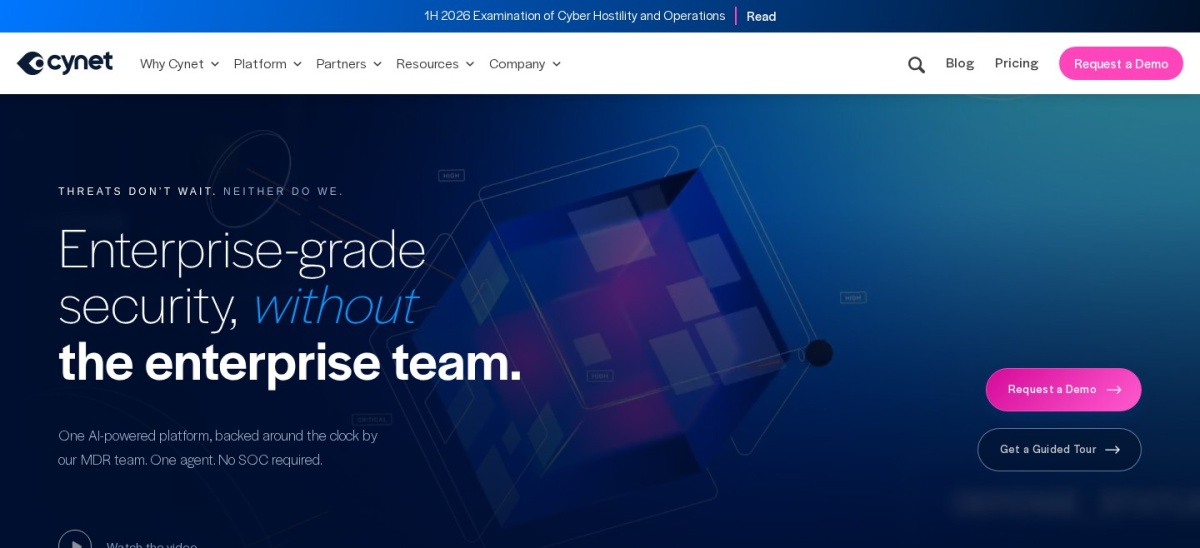
Cynet homepage, captured Nov 2026.
Cynet is a consolidated security platform that brings together endpoint, network, user behavior, and automated response workflows in one console. It holds a 4.7/5 rating across 260 G2 reviews and offers a free trial with quote-based paid licensing.
The trade off is that final paid pricing is quote-based and initial alert tuning can take time for smaller teams. It suits lean IT and mid-market teams that want consolidated security modules without managing separate point tools.
What we like
High 4.7/5 score from 260 reviews on G2
Combines endpoint, network, and user behavior monitoring in one platform
Offers a free trial before committing to a paid plan
Watch out for
No fixed public list price; requires a vendor quote
Initial rule tuning and alert filtering may require setup time
Paid plans scale by organization size and modules, consolidating endpoint, network, and SIEM workflows under one license.Visit cynet.com
06
SentinelOne Singularity
4.8/5on Capterra (117 reviews, checked Nov 2026)
Starts at$179.99/mo
Best for autonomous endpoint response and behavioral AI
Capterra start$179.99/mo usage
Capterra rating4.8/5 (117 reviews)
G2 rating4.7/5 (212 reviews)
Core focusAutonomous AI response
sentinelone.com
SentinelOne Singularity homepage, captured Nov 2026.
SentinelOne Singularity is an AI-driven security platform built for automated threat detection, investigation, and response across endpoints and cloud workloads. Capterra lists Singularity Complete starting at $179.99 per month usage-based alongside a 4.8/5 rating from 117 reviews.
The trade off is usage-based pricing starting at $179.99 per month ($2,159.88/yr) and a learning curve for advanced rules. It suits mid-market and enterprise teams prioritizing automated response and behavioral detection.
What we like
4.8/5 rating across 117 Capterra reviews and 4.7/5 on G2
Autonomous detection and response capabilities across endpoints
Free trial available on Capterra without a credit card
Watch out for
Higher starting monthly cost than per-user or entry endpoint plans
Custom hunting and response rules can require technical setup
Higher editions and retention options add extended data storage, custom hunting rules, and broader cloud or control modules.Visit sentinelone.com
07
Cortex XDR
4.5/5on G2 (99 reviews, checked Nov 2026)
PricingCustom/yr
Best for enterprise correlation across endpoint, network, and cloud
G2 rating4.5/5 (99 reviews)
Pricing modelCustom sales quote
Telemetry scopeEndpoint, network, cloud
Detection engineML models and signatures
paloaltonetworks.com
Cortex XDR homepage, captured Nov 2026.
Cortex XDR is a detection and response platform from Palo Alto Networks that correlates telemetry across endpoints, network traffic, cloud workloads, and identity sources. It holds a 4.5/5 rating across 99 G2 reviews and uses quote-based enterprise licensing.
The trade off is custom quote-only pricing, higher complexity for new analysts, and policy tuning requirements. It suits enterprise security teams consolidating multi-layer telemetry into one incident workflow.
What we like
4.5/5 rating across 99 reviews on G2
Correlates endpoint, network, and cloud alerts into unified incidents
Strong fit for larger SOC teams reducing tool sprawl
Watch out for
Requires contacting sales for pricing rather than fixed public tiers
Steeper learning curve and alert tuning needs for new teams
Enterprise licensing and tiers expand analytics, log ingestion, and response automation across larger security operations.Visit paloaltonetworks.com
How we chose
We built this list from established extended detection and response platforms and endpoint security suites that support cross-source threat detection and response. Each entry represents an actively maintained vendor with public review data on G2 or Capterra.
We checked ratings, review counts, and pricing details on 22 Nov 2026 using G2, Capterra, and vendor pricing pages. Where vendors do not publish a fixed public price, we note quote-based or benchmark pricing rather than inventing a figure.
We excluded discontinued or unverified tools and skipped any product where we could not confirm active maintenance and public review or pricing data. No vendor paid for a place, and we do not claim testing for this list.
How to choose an XDR platform
Follow four practical checks to match an XDR platform to your team size, existing stack, and budget.
Map the telemetry sources you need to connect first. List whether your priority is endpoints alone or broader correlation across identity, email, network, and cloud tools.
Compare entry pricing models and device or user limits. Check whether a plan bills per device per year, per user per month, usage-based, or by custom quote, and watch for device caps.
Check how well the platform fits your current stack. Review native integrations and APIs so the platform works smoothly with your existing identity provider, operating systems, and security tools.
Factor in tuning time and operational overhead. Consider how much time your team can spend on initial policy tuning, alert triage, and workflow setup before rolling out widely.
FAQ
What is the difference between EDR and XDR?
EDR focuses primarily on detecting and responding to threats on endpoints such as laptops and servers. XDR extends detection and response across multiple security layers—such as endpoints, networks, identities, and cloud workloads—to correlate related alerts in one place.
Which XDR platform has the lowest listed starting price?
TEHTRIS XDR Platform lists a $3 per user per month starting price on Capterra, while CrowdStrike Falcon lists Falcon Go from $59.99 per device per year and Hexnode XDR lists $5.50 per device per month. Final costs depend on license count, billing terms, and add-ons.
Do all XDR platforms publish public pricing?
No. Several enterprise and all-in-one vendors—including Cynet and Cortex XDR—rely on custom quotes rather than fixed public price sheets, so you typically request pricing based on seat or endpoint count.
Is CrowdStrike Falcon Go the same as full XDR?
No. CrowdStrike lists Falcon Go at $59.99 per device per year for up to 100 devices with antivirus, device control, and mobile protection, whereas full EDR and threat hunting sit on higher tiers such as Falcon Enterprise.
When does Microsoft Defender XDR make the most sense?
Microsoft Defender XDR fits organizations already standardized on Windows and Microsoft 365 that want native integration across endpoints, identities, email, and cloud apps. Teams with heavy third-party or mixed environments should verify non-Microsoft integration depth.
Why do security teams report alert tuning after deployment?
Correlating telemetry across multiple systems can generate noisy alerts or false positives until rules and policies match your environment. Budgeting time for initial tuning helps analysts focus on real incidents.
SaaS SEO and WordPress specialist with about 8 years of experience. Rakib compares WordPress plugins, themes, hosting and software using public pricing, documentation and user reviews. See how we rank.