DaVinci Resolve (Fusion) is the best VFX software for beginners because its free version includes full node-based compositing, tracking, and rotoscoping with no watermark. Pick Blender for free all-in-one 3D and VFX, or Wondershare Filmora for drag-and-drop effects.
How we make this list: we compare pricing pages, product documentation and public user reviews, then re-check every price before each update. No product paid for a place. Disclosure.
DaVinci Resolve (Fusion) gives beginners node-based compositing for $0, with a $295 one-time Studio upgrade.
Blender covers 3D modeling, camera tracking, fluid simulation, and compositing at $0 with no paid tiers.
Adobe After Effects starts at $22.99/mo billed annually ($275.88/yr) for layer-based motion design and compositing.
Wondershare Filmora offers guided drag-and-drop effects starting at $49.99/yr for beginners skipping node graphs.
Houdini Apprentice is free for learning procedural simulations, while Houdini Indie costs $299/yr.
What to look for in beginner VFX software
Visual effects covers two very different workflows: 2D compositing (combining live-action clips, green screens, and masks) and 3D computer graphics (building models, physics simulations, and camera tracking). Beginners often stall because they download a heavy 3D suite when they only wanted to replace a sky or remove a microphone boom.
Workflow style matters just as much as features. Layer-based tools stack clips and effects vertically like a timeline, which feels familiar if you have edited video before. Node-based tools connect visual blocks in a flowchart, taking slightly longer to grasp on day one while making complex shots easier to debug later.
Hardware and pricing model are the final filters. Most desktop VFX suites demand a dedicated GPU and at least 16 GB of RAM for smooth playback, and free tiers vary wildly between watermarked exports, resolution caps, and unrestricted commercial releases.
DaVinci Resolve (Fusion) homepage, captured Nov 2026.
DaVinci Resolve (Fusion) is a full post-production suite that builds a dedicated node-based VFX compositor directly alongside video editing, color grading, and audio tools. Its free version has no time limit, adds no watermarks, and includes keyers, planar tracking, rotoscoping, and 3D workspace tools.
The trade off is that switching between separate editing and Fusion pages takes practice, and Studio costs $295 one-time (occasionally discounted to $236 during vendor promotions). It suits beginners who want to learn studio-style node workflows without paying a recurring subscription.
What we like
Free version exports unwatermarked video up to Ultra HD
Node-based Fusion page teaches skills transferable to Nuke
Combines editing, color grading, audio, and VFX in one app
No monthly subscription required for the Studio upgrade
Watch out for
Multi-page interface feels dense during the first week
Demands strong GPU hardware for smooth Fusion playback
Studio ($295 one-time) unlocks DaVinci Neural Engine AI tracking, 120fps output, and extra Resolve FX filters.Visit blackmagicdesign.com
02
Blender
4.6/5on G2 (319 reviews, checked Nov 2026)
PriceFree
Best free all-in-one 3D and VFX suite
Workflow3D viewport + node compositor
Free tier100% free, commercial use allowed
PlatformsWindows, macOS, Linux
Paid licenseNone ($0 forever)
blender.org
Blender homepage, captured Nov 2026.
Blender is a free, open-source 3D creation suite that covers modeling, rigging, animation, physics simulation, camera motion tracking, and node-based compositing in one download. Every feature—including Cycles ray-traced rendering and smoke, fire, and fluid solvers—is unlocked at $0 for both personal and commercial work.
The trade off is a steep interface learning curve because 3D modeling, animation, and VFX controls sit side by side, even though the software costs $0. It suits beginners willing to follow step-by-step tutorials to build 3D objects and composite them into live footage.
What we like
Completely free and open-source with zero paid tiers
Covers 3D modeling, camera tracking, simulations, and compositing
Huge library of free community tutorials and add-ons
Runs on Windows, macOS, and Linux
Watch out for
Interface exposes dozens of workspaces that overwhelm newcomers
Built-in video sequence editor is basic compared to Resolve
No paid tiers exist; every rendering engine and simulation tool is included free.Visit blender.org
03
Adobe After Effects
4.6/5on G2 (1,156 reviews, checked Nov 2026)
Starts at$22.99/mo
Best for motion graphics and layer compositing
WorkflowLayer-based timeline
Free tier7-day free trial only
PlatformsWindows, macOS
Paid license$22.99/mo billed annually
adobe.com
Adobe After Effects homepage, captured Nov 2026.
Adobe After Effects is a layer-based compositing and motion design application widely used for title sequences, green-screen keying, rotoscoping, and object removal. Entry access starts with a 7-day trial, while the standalone single-app subscription includes Content-Aware Fill, 3D Camera Tracker, and direct links to Photoshop and Premiere.
The trade off is ongoing subscription pricing at $22.99/mo billed annually ($275.88/yr, or $34.49/mo month-to-month) with no permanent free tier. It suits beginners aiming for freelance motion graphics or YouTube editing roles where client files expect After Effects projects.
What we like
Layer-based timeline feels intuitive for video editors
Largest ecosystem of third-party plugins and templates
Smooth round-tripping with Premiere Pro and Photoshop
Fast tools for wire removal, tracking, and animated typography
Watch out for
No free plan after the 7-day trial ends
Heavy RAM usage and slower rendering on complex 4K comps
Single-app subscription ($22.99/mo annual) unlocks full commercial use and Creative Cloud file syncing.Visit adobe.com
04
Wondershare Filmora
4.4/5on G2 (612 reviews, checked Nov 2026)
Paid from$49.99/yr
Best for guided drag-and-drop effects
WorkflowTimeline + preset effects
Free tierFree download with watermark
PlatformsWindows, macOS
Paid license$49.99/yr (Basic)
filmora.wondershare.com
Wondershare Filmora homepage, captured Nov 2026.
Wondershare Filmora is a beginner-focused video editor packed with drag-and-drop visual effects, green-screen chroma key, motion tracking, and animated title presets. Its free download lets you test the full timeline and effects library before paying, though exported videos carry a watermark.
The trade off is that preset-driven effects limit custom shot control, and removing the watermark starts at $49.99/yr on the Basic plan (or $79.99 for a single-version Perpetual license). It suits creators who want fast, polished social or YouTube effects without learning compositing theory.
What we like
Very short learning curve with drag-and-drop effect overlays
Built-in chroma key, planar tracking, and AI object removal
Affordable entry pricing compared to studio suites
Watch out for
Free exports include a prominent watermark
Skills are app-specific and do not transfer to studio pipelines
Houdini is a 3D animation and visual effects application built around procedural node networks for complex smoke, fire, liquid, cloth, and destruction simulations. Beginners can download Houdini Apprentice for free to access nearly every Houdini FX feature for personal learning, with renders saved at restricted resolution and watermarked.
The trade off is a steep technical learning curve and a $299/yr jump to Houdini Indie once you need unwatermarked commercial renders. It suits patient learners who want to specialize in physics simulations and procedural effects early.
What we like
Houdini Apprentice gives free, non-expiring access to learn FX
Procedural nodes let you tweak simulations without starting over
Industry benchmark for destruction, fluids, and pyro effects
Watch out for
Steepest learning curve on this list for complete beginners
Apprentice renders are watermarked and restricted to non-commercial use
Houdini Indie ($299/yr) removes watermarks, enables commercial work, and includes two Karma render licenses.Visit sidefx.com
06
Unreal Engine
4.5/5on G2 (151 reviews, checked Nov 2026)
Paid from$1,850/yr
Best for real-time 3D environments and virtual sets
WorkflowReal-time 3D viewport + Sequencer
Free tierFree under $1M annual revenue
PlatformsWindows, macOS, Linux
Paid license$1,850/seat/yr (over $1M revenue)
unrealengine.com
Unreal Engine homepage, captured Nov 2026.
Unreal Engine is a real-time 3D creation tool used for virtual production, photorealistic environments, and instant cinematic rendering via Lumen lighting and Nanite geometry. It is completely free for students, hobbyists, and small studios earning less than $1 million USD in annual gross revenue.
The trade off is a game-engine interface that feels unfamiliar for pure video editing, and commercial film or VFX companies exceeding $1 million in annual revenue must pay $1,850/seat/yr. It suits beginners interested in 3D environments, virtual sets, and fast real-time renders.
What we like
Free for individuals and studios under $1M annual gross revenue
Real-time rendering eliminates hours-long wait times for test shots
Sequencer timeline and Composure support live-action compositing
Watch out for
Game-engine terminology and project setup add early friction
Requires a modern dedicated GPU for Lumen and Nanite
Seat-based subscription ($1,850/seat/yr) applies only to non-game commercial studios earning over $1M annually.Visit unrealengine.com
07
Cinema 4D
4.6/5on G2 (136 reviews, checked Nov 2026)
Starts at$839/yr
Best for approachable 3D motion design
WorkflowObject hierarchy + MoGraph
Free tierFree trial + student option
PlatformsWindows, macOS, Linux
Paid license$839/yr ($109/mo monthly)
maxon.net
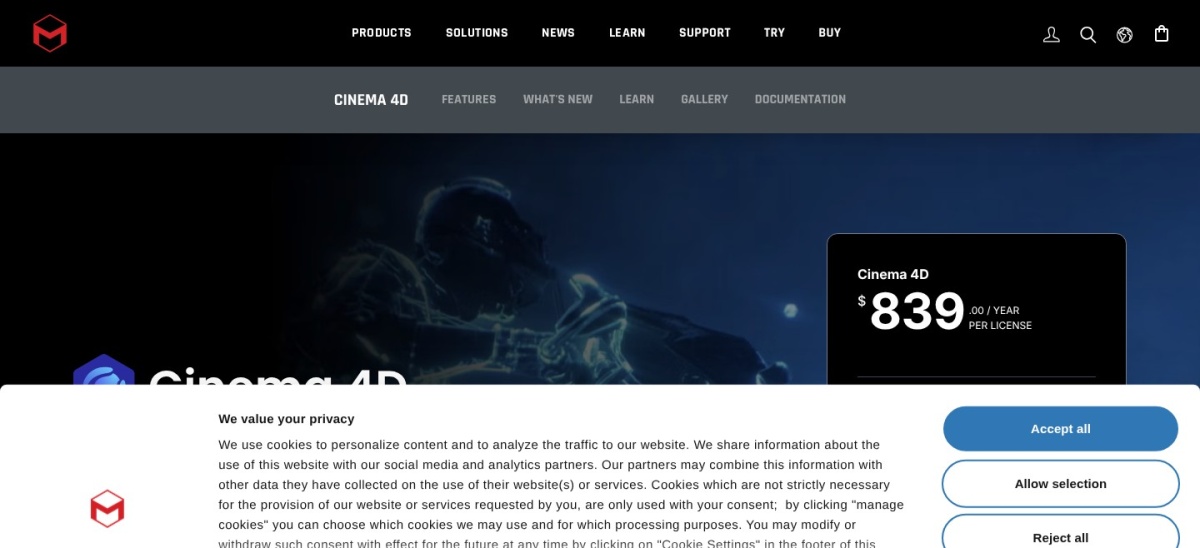
Cinema 4D homepage, captured Nov 2026.
Cinema 4D is a 3D modeling, animation, and simulation application known for an approachable object-manager layout and its MoGraph toolset for broadcast graphics. Every subscription includes the Redshift GPU renderer and access to Cineversity training materials.
The trade off is a high entry price of $839/yr (or $109/mo paid monthly) with no permanent free tier for hobbyists. It suits beginners with a budget who find Blender's interface overwhelming and plan to pair 3D motion graphics with Adobe After Effects.
What we like
Cleaner, more predictable interface than most 3D suites
MoGraph tools simplify complex cloners and broadcast animations
Includes Redshift GPU renderer and Cineversity tutorials
Watch out for
Expensive for hobbyists at $839/yr with no free tier
2D compositing still requires pairing with After Effects or Fusion
Annual subscription ($839/yr) includes full Cinema 4D, Redshift GPU rendering, and 5 Team Render nodes.Visit maxon.net
Node-based vs. layer-based VFX: which should beginners learn first?
Layer-based compositors like Adobe After Effects and Wondershare Filmora stack footage, masks, and effects vertically like an audio mixer or Photoshop document. This layout makes timing animations and keyframes fast to grasp in your first afternoon, though complex shots with dozens of nested pre-compositions can become hard to trace.
Node-based compositors like DaVinci Resolve (Fusion) and Houdini represent every clip, color correction, and mask as a connectable tile on a flow chart. While the blank node grid looks intimidating at first, you can inspect any step in the chain with one click, making node workflows the standard for film and television visual effects.
How we chose
We built this list around established VFX and motion-graphics tools with documented beginner learning paths, active 2026 development, and verified public user ratings on G2. We prioritized options that offer either a usable free edition or a transparent individual license so newcomers can practice without enterprise sales quotes.
All prices, free-tier rules, G2 star ratings, and review counts were checked on 22 Nov 2026 directly against each vendor's official pricing or licensing page and public G2 product listings. Where vendors run seasonal discounts, we recorded the regular list price and noted promotional pricing in the tool summary.
We excluded enterprise-only studio compositors with multi-thousand-dollar entry seats (such as commercial Foundry Nuke at $3,839/yr), abandoned open-source projects without recent updates, and tools lacking sufficient verified G2 reviews. No vendor paid for a place, and we do not claim testing for this list.
How to choose your first VFX software
Pick your starting tool based on the type of shots you want to make and how much you want to spend while learning.
Match the tool to 2D compositing or 3D CGI. Choose DaVinci Resolve (Fusion) or After Effects if you want to key green screens, track text, and clean up live-action footage; choose Blender or Unreal Engine if you want to build 3D objects, creatures, or virtual worlds.
Start with a non-expiring free tier whenever possible. Download DaVinci Resolve or Blender first so you can practice for months without worrying about a 7-day trial expiring before you finish your first project.
Check your computer's RAM and GPU before installing. Verify that your machine has at least 16 GB of RAM and a dedicated graphics card, or opt for lighter timeline tools like Filmora if you are editing on an older laptop.
Commit to one beginner tutorial project from start to finish. Follow a single 30-minute tutorial—such as tracking a 3D object onto a tabletop or pulling a clean green-screen key—before exploring advanced simulation menus.
FAQ
What is the best completely free VFX software for beginners?
DaVinci Resolve (Fusion) and Blender are the two strongest free choices. DaVinci Resolve gives you unwatermarked node-based compositing and editing at no cost, while Blender provides a full open-source 3D, tracking, and compositing suite with zero paid tiers.
Is Blender or After Effects better for a beginner?
Pick Blender if you want to learn 3D modeling, camera tracking, and physics simulations for $0. Pick Adobe After Effects ($22.99/mo billed annually) if your goal is 2D motion graphics, animated titles, and freelance video editing jobs.
Do I need a powerful computer to learn VFX?
You do not need a workstation to learn basic 2D masking and titles, though 16 GB of RAM and a dedicated GPU make playback far smoother. Heavy 3D rendering in Blender, Houdini, or Unreal Engine benefits noticeably from a modern NVIDIA or Apple Silicon GPU.
Why is Foundry Nuke not on this beginner list?
Foundry Nuke is the Hollywood compositing standard, but commercial Nuke starts at $3,839/yr and its free Non-Commercial edition disables third-party plugins, H.264 export, and HD-plus resolution. Learning node workflows in DaVinci Resolve (Fusion) first gives you transferable skills with fewer restrictions.
Can I use free VFX software for monetized YouTube videos?
Yes, provided the license permits commercial work. Blender, DaVinci Resolve (free version), and Unreal Engine (under $1M annual revenue) all allow commercial and monetized video exports without watermarks, whereas Houdini Apprentice restricts output to non-commercial projects.
SaaS SEO and WordPress specialist with about 8 years of experience. Rakib compares WordPress plugins, themes, hosting and software using public pricing, documentation and user reviews. See how we rank.