Best Transactional Email Software in 2026: 7 Tools Compared
WLWPLegible EditorsLast verified 22 Nov 2026How we rank12 min read
★ Short answer
Postmark is the best transactional email software for most applications, with API and SMTP delivery, 45-day data retention and Basic pricing of $15 per month for 10,000 emails. Mailgun suits developers needing inbound routing and detailed API controls, while MailerSend offers a cheaper starting plan at $7 monthly.
How we make this list: we compare pricing pages, product documentation and public user reviews, then re-check every price before each update. No product paid for a place. Disclosure.
Postmark Basic costs $15/mo for 10,000 emails, with 45-day data retention and 5 custom sending domains.
Mailgun Basic starts at $15/mo for 10,000 emails, with API and SMTP access, webhooks and 5 inbound routes.
MailerSend Hobby costs $7/mo for 5,000 emails, or $5.60/mo billed annually, and includes 5 user seats.
SMTP2GO Starter costs $10/mo for 10,000 emails and includes 30 days of reporting; its free tier supports 1,000 emails monthly.
Twilio SendGrid Email API Essentials starts at $19.95/mo, while its free trial allows 100 emails daily for 60 days.
Mailjet Starter costs $9/mo for 8,000 emails; Resend Pro costs $20/mo for 50,000 emails, with additional sending at $0.90 per 1,000.
What to look for in transactional email software
Transactional email software sends messages triggered by user actions or application events. Common examples include password resets, account verification, order confirmations, payment receipts and security notifications.
The most important requirement is reliable message delivery. Look for delivery event tracking, bounce handling, suppression lists and tools for authenticating your sending domain. No email provider can guarantee that every message reaches the inbox.
Next, compare SMTP relay and email API support. SMTP can connect existing applications with relatively little development work, while APIs provide more control over templates, metadata, sending events and automated workflows.
Email volume and retention periods affect total costs. A low-priced plan may include limited email logs, sending domains or daily API requests. Check overage charges if your application sends unpredictable volumes.
Finally, separate transactional email from promotional campaigns. Password resets and account alerts have different urgency and consent considerations than newsletters. Platforms that handle both may provide separate sending streams, policies or reporting.
Postmark is a transactional email service for sending application notifications, account messages and other triggered emails through an API or SMTP. Its free developer plan supports 100 emails monthly. Basic costs $15 monthly for 10,000 emails and includes 5 sending domains, 45-day data retention, delivery analytics and unlimited daily sending.
The trade off is that Basic has limited domain capacity and does not include inbound email processing, which starts with Pro at $16.50 monthly. Additional emails cost $1.80 per 1,000. It suits SaaS applications and online businesses that prioritize transactional email monitoring and separation from promotional messages.
What we like
Dedicated transactional email infrastructure
Email API and SMTP support
Delivery analytics and event monitoring
Separate transactional and broadcast streams
Free developer plan for integration testing
Watch out for
Free tier is limited to 100 monthly emails
Basic excludes inbound email processing
Additional volume incurs overage charges
More sending domains require higher plans
Pro adds inbound processing and more domains; Platform expands capacity for larger teams.Visit postmarkapp.com
02
Mailgun
4.2/5on G2 (333 reviews, checked Nov 2026)
Paid from$15/mo
Best for developer-controlled email infrastructure
Entry planBasic
Monthly emails10,000
Sending domains1
Inbound routes5
mailgun.com
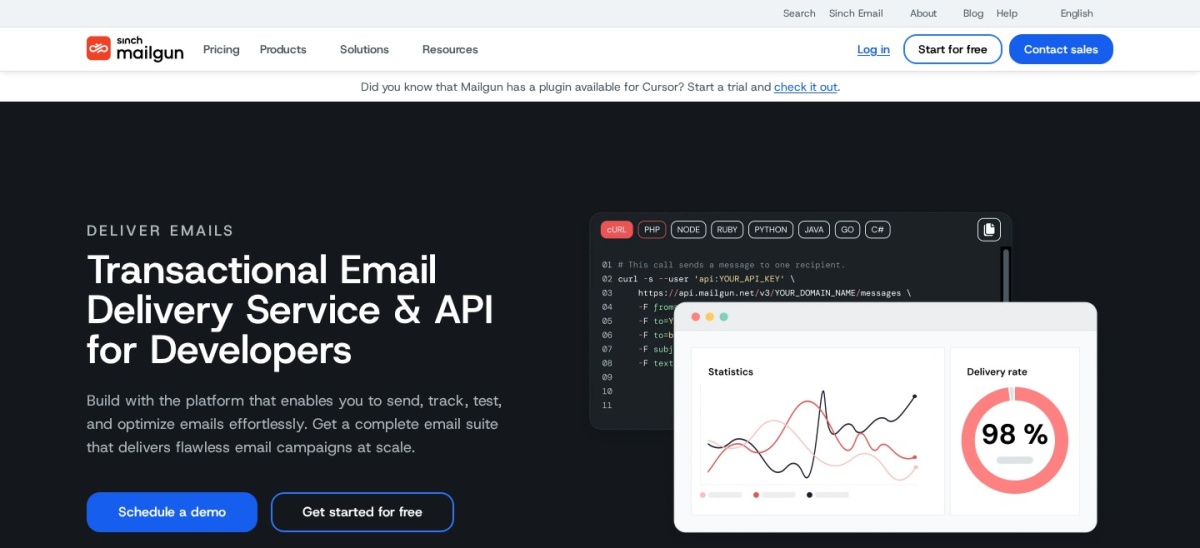
Mailgun homepage, captured Nov 2026.
Mailgun is an email delivery platform for applications that need API sending, SMTP relay, event webhooks and inbound email routing. Its free plan allows 100 emails daily. Basic costs $15 monthly for 10,000 emails and includes one sending domain, 5 inbound routes, tracking, analytics and a customizable dashboard.
The trade off is limited log retention and domain capacity on Basic. Extra sending starts at $1.80 per 1,000 emails, while Foundation costs $35 monthly and adds more domains, template tools and longer retention. It suits developers who need flexible email delivery and inbound processing within application workflows.
What we like
REST API and SMTP relay included
Inbound email routing
Event webhooks and analytics
Free plan for smaller workloads
Higher plans support large sending programs
Watch out for
Basic has one-day log retention
Entry plan supports one sending domain
Advanced template features require Foundation
Overage charges apply beyond plan limits
Foundation adds more sending domains, template management and longer log retention.Visit mailgun.com
03
MailerSend
4.1/5on G2 (46 reviews, checked Nov 2026)
Paid from$7/mo
Best affordable email API for small applications
Entry planHobby
Monthly emails5,000
User seats5
Email templates10
mailersend.com
MailerSend homepage, captured Nov 2026.
MailerSend is a transactional email platform combining API delivery, SMTP relay, templates and message monitoring. Its free plan includes 500 monthly emails. Hobby costs $7 monthly and includes 5,000 emails, 5 user seats, one sending domain, 10 templates and user permissions.
The trade off is that Hobby stores activity data for only one day and limits API requests. Annual billing reduces the subscription to $5.60 monthly, while extra emails cost $1.50 per 1,000. It suits startups and smaller development teams that want affordable email delivery with visual template editing.
What we like
Affordable paid subscription
Free plan for occasional sending
Email API and SMTP relay
Visual email template builders
User roles and permissions
Watch out for
Hobby has short activity retention
Only one sending domain on Hobby
API request limits apply
Advanced monitoring requires higher plans
Starter expands sending volume, domains, templates and activity retention.Visit mailersend.com
04
SMTP2GO
4.7/5on G2 (226 reviews, checked Nov 2026)
Paid from$10/mo
Best for straightforward SMTP email delivery
Entry planStarter
Monthly emails10,000
Reporting history30 days
Extra emails$1 per 1,000
smtp2go.com
SMTP2GO homepage, captured Nov 2026.
SMTP2GO is an email delivery service for applications, websites and business systems that need SMTP relay or API sending. Its free plan supports 1,000 emails monthly. Starter costs $10 monthly for 10,000 emails and includes 30-day reporting, subaccount management and ticket, chat and phone support.
The trade off is that advanced reporting retention and larger sending allowances require higher plans. Additional messages cost $1 per 1,000, while annual billing lists at $100 yearly for Starter. It suits businesses that need dependable SMTP configuration, delivery monitoring and accessible support.
What we like
Free SMTP sending allowance
Simple SMTP relay setup
Delivery reports and tracking
Multiple support channels
Subaccount management included
Watch out for
Entry plan has limited reporting retention
Higher email volume increases costs
Less focused on advanced template design
Advanced needs may require higher plans
Higher-volume plans increase sending capacity and provide expanded reporting options.Visit smtp2go.com
05
Twilio SendGrid
4/5on G2 (369 reviews, checked Nov 2026)
Starts at$19.95/mo
Best for established high-volume email programs
Entry planEssentials
Starting price$19.95/mo
Free trial60 days
Trial sending100 emails/day
twilio.com
Twilio SendGrid homepage, captured Nov 2026.
Twilio SendGrid is an email delivery platform providing APIs, SMTP relay, dynamic templates and delivery analytics. Its free trial lasts 60 days and permits 100 emails daily. Essentials starts at $19.95 monthly and includes core email delivery, tracking and authentication features for smaller production workloads.
The trade off is that dedicated IPs, expanded collaboration and advanced email testing require Pro, starting at $89.95 monthly. The free offering is a trial rather than a permanent subscription. It suits developers and established businesses planning to scale transactional sending through a widely used email infrastructure provider.
What we like
Established email API infrastructure
SMTP relay and REST API
Dynamic email templates
Delivery tracking and analytics
Higher-volume plans available
Watch out for
Free access expires after the trial
Dedicated IPs require Pro
Advanced collaboration costs more
Entry pricing varies with email volume
Pro adds dedicated IPs, subuser management, SSO and email testing credits.Visit twilio.com
06
Mailjet
4/5on G2 (180 reviews, checked Nov 2026)
Paid from$9/mo
Best for transactional and marketing emails together
Entry planStarter
Monthly emails8,000
Contacts2,000
Subaccounts1
mailjet.com
Mailjet homepage, captured Nov 2026.
Mailjet is an email platform combining transactional API delivery, SMTP relay and marketing campaigns. Its free plan includes 6,000 monthly emails with a 200-email daily limit. Starter costs $9 monthly for 8,000 emails, removes the daily sending limit and includes 2,000 contacts, basic statistics and one subaccount.
The trade off is that Starter retains limits on contacts and advanced marketing features. Essential costs $19 monthly and increases the allowance to 15,000 emails while adding unlimited contacts and email validation credits. It suits businesses that want transactional messages and newsletters managed within one email platform.
What we like
Email API and SMTP relay
Free plan with useful sending capacity
Transactional and marketing messages
Visual email editor
Webhooks and delivery statistics
Watch out for
Free plan has a daily sending cap
Starter has a contact limit
Advanced segmentation requires Essential
Premium collaboration features cost more
Essential expands sending and contacts, removes branding and adds validation and preview credits.Visit mailjet.com
07
Resend
2.5/5on Trustpilot (23 reviews, checked Nov 2026)
Paid from$20/mo
Best for modern developer email workflows
Entry planPro
Monthly emails50,000
Sending domains10
Extra emails$0.90 per 1,000
resend.com
Resend homepage, captured Nov 2026.
Resend is a developer-focused email platform supporting API delivery, SMTP relay, React Email templates and event webhooks. Its free plan allows 3,000 monthly emails with a 100-email daily limit. Pro costs $20 monthly for 50,000 emails and includes 10 domains, unlimited daily sending and 5 webhook endpoints.
The trade off is that additional sending, domains and advanced infrastructure features may cost extra. Trustpilot displays a 2.5/5 rating from 23 reviews, indicating customer concerns worth investigating. It suits development teams that value modern APIs and template workflows and can evaluate service reliability before committing.
What we like
Developer-oriented API and SDKs
React Email template support
Free plan for smaller applications
No daily sending limit on Pro
Transparent additional-email pricing
Watch out for
Low Trustpilot customer rating
Free plan has a daily cap
Additional sending creates overage charges
Dedicated IP features require higher plans
Pro increases sending and domains; Scale adds more domains, webhooks and support options.Visit resend.com
SMTP relay vs transactional email API: which should you use?
SMTP relay connects applications to an external mail server using established email protocols. It is useful when software already supports SMTP credentials and requires minimal custom development.
An email API lets applications create and send messages through programmatic requests. APIs often provide more direct access to templates, metadata, batch operations, delivery events and provider-specific functionality.
Most platforms in this comparison support both methods. SMTP2GO emphasizes accessible SMTP delivery, while Resend, Mailgun and Postmark provide developer-oriented APIs alongside SMTP options.
Choose the method supported by your application and team. Delivery monitoring, authentication and bounce handling remain important regardless of the connection type.
How to improve transactional email deliverability
Configure SPF, DKIM and DMARC correctly for the sending domain. These authentication mechanisms help receiving systems verify that messages are authorized and protect against certain forms of email impersonation.
Send transactional messages promptly and keep their content relevant to the action that triggered them. A password reset message should not be buried under promotional material.
Monitor bounces, spam complaints and suppression events. Repeated sending to invalid addresses can harm sender reputation, while ignoring provider warnings may lead to account restrictions.
Use delivery logs and webhook events to investigate problems. Remember that provider acceptance, recipient-server delivery and inbox placement are different outcomes, so a successful API response does not guarantee inbox visibility.
How we chose
We shortlisted established transactional email services offering SMTP relay, email APIs or both. Selection focused on application-triggered messages, delivery monitoring, authentication, sending allowances, developer documentation and public customer reviews rather than newsletter design alone.
We opened official pricing pages and public G2 or Trustpilot review listings on 22 Nov 2026. Regular subscription prices were compared using the entry paid plan multiplied by twelve. Annual-billing discounts, overage fees and time-limited trials were identified separately.
We excluded services without confirmable published USD pricing and products without sufficient public review evidence. Resend uses Trustpilot because its G2 listing has fewer than 20 reviews, while its lower Trustpilot rating is disclosed. No vendor paid for a place, and we do not claim testing for this list.
How to choose the best transactional email software
Estimate your email volume, identify your application's integration requirements and compare monitoring, security and overage costs.
Calculate your expected transactional email volume. Estimate password resets, verification emails, order confirmations and other application notifications. Allow room for growth and unusual traffic spikes. Compare included sends with overage rates rather than selecting a service based only on its minimum subscription price.
Choose between SMTP and API integration. Check whether your application supports SMTP credentials or requires a dedicated email API. Review official SDKs, authentication methods, webhook documentation and template management before selecting a provider.
Evaluate delivery monitoring and security. Prioritize SPF, DKIM, DMARC, bounce handling, suppression lists and event tracking. Check how long message logs remain available and whether you can investigate delivery problems without purchasing an expensive upgrade.
Compare total operating costs. Include email volume, extra domains, dedicated IPs, extended log storage and support options. Consider how the subscription changes as your application grows, and evaluate whether separating promotional and transactional traffic is necessary.
FAQ
What is the best transactional email software in 2026?
Postmark is our top recommendation for applications that prioritize transactional email delivery and monitoring. Its Basic plan includes 10,000 monthly emails, 5 sending domains and 45-day data retention for $15 monthly. Mailgun is another option for developers needing inbound routing, while MailerSend offers a lower-cost entry subscription.
What is the cheapest paid transactional email service?
MailerSend Hobby has the lowest flat monthly subscription in this comparison at $7 for 5,000 emails. Mailjet Starter costs $9 for 8,000 emails, while SMTP2GO Starter costs $10 for 10,000. Compare additional-email charges and monitoring features before choosing.
Which transactional email services have free plans?
Postmark, Mailgun, MailerSend, SMTP2GO, Mailjet and Resend offer free sending allowances with different restrictions. Twilio SendGrid provides a 60-day free trial rather than permanent free access. Check daily limits, domain verification and log retention before using a free service in production.
What is the difference between transactional and marketing email?
Transactional emails are triggered by actions such as account registration, purchases or password recovery. Marketing emails promote content, products or offers to an audience. Both require appropriate sending practices, but transactional messages are generally more time-sensitive and may need separate infrastructure or message streams.
Is SMTP or API better for transactional email?
SMTP is convenient when an existing application already supports external mail servers. Email APIs provide more direct programmatic control and commonly expose provider-specific functionality. Both can deliver transactional messages effectively when configured correctly. Integration needs and operational monitoring should guide the choice.
Can I use transactional email software with WordPress?
Yes. Many WordPress SMTP plugins can connect websites to external email services using SMTP credentials or supported API integrations. This can help route contact notifications, account emails and order confirmations through dedicated delivery infrastructure instead of relying only on the hosting server.
Do transactional email services guarantee inbox delivery?
No provider can guarantee that every message reaches the inbox. Recipient filters, authentication, sending reputation, message content and user settings all affect the outcome. Look for delivery event logs, suppression management and domain authentication tools, then monitor real-world results after deployment.
Should transactional and promotional emails use separate domains?
Separating sending streams or subdomains can help teams organize traffic and manage reputation independently. It is especially useful when promotional campaigns generate different engagement patterns from critical account notifications. The ideal configuration depends on message volume, domain strategy and provider capabilities.
What happens when I exceed my monthly email allowance?
Many providers charge for additional email volume, while free plans may stop sending after their limits are reached. Postmark Basic lists extra emails at $1.80 per 1,000, and Resend Pro lists $0.90 per 1,000. Review overage rules and configure monitoring to avoid unexpected costs.