Opti Digital leads our supply side platform comparison with a 4.5 out of 5 G2 rating across 44 reviews for publisher yield optimization. Google Ad Manager offers a free standard tier for direct and programmatic trafficking, while 33Across focuses on cookieless inventory monetization.
How we make this list: we compare pricing pages, product documentation and public user reviews, then re-check every price before each update. No product paid for a place. Disclosure.
Opti Digital holds a 4.5/5 G2 rating from 44 reviews and uses a revenue-share model rather than upfront software fees.
Google Ad Manager provides a free standard tier alongside enterprise Ad Manager 360 options, backed by 236 G2 reviews.
33Across earns a 4.3/5 rating across 128 G2 reviews with a focus on cookieless audience addressability.
Sharethrough holds a 4.5/5 G2 rating across 88 reviews for native placements and video formats.
PropellerAds posts a 4.6/5 G2 rating from 52 reviews for alternative formats and global traffic monetization.
What to look for in a supply side platform
A supply side platform helps publishers sell display, video, native, and mobile ad inventory through real-time bidding, private marketplaces, and header bidding integrations. Selecting the right platform depends on your monthly impression volume, ad formats, and how much ad operations work your team handles internally.
Demand diversity matters because a wider pool of connected demand-side platforms and buyers keeps auctions competitive across browsers, mobile apps, and connected TV. Publishers also need clear floor-price controls, brand-safety blocks, and transparent reporting to protect page speed and reader experience.
Pricing across supply side platforms rarely looks like standard monthly SaaS software. Many vendors operate on custom enterprise contracts or a revenue-share structure, meaning public list prices for paid tiers are often not published openly.
Opti Digital is a publisher monetization platform built around yield optimization, header bidding, and controlled A/B testing. Its documentation notes that Opti Digital operates on a revenue-share model with no standalone fixed software fee on entry.
The trade off is that public flat-rate pricing is not listed upfront and depends on revenue share terms rather than a fixed annual price. It suits web publishers that want managed yield tuning and format testing with responsive support.
What we like
High 4.5/5 rating across 44 G2 reviews
No upfront fixed software fee under its revenue-share model
Supports A/B testing and Prebid header bidding workflows
Strong G2 feedback for account support and setup speed
Watch out for
No public fixed-price plan listed on the site
Revenue share reduces gross programmatic take on each impression
Dashboard complexity can take time to learn for smaller teams
Custom enterprise agreements and managed services vary by publisher setup.Visit optidigital.com
02
Google Ad Manager
4.2/5on G2 (236 reviews, checked Nov 2026)
PriceFree
Best for direct and programmatic ad serving
G2 rating4.2 / 5 (236)
Entry costFree standard tier
Ad formatsDisplay, video, app, CTV
ControlsUp to 200 pricing rules
admanager.google.com
Google Ad Manager homepage, captured Nov 2026.
Google Ad Manager is Google's ad serving and inventory management platform for publishers running direct campaigns, header bidding, and programmatic auctions. The standard version is free for eligible publishers, while Ad Manager 360 uses custom contract pricing.
The trade off is that Ad Manager 360 requires a custom enterprise contract with no public flat rate, and the interface has a steep setup curve. It suits publishers that want a free core ad server and granular floor-price rules.
What we like
Free standard tier for publishers within impression limits
Supports up to 200 pricing rules per network
Broad adoption with 236 reviews on G2
Watch out for
Ad Manager 360 pricing is custom rather than publicly listed
Setup and line-item trafficking can feel complex for beginners
Limited hand-holding on the free standard tier
Ad Manager 360 adds enterprise contract terms, higher limits, and expanded demand access.Visit admanager.google.com
03
33Across
4.3/5on G2 (128 reviews, checked Nov 2026)
PricingRev-share (custom terms)
Best for cookieless inventory monetization
G2 rating4.3 / 5 (128)
FocusCookieless traffic
FormatsDisplay, native, video
Billing modelRevenue-share terms
33across.com
33Across homepage, captured Nov 2026.
33Across is a supply side platform and identity solution focused on monetizing publisher traffic without relying on third-party cookies. Publisher partnerships use revenue-share terms with no published upfront subscription fee.
The trade off is that exact revenue-share rates and public tier prices are not listed openly, and new users note a learning curve in reporting. It suits content publishers looking to monetize privacy-restricted and cookieless sessions.
What we like
Established presence with 128 reviews on G2
Designed for cookieless browser and audience addressability
Covers web, mobile, native, and video inventory
Watch out for
No public flat-rate pricing sheet available
Reporting and setup can feel complex at first
Requires publisher approval and quality checks
Custom publisher agreements govern revenue share, formats, and deal access.Visit 33across.com
04
Sharethrough
4.5/5on G2 (88 reviews, checked Nov 2026)
PricingRev-share (custom terms)
Best for native inventory and video formats
G2 rating4.5 / 5 (88)
StrengthNative & video ads
ChannelsWeb, mobile, CTV
PricingCustom / rev-share
sharethrough.com
Sharethrough homepage, captured Nov 2026.
Sharethrough is a supply side platform known for native ad placements, video formats, and curated private marketplace deals across web, mobile, and CTV. Publisher commercial terms rely on custom revenue-share arrangements rather than public SaaS tiers.
The trade off is that public pricing is not disclosed upfront and some buyers or sellers report uneven front-end benchmarks depending on targeting. It suits publishers prioritizing native layouts and video demand.
What we like
Strong 4.5/5 score across 88 G2 reviews
Focused on native placements and video ad units
Active support and account teams cited by reviewers
Watch out for
No public pricing tiers listed on the site
Deal customization can feel less flexible than expected
Performance varies by targeting rules and inventory mix
Custom partner contracts cover PMP setup, video units, and revenue splits.Visit sharethrough.com
05
PropellerAds
4.6/5on G2 (52 reviews, checked Nov 2026)
PricingRev-share (publisher model)
Best for alternative formats and global reach
G2 rating4.6 / 5 (52)
FormatsPush, popunder, interstitial
ReachGlobal web & mobile
PricingNo public flat fee
propellerads.com
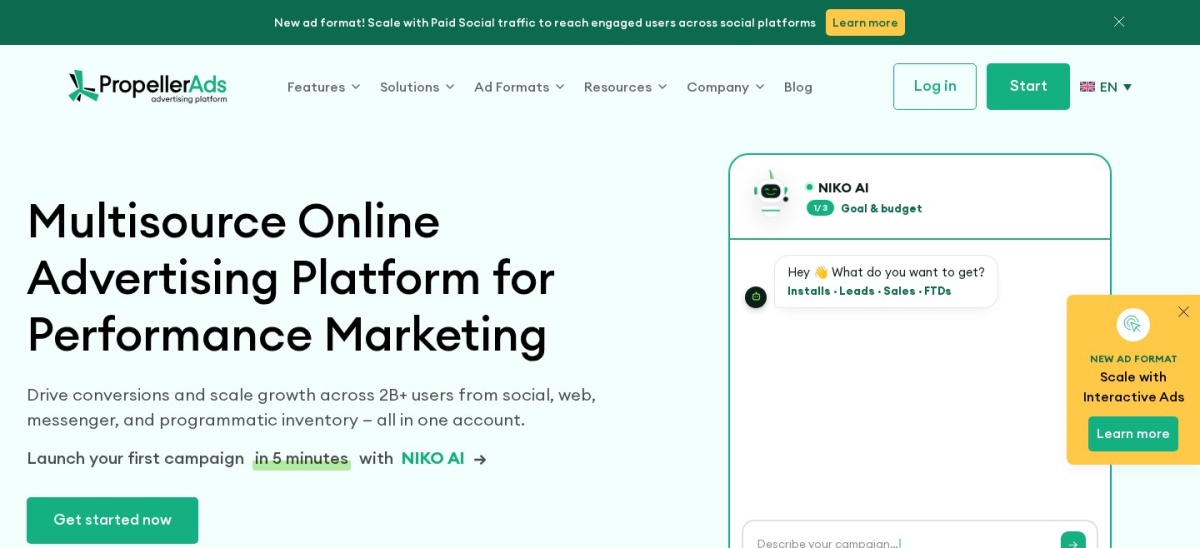
PropellerAds homepage, captured Nov 2026.
PropellerAds is an advertising platform offering publisher monetization across push notifications, popunders, interstitials, and web formats. Publishers monetize traffic through the platform without a published flat-rate software subscription.
The trade off is that public publisher fee schedules are not listed openly and aggressive ad formats can affect user experience if overused. It suits publishers looking to diversify traffic monetization across global regions and alternative formats.
What we like
Highest G2 rating on this list at 4.6/5 across 52 reviews
Supports push, popunder, and interstitial ad formats
Straightforward dashboard and campaign tools
Watch out for
No public flat-rate publisher pricing listed
Pop and push formats require care to protect reader UX
Traffic quality and rates vary across regions
Format availability and payout terms vary by site traffic and vertical.Visit propellerads.com
06
EX.CO
4.3/5on G2 (25 reviews, checked Nov 2026)
PricingCustom (contact sales)
Best for video player monetization
G2 rating4.3 / 5 (25)
Core focusVideo monetization
SetupEmbeddable video player
PricingCustom / sales quote
ex.co
EX.CO homepage, captured Nov 2026.
EX.CO provides video player technology and programmatic video monetization tools for publishers looking to increase video yield. Plan pricing is not published openly and requires direct sales outreach.
The trade off is that there is no public self-serve price card, and reviewers note the main dashboard UI could be cleaner. It suits publishers focused on video placements and monetization support.
What we like
Solid 4.3/5 rating across 25 G2 reviews
Combines video player customization with ad monetization
Frequently praised for responsive account support
Watch out for
Pricing requires a direct quote rather than public tiers
Main dashboard interface has room for usability polish
Best suited to video-led inventory rather than static banners
Custom plans depend on video volume, player features, and managed support.Visit ex.co
07
Magnite
3.2/5on G2 (20 reviews, checked Nov 2026)
PricingCustom (enterprise deal)
Best for CTV and omnichannel scale
G2 rating3.2 / 5 (20)
ChannelsCTV, web, mobile, DOOH
PricingCustom commercial terms
FitMid-market to enterprise
magnite.com
Magnite homepage, captured Nov 2026.
Magnite is an independent sell-side advertising platform serving publishers across connected TV, online video, mobile, and web inventory. Commercial terms are negotiated directly without a public self-serve plan or free tier.
The trade off is that pricing is not publicly listed, no free plan is offered, and G2 seller reviews sit at 3.2/5 across 20 reviews. It suits larger publishers and broadcasters needing CTV and omnichannel buyer reach.
What we like
Broad reach across CTV, web, and mobile supply
Supports private marketplaces and yield optimization
Many publishers use a primary ad server such as Google Ad Manager alongside one or more supply side platforms or header bidding wrappers. The ad server often coordinates final delivery, while supply side platforms bring competing demand from multiple buyers into the auction.
Adding too many demand sources at once can slow page rendering or create timeout issues if not tuned carefully. Most teams start with a core setup and expand demand partners as traffic and yield data justify it.
How we chose
This list starts from established supply side and publisher monetization platforms active in programmatic advertising, looking at public review profiles on G2 and vendor documentation.
All ratings, review counts, and pricing disclosures were checked on 22 Nov 2026 from G2 review pages and official vendor documentation.
We excluded platforms without verifiable public review data on our checked sources or lacking clear publisher monetization details. No vendor paid for a place, and we do not claim testing for this list.
How to choose a supply side platform
Follow four practical steps to narrow down the right platform for your inventory.
Audit your primary inventory formats. List how much traffic comes from display banners, video players, mobile apps, or connected TV before comparing platforms.
Check buyer demand and integration fit. Confirm how each platform connects with your existing ad server, header bidding wrapper, or direct sales workflow.
Clarify commercial terms before onboarding. Ask how revenue share, auction fees, or custom contracts are calculated so net yield stays predictable.
Monitor page speed and user experience. Track ad load impact, viewability, and floor-price rules after launch so higher fill does not hurt reader retention.
FAQ
What is a supply side platform in ad tech?
A supply side platform is technology that lets publishers manage, package, and sell ad inventory across programmatic auctions and demand partners. It helps automate bidding so available impressions reach competing buyers in real time.
Do supply side platforms charge a flat monthly fee?
Most supply side platforms do not publish flat monthly SaaS tiers. Instead, they commonly use custom commercial contracts or revenue-share structures tied to ad spend or publisher earnings.
Can small or mid-sized sites use supply side platforms?
Yes, though eligibility and demand access vary by vendor and traffic profile. Some platforms offer free entry tiers or flexible onboarding, while others focus primarily on mid-market and enterprise publishers.
How does a supply side platform differ from a demand side platform?
A supply side platform works on the publisher side to sell ad inventory, while a demand side platform works on the advertiser side to buy impressions. Both often connect through real-time bidding and private marketplace deals.
Why do ratings vary across supply side platforms on G2?
Publisher ad tech tools serve different workflows, from self-serve ad formats to complex enterprise setups with heavy reporting. Setup complexity, support responsiveness, and reporting speed strongly shape user ratings.
Should I rely on a single supply side platform?
Many publishers connect multiple demand sources or pair an ad server with programmatic partners to boost auction competition. Balancing demand competition against page latency is key.
SaaS SEO and WordPress specialist with about 8 years of experience. Rakib compares WordPress plugins, themes, hosting and software using public pricing, documentation and user reviews. See how we rank.