SimpleRisk is the best risk management software for organizations needing dedicated governance, risk and compliance workflows. Its free Core edition supports unlimited users, while paid packages start at $5,000 annually. Smartsheet is better for spreadsheet-style risk registers, and monday.com suits teams managing operational risks alongside everyday projects.
How we make this list: we compare pricing pages, product documentation and public user reviews, then re-check every price before each update. No product paid for a place. Disclosure.
SimpleRisk provides a free self-hosted GRC platform with unlimited users; its paid Starter Package costs $5,000/year.
Smartsheet Pro costs $12/member/month with monthly billing and includes unlimited sheets, forms and reports.
monday.com offers a free plan for two seats, while Basic starts at $9/seat/month billed annually.
ClickUp Core has a regular price of $12/user/month and includes custom fields, unlimited forms and 1,000 monthly automation actions.
Wrike Team costs $10/user/month billed annually and supports teams of 2–15 users.
Airtable Team starts at $20/user/month billed annually, while Asana Starter costs $13.49/user/month with monthly billing.
What to look for in risk management software
Risk management software helps organizations identify threats, assess their likelihood and impact, assign responsibilities and monitor mitigation activities. The right platform depends on whether risks affect the entire organization, regulatory compliance or individual projects.
Start with a risk register. A useful system records risk descriptions, owners, categories, likelihood, impact, mitigation plans and review dates. Dedicated governance, risk and compliance platforms usually offer more structured assessment methods than general project management tools.
Reporting is another important consideration. Risk matrices, dashboards, status reports and historical records help decision-makers understand exposure and evaluate mitigation progress.
Workflow automation improves accountability. Look for assigned risk owners, recurring reviews, reminders, approvals and escalation processes. Some products also connect risks to controls, policies, incidents and compliance requirements.
Finally, distinguish dedicated GRC software from configurable work management platforms. The latter can organize risk registers and mitigation tasks but may require custom setup and lack specialized risk scoring, audit trails or regulatory workflows.
SimpleRisk is a dedicated governance, risk and compliance platform covering risk identification, assessments, mitigation, controls and reporting. Its open-source Core edition is free to self-host and supports unlimited users. The paid Starter Package costs $5,000 annually and includes Core, three Standard Extras, support and updates, with self-hosted or SaaS deployment options.
The trade off is that advanced features such as API integration, structured questionnaires, workflows and custom authentication require paid Extras. The Starter Package also costs considerably more than general-purpose risk trackers. It suits organizations requiring formal risk management processes rather than a configurable project spreadsheet.
What we like
Dedicated governance, risk and compliance functionality
Free open-source Core edition
Unlimited users without seat-based licensing
Risk assessments and mitigation tracking
Published annual prices for additional modules
Watch out for
Free deployment requires self-hosting
Advanced functionality requires paid Extras
Higher paid entry price than general work management tools
Smartsheet is a collaborative work management platform that supports customizable risk registers, assessment forms, mitigation tracking and reporting. Pro costs $12 per member monthly with monthly billing and includes unlimited sheets, forms and reports, multiple project views, formulas and 250 automations per month.
The trade off is that Smartsheet is not a dedicated enterprise risk management platform, so risk scoring methods, control mapping and governance processes require configuration. Business adds broader collaboration and automation capabilities at $24 per member monthly. It suits teams moving risk registers from spreadsheets into shared workflows.
Business adds expanded collaboration and automation capabilitiesVisit smartsheet.com
03
monday.com
4.7/5on G2 (17,974 reviews, checked Nov 2026)
Paid from$9/mo
Best for operational risk workflows
Free seats2
Paid entryBasic, $9/seat/mo billed annually
Free boards3
G2 rating4.7/5, 17,974 reviews
monday.com
monday.com homepage, captured Nov 2026.
monday.com is a visual work management platform that teams can configure for operational risk registers, ownership, mitigation activities and status reporting. Its free plan supports two seats and three boards. Basic starts at $9 per seat monthly billed annually and adds unlimited boards, expanded storage and additional collaboration options.
The trade off is that risk automation and more advanced reporting require higher plans, while formal GRC capabilities are not included as a dedicated risk management system. Paid plans also have seat requirements. It suits operations teams managing risks alongside projects, approvals and recurring business activities.
What we like
Visual boards for tracking risk status
Free plan for small teams
Customizable ownership and mitigation workflows
Large template collection
Automation and dashboard upgrades
Watch out for
Dedicated GRC controls require customization
Basic lacks advanced automation
Paid subscriptions have seat requirements
Basic adds unlimited boards, storage and collaboration featuresVisit monday.com
04
ClickUp
4.6/5on G2 (15,553 reviews, checked Nov 2026)
Paid from$12/mo
Best for affordable risk mitigation tracking
Free planUnlimited tasks
Paid entryCore, $12/user/mo regular
Core automation1,000 actions/mo
G2 rating4.6/5, 15,553 reviews
clickup.com
ClickUp homepage, captured Nov 2026.
ClickUp is a work management platform that can organize risk registers, assessment requests, mitigation tasks and accountability workflows. Its Free Forever plan includes unlimited tasks, collaborative documents and board views. Core has a regular price of $12 per user monthly and adds custom fields, unlimited forms, storage, Gantt charts and 1,000 monthly automation actions.
The trade off is that formal risk matrices, compliance controls and audit workflows require custom configuration rather than arriving as a specialized GRC system. Core is currently displayed with discounted annual pricing, but the regular rate is used here. It suits project teams that need risk tracking alongside task management.
What we like
Permanent free plan
Custom fields for risk categories and scores
Task assignments and mitigation deadlines
Forms and automations on Core
Multiple project views
Watch out for
Not a dedicated enterprise risk management system
Advanced reporting requires higher plans
Setup complexity increases with custom workflows
Core adds custom fields, forms, Gantt charts and automationsVisit clickup.com
05
Wrike
4.2/5on G2 (4,539 reviews, checked Nov 2026)
Paid from$10/mo
Best for project and portfolio risk tracking
Free planProject and task management
Paid entryTeam, $10/user/mo billed annually
Team size2–15 users
G2 rating4.2/5, 4,539 reviews
wrike.com
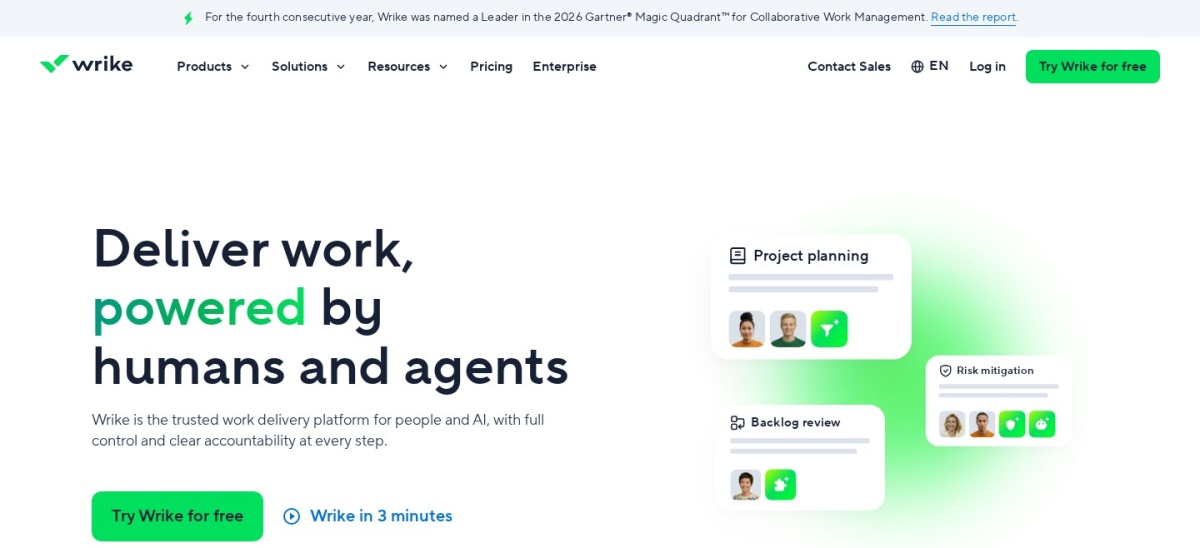
Wrike homepage, captured Nov 2026.
Wrike is a collaborative project and portfolio management platform that supports risk tracking through tasks, dashboards, schedules and configurable workflows. Its free plan includes project management, board views and tables. Team costs $10 per user monthly billed annually and adds shareable dashboards, interactive Gantt charts and AI-assisted work management.
The trade off is that advanced customization, reporting and automation require Business at $25 per user monthly, while dedicated compliance assessments are outside Wrike's core functionality. Paid subscriptions also have team-size conditions. It suits project managers tracking delivery risks, dependencies and mitigation responsibilities across multiple initiatives.
What we like
Free project tracking tools
Shareable dashboards on Team
Gantt charts for schedule risk visibility
Task ownership and due dates
Advanced workflow options on Business
Watch out for
Formal GRC features are not native
Advanced workflows require Business
Paid plans have user-group licensing rules
Team adds dashboards, Gantt charts and AI-assisted managementVisit wrike.com
06
Airtable
4.6/5on G2 (3,306 reviews, checked Nov 2026)
Paid from$20/mo
Best for customizable risk databases
Free planAvailable
Paid entryTeam, $20/user/mo billed annually
Billing modelUsers with edit access
G2 rating4.6/5, 3,306 reviews
airtable.com
Airtable homepage, captured Nov 2026.
Airtable is a relational database and workflow platform that can connect risk records with owners, controls, incidents and mitigation tasks. Its free plan supports basic databases and collaboration. Team costs $20 per user monthly billed annually and adds capacity and functionality for shared operational databases.
The trade off is that Airtable requires users to design their own risk methodology, scoring fields and reporting workflows. The paid subscription also charges for collaborators with editing permissions, while read-only collaborators are free. It suits organizations needing flexible risk registers without purchasing a dedicated enterprise GRC platform.
What we like
Flexible relational risk registers
Free plan for lightweight databases
Custom forms and linked records
Automations and integration options
Read-only collaborators do not require paid seats
Watch out for
Risk scoring requires custom setup
No dedicated enterprise risk methodology
Paid editing seats increase subscription costs
Team adds expanded database capacity and collaboration featuresVisit airtable.com
07
Asana
4.4/5on G2 (14,143 reviews, checked Nov 2026)
Paid from$13.49/mo
Best for collaborative mitigation plans
Free planPersonal
Paid entryStarter, $13.49/user/mo
Annual billing$10.99/user/mo
G2 rating4.4/5, 14,143 reviews
asana.com
Asana homepage, captured Nov 2026.
Asana is a collaborative work management platform that helps teams document risks, assign mitigation activities and monitor deadlines. Its free Personal plan provides task management and basic collaboration. Starter costs $13.49 per user monthly and adds custom fields, reporting dashboards, forms, unlimited automations, timelines and Gantt views.
The trade off is that Asana focuses on project execution rather than formal enterprise risk assessment, so risk matrices, controls and compliance tracking require configuration. Portfolio-level reporting and more advanced management features require higher plans. It suits teams prioritizing action ownership and ongoing mitigation follow-ups.
Starter adds custom fields, dashboards, forms and unlimited automationsVisit asana.com
Dedicated GRC software vs. project risk management tools
Dedicated GRC software and general project management software solve different problems. GRC platforms are designed to formalize risk identification, assessment, control mapping, treatment and evidence collection across an organization.
SimpleRisk is the dedicated GRC option in this comparison. Its free Core edition includes risk management and compliance capabilities, while paid Extras add structured assessments, vendor risk, integrations and automation.
Smartsheet, monday.com, ClickUp, Wrike, Airtable and Asana are configurable work management platforms. They can maintain registers, assign risk owners, track mitigation tasks and provide reporting, but they do not automatically replace specialized compliance or enterprise risk systems.
For straightforward operational or project risk tracking, a configurable platform may be sufficient. Organizations managing formal regulatory obligations, complex control frameworks or board-level enterprise risk programs should prioritize dedicated risk software.
Financial institutions also may need specialized credit, liquidity, market or fraud risk capabilities. A general project risk register does not replace quantitative financial risk modeling or transaction monitoring.
How to organize a practical business risk register
Create a separate record for each meaningful risk. Include a description, category, responsible owner, affected process and current status. Avoid combining unrelated threats into a single record.
Assess likelihood and business impact using a consistent scoring method. Document the reasoning behind each score and distinguish the original exposure from the remaining risk after controls.
Assign mitigation activities with clear owners and deadlines. Connect the risk record to relevant tasks, evidence, policies or controls so progress can be verified.
Set review dates based on risk severity and business changes. Update records following incidents, significant control failures or major operational changes.
Use dashboards to show unresolved high-priority risks, overdue actions and changing exposure. Reports should explain both the current risk position and the progress of mitigation activities.
How we chose
We compared established products that support organizational risk management, operational risk registers or project risk mitigation. The shortlist distinguishes dedicated governance, risk and compliance functionality from configurable work management systems. We evaluated risk tracking, reporting, automation, responsibilities, flexibility and published customer feedback.
Prices and public ratings were checked on 22 Nov 2026 using official vendor pricing pages and G2 reviews. Annual comparisons use regular monthly prices multiplied by 12 or the vendor's published annual subscription where monthly billing is unavailable. Per-seat charges, annual billing requirements and add-on costs are identified separately.
We excluded enterprise risk vendors without confirmable public subscription prices, including several quote-based integrated risk management platforms. We retained SimpleRisk for its established open-source GRC offering despite its smaller public review count. No vendor paid for a place, and we do not claim testing for this list.
How to choose the best risk management software
Define the risks your organization needs to manage, then compare assessment, reporting and workflow requirements before selecting a platform.
Identify your risk management scope. Determine whether you need enterprise-wide governance, compliance risk assessments, project delivery tracking or operational risk registers. Choose a dedicated GRC platform when formal methodologies, controls and evidence management are essential.
Evaluate risk assessment and reporting. Check whether the software supports risk categories, likelihood and impact scoring, inherent and residual risk, dashboards, review histories and mitigation reports. Confirm how much configuration is required for your methodology.
Review ownership and automation. Look for risk owners, assigned actions, approval workflows, review reminders and escalation processes. Teams should be able to monitor overdue mitigation activities and maintain accountability across departments.
Compare total costs and implementation. Include subscription fees, user licenses, required add-ons, setup and ongoing administration. A flexible work management tool may cost less initially but require more configuration than a dedicated risk platform.
FAQ
What is the best risk management software in 2026?
SimpleRisk is a strong choice for dedicated governance, risk and compliance management because it provides risk registers, assessments, controls and reporting. Its Core edition is free to self-host. Smartsheet and monday.com are useful alternatives for organizations primarily managing operational and project risks.
Is there free risk management software?
Yes. SimpleRisk Core is free, open-source GRC software supporting unlimited users through self-hosting. ClickUp, monday.com, Wrike, Airtable and Asana also offer free plans that can be configured for basic risk registers and mitigation tracking, although they are not specialized enterprise risk systems.
What is the difference between GRC and risk management software?
Risk management software focuses on identifying, assessing, monitoring and treating risks. Governance, risk and compliance software also connects risk activities to policies, controls, regulatory obligations and audit evidence. Some GRC platforms provide integrated reporting across those functions, while general risk trackers focus on registers and mitigation.
Which risk management tool is best for small businesses?
ClickUp and monday.com are practical choices for small businesses needing simple risk registers and assigned mitigation tasks. Both offer free plans. Businesses requiring formal compliance assessments should also consider SimpleRisk Core, provided they have the technical resources to manage a self-hosted deployment.
Can Smartsheet be used for risk management?
Yes. Smartsheet can maintain risk registers, collect assessment information through forms, assign owners and track mitigation actions. Pro costs $12 per member monthly on monthly billing. However, specialized risk methodologies and control relationships must be configured rather than relying on native enterprise risk management functions.
How much does risk management software cost?
General work management platforms start at relatively low per-user subscription prices, while dedicated GRC software may cost substantially more. SimpleRisk offers a free Core edition and paid packages from $5,000 annually. Total costs depend on users, modules, deployment, reporting requirements and implementation work.
What should a risk register include?
A risk register should record each risk's description, category, owner, likelihood, impact, controls, mitigation plan, status and review date. More formal programs also document inherent and residual risk scores, evidence, responsible control owners and acceptance decisions. Consistent updates are important for useful reporting.
Can project management software replace enterprise risk management software?
Project management software can replace a spreadsheet-based risk register for straightforward operational needs. It usually cannot replace formal enterprise risk management systems that require regulatory control mapping, audit histories, risk appetite monitoring, incident analysis or specialized financial risk assessments without extensive configuration.
Which software is best for tracking risk mitigation?
ClickUp, Asana, Wrike and monday.com are useful for assigning mitigation tasks, setting deadlines and monitoring progress. Smartsheet adds spreadsheet-style registers and reporting. SimpleRisk is more appropriate when mitigation activities must connect to formal risk assessments, controls and compliance documentation.
SaaS SEO and WordPress specialist with about 8 years of experience. Rakib compares WordPress plugins, themes, hosting and software using public pricing, documentation and user reviews. See how we rank.