Best SaaS Billing Software in 2026: 7 Tools Compared
WLWPLegible EditorsLast verified 22 Nov 2026How we rank12 min read
★ Short answer
Billsby is the best SaaS billing software for growing businesses that need subscription management without a large fixed commitment. Its Core plan costs $45 monthly, plus 0.4% of revenue above $15,000 monthly. Zoho Billing suits finance-focused teams, while Outseta combines subscription billing with customer authentication and CRM.
How we make this list: we compare pricing pages, product documentation and public user reviews, then re-check every price before each update. No product paid for a place. Disclosure.
Billsby Core costs $45 monthly, or $540 annually, plus 0.4% on monthly revenue above $15,000. G2 rates it 4.8/5 from 486 reviews.
Zoho Billing Standard costs $39 per organization monthly with annual billing and includes 3 users, making it suitable for small finance teams.
Outseta Start costs $37 monthly with annual billing plus a 2% transaction fee. It includes unlimited team seats and supports 1,000 contacts.
SubscriptionFlow Startup costs $99 monthly with annual billing and includes $100,000 in annual revenue capacity.
ChargeOver starts at $229 monthly without percentage-of-revenue software charges. Its pricing scales with active billing customers.
Recurly Starter costs $249 monthly plus 0.9% on billing volume above $40,000 monthly, while Maxio Grow starts at $599 monthly.
What to look for in SaaS billing software
SaaS billing software automates the recurring financial processes behind subscription products. It manages pricing plans, renewals, invoices, payment collection, and subscription changes that would otherwise require manual accounting work.
The first priority is billing model flexibility. Simple SaaS products may charge a fixed monthly subscription, while growing platforms often introduce seat-based pricing, usage charges, add-ons, prepaid credits, or hybrid contracts. Your billing platform must support the models you intend to offer.
Payment recovery matters because failed renewals can cause involuntary churn. Look for automated retries, payment reminders, customer billing portals, and clear records of failed transactions. Some platforms include basic dunning while charging more for advanced recovery workflows.
Pricing structures differ substantially. Flat monthly fees provide predictable platform costs, while revenue-based and transaction-based models increase with billing volume. Compare payment processing, tax handling, revenue recognition, and integrations separately rather than assuming every feature is included.
Billsby is a subscription billing platform for SaaS businesses managing recurring payments, customer plans, and billing automation. Its free plan allows businesses to configure their billing environment before launching. Core costs $45 monthly and supports subscription management, invoicing, prorated billing, and usage-based charges, with a 0.4% fee on monthly revenue exceeding $15,000.
The trade off is that Core supports a single payment gateway and tax region, with additional charges once revenue passes its threshold. Its $45 monthly platform fee equals $540 annually before overages and processing fees. It suits SaaS startups and growing subscription businesses that need flexible billing without enterprise-level costs.
What we like
Free plan for preparing a subscription business
Supports recurring, unit and usage-based billing
Customer self-service and automated dunning
Core has a published monthly subscription price
Rated 4.8/5 from 486 G2 reviews
Watch out for
Core adds revenue-based fees above its threshold
Core limits payment gateway and tax-region options
Revenue recognition features may require add-ons
Core enables live subscription billing; Pro expands gateways, tax regions and advanced capabilitiesVisit billsby.com
02
Zoho Billing
4.4/5on G2 (45 reviews, checked Nov 2026)
Starts at$39/mo
Best for subscription billing and finance workflows
Standard users3
Invoice allowance100,000/year
Billing methodsRecurring and usage-based
Paid planStandard, $39/org/mo annually
zoho.com
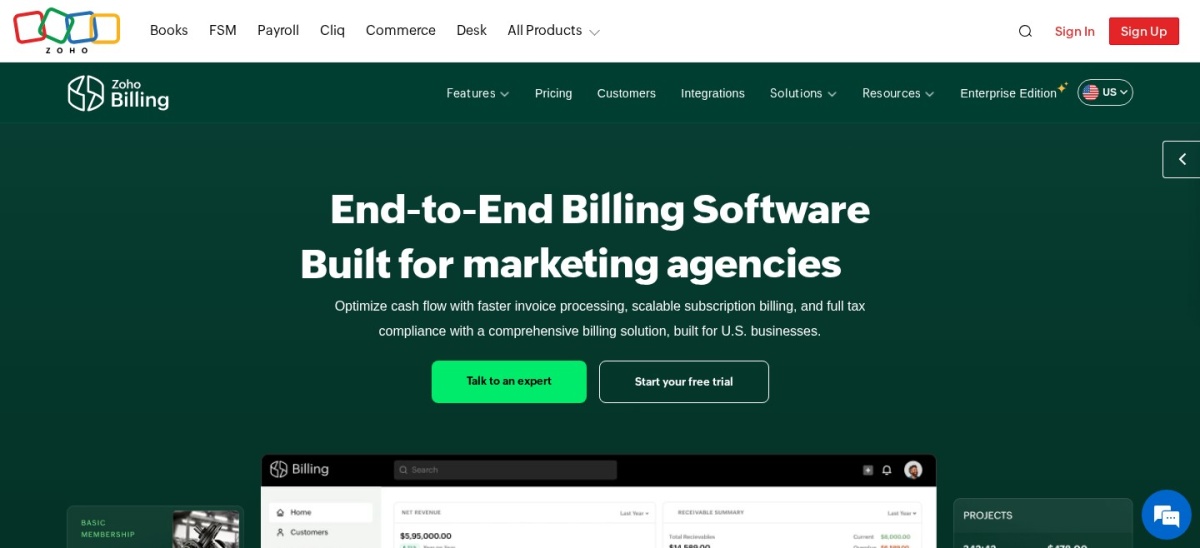
Zoho Billing homepage, captured Nov 2026.
Zoho Billing is a billing and subscription management platform combining invoicing, payment collection, product catalogs, and revenue reporting. Standard costs $39 per organization monthly with annual billing and includes 3 users and an allowance of 100,000 invoices yearly. The platform supports recurring subscriptions, pricing models, payment reminders, and customer account management.
The trade off is that advanced configurations and larger organizations may require Premium or Enterprise. Standard costs $468 annually, with higher editions offering additional users and controls. It suits SaaS businesses that want billing connected to accounting, customer records, and broader finance processes.
What we like
Organization-based pricing includes 3 users
Supports recurring and usage-based billing
Large published annual invoice allowance
Connects with other Zoho business applications
Subscription management and invoicing in one platform
Complex configurations may require additional setup
Some capabilities depend on connected Zoho services
Premium expands user capacity and billing controls; Enterprise adds higher-volume capabilitiesVisit zoho.com
03
Outseta
4.7/5on G2 (11 reviews, checked Nov 2026)
Starts at$37/mo
Best for SaaS startups needing billing and authentication
Start contacts1,000
Team seatsUnlimited
Transaction fee2%
Paid planStart, $37/mo annually
outseta.com
Outseta homepage, captured Nov 2026.
Outseta is an integrated platform for managing SaaS subscriptions, user authentication, customer relationships, and email communication. Its Start plan costs $37 monthly with annual billing and supports up to 1,000 contacts and unlimited team seats. It combines Stripe payments, protected content, CRM, email, and help desk functionality.
The trade off is a 2% transaction fee on Start, in addition to the $444 annual subscription. Larger contact allowances and lower transaction fees require upgrades. It suits smaller SaaS products that want customer accounts, subscription payments, and communication tools in the same platform.
What we like
Combines billing with authentication and CRM
Unlimited team seats on Start
Includes email and help desk functionality
Supports Stripe payments and customer subscriptions
Published monthly and annual billing options
Watch out for
Start adds a 2% transaction fee
Contact capacity is limited by subscription tier
Only 11 public G2 reviews
Less suitable for complex enterprise contracts
Scale expands contact capacity and reduces the transaction fee to 1%Visit outseta.com
04
SubscriptionFlow
4.6/5on G2 (34 reviews, checked Nov 2026)
Starts at$99/mo
Best for customizable subscription lifecycles
Startup revenue$100,000/year included
Onboarding25 hours included
Billing methodsRecurring, usage and hybrid
Paid planStartup, $99/mo annually
subscriptionflow.com
SubscriptionFlow homepage, captured Nov 2026.
SubscriptionFlow is a recurring billing and subscription management platform covering subscription plans, invoicing, checkout, collections, and customer lifecycle automation. Its Startup plan costs $99 monthly with annual billing, includes $100,000 in annual revenue capacity, and provides 25 onboarding hours. The software supports different pricing models and automated payment recovery.
The trade off is the annual subscription commitment and revenue allowance attached to Startup. Its listed base cost is $1,188 annually, while larger businesses may need higher plans. It suits growing SaaS companies that want configurable billing workflows and guided onboarding.
What we like
Supports multiple subscription pricing models
Includes dunning and subscription lifecycle automation
Startup includes 25 onboarding hours
Customer portal and subscription management tools
Published annual revenue allowance
Watch out for
Startup is billed annually
Revenue capacity varies by plan
Only 34 public G2 reviews
Pricing and plan details require careful comparison
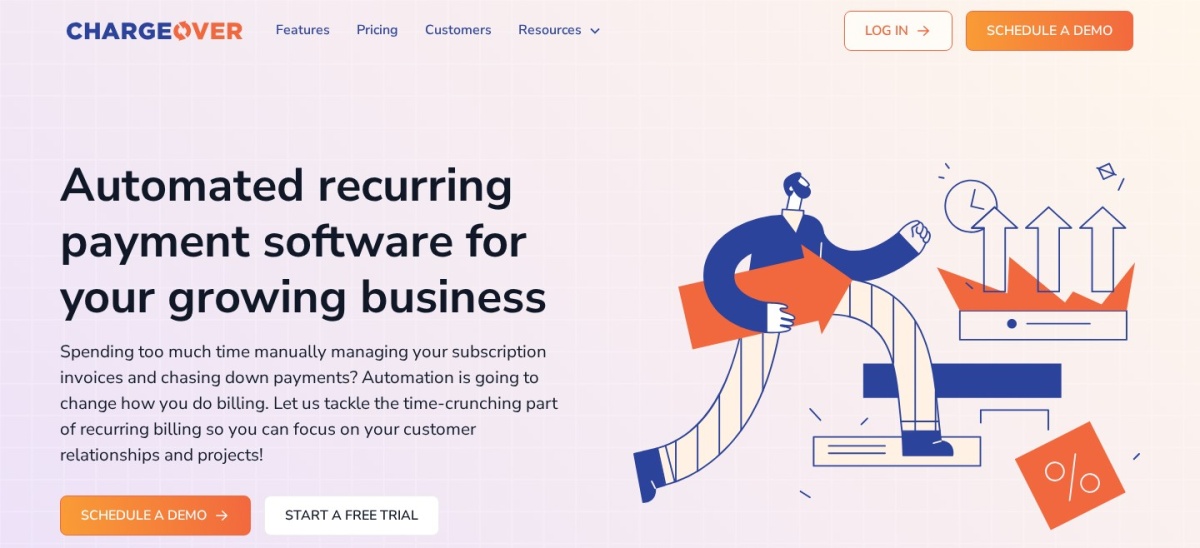
ChargeOver is recurring billing software that automates subscription invoices, payment collection, payment reminders, and customer account management. Its published plans start at $229 monthly and include unlimited invoices, API access, customizable emails, and accounting integrations. Pricing depends on the number of active paying customers rather than a percentage of invoiced revenue.
The trade off is its higher starting subscription cost, with pricing increasing as the number of paying customers grows. The $229 monthly entry price equals $2,748 annually before gateway processing charges. It suits established SaaS businesses that prefer fixed platform pricing instead of revenue-percentage software fees.
What we like
No percentage-of-revenue software charge
Unlimited invoices included
Supports fixed, metered and quantity-based billing
QuickBooks and Xero integrations
Customer billing portal and automated reminders
Watch out for
Starting platform fee is $229 monthly
Cost increases with active paying customers
Payment gateway fees are additional
Not the cheapest choice for early-stage SaaS
Paid plans enable live billing and scale according to active customer volumeVisit chargeover.com
06
Recurly
4.1/5on G2 (228 reviews, checked Nov 2026)
Starts at$249/mo
Best for subscription retention and payment recovery
Starter platform fee$249/mo
Included billing volume$40,000/mo
Additional volume fee0.9%
Paid planStarter, $249/mo plus overages
recurly.com
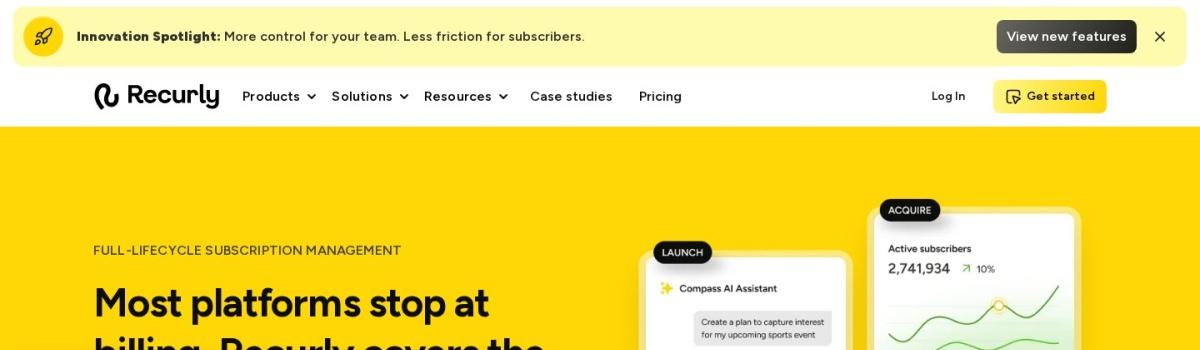
Recurly homepage, captured Nov 2026.
Recurly is a subscription management platform for recurring billing, customer lifecycle management, and payment recovery. Starter costs $249 monthly and includes the first $40,000 of monthly billing volume before a 0.9% volume charge applies. It provides automated subscription billing, flexible pricing plans, and a dunning campaign.
The trade off is that the monthly platform fee combines with additional billing-volume charges as revenue grows. The fixed portion equals $2,988 annually, excluding overages and payment processing. It suits subscription businesses that need dedicated renewal management and recovery workflows rather than basic recurring invoices.
What we like
Designed specifically for subscription businesses
Automated recurring billing and plan management
Includes payment recovery workflows
Supports more than 20 payment gateways
Starter includes a published billing-volume allowance
Watch out for
Higher fixed cost than startup-focused options
Additional charges apply above the included billing volume
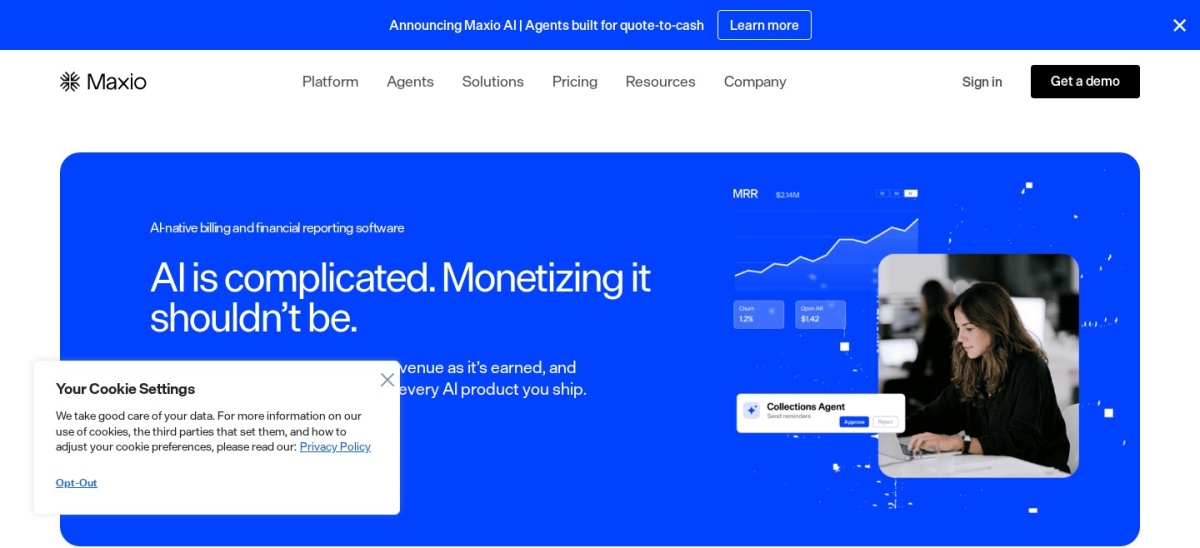
Maxio is a SaaS billing and financial operations platform combining subscription management, invoicing, revenue recognition, and reporting. Its Grow plan starts at $599 monthly, with annual agreements as the standard commitment. The platform supports recurring contracts, subscription changes, usage-based billing, and financial visibility for growing B2B software businesses.
The trade off is its higher entry price and greater implementation complexity compared with lightweight billing platforms. Grow starts at $7,188 annually, with costs depending on business requirements and optional modules. It suits established B2B SaaS companies managing complex contracts, billing operations, and revenue reporting.
What we like
Combines subscription billing and revenue reporting
Supports contract-based and usage-based billing
Financial reporting designed for SaaS businesses
Accounting and revenue recognition capabilities
Rated by 831 G2 reviewers
Watch out for
Starting cost is $599 monthly
Annual agreements are the default
Optional modules may increase total costs
Greater setup complexity than simpler billing tools
Higher plans and optional modules extend revenue, collections and multi-entity capabilitiesVisit maxio.com
Which SaaS billing models should your platform support?
Flat-rate subscriptions charge customers a fixed recurring amount. They are straightforward to configure and reconcile, making them suitable for simple software products with predictable plans.
Seat-based billing calculates charges using active users or purchased licenses. The billing platform should manage quantities, mid-cycle adjustments, renewals, and prorated upgrades without requiring manual invoices.
Usage-based billing charges according to consumption, such as API requests, storage, or processing volume. Businesses adopting this model need accurate metering, usage aggregation, customer visibility, and invoice calculations.
Hybrid billing combines subscriptions with usage charges, minimum commitments, add-ons, or prepaid credits. These models require more flexible pricing configuration and often favor platforms designed for established B2B SaaS operations.
How to calculate the total cost of SaaS billing software
The subscription price is only one part of billing software costs. Businesses should also account for payment processing, billing-volume percentages, transaction fees, optional modules, and implementation requirements.
Billsby Core has a $45 monthly subscription plus a revenue-based charge above its published threshold. Recurly Starter combines a $249 monthly platform fee with additional volume charges. ChargeOver instead charges based on active customers without taking a percentage of invoiced revenue.
Different models become economical at different volumes. A lower fixed subscription may cost more when transaction percentages accumulate, while a higher platform fee may be easier to budget at scale. Compare costs using your expected customer count, revenue, transactions, and billing complexity.
How we chose
We shortlisted established SaaS billing platforms with active subscription management products, public pricing information, and independent review profiles. The comparison covers startup billing, general recurring invoicing, subscription lifecycle management, payment recovery, and B2B revenue operations.
This guide carries the editorial date 22 Nov 2026. Official pricing pages and public G2 ratings were opened during verification on 23 Nov 2026. Annual base costs use published regular entry-level rates and exclude variable transaction, revenue, gateway, or optional-module charges unless specifically stated.
We excluded products without a confirmed public entry-level price and tools offering only general accounting without substantial subscription management functionality. Outseta remains included despite its smaller review sample because its published pricing and integrated SaaS capabilities are relevant. No vendor paid for a place, and we do not claim testing for this list.
How to choose the right SaaS billing software
Identify your billing requirements, estimate subscription volume, and compare how each platform handles payments, recurring charges, and financial reporting.
Define your pricing and billing models. List the subscription structures your business currently supports and expects to introduce. Check whether each platform handles fixed recurring fees, seat quantities, usage charges, upgrades, discounts, and prepaid commitments.
Calculate costs using realistic billing volume. Compare the fixed subscription price with revenue percentages, transaction charges, active customer limits, and payment gateway fees. Use projected billing volume rather than the published starting price alone.
Evaluate payment recovery and customer management. Look for automated retries, failed-payment notifications, customer billing portals, subscription changes, cancellation handling, and renewal reporting. These features reduce manual administration and help address involuntary churn.
Check integrations and financial requirements. Confirm compatibility with your payment processors, accounting system, CRM, and reporting tools. If you need detailed revenue recognition, complex contracts, or multiple entities, evaluate those capabilities before committing.
FAQ
What is the best SaaS billing software in 2026?
Billsby is our top overall pick because it combines recurring billing, subscription management, and usage-based charges with a published $45 monthly Core plan. Zoho Billing is a good alternative for finance-focused workflows, while Maxio is better suited to established B2B SaaS businesses with complex revenue operations.
What is the cheapest SaaS billing software?
Outseta Start has the lowest paid base subscription in this comparison at $37 monthly with annual billing, but it also charges a 2% transaction fee. Zoho Billing Standard costs $39 per organization monthly with annual billing. The cheapest overall option depends on transaction volume and business requirements.
Is there free SaaS billing software?
Billsby offers a free plan for configuring a subscription business before launching live paid operations. Other providers may offer free trials or sandbox environments. A free setup option does not necessarily mean a business can collect recurring payments indefinitely without software fees.
What is the difference between SaaS billing and subscription management?
SaaS billing handles invoices, recurring charges, payment collection, and financial records. Subscription management covers the broader customer lifecycle, including trials, upgrades, renewals, pauses, cancellations, and reactivations. Many modern billing platforms combine these functions, although the depth of automation varies.
Which billing software supports usage-based SaaS pricing?
Billsby, Zoho Billing, SubscriptionFlow, ChargeOver, and Maxio provide capabilities for usage-based or metered billing. Their implementations differ, so businesses should check usage collection, billing thresholds, prepaid balances, invoice adjustments, and whether additional modules are required.
How much does SaaS billing software cost?
Entry-level subscription prices in this comparison range from $37 monthly for Outseta Start to $599 monthly for Maxio Grow, using the listed billing commitments. Some platforms also charge transaction percentages, revenue-based overages, gateway fees, or additional module charges. Total costs depend on usage and scale.
Which SaaS billing software is best for startups?
Outseta is useful for startups that need billing, authentication, CRM, and customer communication together. Billsby is better for businesses focused primarily on subscription payments and flexible pricing models. Zoho Billing works well for small teams that prioritize invoicing and financial administration.
Which software is best for B2B SaaS billing?
Maxio is a strong fit for B2B SaaS companies handling contract-based pricing, subscription changes, revenue recognition, and financial reporting. Recurly is another option for complex subscription lifecycles and payment recovery. Smaller B2B companies may prefer Billsby or Zoho Billing depending on their requirements.
Can SaaS billing software reduce failed payments?
Yes. Platforms offering automated retries, payment reminders, customer billing portals, and subscription recovery workflows can help businesses address failed renewals. However, results depend on payment methods, customer behavior, retry settings, and the platform's recovery capabilities. No billing tool can guarantee successful payment collection.