Mender is a top pick for over-the-air firmware updates, combining a free open-source core with a $34/mo Basic hosted plan for up to 50 devices. For fast mobile dashboards, Blynk starts at $29/mo, while Arduino Cloud starts at $72/yr for individual makers.
How we make this list: we compare pricing pages, product documentation and public user reviews, then re-check every price before each update. No product paid for a place. Disclosure.
Mender offers an open-source option alongside a Basic hosted tier at $34/mo for up to 50 devices.
Blynk holds a 4.8 out of 5 rating across 1,062 reviews on Capterra with a Free tier for up to 5 devices.
Arduino Cloud starts at $72/yr on the Maker plan and supports over-the-air code updates over Wi-Fi.
Golioth uses usage-based pricing with $50 in free credits and a 5/5 rating across 2 reviews on G2.
Particle includes up to 100 devices and 100K monthly data operations on its Free plan, with a 4.5 out of 5 rating across 195 reviews on G2.
What to look for in OTA firmware update software
Over-the-air firmware update software lets engineering teams push operating system images, application code, and configuration changes to connected devices without physical cables. Reliability matters more than raw speed because a dropped connection or bad image during an update can leave hardware unresponsive in the field.
Look for atomic updates, signature verification, and automatic rollback so a failed boot returns the device to a known-good state. Delta updates are also worth checking if your fleet runs over cellular or metered links, since sending binary diffs reduces bandwidth costs compared with full images.
Match the platform to your hardware and team size rather than overbuying enterprise orchestration on day one. Microcontrollers, embedded Linux boards, and mobile-connected prototypes each place different demands on memory, security keys, and fleet management.
Check whether a vendor charges per device, per payload or data operation, or by fleet block size. A pricing model that looks inexpensive during prototyping can scale differently once hundreds or thousands of devices report telemetry.
Mender is an over-the-air update and device lifecycle platform built around embedded Linux and real-time operating systems. It offers a free open-source core alongside a Basic hosted plan starting at $34/mo for up to 50 devices.
The trade off is that delta updates, scheduled deployments, and automatic retries sit on higher tiers starting at $291/mo. It suits engineering teams shipping Linux or RTOS hardware that need atomic updates and rollback controls.
What we like
Free open-source core with self-hosted and commercial cloud options
Supports full disk image and application updates with rollback safety
Offers REST API access and a 12-month hosted trial
Watch out for
Delta updates and scheduled rollouts require the $291/mo Professional tier
Smaller public review count on G2 than broad cloud suites
Paid plans add managed hosting, higher device counts, and automation features like delta updates and retries.Visit mender.io
02
Blynk
4.8/5on Capterra (1,062 reviews, checked Nov 2026)
Paid from$29/mo
Best for connected mobile dashboards
Free tier$0 (5 devices, 1 user)
Entry paid tier$29/mo (Starter, 10 devices)
Production tier$199-$1,099/mo (100-1,000 devices)
Mobile appsiOS and Android dashboards
blynk.io
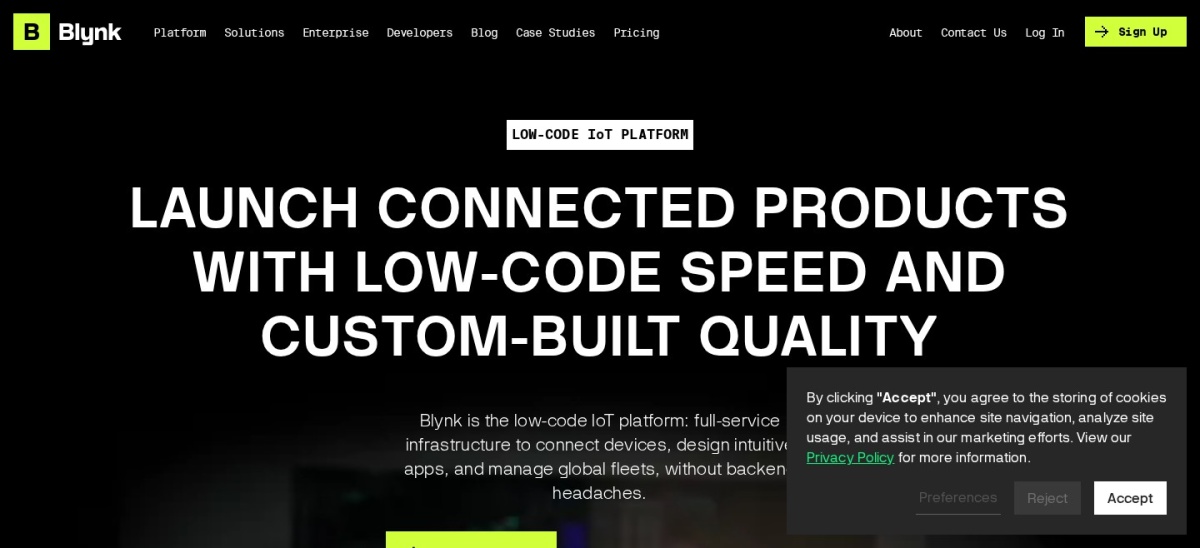
Blynk homepage, captured Nov 2026.
Blynk is a connected device platform pairing hardware libraries and cloud services with drag-and-drop mobile and web dashboards. Its Free plan covers up to 5 devices and 100,000 messages, while paid tiers start at $29/mo.
The trade off is that production tiers jump to $199-$1,099/mo for 100 to 1,000 devices and rely on steady network connectivity. It suits teams building connected hardware that needs a fast mobile control interface alongside remote updates.
What we like
Strong 4.8 out of 5 rating across 1,062 Capterra reviews
Includes built-in mobile and web dashboard tools without building an app from scratch
Offers a Free tier for up to 5 devices and 1 user
Watch out for
Commercial fleet tiers scale up quickly once you pass small device counts
Dependence on network connectivity can interrupt remote device control
Paid plans expand device limits, message allowances, data retention, and SLA support.Visit blynk.io
03
Arduino Cloud
4.5/5on Capterra (51 reviews, checked Nov 2026)
Paid from$72/yr
Best for makers and rapid prototypes
Maker plan$72/yr (1 user, 25 Things)
Team plan$1,000/yr (50 users, 100 Things)
OTA deliveryOver-the-air updates via Wi-Fi
Data retentionUp to 1 year on Maker & Team
cloud.arduino.cc
Arduino Cloud homepage, captured Nov 2026.
Arduino Cloud combines an online code editor, dashboards, and wireless over-the-air firmware deployment for connected boards. It offers a Free tier for up to 2 Things and a Maker plan at $72/yr for 1 user and 25 Things.
The trade off is a sharp price jump to $1,000/yr on the Team plan for multi-user collaboration and 100 Things. It suits individual developers and small prototypes looking for a straightforward Wi-Fi update workflow.
What we like
Low entry cost at $72/yr on the Maker plan
Supports over-the-air code updates over Wi-Fi from the cloud workflow
Includes cloud CLI and dashboard tools for monitoring connected devices
Watch out for
Team plan steps up to $1,000/yr for shared spaces and up to 50 users
Less suited to heavy industrial Linux fleet orchestration than dedicated Linux OTA tools
Paid plans increase connected device limits, longer data retention, and multi-user workspace controls.Visit cloud.arduino.cc
04
Particle
4.5/5on G2 (195 reviews, checked Nov 2026)
Paid from$299/mo
Best for integrated IoT hardware and cloud
Free tier$0/mo (100 devices, 100K ops)
Basic tier$299/mo per block (100 devices)
Plus tier$599/mo per block (100 devices)
SecurityDevice-to-cloud encryption, SOC 2
particle.io
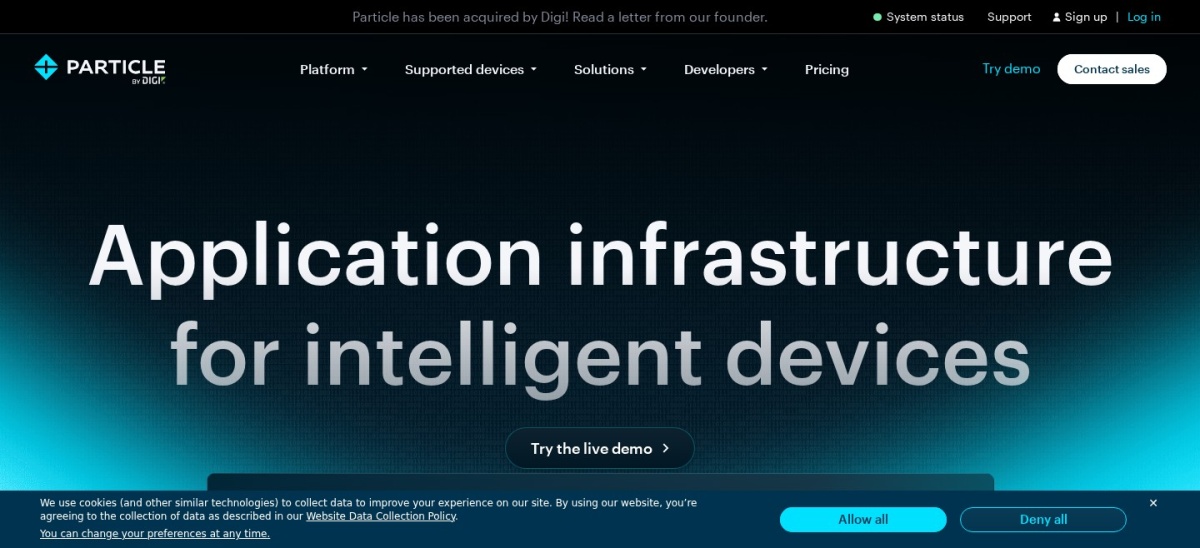
Particle homepage, captured Nov 2026.
Particle provides a managed device cloud, connectivity options, and remote firmware updates for connected hardware products. Its Free tier supports up to 100 devices and 100K monthly data operations, with Basic blocks starting at $299/mo.
The trade off is block-based paid pricing that starts at $299/mo per 100-device block on Basic and $599/mo on Plus. It suits teams building connected devices that want managed cloud infrastructure and remote firmware updates in one stack.
What we like
Generous Free tier covering up to 100 devices and 100K data operations
Established review footprint with 4.5 out of 5 across 195 G2 reviews
Built-in encryption and remote diagnostics for deployed devices
Watch out for
Paid Basic blocks start at $299/mo, a steep jump from the free tier
Some users note mixed customer support experiences on tickets
Paid blocks expand data operation pools, extend location data retention, and add invoice billing.Visit particle.io
05
Golioth
5/5on G2 (2 reviews, checked Nov 2026)
Paid from$0.25/mo
Best for usage-based MCU fleet updates
Pricing modelPay-as-you-go usage pricing
Connectivity$0.25 per active device/mo
OTA bandwidth$0.0095 per MB transferred
Starter credit$50 in free credits
golioth.io
Golioth homepage, captured Nov 2026.
Golioth is a cloud platform built for microcontroller and IoT fleets with usage-based pricing and $50 in starting credits. Active device connectivity starts at $0.25 per device/mo plus $0.0095 per MB of OTA update bandwidth.
The trade off is usage-based billing where high update volumes or frequent data streams add up per megabyte. It suits teams running microcontroller fleets that want granular pay-as-you-go costs rather than rigid seat tiers.
What we like
No rigid platform tiers or seat minimums, backed by $50 in free credits
Low per-device connectivity rate starting at $0.25 per active device/mo
Transparent per-MB OTA update bandwidth rate at $0.0095 per MB
Watch out for
Large firmware images or frequent rollouts increase bandwidth charges
Limited number of public reviews on G2
Usage billing scales with active connections, OTA transfer bandwidth, and long-term data retention.Visit golioth.io
06
Kaa IoT
5/5on G2 (2 reviews, checked Nov 2026)
Paid from$99/mo
Best for device-tier cloud plans
Free tierUp to 5 connected devices
Entry cloud plan$99/mo (up to 100 devices)
Mid cloud plans$175/mo (250) or $325/mo (500)
Hosting optionsKaa Cloud or self-hosted
kaaiot.com
Kaa IoT homepage, captured Nov 2026.
Kaa IoT is a device management and IoT cloud platform supporting remote device operations, telemetry, and flexible hosting. It includes a free plan for up to 5 devices, with Kaa Cloud starting at $99/mo for up to 100 devices.
The trade off is a steeper initial paid jump to $99/mo compared with lightweight hobby plans, plus a learning curve during setup. It suits growing device fleets that prefer predictable device-count tiers and hosting flexibility.
What we like
Clear device-count tiers at $99/mo for 100 devices, $175/mo for 250, and $325/mo for 500
Free plan available for up to 5 devices to test workflows
Supports both hosted cloud and self-managed deployment paths
Watch out for
Can feel complex to configure initially for first-time IoT teams
Few public reviews posted on G2
Higher cloud tiers increase included endpoints, storage allocation, and virtual machine capacity.Visit kaaiot.com
07
Memfault
4.9/5on Capterra (10 reviews, checked Nov 2026)
Paid from$3,495/mo
Best for diagnostics paired with OTA
Developer tierFree up to 10 dev devices (Nordic)
Growth plan$3,495/mo (30-day retention)
Scale plan$6,695/mo (45-day retention)
OTA updatesIncluded across plans
memfault.com
Memfault homepage, captured Nov 2026.
Memfault pairs device health monitoring, crash diagnostics, and over-the-air firmware updates across embedded fleets. It offers a free Developer option for up to 10 development devices on Nordic low-power wireless solutions, while Growth starts at $3,495/mo.
The trade off is commercial pricing aimed at larger engineering fleets rather than small side projects. It suits hardware teams that want crash traces and fleet health metrics tied directly to firmware rollouts.
What we like
High 4.9 out of 5 rating across 10 reviews on Capterra
Combines crash and health diagnostics with over-the-air firmware deployment
Includes a free Developer tier for up to 10 Nordic development devices
Watch out for
Growth pricing at $3,495/mo is high for early-stage or small fleets
Commercial plans restrict chip and architecture counts by tier
Higher tiers expand data retention windows, supported chip and architecture counts, and team seats.Visit memfault.com
How to keep OTA rollouts safe in production
Even the best over-the-air update service cannot fix a bootloader that lacks integrity checks or a fallback image. Verify image signatures before writing to flash and test automatic rollback on power loss or boot failure before shipping units.
Roll out firmware in small staged groups rather than hitting an entire fleet at once. Watching crash rates, connectivity drops, and battery or memory metrics on an early cohort lets you halt a bad build early.
How we chose
We built this list from established over-the-air firmware update and connected-device management platforms across embedded Linux, microcontrollers, and cloud ecosystems.
All pricing tiers, plan limits, and third-party review scores were checked on 22 Nov 2026 using official vendor pricing pages and public review directories.
We excluded platforms without clear public pricing or verified review figures on our checked sources, as well as tools that only handle raw bootloaders without fleet management. No vendor paid for a place, and we do not claim testing for this list.
How to choose OTA firmware update software
Follow four practical steps to narrow down an over-the-air update platform for your hardware.
Match the client to your hardware architecture. Confirm whether the platform supports your target Linux distribution, RTOS, or microcontroller and fits within available memory and storage.
Check rollback, signing, and delta support. Look for cryptographic image verification, automatic rollback on failed boots, and delta updates if bandwidth is constrained.
Model costs at real fleet volume. Compare free tiers against paid device blocks, per-device fees, or data-operation charges at your expected production fleet size.
Decide between managed cloud and self-hosting. Pick a hosted service if you want lower maintenance overhead, or look for open-source and on-premise options when you need local control.
FAQ
What is OTA firmware update software?
Over-the-air firmware update software delivers operating system images, device code, and configuration updates remotely over a network. It removes the need to connect each unit manually with a cable or visit sites in person for routine updates.
Do I need automatic rollback for OTA firmware updates?
Automatic rollback is strongly recommended for production devices so a failed update or crash loop reverts to a working image. Without rollback protection, a bad firmware build can strand remote hardware in the field.
What is the difference between full image and delta OTA updates?
A full image update sends the entire firmware or OS package, while a delta update sends only the changed bytes between versions. Delta updates cut data transfer size and save bandwidth on cellular or metered connections.
Can I start with a free tier before paying for fleet scale?
Yes, several platforms offer free tiers or starter credits for small device counts, prototypes, or evaluation projects. Paid plans typically become necessary as you add more devices, users, longer data retention, or production support.
When should I self-host an OTA server instead of using cloud hosting?
Self-hosting makes sense when internal security policy, network isolation, or custom infrastructure rules require keeping update servers on your own environment. Managed cloud hosting is usually faster to set up when you want the vendor to run server infrastructure.
How do device-based and usage-based pricing models compare?
Device-based or block-based plans tie costs to connected units or fixed tiers, which helps predict bills when device counts are steady. Usage-based plans charge by active connections, data operations, or bandwidth transferred, which can fluctuate with update frequency.
SaaS SEO and WordPress specialist with about 8 years of experience. Rakib compares WordPress plugins, themes, hosting and software using public pricing, documentation and user reviews. See how we rank.