Brevo is our top pick for omnichannel software, combining email, SMS, WhatsApp, and live chat on a volume-based model starting at $9/mo with a free tier. For ecommerce stores needing real-time cart flows, Klaviyo starts at $20/mo, while Freshdesk handles omnichannel support tickets from $19/agent/mo.
How we make this list: we compare pricing pages, product documentation and public user reviews, then re-check every price before each update. No product paid for a place. Disclosure.
Brevo starts at $9/mo ($108/yr) for 5,000 emails and bills by sending volume rather than contact list size.
Omnisend starts at $16/mo ($192/yr) and includes a free tier for 250 contacts and 500 emails per month.
Klaviyo tracks 1,372 G2 reviews at 4.6/5 and starts at $20/mo ($240/yr) after its 250-profile free tier.
Freshdesk and Zendesk both start at $19/agent/mo ($228/yr) billed annually for centralized support queues.
Customer.io targets product-led SaaS teams with event-driven messaging starting at $100/mo ($1,200/yr).
What to look for in omnichannel software
Omnichannel software connects customer interactions across email, SMS, web push, live chat, and social messaging into a single profile. Instead of running disconnected blasts on separate tools, every channel reacts to what a buyer or user just did on your site or app.
Platforms split into two camps: marketing automation tools that drive revenue through coordinated campaigns, and customer service suites that unify support tickets. Pricing follows that divide, with marketers paying by contact count or send volume and support teams paying per agent seat.
Before committing, check which channels sit behind higher tiers. Several platforms advertise WhatsApp, SMS, or AI routing on their homepage while locking those channels behind mid-tier upgrades or separate usage credits.
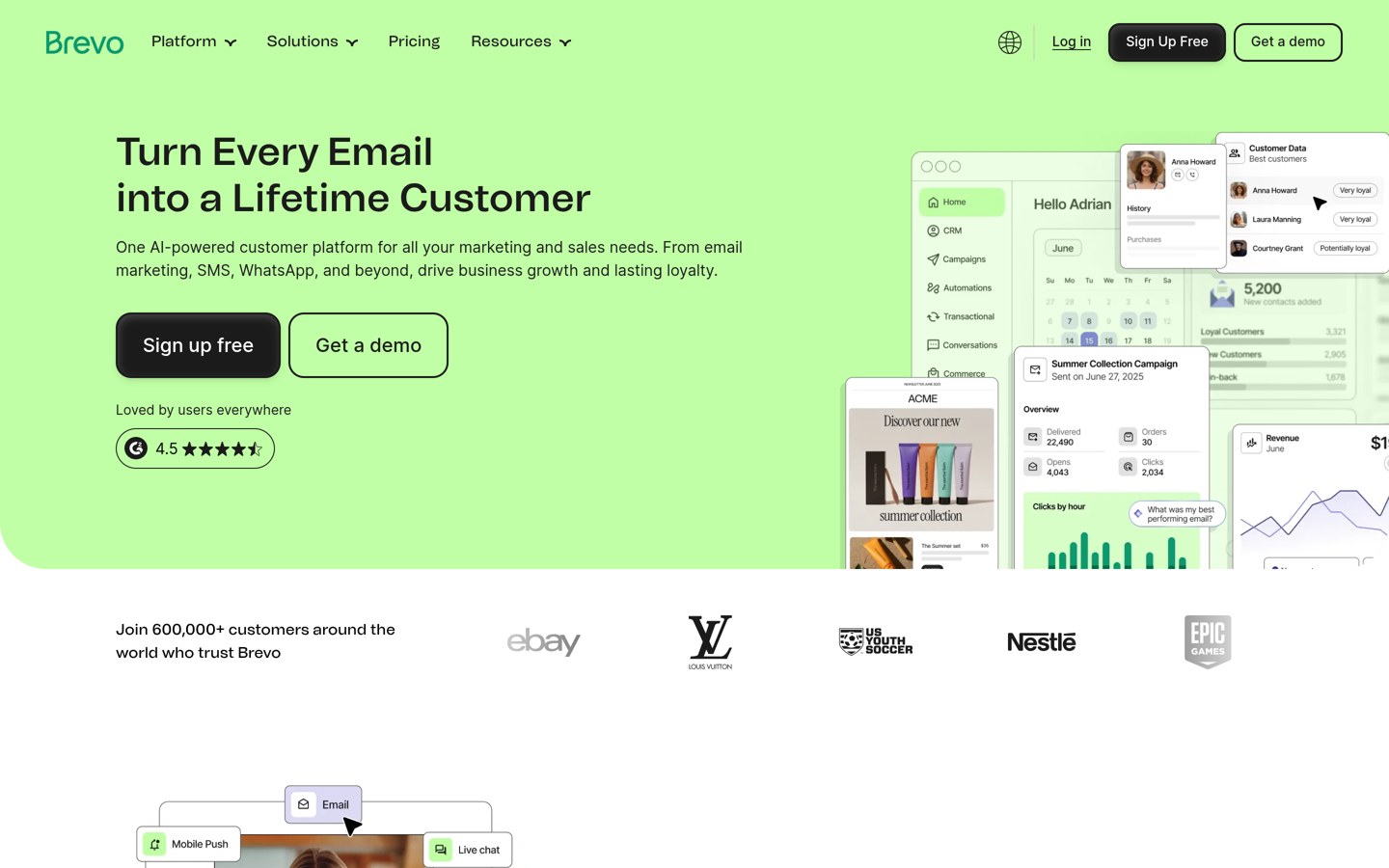
Brevo is a multi-channel marketing and CRM platform that unifies email, SMS, WhatsApp, web push, and live chat in one workspace. Its free plan allows 300 emails per day, while the entry Starter plan costs $9/mo ($8.08/mo billed annually) for 5,000 monthly emails and 500 contacts.
The trade off is that multi-step automation workflows and WhatsApp campaigns require higher tiers, with Standard at $18/mo and Professional jumping to $499/mo. It suits small businesses with large contact lists that send campaigns infrequently.
What we like
Charges by monthly email sends rather than total stored contacts
Includes a permanent free plan with 300 daily sends
Combines transactional SMTP and marketing campaigns under one login
Supports prepaid SMS and WhatsApp credits without rigid contracts
Watch out for
Starter plan caps contacts at 500 and keeps the Brevo email footer
WhatsApp campaigns are locked behind the $499/mo Professional tier
Starter ($9/mo) removes the 300/day sending cap and unlocks 24/7 email support.Visit brevo.com
02
Klaviyo
4.6/5on G2 (1,372 reviews, checked Nov 2026)
Paid from$20/mo
Best for ecommerce revenue automation
Billing modelActive profiles
Entry paid tier$20/mo (251-500 profiles)
Free tier250 profiles, 500 emails/mo
ChannelsEmail, SMS, mobile push, WhatsApp
klaviyo.com
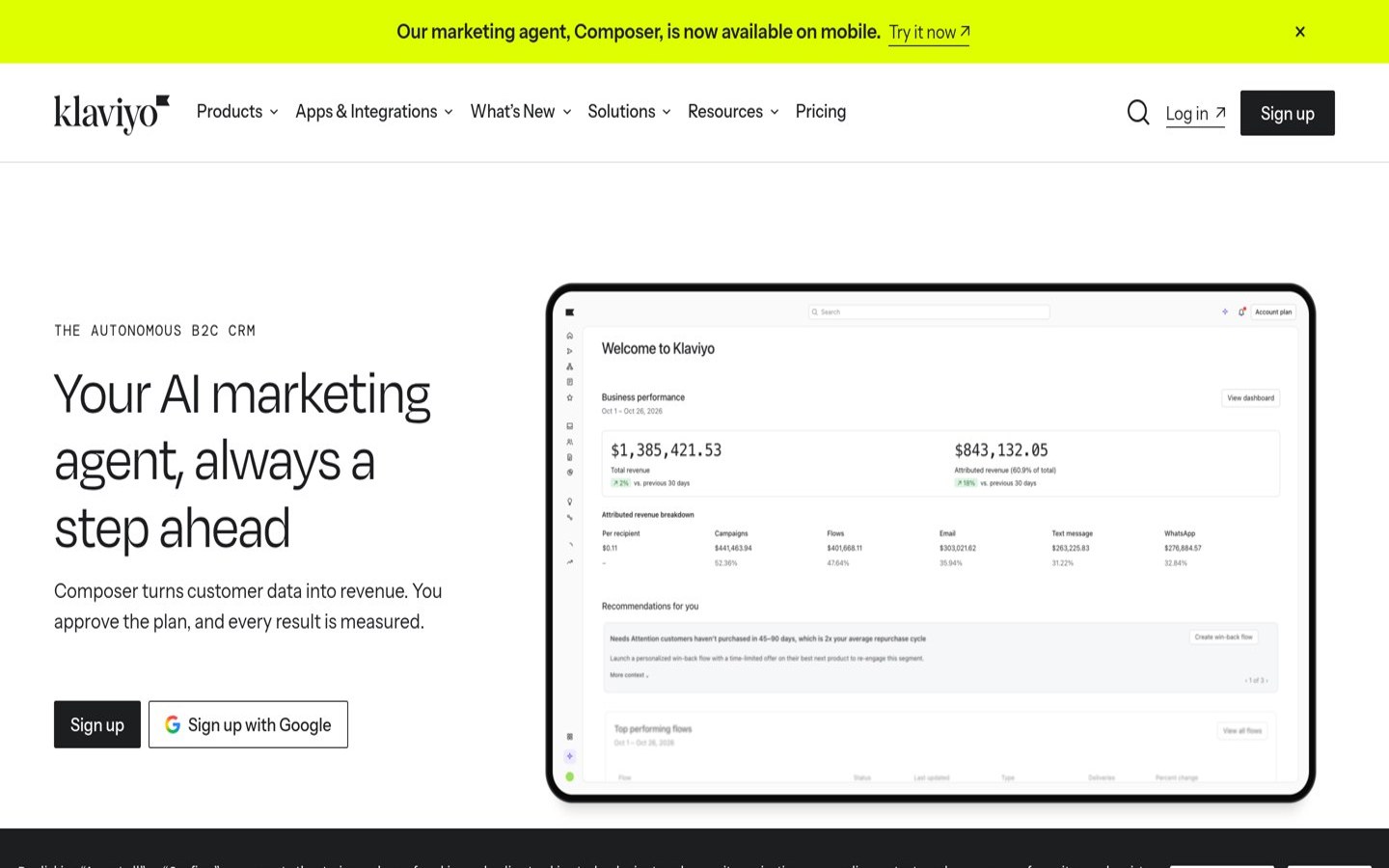
Klaviyo homepage, captured Nov 2026.
Klaviyo is a B2C marketing platform built around real-time store, cart, and browsing data for Shopify and WooCommerce brands. Its free tier covers up to 250 active profiles and 500 monthly emails, and paid Email plans start at $20/mo for 251 to 500 profiles.
The trade off is steep list-based pricing that rises quickly as active profiles grow, reaching $150/mo at 10,000 profiles before SMS credits. It suits online retailers focused on lifecycle flows and revenue attribution.
What we like
Deep real-time integrations with Shopify, WooCommerce, and BigCommerce
Built-in predictive analytics for churn risk and next order date
Unifies email, SMS, mobile push, and WhatsApp in one flow builder
Detailed per-flow revenue attribution out of the box
Watch out for
Active-profile billing becomes expensive as contact lists scale
Features and templates are heavily tailored to retail rather than B2B
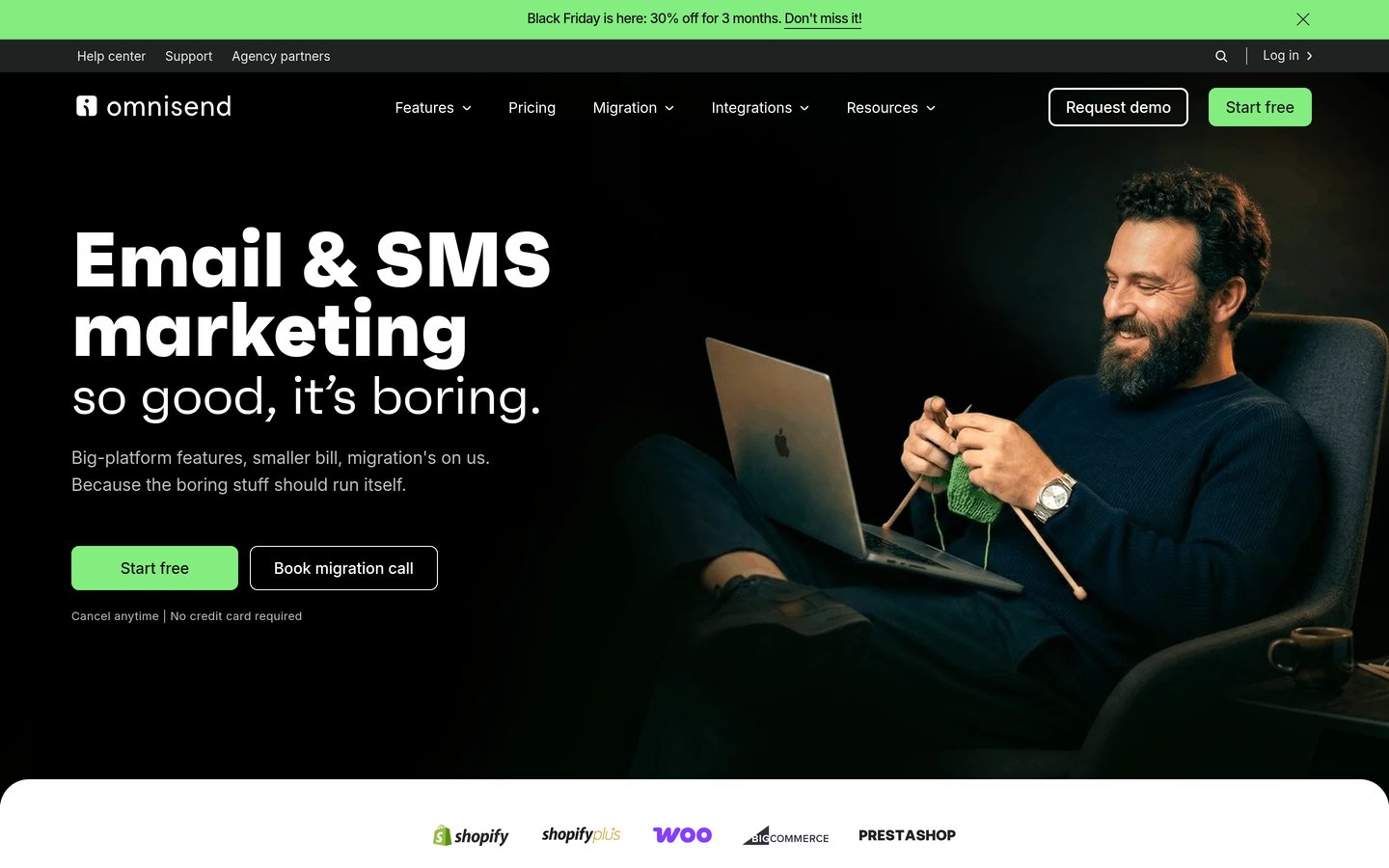
Omnisend is an ecommerce marketing automation platform combining email, SMS, and web push notifications with prebuilt store workflows. Its free tier includes all core automation features for up to 250 contacts and 500 monthly emails, while the Standard plan starts at $16/mo for 500 contacts and 6,000 emails.
The trade off is that SMS campaigns are restricted to the Pro tier starting at $59/mo plus separate SMS credit budgets. It suits small and mid-sized online stores wanting straightforward multi-channel flows without Klaviyo's steeper curve.
What we like
Free plan includes prebuilt automations and 500 monthly web push messages
Undercuts Klaviyo at comparable contact tiers for email automation
Drag-and-drop product picker pulls store items directly into emails
24/7 live chat and email support included on all paid plans
Watch out for
New subscribers must upgrade to the $59/mo Pro plan to send SMS
Reporting and multi-branch logic are simpler than enterprise suites
Standard ($16/mo) raises monthly sends to 6,000 emails and removes branding.Visit omnisend.com
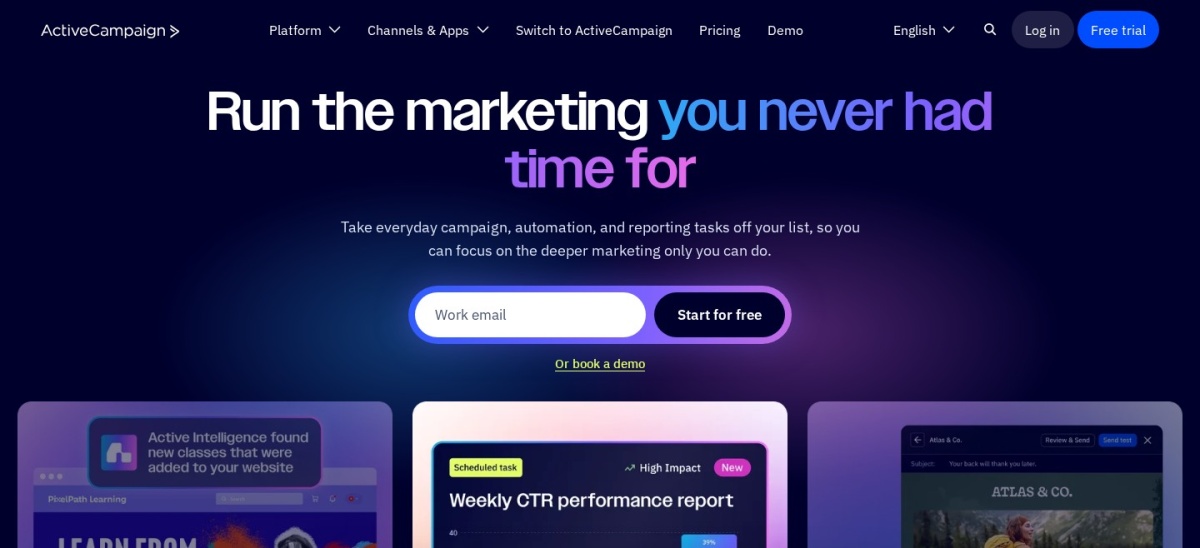
ActiveCampaign is a cross-channel marketing automation platform known for visual branching workflows, site tracking, and over 1,000 app integrations. There is no permanent free tier; the Starter plan begins at $15/mo billed annually ($180/yr) for 1,000 contacts, 10,000 monthly email sends, and one user seat.
The trade off is that predictive sending, generative AI content tools, and multi-user access require jumping to Plus at $49/mo or Pro at $79/mo. It suits B2B and service teams that rely on detailed conditional automation.
What we like
Flexible visual workflow builder with granular conditional branching
Over 1,000 native integrations across CRMs, ecommerce, and web forms
Includes 10x contact email send allowance on Starter
Optional Pipelines and Sales Engagement add-ons connect marketing to sales
Watch out for
No forever-free plan beyond a short trial
Key AI tools and lead scoring require higher tiers or paid add-ons
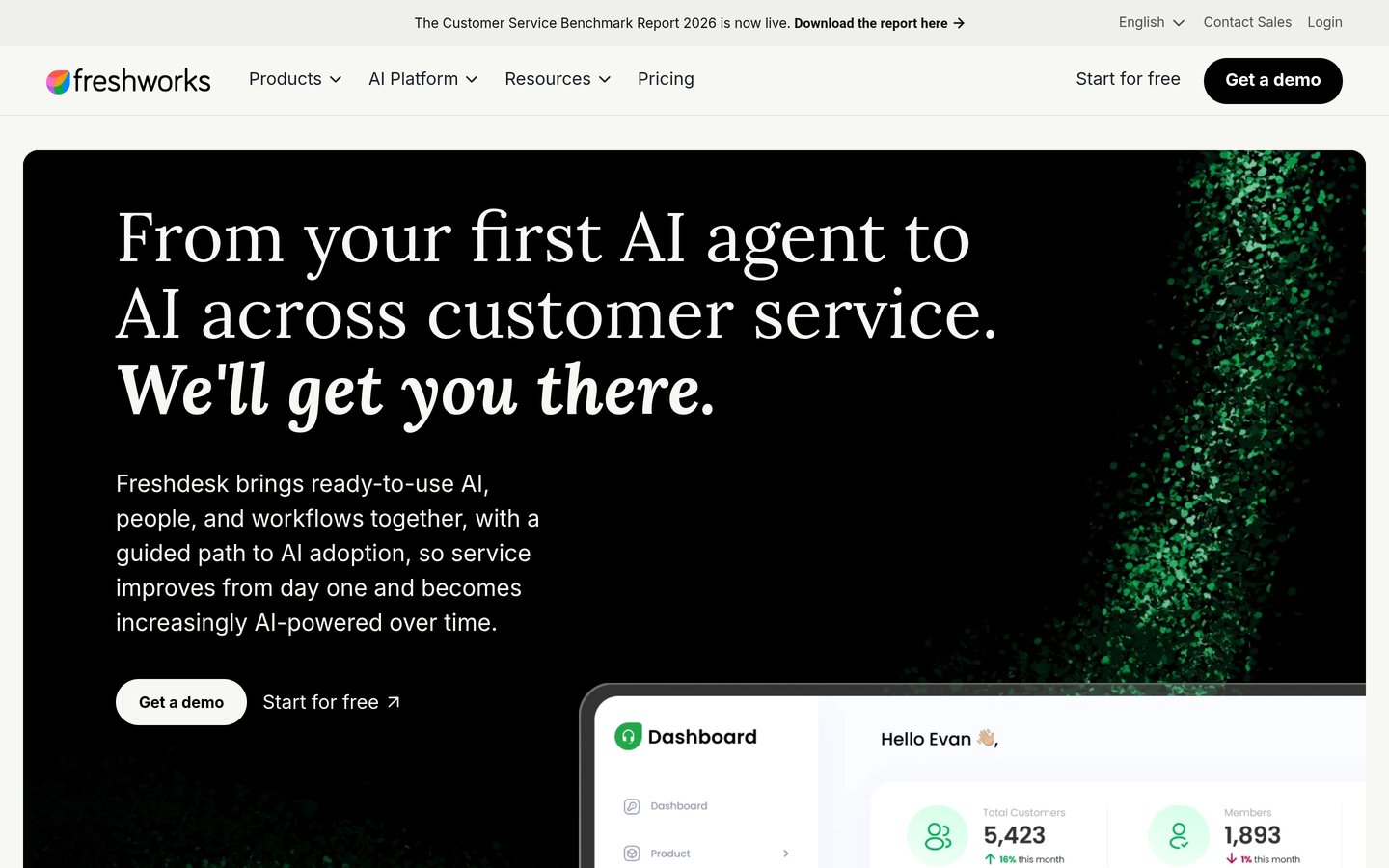
Freshdesk is an omnichannel customer service platform that routes email, chat, phone, social, and messaging conversations into a single ticket queue. Paid Growth plans start at $19/agent/mo billed annually ($228/yr per agent) and include a shared inbox, knowledge base, and the first 500 Freddy AI Agent sessions.
The trade off is that advanced automation rules, collision detection, and custom reports sit on the Pro plan at $55/agent/mo billed annually. It suits support teams looking to consolidate scattered customer inquiries with a quick setup.
What we like
Clean shared inbox keeps ticket status and history visible across channels
Includes 500 complimentary Freddy AI Agent sessions on paid plans
Built-in customer portal and self-service knowledge base
Faster initial configuration than enterprise help desks
Watch out for
Additional AI Agent sessions cost $49 per 100 sessions after the initial 500
Agent collision detection and custom reporting require the $55/agent/mo Pro plan
Growth ($19/agent/mo billed annually) adds ticketing automation and 500 AI sessions.Visit freshworks.com
06
Zendesk
4.3/5on G2 (6,700 reviews, checked Nov 2026)
Starts at$19/mo
Best for high-volume support operations
Billing modelPer agent seat
Entry paid tier$19/agent/mo billed annually
Free tierFree trial only
ChannelsEmail, messaging, voice, social, help center
zendesk.com
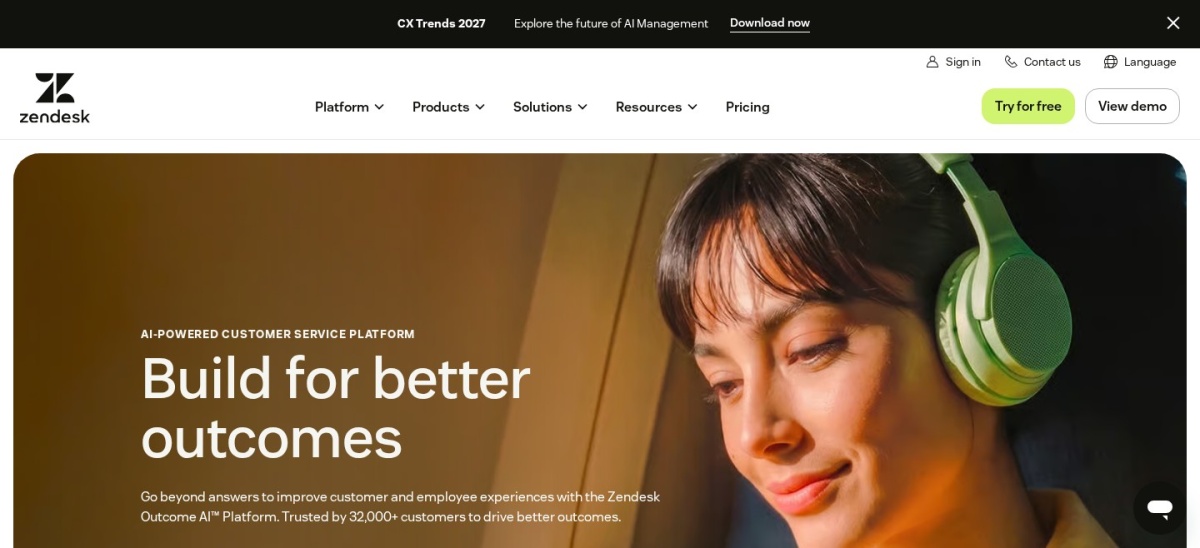
Zendesk homepage, captured Nov 2026.
Zendesk is an omnichannel customer service suite built to manage high ticket volumes across email, web messaging, voice, and social channels. The entry Support Team plan starts at $19/agent/mo billed annually ($228/yr per agent), while full omnichannel routing, live chat, and telephony start on Suite Team at $55/agent/mo.
The trade off is that core omnichannel features and AI agents require moving to the $55/agent/mo Suite Team tier, and admin configuration takes planning. It suits growing and mid-market support teams needing strict SLAs and granular permissions.
What we like
Handles high ticket queues with reliable macros, triggers, and SLAs
Extensive app marketplace and open APIs for custom CRM connections
Scales smoothly from small desks to multi-department enterprises
Strong self-service help center and AI agent deflection on Suite plans
Watch out for
The $19/agent/mo entry tier covers email ticketing without live chat or voice
Admin setup and workflow customization carry a steeper learning curve
Support Team ($19/agent/mo billed annually) provides core ticketing, routing, and macros.Visit zendesk.com
07
Customer.io
4.4/5on G2 (1,018 reviews, checked Nov 2026)
Starts at$100/mo
Best for SaaS and product-led messaging
Billing modelProfiles and message volume
Entry paid tier$100/mo (5,000 profiles)
Free tierNone
ChannelsEmail, in-app, mobile push, SMS, WhatsApp
customer.io
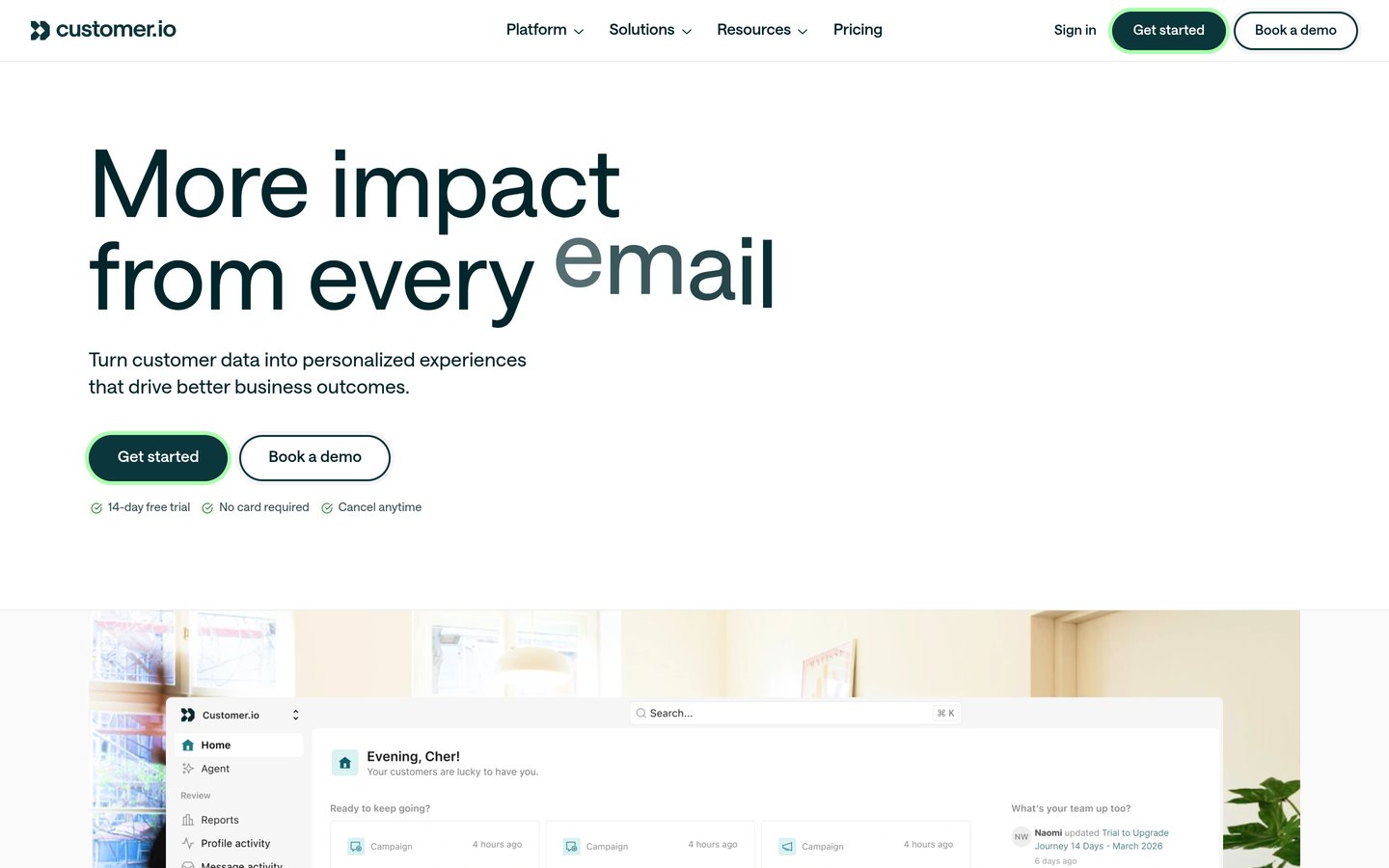
Customer.io homepage, captured Nov 2026.
Customer.io is a behavioral messaging platform built for SaaS and mobile apps to trigger messages from live product events and warehouse data. There is no free plan; the Essentials plan starts at $100/mo ($1,200/yr) for 5,000 profiles, 1 million monthly emails, unlimited push and in-app messages, and native WhatsApp.
The trade off is a $100/mo entry floor with no free trial and a technical setup geared toward teams comfortable with APIs and event schemas. It suits digital product teams orchestrating onboarding and retention journeys.
What we like
Triggers journeys directly from real-time app events and custom objects
Includes unlimited mobile push, web push, and in-app messages on Essentials
Supports reverse ETL and direct data connections without rigid schemas
Transparent segmentation rules with real-time profile attribute updates
Watch out for
No free tier or self-serve free trial before committing to $100/mo
Requires developer or data-ops setup to stream product events properly
Essentials ($100/mo) includes 5,000 profiles, 1M emails, and unlimited push/in-app sends.Visit customer.io
Marketing automation vs. omnichannel support desks
Tools labeled omnichannel fall into two distinct software categories. Marketing platforms like Brevo, Klaviyo, Omnisend, ActiveCampaign, and Customer.io focus on outbound journeys—sending coordinated emails, texts, and push notifications based on purchases or app behavior.
Support platforms like Freshdesk and Zendesk focus on inbound resolution—pulling email, live chat, phone calls, and social DMs into a single ticket queue so agents see the full conversation history. Pick your primary workflow first, then connect the other side via native integrations.
How we chose
We evaluated standalone SaaS platforms across both omnichannel marketing automation and omnichannel customer support to reflect how businesses actually unify customer touchpoints.
All pricing tiers, regular monthly and annual rates, G2 ratings, and review counts were verified directly from official vendor pricing pages and G2 product listings on 22 Nov 2026.
We excluded enterprise-only platforms that hide all pricing behind sales calls—such as Braze, Iterable, and Insider One—as well as legacy tools with fewer than 20 verified reviews. No vendor paid for a place, and we do not claim testing for this list.
How to choose omnichannel software
Narrow down your shortlist in four practical steps before signing an annual contract.
Separate outbound campaigns from inbound support. Choose a marketing platform if your goal is automated lifecycle messages, or a help desk if your team resolves customer tickets across chat, email, and voice.
Audit which channels are gated by tier. Confirm whether SMS, WhatsApp, or live chat come with the entry plan or require jumping to a mid-tier subscription plus per-message credits.
Match the billing metric to your list growth. Pick volume-based pricing like Brevo if you hold a large database with low send frequency, or profile-based pricing like Klaviyo if you monetize active subscribers.
Check native data integrations before buying. Verify that your store, CRM, or product database syncs events in real time so cross-channel triggers fire without custom middleware.
FAQ
What is the difference between multichannel and omnichannel software?
Multichannel tools let you message customers on separate channels like email and SMS independently. Omnichannel software syncs customer data across every channel in real time so a message or support ticket updates automatically based on actions taken elsewhere.
Which omnichannel software has the best free plan?
Brevo offers the highest free sending limit at 300 emails per day with unlimited contacts, while Omnisend includes prebuilt ecommerce automations and 500 web push messages per month for up to 250 contacts.
Why do some omnichannel tools charge per contact and others per agent?
Marketing platforms like Klaviyo and Omnisend scale with audience size because they send automated campaigns to your contact list. Customer service platforms like Freshdesk and Zendesk charge per agent seat because human support staff work inside the shared inbox.
Do omnichannel platforms include SMS and WhatsApp costs in the base price?
Rarely. Even when a plan unlocks SMS or WhatsApp workflows, carriers charge per message sent, so platforms like Brevo, Omnisend, and Klaviyo bill SMS and WhatsApp usage via separate prepaid credits or monthly spend budgets.
Can one platform handle both omnichannel marketing and customer support?
Large suites like HubSpot offer separate Marketing and Service hubs on a shared CRM, though running both gets expensive quickly. Most small and mid-sized teams pair a dedicated marketing tool like Klaviyo with a support desk like Zendesk or Freshdesk.
SaaS SEO and WordPress specialist with about 8 years of experience. Rakib compares WordPress plugins, themes, hosting and software using public pricing, documentation and user reviews. See how we rank.