Aplos is the top pick for dedicated nonprofit fund accounting, with Lite starting at $79/mo and including balance sheets and income statements by fund. MoneyMinder suits budget-conscious volunteer treasurers at $299/yr, while MonkeyPod combines fund accounting with donor CRM starting at $167/mo billed annually.
How we make this list: we compare pricing pages, product documentation and public user reviews, then re-check every price before each update. No product paid for a place. Disclosure.
Aplos Lite starts at $79/mo ($948/yr) with fund-level balance sheets and income statements, while Core starts at $129/mo.
MoneyMinder costs $299/yr with unlimited users and includes a free budgeting edition after a 30-day trial.
MonkeyPod starts at $167/mo billed annually ($2,004/yr) and includes unlimited users, fund accounting, and CRM tools.
Wave offers a $0 Starter plan and charges $19/mo (or $190/yr) for Pro, though it lacks native fund accounting.
QuickBooks Online starts at $38/mo for Simple Start and uses class and location tracking rather than native fund accounting.
What to look for in nonprofit accounting software
Nonprofit accounting differs from standard small-business bookkeeping because organizations must track restricted and unrestricted net assets separately. True fund accounting shows balances and activity by fund so boards and grantors can verify how designated money was spent.
General business ledgers often rely on workarounds such as classes, locations, or tracking categories instead of native fund accounting. Those workarounds can help small teams categorize expenses, but they still require care when preparing fund-specific financial statements or tracking multi-year grants.
Seat limits, add-on fees, and onboarding costs often matter more than the headline monthly rate. Check how many users are included, whether payroll or payment processing costs extra, and whether historical data migration requires manual imports or paid services.
Finally, match software depth to your team's bookkeeping skills and reporting needs. Volunteer treasurers running clubs or booster groups usually want guided workflows and clear budget-to-actual reports, while larger teams managing grants or donor databases benefit from deeper reporting and integrations.
Aplos is nonprofit accounting software built around fund accounting, starting with Lite at $79/mo for two users. Lite includes balance sheets and income statements by fund, bank reconciliation, custom reports, a board portal, and 1099 management.
The trade off is that Lite omits third-party integrations and user roles or permissions, which start on Core at $129/mo ($1,548/yr), while Aplos also runs occasional promotional offers. It suits small nonprofits and churches that want dedicated fund accounting without complex ERP setup.
What we like
Includes fund-level balance sheets and income statements on the entry Lite plan
Offers a board portal and 1099 management out of the box
Provides clear upgrade paths into Core ($129/mo) and Advanced (from $229/mo) as needs grow
Watch out for
Lite includes only two users and lacks third-party integrations or granular role permissions
Accounts payable, budgeting, and period close require upgrading to Core at $129/mo
Core at $129/mo adds basic budgeting, accounts payable and receivable, recurring transactions, period close, user permissions, and third-party integrations.Visit aplos.com
02
MoneyMinder
4.9/5on Capterra (122 reviews, checked Nov 2026)
Paid from$299/yr
Best for volunteer treasurers and small clubs
Annual price$299/yr (no per-user fees)
Free editionBudgeting tool after 30-day trial
Tax filing990-N included; 990-EZ $99/yr
Trial30-day free trial, no card needed
moneyminder.com
MoneyMinder homepage, captured Nov 2026.
MoneyMinder is nonprofit bookkeeping and budgeting software designed for volunteer treasurers, starting with a free budgeting edition after a 30-day trial and a full plan at $299/yr. The paid subscription covers bookkeeping, bank reconciliation, treasurer reports, multiple users, and IRS 990-N e-filing.
The trade off is that the $299/yr plan is tailored to smaller volunteer-led groups rather than complex multi-grant organizations, and IRS 990-EZ e-filing costs an extra $99 per filing. It suits PTAs, booster clubs, and small community groups that want predictable annual pricing.
What we like
Simple flat annual pricing at $299/yr with no per-user charges
Includes a free budgeting edition after the 30-day full trial ends
Built for volunteer treasurers without requiring an accounting background
Watch out for
Less suited to complex multi-grant organizations than specialized fund platforms
IRS 990-EZ filing carries an additional $99 fee per filing
The $299/yr subscription unlocks full bookkeeping, bank reconciliation, treasurer reports, payment tools, and 990 tax e-filing.Visit moneyminder.com
03
MonkeyPod
4.8/5on Capterra (101 reviews, checked Nov 2026)
Starts at$167/mo
Best all-in-one accounting and nonprofit CRM
Entry planEssentials at $167/mo billed annually
Users & contactsUnlimited users and no per-donor fees
MonkeyPod is an all-in-one nonprofit platform combining fund accounting, donor CRM, email marketing, and grant tools, starting at $167/mo billed annually ($2,004/yr) on Essentials. Every plan includes unlimited users and unlimited data with no per-donor pricing.
The trade off is that Essentials does not include full API access or bundled advanced apps, which are sold à la carte or included on higher tiers up to $417/mo billed annually. It suits small to mid-sized nonprofits that want accounting and donor tracking in one system.
What we like
Combines nonprofit fund accounting, CRM, and grant tracking in one platform
Includes unlimited users and no per-donor fees across plans
Avoids starter plans that strip out core accounting or CRM functionality
Data migration and advanced add-ons cost extra below the Enterprise tier
Pro ($292/mo annually) adds advanced support and training plus more AI donor profiles, while Enterprise ($417/mo annually) includes all advanced apps, API access, and data migration.Visit monkeypod.com
04
Zoho Books
4.6/5on Gartner (15 reviews, checked Nov 2026)
Paid from$15/mo
Best budget cloud accounting for small teams
Entry paid planStandard at $15/mo billed annually
Free planAvailable ($0 for 1 user + 1 accountant)
Users on Standard3 users included
Multi-currencyStarts on Professional ($40/mo annual)
zoho.com
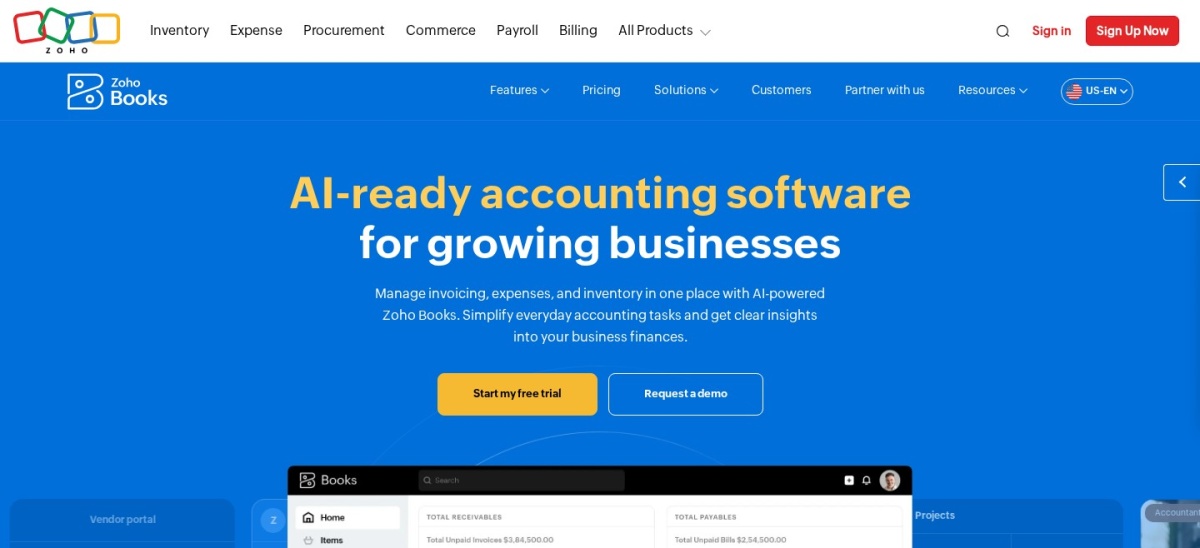
Zoho Books homepage, captured Nov 2026.
Zoho Books is cloud accounting software offering a $0 entry plan for one user plus one accountant and a Standard plan starting at $15/mo billed annually ($180/yr). Standard includes bank feeds, custom reports, API access, and support for three users.
The trade off is that Zoho Books is general business accounting rather than dedicated nonprofit fund software, and multi-currency requires Professional at $40/mo billed annually. It suits budget-conscious small nonprofits with straightforward accounting needs.
What we like
Low entry pricing with a $0 plan and a Standard tier at $15/mo billed annually
Includes three users and bank feeds on the Standard plan
Connects easily with other Zoho applications if your team already uses them
Watch out for
Lacks specialized nonprofit fund accounting out of the box
Multi-currency and project features wait until higher-priced tiers
Standard ($15/mo billed annually) adds bank feeds, custom reports, API access, and three user seats, while Professional ($40/mo annually) adds multi-currency and projects.Visit zoho.com
05
Wave
4.3/5on G2 (328 reviews, checked Nov 2026)
Paid from$190/yr
Best free option for basic bookkeeping
Starter plan$0 (manual bank entry & basic reports)
Pro plan$19/mo or $190/yr billed annually
Payment fees2.9% + $0.60 per credit card transaction
Fund accountingNot built in
waveapps.com
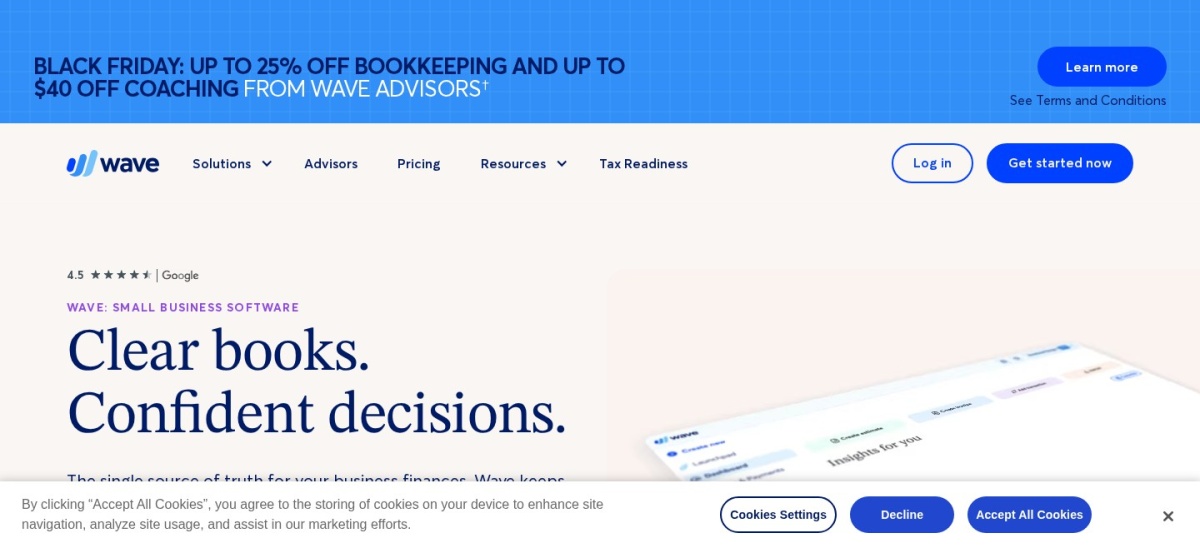
Wave homepage, captured Nov 2026.
Wave is accounting and invoicing software with a $0 Starter plan for basic bookkeeping and a Pro plan at $19/mo or $190/yr billed annually. Starter lets users create unlimited invoices, bills, and bookkeeping records, while Pro adds automated bank feeds and receipt capture.
The trade off is that Wave does not include native fund accounting, and Starter lacks automated bank imports and accountant user roles. It suits very small nonprofits or early-stage groups with simple cash and invoice tracking.
What we like
Offers a $0 Starter plan with unlimited invoices, bills, and basic bookkeeping
Pro at $190/yr provides automated bank feeds and receipt capture at a low cost
Straightforward interface that beginners can learn quickly
Watch out for
No native fund accounting or restricted-grant tracking
Payment processing fees and optional payroll or bookkeeping add-ons cost extra
Pro ($19/mo monthly or $190/yr annually) adds automated bank transaction imports, receipt capture, and discounted card rates on initial monthly transactions.Visit waveapps.com
06
Xero
4.4/5on G2 (1,864 reviews, checked Nov 2026)
Starts at$27/mo
Best for unlimited users and clean bank feeds
Entry planEarly at $27/mo ($324/yr)
User limitUnlimited users across plans
Early caps20 invoices and 5 bills per month
Higher tiersGrowing $59/mo; Established $97/mo
xero.com
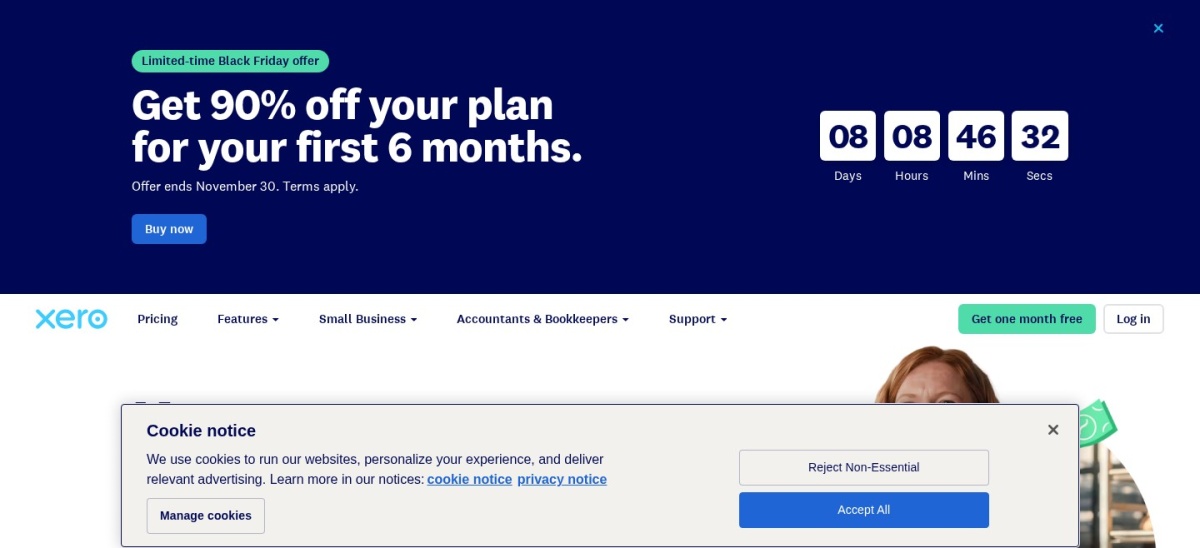
Xero homepage, captured Nov 2026.
Xero is cloud accounting software whose US Early plan lists at $27/mo ($324/yr), with Growing at $59/mo and Established at $97/mo. All plans include unlimited users with no per-user seat fees alongside bank reconciliation and financial reporting.
The trade off is that Early caps volume at 20 invoices and 5 bills per month, and Xero relies on tracking categories rather than dedicated nonprofit fund accounting. It suits small nonprofits with multiple staff or volunteers who want unlimited logins.
What we like
Includes unlimited users on every plan with no per-seat charge
Clean interface with fast bank reconciliation and broad app integrations
Higher tiers add budgeting, multi-currency, and project tracking as teams scale
Watch out for
Early plan caps monthly invoices at 20 and bills at 5
Lacks native fund accounting out of the box
Growing ($59/mo) removes the monthly invoice and bill caps and adds budgets, while Established ($97/mo) adds multi-currency and project tracking.Visit xero.com
07
QuickBooks Online
4.3/5on Capterra (8,546 reviews, checked Nov 2026)
Starts at$38/mo
Best for broad accountant familiarity and add-ons
Entry planSimple Start at $38/mo (1 user)
Mid-tier plansEssentials $85/mo; Plus $140/mo
Fund workaroundClasses and locations on Plus ($140/mo)
PayrollSold separately via QuickBooks Workforce
quickbooks.intuit.com
QuickBooks Online homepage, captured Nov 2026.
QuickBooks Online is widely used accounting software with US list pricing starting at $38/mo ($456/yr) for Simple Start, $85/mo for Essentials, and $140/mo for Plus. It supports invoicing, expense tracking, bank feeds, and broad third-party integrations.
The trade off is that QuickBooks Online uses classes and locations on Plus rather than true fund accounting, and payroll or payment fees cost extra. It suits nonprofits that already work with QuickBooks bookkeepers or need a large integration ecosystem.
What we like
Familiar to most bookkeepers, CPAs, and third-party nonprofit tools
Strong ecosystem of integrations, bank feeds, and reporting options
Classes and locations on Plus help separate programs or funds
Watch out for
Classes and locations are a workaround rather than native fund accounting
Seat limits and add-ons like payroll or payment processing raise total cost
Essentials ($85/mo) adds three users and bill management, while Plus ($140/mo) supports five users, budgets, inventory, and up to 40 classes and locations.Visit quickbooks.intuit.com
Fund accounting vs. class tracking
Dedicated nonprofit tools such as Aplos and MonkeyPod are structured around fund accounting, separating restricted and unrestricted net assets from the start. That structure helps boards review fund-specific balances without building manual workarounds.
General accounting platforms like QuickBooks Online and Xero track money by commercial accounts and use classes, locations, or tracking categories to group activity. That approach can work for simpler organizations, but teams with complex restricted grants should verify how cleanly reports separate net assets.
How we chose
We shortlisted established cloud accounting platforms commonly used by nonprofits, clubs, and mission-driven teams based on vendor documentation and public software directories.
All listed prices, plan inclusions, and user review ratings were checked on 22 Nov 2026 using official vendor pricing pages and review platforms.
We excluded tools without verifiable public pricing or review data on the checked pages, as well as software aimed strictly at enterprise ERP deployments outside a concise SMB and nonprofit comparison. No vendor paid for a place, and we do not claim testing for this list.
No vendor paid for a place, and we do not claim testing for this list.
How to choose nonprofit accounting software
Follow four steps to pick software that fits your compliance and team needs.
Map your fund and grant reporting requirements first. List whether your board or grantors require separate fund balance sheets and restricted net asset tracking or if simple category tracking is enough.
Count users, volunteers, and outside bookkeepers. Check how many seats are included on the entry plan and whether your treasurer or external accountant needs separate login access.
Calculate full annual cost beyond the base plan. Factor in annual versus monthly billing, promotional periods ending, payment processing fees, tax filing add-ons, and payroll.
Check data import and payment integrations. Confirm how bank feeds connect, how historical transactions import, and whether your donation or invoicing tools sync cleanly.
FAQ
Do nonprofits need specialized fund accounting software?
Nonprofits with restricted donations, grants, or fund-level board reporting often benefit from dedicated fund accounting. Smaller groups with simple cash inflows and expenses sometimes manage with general accounting tools, provided reports clearly separate restricted funds.
Is free accounting software enough for a small nonprofit?
Free tiers like MoneyMinder's free budget edition or Wave Starter can work for very small groups or early budgeting. Once you need bank feeds, fund reporting, or multiple user permissions, a paid plan is usually worth the cost.
What is the difference between fund accounting and class tracking?
Fund accounting treats restricted funds as distinct financial buckets with their own balances and net asset reporting. Class or location tracking tags transactions inside a standard business ledger, which can approximate program or department tracking without acting as true fund accounting.
Are payment processing fees included in subscription prices?
No, subscription fees cover software access rather than card or bank transfer processing fees. Accepting online payments or donations typically carries separate per-transaction percentage and flat fees.
Should we choose monthly or annual billing?
Annual billing often lowers the effective monthly rate on platforms that offer annual plans, while monthly billing preserves flexibility. Always check the regular renewal rate after any introductory discount ends.
SaaS SEO and WordPress specialist with about 8 years of experience. Rakib compares WordPress plugins, themes, hosting and software using public pricing, documentation and user reviews. See how we rank.