LitCommerce stands out for fast 15-minute stock and order sync starting at $29/mo, with a 4.7/5 rating on G2 across 26 reviews. Sellbrite fits small US sellers with a free plan up to 30 orders/mo, while Vendoo targets resellers starting at $14.99/mo.
How we make this list: we compare pricing pages, product documentation and public user reviews, then re-check every price before each update. No product paid for a place. Disclosure.
LitCommerce starts at $29/mo for 3 channels and 1,000 listings, holding a 4.7/5 rating across 26 G2 reviews.
Sellbrite offers a free tier for up to 30 orders/mo and paid plans from $29/mo, rated 4.6/5 across 78 Capterra reviews.
Vendoo starts at $14.99/mo billed monthly with unlimited items and auto-delisting for resellers, holding a 4.7/5 rating on Capterra.
Channable supports feed management and marketplaces starting at $49/mo on Capterra for Core Standard, holding a 4.6/5 rating across 96 reviews.
Goflow pairs a free Core tier up to 500 orders/mo with paid plans from $499/mo and a 4.8/5 rating across 119 G2 reviews.
What to look for in multichannel listing software
Selling across marketplaces like Amazon, eBay, Etsy, and Walmart alongside a web storefront creates duplicate catalog work and overselling risk when stock quantities fall out of step. Multichannel listing software centralizes product data, pushes bulk listings, and updates inventory counts as orders arrive.
Different platforms charge on different meters, including monthly order volume, active listing counts, SKU limits, or connected channels. A tool priced by order count can suit high-SKU catalogs with slow turnover, while listing-based plans can favor high-velocity sellers with a compact catalog.
Sync speed and workflow depth also vary widely across tools. Some apps focus on quick cross-posting and delisting for resale items, while others add warehouse management, purchase orders, dynamic repricing, or product feed rules for larger catalogs.
Before committing to an annual plan, check whether features like fulfillment routing, repricing, or extra channels sit in higher tiers or paid add-ons. Testing with a trial or free tier helps verify category mapping and order sync behavior on your actual catalog.
LitCommerce is a multichannel listing and inventory sync tool that connects a main store to marketplaces such as eBay, Etsy, Amazon, and Shopify. Its entry multichannel listing plan starts at $29/mo for 1,000 listings and 3 channels with 15-minute syncs.
The trade off is paying $29/mo ($348/yr) for the entry listing plan rather than having an ongoing free tier on the listing app. It suits small to midsize store owners who want straightforward listing templates and frequent stock updates.
What we like
15-minute inventory, price, and order sync starting on the entry plan
Unlimited orders on the $29/mo entry multichannel listing tier
4.7/5 rating across 26 reviews on G2
20% annual billing discount option on subscription plans
Watch out for
Listing count applies to each connected channel separately
Can feel when configuring custom channel templates
Higher tiers expand listing capacity up to 200,000 listings and additional channels.Visit litcommerce.com
02
Sellbrite
4.6/5on Capterra (78 reviews, checked Nov 2026)
Paid from$29/mo
Best for small sellers with a free tier
Free planUp to 30 orders/mo
Paid entryPro 100 at $29/mo (up to 100 orders)
FBA add-on+$19/mo for FBA inventory & MCF
Capterra rating4.6/5 (78 reviews)
sellbrite.com
Sellbrite homepage, captured Nov 2026.
Sellbrite is a multichannel listing and inventory management platform built for brands and retailers selling on marketplaces like Amazon, Walmart, and Etsy. It offers a free plan for up to 30 orders/mo alongside a 14-day trial.
The trade off is that paid plans start at $29/mo ($348/yr) for 100 orders and charge an extra $19/mo for FBA inventory and fulfillment routing. It suits small merchants starting out on major marketplaces with simple order workflows.
What we like
Free plan available for up to 30 monthly orders
Amazon FBA orders do not count toward monthly order limits on paid plans
4.6/5 rating across 78 reviews on Capterra
Includes bulk listing creation and inventory sync across connected channels
Watch out for
FBA inventory and multi-channel fulfillment cost an extra $19/mo
Lighter warehouse and purchasing features than full ERP platforms
Higher Pro tiers scale monthly order allowances to 500 ($79/mo) and 2,000 ($179/mo).Visit sellbrite.com
03
Vendoo
4.7/5on Capterra (3 reviews, checked Nov 2026)
Starts at$14.99/mo
Best for individual resellers cross-listing items
Starter plan$14.99/mo billed monthly
Catalog limitUnlimited items across marketplaces
AutomationSale detection and auto-delisting
Capterra rating4.7/5 (3 reviews)
vendoo.co
Vendoo homepage, captured Nov 2026.
Vendoo is a cross-listing app tailored to online resellers posting single or limited-quantity items across multiple marketplaces. Its Starter plan costs $14.99/mo billed monthly and includes unlimited items plus sale detection and auto-delisting.
The trade off is paying $14.99/mo ($179.88/yr) for the entry plan while AI listing enhancement and background removal quotas sit on higher tiers. It suits individual resellers who cross-post unique items and need items removed after a sale.
What we like
Low entry price at $14.99/mo billed monthly with a 14-day free trial
Includes unlimited items, sale detection, and auto-delisting on Starter
Lower effective monthly rate when billed yearly
4.7/5 rating on Capterra
Watch out for
AI listing enhancement and background removal allowances require Growth or Pro
Small review count on Capterra compared with enterprise inventory suites
Growth ($29.99/mo) and Pro ($59.99/mo) add AI listing tools, background removal credits, and offer automation.Visit vendoo.co
Marketplaces add-on$35/mo add-on listed on Capterra
Capterra rating4.6/5 (96 reviews)
TrialFree trial available
channable.com
Channable homepage, captured Nov 2026.
Channable is a product feed and channel management platform that transforms catalog attributes and pushes listings to marketplaces and ad channels. Capterra lists Core Standard starting at $49/mo for 500 items, 1 project, and 3 channels.
The trade off is modular pricing where marketplace connections and creative tools can add extra monthly fees at $49/mo ($588/yr) base. It suits marketing and catalog teams managing structured product feeds across channels.
What we like
Strong rule-based feed mapping and catalog transformation workflows
Combines marketplace feeds with shopping ad and creative modules
4.6/5 rating across 96 reviews on Capterra
Higher tiers add AI attribute tools and faster daily sync schedules
Watch out for
Add-on modules raise total cost beyond the base Core plan
Steeper setup curve for teams new to feed rules
Core Plus ($64/mo) and Core Pro ($74/mo) add AI enrichment, more syncs, and team controls.Visit channable.com
05
SellerChamp
4.4/5on Capterra (111 reviews, checked Nov 2026)
Starts at$399/mo
Best for high-SKU sellers avoiding GMV percentage fees
Growth plan$399/mo starting quote
Fee structureNo GMV percentage fees on standard quotes
ContractMonth-to-month available; 20% off yearly
Capterra rating4.4/5 (111 reviews)
sellerchamp.com
SellerChamp homepage, captured Nov 2026.
SellerChamp is a multichannel listing, inventory sync, and order management platform built for high-volume sellers and resellers. Its Growth tier starts at $399/mo with no GMV percentage fees on standard quotes.
The trade off is a higher starting price of $399/mo ($4,788/yr) tailored to volume rather than casual sellers at $399/mo ($4,788/yr). It suits growing multichannel sellers who want bulk listing, repricing, and order tools without revenue cuts.
What we like
No GMV percentage fees or per-channel fees on standard quotes
Month-to-month billing available with a 20% discount for annual payment
Includes bulk listing, real-time inventory sync, and profit reporting
4.4/5 rating across 111 reviews on Capterra
Watch out for
Starting cost is steep for low-volume or new stores
Dense screens can take time for new operators to learn
Scale ($399 to $999/mo typical) adds repricing, forecasting, vendor feeds, and multi-warehouse workflows.Visit sellerchamp.com
06
Goflow
4.8/5on G2 (119 reviews, checked Nov 2026)
Paid from$499/mo
Best for multichannel operations with a free starter tier
Free planGoflow Core up to 500 orders/mo
Paid entryFrom $499/mo month-to-month
Integrations2,100+ on paid plans; 5 channels on Core
G2 rating4.8/5 (119 reviews)
goflow.com
Goflow homepage, captured Nov 2026.
Goflow is an omnichannel listing, order, inventory, and warehouse management platform for growing and high-volume sellers. Its free Core plan supports up to 500 monthly orders across 5 channels with up to 3 users.
The trade off is a sharp jump to $499/mo ($5,988/yr) for paid plans and order overage charges once limits are exceeded. It suits multichannel sellers who need catalog creation, purchasing, and warehouse workflows in one system.
What we like
Free Core plan covers up to 500 orders/mo without a credit card
High 4.8/5 rating across 119 reviews on G2
Month-to-month paid subscriptions starting at $499/mo
Supports bulk and single listing creation with variation families
Watch out for
Paid plans start at $499/mo, which can exceed small-seller budgets
Free Core caps users at 3 and new Goflow-created listings at 1,000
Paid subscriptions unlock unlimited channels, unlimited users, continuous order imports, and the Goflow API.Visit goflow.com
07
ShipStation
4.6/5on Capterra (963 reviews, checked Nov 2026)
Starts at$14.99/mo
Best for order fulfillment alongside channel syncing
Starter plan$14.99/mo for 50 shipments/mo
ChannelsZero extra fee to connect standard channels
Capterra rating4.6/5 (963 reviews)
TrialFree trial available
shipstation.com
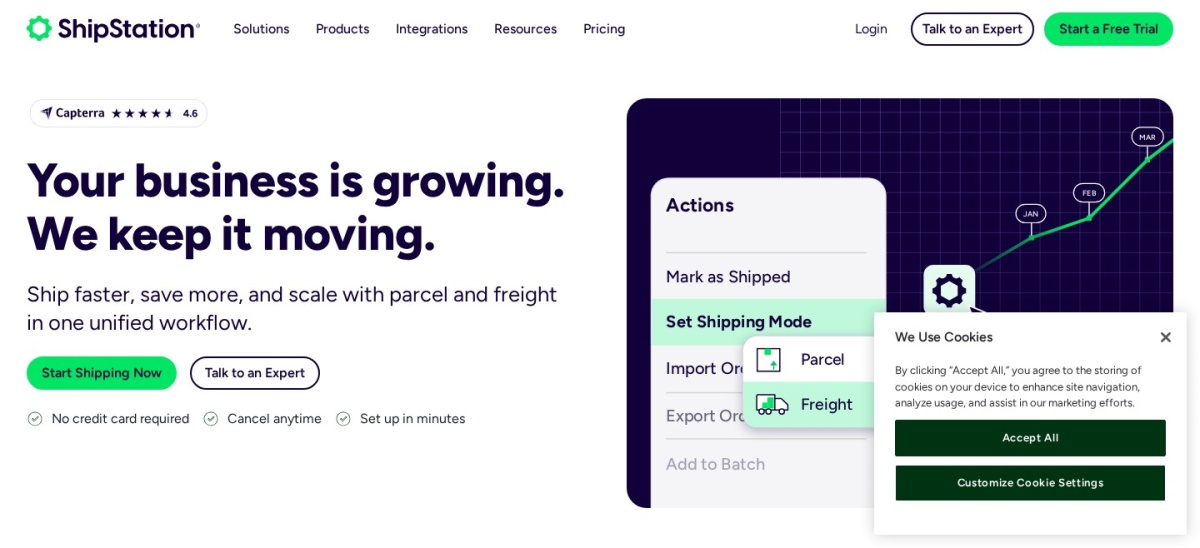
ShipStation homepage, captured Nov 2026.
ShipStation is a shipping and multichannel order management platform that pulls orders from stores and marketplaces into one fulfillment queue. Its Starter plan begins at $14.99/mo for 50 shipments per month.
The trade off is that it focuses on order fulfillment and shipping rather than deep marketplace catalog creation at $14.99/mo ($179.88/yr). It suits merchants whose main bottleneck is processing orders and labels across multiple sales channels.
What we like
Low starting price at $14.99/mo for up to 50 monthly shipments
No fee to connect additional standard selling channels
4.6/5 rating across 963 reviews on Capterra
Bulk order updates and carrier rate comparison streamline fulfillment
Watch out for
Less focused on building and optimizing marketplace listings than dedicated listers
Monthly shipment tiers rise quickly as volume increases
Standard ($29.99/mo starting) and Premium ($349.99/mo starting) add higher shipment tiers and expanded support.Visit shipstation.com
How multichannel listing pricing meters differ
Most multichannel listing tools charge based on monthly order volume, active listing counts, or SKU limits. A seller with 50 products and 2,000 monthly orders faces a very different bill from a seller with 5,000 products and 150 monthly orders.
Watch for add-ons that sit outside the base tier, such as fulfillment routing, repricing, extra sales channels, or annual versus monthly billing terms. Checking overage rules before a busy season prevents unexpected billing spikes.
How we chose
We built this shortlist by reviewing established multichannel listing and channel management platforms across software directories and vendor documentation.
All prices, plan tiers, and review ratings were checked on 22 Nov 2026 from vendor pricing pages and public review listings.
We excluded quote-only enterprise platforms without published entry prices and tools lacking clear multichannel listing or order sync details.
No vendor paid for a place, and we do not claim testing for this list.
How to choose multichannel listing software
Follow four steps to match a tool to your catalog and order flow:
List your active sales channels and target marketplaces first. Confirm native integrations for every storefront and marketplace you plan to use, including regional or niche channels.
Compare pricing against your real SKU count and monthly order volume. Check whether the entry plan measures listings, SKUs, orders, or shipments so your cost stays predictable as you grow.
Verify how often inventory and orders sync across channels. Shorter sync intervals reduce overselling risk when the same item is listed in multiple places.
Check whether fulfillment, repricing, or extra channels cost extra. Review add-on fees and higher plan tiers so essential workflows are not locked behind unexpected upgrades.
FAQ
What does multichannel listing software do?
It lets sellers create, edit, and publish product listings across multiple online stores and marketplaces from one dashboard. Most tools also sync stock quantities and import orders to reduce overselling.
Is there a free multichannel listing tool?
Yes, tools like Sellbrite and Goflow offer free plans with monthly order caps, such as 30 orders/mo on Sellbrite or 500 orders/mo on Goflow Core. Free plans usually limit channels, users, or automation features.
How does listing-based pricing differ from order-based pricing?
Listing-based pricing charges by how many listings or SKUs you push across channels, which fits stores with large catalogs and lower order counts. Order-based pricing scales with monthly order volume, which favors high-SKU sellers with slower sales.
Do multichannel listers prevent overselling?
They help by updating stock counts across channels when an order comes in, though sync frequency depends on the plan and integration. Fast-moving items still benefit from frequent syncs and clear SKU matching.
Can I use one tool for both marketplaces and shipping labels?
Some platforms combine listing and inventory sync with shipping label printing or fulfillment routing, while dedicated shipping tools focus mainly on orders and labels. Many sellers pair a listing tool with their preferred shipping workflow.
Should resellers pick the same tool as brand manufacturers?
Not always, because individual resellers often prioritize fast cross-posting and auto-delisting for single items, while brands need bulk catalog templates and warehouse sync. Matching the tool to your catalog type avoids paying for unused complexity.
SaaS SEO and WordPress specialist with about 8 years of experience. Rakib compares WordPress plugins, themes, hosting and software using public pricing, documentation and user reviews. See how we rank.