Spacelift is the best multi-cloud management platform for infrastructure automation, offering policy-as-code controls and a $399 monthly Starter plan with 10 users. Pulumi is a better fit for developers who prefer familiar programming languages, while Vantage offers affordable cloud spending visibility across multiple providers.
How we make this list: we compare pricing pages, product documentation and public user reviews, then re-check every price before each update. No product paid for a place. Disclosure.
Spacelift supports multiple infrastructure-as-code workflows, with its $399/month Starter plan covering 10 users.
Pulumi scores 4.8/5 on G2 and offers team infrastructure management from $40/month.
Vantage starts at $30/month and supports more than 40 cost data providers.
IBM HCP Terraform publishes Essentials pricing from $0.10 per managed resource per month.
Cast AI has a 4.5/5 G2 rating from 284 reviews and specializes in Kubernetes optimization.
The 3 fixed-price podium plans range from $360 to $4,788 per year before additional usage charges.
What to look for in a multi-cloud management platform
Multi-cloud management platforms give organizations a common way to operate infrastructure across AWS, Microsoft Azure, Google Cloud and other environments. They reduce the need to manage every service through a separate provider console.
Start by identifying whether your main challenge is infrastructure provisioning, cloud governance, spending visibility or Kubernetes operations. These categories overlap, but their platforms solve different problems.
Infrastructure-as-code platforms help engineering teams standardize deployments and review changes before applying them. Financial operations platforms focus on understanding spending, allocating costs and identifying waste.
Check how each vendor measures usage. Subscription fees may depend on managed resources, infrastructure workers, cloud spending or organizational requirements.
Review access controls, audit records, deployment approvals and supported integrations before committing to a platform that needs access to production infrastructure.
Best for overall multi-cloud infrastructure automation
Free plan2 users
Paid planStarter
AutomationMulti-IaC workflows
Starter workers2 public workers
spacelift.io
Spacelift homepage, captured Nov 2026.
Spacelift is an infrastructure orchestration platform that centralizes provisioning, deployment workflows and governance across cloud environments. Its free plan supports 2 users and includes infrastructure cost estimates, repository integration and resource visualization.
The trade off is the jump to Starter pricing, which begins at $399 per month for 10 users and introduces additional policy and workflow controls. It suits platform engineering teams managing infrastructure changes across different cloud providers and automation frameworks.
Starter adds policy controls, webhooks and a private module registry.Visit spacelift.io
02
Pulumi
4.8/5on G2 (25 reviews, checked Nov 2026)
Paid from$40/mo
Best for programming-language-based cloud automation
Free users1
Paid planEssentials
Entry capacityUp to 500 managed resources
Programming languagesPython, TypeScript, Go and others
pulumi.com
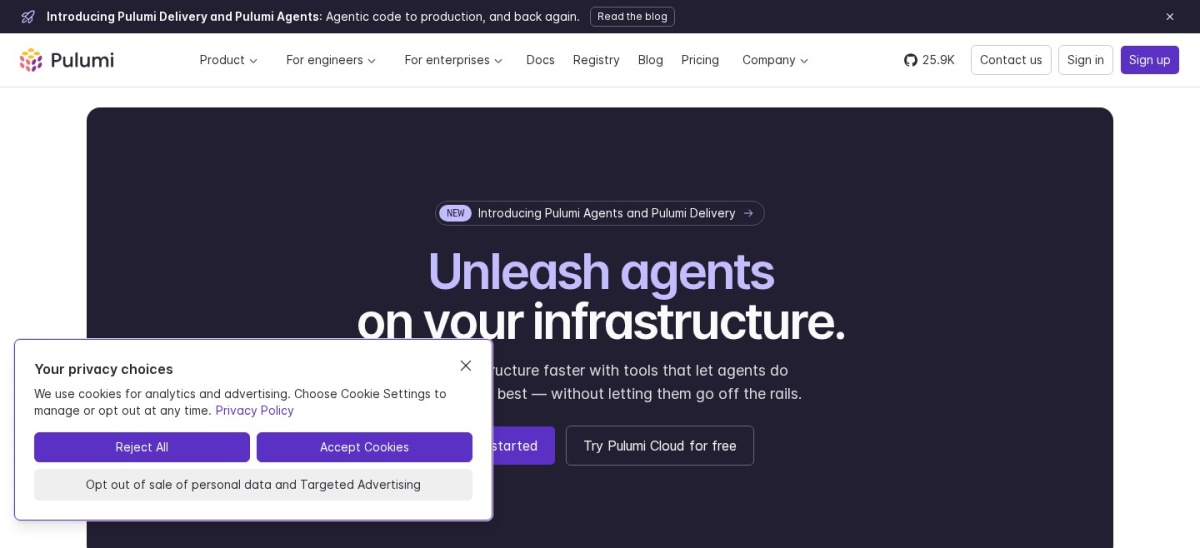
Pulumi homepage, captured Nov 2026.
Pulumi is an infrastructure management platform that lets developers define cloud resources using familiar programming languages. Its free edition includes individual state management, unlimited projects and stacks, and up to 500 workflow minutes.
The trade off is that enterprise governance and automated drift remediation require higher subscription levels, while Essentials starts at $40 per month with 40 credits. It suits development teams that want reusable infrastructure components and application code to follow similar engineering practices.
What we like
Supports general-purpose programming languages
Reusable infrastructure components
Affordable starting subscription
Unlimited users on Essentials
Broad cloud provider compatibility
Watch out for
Credit-based billing requires monitoring
Programming knowledge is necessary
Advanced governance requires Pro or Enterprise
Essentials adds team collaboration, resource search and automated secrets rotation.Visit pulumi.com
03
Vantage
4.7/5on G2 (72 reviews, checked Nov 2026)
Paid from$30/mo
Best for affordable multi-cloud cost management
Free spending limit$2,500
Paid planPro
Pro spending limit$7,500
Supported providers40+
vantage.sh
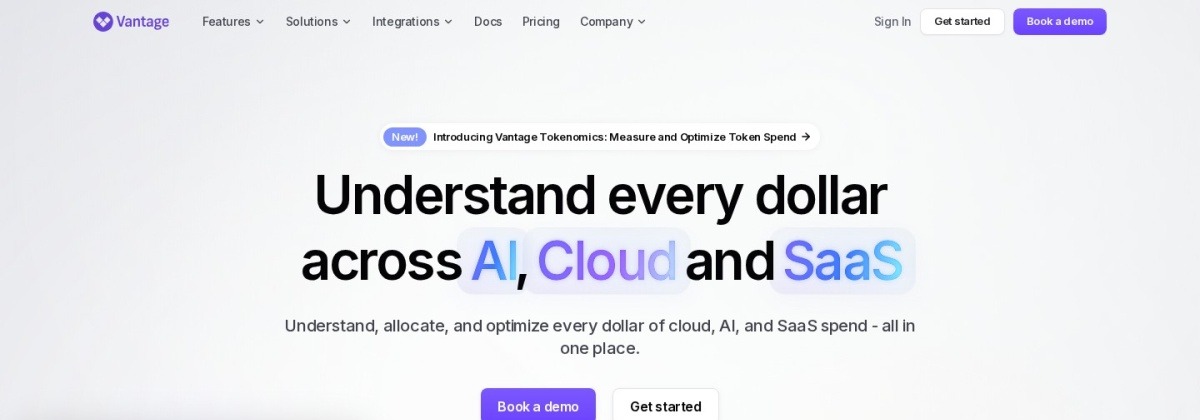
Vantage homepage, captured Nov 2026.
Vantage is a cloud financial management platform that brings infrastructure, software and AI spending into shared cost reports. Its free Starter plan accommodates 3 users and up to $2,500 in tracked cloud spending.
The trade off is that subscription levels depend on monitored spending rather than infrastructure complexity, with Pro costing $30 per month for up to $7,500 in cloud spending. It suits finance and engineering teams that prioritize budget accountability instead of infrastructure provisioning.
What we like
Predictable subscription tiers
Cross-provider spending reports
Free entry-level subscription
Virtual tagging for cost allocation
Connects cloud and AI spending sources
Watch out for
Higher spending requires a larger subscription
Not a general infrastructure provisioning platform
Entry-level subscriptions limit users
Pro adds virtual tagging, additional spending capacity and AWS commitment automation.Visit vantage.sh
04
IBM HCP Terraform
4.6/5on G2 (152 reviews, checked Nov 2026)
Starts at$0.10/mo
Best for standardized multi-cloud provisioning
Paid planEssentials
Billing unitManaged resource
ConfigurationTerraform HCL
ExecutionRemote plan and apply
hashicorp.com
IBM HCP Terraform homepage, captured Nov 2026.
IBM HCP Terraform is a managed infrastructure-as-code service that coordinates resource provisioning across cloud providers. Its Essentials subscription starts at $0.10 per resource per month and supports shared infrastructure workflows through remote execution and centralized state management.
The trade off is resource-based billing, which makes the $0.10 monthly entry rate dependent on infrastructure size and usage duration. It suits engineering organizations that already use Terraform configurations and want consistent deployment processes without maintaining their own orchestration infrastructure.
What we like
Established infrastructure provider ecosystem
Reusable Terraform modules
Infrastructure change previews
Centralized state management
Published resource-based pricing
Watch out for
Costs increase with managed resource volume
Requires knowledge of Terraform configuration
State migration needs careful planning
Essentials provides managed workflows; the annual ladder figure represents one continuously managed resource.Visit hashicorp.com
05
SUSE Rancher
4.4/5on G2 (167 reviews, checked Nov 2026)
PricingCustom pricing
Best for multi-cloud Kubernetes management
Free optionOpen-source Rancher
Paid editionRancher Prime
InfrastructureCloud and on-premises
Core functionKubernetes fleet management
rancher.com
SUSE Rancher homepage, captured Nov 2026.
SUSE Rancher is a Kubernetes management platform that centralizes cluster administration across public clouds, private infrastructure and edge environments. Its open-source edition provides an entry point for cluster management, while Rancher Prime extends the platform with enterprise security and support.
The trade off is that Rancher Prime uses custom pricing, and organizations need Kubernetes expertise to manage their environments effectively. Its 4.4/5 G2 rating reflects the broader Rancher product family. It suits teams operating Kubernetes clusters across different infrastructure providers.
What we like
Manages clusters across different providers
Centralized authentication and policy controls
Open-source entry option
Supports on-premises Kubernetes environments
Watch out for
Enterprise subscription requires a quote
Requires Kubernetes administration knowledge
Not a general-purpose cloud spending platform
Rancher Prime adds enterprise support, security capabilities and curated application delivery.Visit rancher.com
06
Cast AI
4.5/5on G2 (284 reviews, checked Nov 2026)
PricingCustom pricing
Best for automated multi-cloud Kubernetes optimization
Primary functionKubernetes optimization
Cloud coverageAWS, Azure, Google Cloud and others
AutomationWorkload and node scaling
Paid pricingQuote required
cast.ai
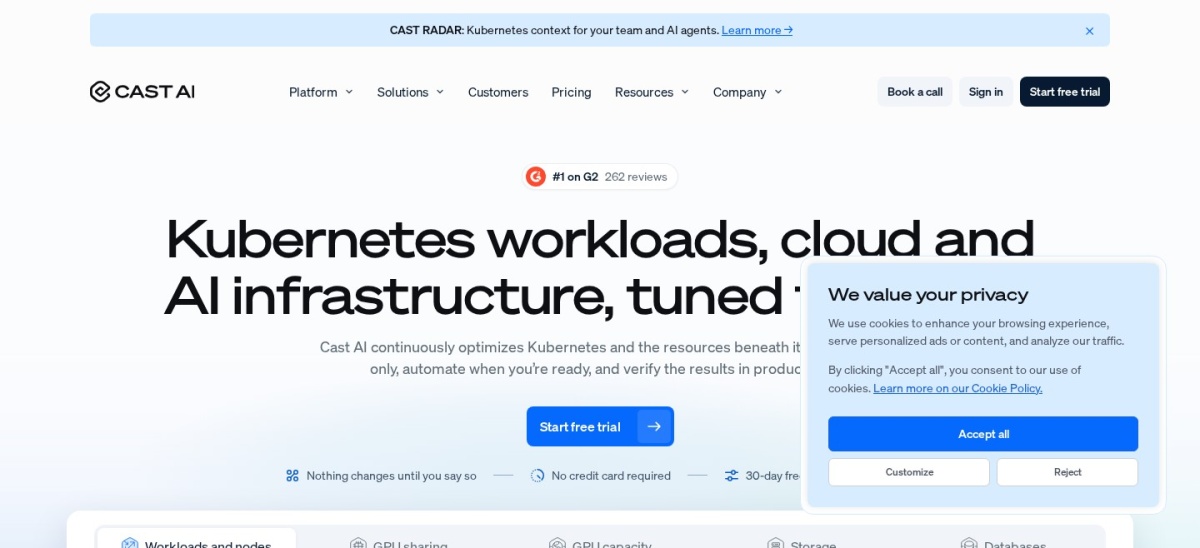
Cast AI homepage, captured Nov 2026.
Cast AI is a Kubernetes automation platform that helps organizations adjust infrastructure capacity, improve workload resource allocation and reduce unnecessary compute consumption. Its official pricing page reports adoption by more than 2,100 companies, while G2 documents a limited free option.
The trade off is that automated changes require careful configuration, and paid pricing must be requested from the vendor. It suits organizations running containerized workloads that want to reduce manual scaling decisions and improve resource utilization across supported cloud providers.
What we like
Automated Kubernetes resource adjustment
Cross-cloud workload optimization
Identifies underused compute capacity
Established customer base
Supports automated scaling decisions
Watch out for
Paid pricing requires contacting sales
Complex workloads may require policy tuning
Focuses on Kubernetes rather than all cloud services
Commercial arrangements provide automated infrastructure optimization under agreed usage terms.Visit cast.ai
07
Flexera One
4.4/5on G2 (194 reviews, checked Nov 2026)
PricingCustom pricing
Best for enterprise hybrid-cloud governance
DeploymentManaged SaaS
CoverageHybrid IT environments
CapabilitiesFinOps and asset management
Commercial accessSales consultation
flexera.com
Flexera One homepage, captured Nov 2026.
Flexera One is an enterprise IT management suite that combines cloud cost optimization, asset discovery, software licensing and spending governance. Its 4.4/5 G2 rating comes from 194 reviews, and its commercial offering addresses organizations with complex infrastructure and licensing requirements.
The trade off is procurement complexity, because Flexera directs prospective buyers toward a sales consultation rather than publishing a standard subscription price. Its custom commercial arrangement suits enterprises that need financial governance across cloud services, traditional software and private infrastructure.
What we like
Combines cloud spending and IT asset visibility
Supports complex hybrid infrastructure
Software licensing management
Enterprise cost allocation capabilities
Cloud governance automation
Watch out for
No public fixed subscription price
Implementation may require specialist resources
Broader feature set may exceed small-team requirements
Commercial subscriptions combine selected IT visibility, asset management and FinOps capabilities.Visit flexera.com
08
IBM Cloudability
4.2/5on G2 (211 reviews, checked Nov 2026)
PricingCustom pricing
Best for enterprise multi-cloud financial operations
AccessFree trial
Primary functionCloud financial management
OptimizationCommitments and resource usage
Paid pricingCustom subscription
ibm.com
IBM Cloudability homepage, captured Nov 2026.
IBM Cloudability is a financial operations platform that consolidates cloud spending data for budgeting, forecasting and optimization. It has a 4.2/5 G2 rating from 211 reviews and offers trial access for organizations evaluating its cloud financial management capabilities.
The trade off is that the vendor's product page does not publish a fixed subscription price, while G2 identifies custom pricing. It suits larger finance and engineering departments that need detailed spending allocation, commitment management and financial accountability across cloud environments.
What we like
Centralized cloud financial reporting
Budgeting and spending forecasts
Cloud commitment utilization insights
Supports cross-department cost accountability
Watch out for
Pricing requires a commercial inquiry
Not designed for infrastructure deployment
Meaningful reporting depends on billing data quality
Commercial access provides cloud financial analysis and optimization according to the contracted scope.Visit ibm.com
How multi-cloud management platform pricing works
Fixed subscriptions make budgeting easier when your organization falls within published usage limits. Vantage uses monitored spending thresholds, while Spacelift uses subscription tiers that include specified users and infrastructure workers.
Resource-based subscriptions behave differently. IBM HCP Terraform publishes a starting rate of $0.10 per resource per month, equivalent to $1.20 annually for a continuously managed resource at the displayed monthly rate. This is a unit-price illustration, not a complete platform subscription.
Pulumi combines subscription pricing with usage credits. Review expected resource consumption rather than relying on the starting monthly fee alone.
Platforms with custom commercial arrangements require a separate estimate. A zero in the structured annual pricing field indicates unavailable fixed pricing, not a free commercial subscription.
Infrastructure automation versus cloud financial management
Infrastructure automation platforms manage how resources are created, updated and governed. Spacelift, Pulumi and IBM HCP Terraform belong primarily to this category.
Financial operations platforms organize spending information and help organizations identify opportunities to improve cloud efficiency. Vantage, Flexera One and IBM Cloudability focus on these financial and governance requirements.
Kubernetes management platforms address another operational layer. SUSE Rancher coordinates cluster administration, while Cast AI focuses on workload capacity and infrastructure optimization.
These categories are complementary. An organization may use an infrastructure automation platform alongside a financial management service instead of expecting either product to solve every multi-cloud challenge.
How we chose
We shortlisted established multi-cloud infrastructure automation, governance, Kubernetes management and financial operations platforms. Selection considered cloud compatibility, operational scope, entry-level accessibility and public customer feedback.
The editorial check date is 22 Nov 2026. Pricing and ratings were verified against accessible vendor and G2 pages during preparation; historical snapshots for that exact editorial date could not be independently established. Some lower-ranked vendors provide sales-led commercial information rather than public subscription prices.
We excluded products with insufficient review evidence, unclear infrastructure management capabilities or inaccessible commercial information. Custom-price platforms remain eligible below the podium, and resource-based prices are identified separately from complete subscription fees. No vendor paid for a place, and we do not claim testing for this list.
How to choose the right multi-cloud management platform
Identify your main operational challenge before comparing platform features, subscription costs and infrastructure integrations.
**Define the problem you need to solve.** Choose whether your priority is infrastructure deployment, Kubernetes administration, financial reporting or organization-wide governance. Avoid buying a broad platform when a specialized service addresses your main requirement.
**Confirm provider and workload compatibility.** Check whether the platform supports your cloud accounts, infrastructure frameworks, Kubernetes distributions and private environments. Review supported resource types and integration limitations.
**Calculate realistic annual costs.** Estimate managed resources, users, infrastructure workers, cloud spending and anticipated growth. Include implementation, support and potential overage charges when comparing commercial subscriptions.
**Evaluate governance and operational controls.** Review authentication, permissions, audit records, deployment approval workflows and credential management. Use available trial access to assess compatibility with nonproduction environments before connecting sensitive infrastructure.
FAQ
What is a multi-cloud management platform?
A multi-cloud management platform helps organizations administer infrastructure, spending or operational policies across different cloud providers. Depending on its focus, it may support automated provisioning, resource inventory, financial reporting, Kubernetes administration and centralized governance.
What is the best multi-cloud management platform?
Spacelift is our top pick for engineering teams that prioritize infrastructure automation across multiple environments. Pulumi is an alternative for developers who prefer general-purpose programming languages, while Vantage is more appropriate for financial reporting and cloud cost visibility.
Are there free multi-cloud management platforms?
Yes. Spacelift, Pulumi and Vantage provide free entry-level options with different operational limits. Rancher also offers an open-source route for Kubernetes management. Check whether free access includes the specific governance, collaboration and deployment features your organization requires.
How much does multi-cloud management software cost?
Fixed-price subscriptions in this comparison begin at $30 per month for Vantage, $40 for Pulumi and $399 for Spacelift. Other platforms charge according to managed resources or negotiated commercial agreements, so actual annual costs depend on infrastructure usage.
Can I manage AWS, Azure and Google Cloud from one platform?
Yes. Several infrastructure automation, Kubernetes management and financial operations platforms support these providers. However, available functionality varies by integration, and some provider-specific resources may still require native management consoles or additional configuration.
What is the difference between hybrid cloud and multi-cloud management?
Multi-cloud management coordinates services across different cloud providers. Hybrid cloud management also addresses the relationship between cloud resources and private or on-premises infrastructure. Organizations operating both environments should verify that their selected platform supports the required infrastructure types.
Is Terraform a multi-cloud management platform?
Terraform provides infrastructure-as-code capabilities across many providers. Its managed cloud service adds centralized execution, state management and collaboration. However, comprehensive cloud financial reporting and Kubernetes fleet administration may require additional specialized management platforms.
Can multi-cloud management platforms reduce cloud spending?
They can help identify unused resources, improve cost allocation, optimize workload capacity and manage spending commitments. Actual savings depend on existing infrastructure efficiency, workload characteristics, subscription costs and the organization's ability to implement recommended changes.
SaaS SEO and WordPress specialist with about 8 years of experience. Rakib compares WordPress plugins, themes, hosting and software using public pricing, documentation and user reviews. See how we rank.