Best Mechanical CAD Software in 2026: 7 Tools Compared
WLWPLegible EditorsLast verified 22 Nov 2026How we rank13 min read
★ Short answer
SOLIDWORKS is our top mechanical CAD pick for professional product engineering, with parametric parts, assemblies, production drawings and cloud collaboration from $2,820 yearly. Autodesk Fusion is a more affordable choice for integrated CAD and CAM at $680 yearly, while Onshape suits distributed design teams needing browser-based CAD and version control.
How we make this list: we compare pricing pages, product documentation and public user reviews, then re-check every price before each update. No product paid for a place. Disclosure.
SOLIDWORKS Design Standard costs $2,820/yr and includes parametric parts, assemblies, drawings and cloud data management.
Autodesk Fusion costs $680/yr, combining 3D CAD, CAM, electronics design and cloud-connected product development.
Onshape Standard costs $1,500/user/yr; its free plan supports noncommercial projects with public documents.
Autodesk Inventor costs $2,585/yr and includes mechanical assemblies, sheet metal tools and iLogic automation.
Shapr3D Pro costs $299/yr per editor, while Basic allows 2 projects at no charge.
Rhino 9 costs $995 one-time, and AutoCAD costs $2,095/yr with specialized mechanical drafting tools.
What to look for in mechanical CAD software
Mechanical CAD software helps engineers design parts, assemblies, machines and manufactured products. It replaces manual drafting with digital models that can be modified, measured, documented and prepared for production.
Start with parametric modeling. A parametric CAD system records dimensions, constraints and feature relationships, allowing design changes to update dependent geometry. This is particularly useful for mechanical components that require repeated revisions.
Assembly management is equally important. Look for component relationships, interference checking, assembly drawings and bills of materials. Complex products require more than individual part modeling.
Next, compare manufacturing features. Sheet metal tools, weldments, machining preparation, simulation and technical drawings can determine whether a platform fits your production workflow. Some products include these capabilities, while others charge for advanced extensions.
Finally, review collaboration, operating system support and licensing. Browser-based CAD can simplify distributed teamwork, while desktop programs may better match established engineering processes. Compare annual subscriptions, perpetual licenses and commercial-use restrictions before purchasing.
Best for professional mechanical design and assemblies
Entry planDesign Standard
LicenseNamed user, annual
3D modelingParametric parts and assemblies
Data managementCloud collaboration included
solidworks.com
SOLIDWORKS homepage, captured Nov 2026.
SOLIDWORKS is professional mechanical CAD software for parametric modeling, assemblies, sheet metal, weldments and manufacturing drawings. Design Standard costs $2,820 yearly and includes part and assembly modeling, production documentation, cloud file management, collaboration and basic engineering analysis capabilities. It supports engineers designing manufactured products with defined dimensions and component relationships.
The trade off is the higher subscription price and the additional cost of advanced simulation and engineering features. Professional costs $3,456 yearly, while Premium costs $4,716 yearly. It suits mechanical engineering companies, product manufacturers and design teams working with detailed assemblies and production drawings.
What we like
Comprehensive parametric part and assembly modeling
Sheet metal, weldment and mold design tools
Production drawings and manufacturing documentation
Cloud collaboration and revision management
Established engineering file exchange workflows
Watch out for
Higher subscription price than entry-level alternatives
Advanced simulation and routing require higher packages
Full desktop workflows require suitable workstation hardware
Professional adds rendering and cost analysis; Premium adds advanced simulation and routingVisit solidworks.com
02
Autodesk Fusion
4.5/5on G2 (552 reviews, checked Nov 2026)
Paid from$680/yr
Best value for integrated mechanical CAD and manufacturing
Annual subscription$680
Monthly subscription$85
Core toolsCAD, CAM, CAE and PCB
Personal-use optionFree with restrictions
autodesk.com
Autodesk Fusion homepage, captured Nov 2026.
Autodesk Fusion is an integrated product development platform combining mechanical CAD, manufacturing, simulation and electronics design. Its commercial subscription costs $680 annually or $85 monthly, with parametric modeling, assemblies, manufacturing tools and cloud-connected project management. A restricted personal-use edition is available for qualifying noncommercial projects.
The trade off is that advanced manufacturing, simulation and design capabilities may require additional paid extensions. The personal-use edition also has commercial and functionality restrictions. It suits independent engineers, product startups and machine shops that want mechanical modeling and manufacturing preparation in one application.
What we like
Combines CAD, CAM, CAE and PCB workflows
Lower commercial entry cost than many engineering suites
Cloud-connected workflows depend on account access
Manufacturing and simulation extensions add advanced production and engineering toolsVisit autodesk.com
03
Onshape
4.7/5on G2 (724 reviews, checked Nov 2026)
Paid from$1,500/yr
Best for browser-based mechanical CAD collaboration
Entry paid planStandard
Annual price$1,500/user
Free planNoncommercial, public files
Data managementBuilt-in PDM
onshape.com
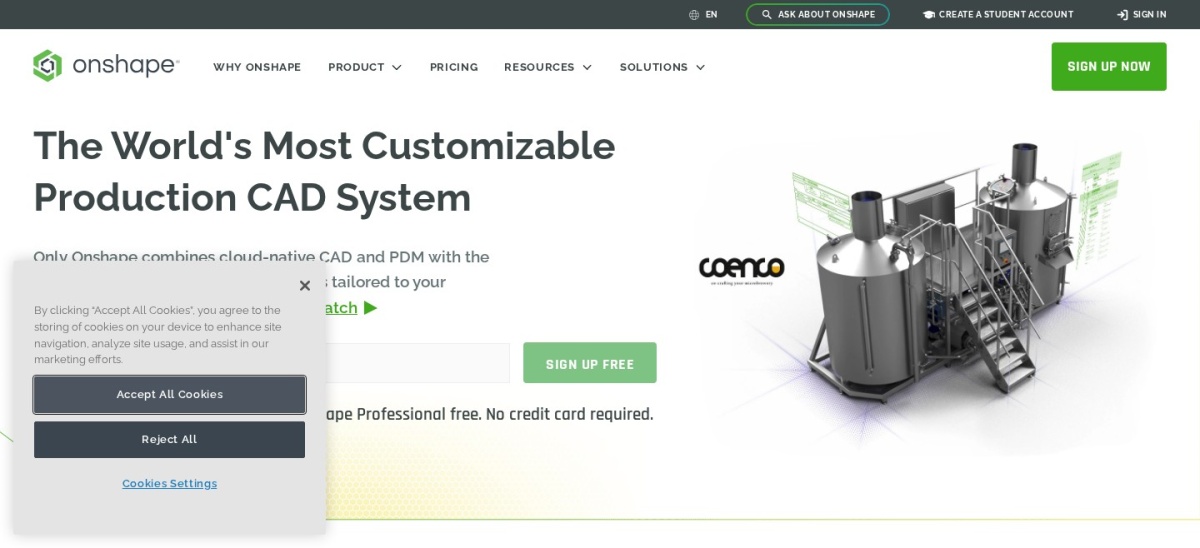
Onshape homepage, captured Nov 2026.
Onshape is a cloud-native mechanical CAD and product data management platform that runs through a web browser. Standard costs $1,500 per user yearly and includes professional parametric modeling, private document storage, built-in data management and product support. Its free plan offers CAD functionality for noncommercial projects with publicly accessible documents.
The trade off is that private commercial projects require a paid subscription, while advanced simulation, rendering, CAM and PCB features are included in Professional at $2,500 per user yearly. It suits distributed engineering teams that need shared design access, version history and collaboration without traditional desktop file management.
What we like
Browser-based CAD without conventional desktop installation
Integrated product data and version management
Collaborative mechanical design workflows
Free option for noncommercial learning
Private document storage on paid plans
Watch out for
Free documents are publicly accessible
Commercial projects require paid licensing
Advanced simulation and manufacturing tools require Professional
Professional adds simulation, rendering, CAM, PCB tools and expanded team managementVisit onshape.com
04
Inventor
4.4/5on G2 (440 reviews, checked Nov 2026)
Starts at$2,585/yr
Best for machinery design and engineering automation
Annual subscription$2,585
Monthly subscription$320
Operating systemWindows
AutomationiLogic and APIs
autodesk.com
Inventor homepage, captured Nov 2026.
Inventor is Autodesk's mechanical engineering CAD platform for parametric parts, assemblies, sheet metal, documentation and product simulation. Its subscription costs $2,585 annually or $320 monthly and includes specialized mechanical design tools, native DWG drawing support and iLogic automation. Engineers can use rules to configure repeatable product variations and automate design tasks.
The trade off is its higher cost, Windows-only operation and additional licensing requirements for advanced engineering tools. Inventor Nastran is included in the separate Product Design and Manufacturing Collection rather than the standalone subscription. It suits machinery manufacturers and engineering teams already using Autodesk design and data management systems.
What we like
Detailed mechanical part and assembly modeling
Sheet metal and manufacturing documentation
iLogic rules for design automation
Native DWG compatibility
Integration with Autodesk Vault
Watch out for
Requires Windows
Higher subscription cost than Fusion
Advanced Nastran analysis requires a separate collection
The Product Design and Manufacturing Collection adds Inventor Nastran and related engineering applicationsVisit autodesk.com
05
Shapr3D
4.8/5on G2 (173 reviews, checked Nov 2026)
Paid from$299/yr
Best for fast mechanical concepts and portable 3D modeling
Entry paid planPro
Annual price$299/editor
Free projects2
Supported devicesiPad, Mac and Windows
shapr3d.com
Shapr3D homepage, captured Nov 2026.
Shapr3D is mechanical and product design CAD software combining direct modeling with history-based parametric workflows. Basic supports 2 projects, while Pro costs $299 per editor yearly and provides unlimited projects, technical drawings, professional exports and visualization tools. Users can work across supported desktop and tablet devices with project synchronization.
The trade off is that Basic limits project capacity and export quality, making Pro more practical for professional production work. Enterprise features such as expanded administration and security require customized pricing. It suits product designers, mechanical engineers and prototype developers who value flexible modeling and portable design access.
What we like
Direct and history-based parametric modeling
Works across desktop and tablet devices
Free Basic plan for limited projects
Professional export formats on Pro
Technical drawings and visualization tools
Watch out for
Basic supports only 2 projects
Professional exports require a paid plan
Complex engineering simulation is not its primary focus
Pro unlocks unlimited projects, technical drawings, professional exports and visualizationVisit shapr3d.com
06
Rhino
4.4/5on G2 (192 reviews, checked Nov 2026)
Starts at$995 one-time
Best for complex surfaces and custom mechanical forms
Current versionRhino 9
License price$995 one-time
ModelingNURBS and SubD
Operating systemsWindows and Mac
rhino3d.com
Rhino homepage, captured Nov 2026.
Rhino is 3D CAD software specializing in precise NURBS geometry, freeform surfaces and complex product shapes. Rhino 9 costs $995 for a commercial single-user license, with modeling, drafting, visualization and Grasshopper-based computational design capabilities. The license is purchased outright rather than through a recurring subscription.
The trade off is that Rhino is not a direct replacement for a history-based mechanical CAD system with integrated assembly constraints and engineering PDM. Specialized manufacturing workflows may require additional plugins. It suits industrial designers, prototype developers and engineers working with complex surfaces or custom geometry.
What we like
One-time commercial license
Precise NURBS and freeform surface modeling
Grasshopper computational design environment
Windows and Mac support
Broad geometry import and export capabilities
Watch out for
Less specialized for parametric mechanical assemblies
Manufacturing extensions may require additional tools
Future major-version upgrades can involve separate fees
Paid version upgrades provide access to newer releases while preserving the purchased licenseVisit rhino3d.com
07
AutoCAD
4.4/5on G2 (2,017 reviews, checked Nov 2026)
Starts at$2,095/yr
Best for mechanical drafting and DWG documentation
Annual subscription$2,095
Monthly subscription$260
Specialized toolsets7
Mechanical toolsIncluded
autodesk.com
AutoCAD homepage, captured Nov 2026.
AutoCAD is computer-aided drafting and design software for precise technical drawings, layouts and 3D geometry. Its annual subscription costs $2,095 and includes 7 specialized toolsets, including mechanical design tools, alongside drawing automation and DWG documentation. Users can create, annotate and revise mechanical drawings across supported desktop and connected workflows.
The trade off is that AutoCAD is primarily a drafting platform rather than a dedicated parametric assembly design system. Its monthly subscription costs $260, and the specialized Mechanical toolset is intended for Windows workflows. It suits engineering departments that prioritize DWG compatibility, mechanical documentation and standardized drafting.
What we like
Mechanical drafting toolset included
Extensive 2D documentation capabilities
DWG-based drawing exchange
Automation and customization through APIs
Desktop, web and mobile access
Watch out for
Not a direct substitute for parametric assembly CAD
Higher annual price than several 3D CAD alternatives
Specialized Mechanical toolset requires Windows
Full AutoCAD includes mechanical automation and 3D tools beyond AutoCAD LTVisit autodesk.com
Parametric vs direct modeling: which is better for mechanical CAD?
Mechanical CAD programs use different approaches to building and modifying geometry. Understanding these differences helps you choose a platform that fits your design process.
Parametric modeling uses dimensions, constraints and feature relationships. Changing a dimension can update dependent parts of the design. SOLIDWORKS, Inventor, Fusion and Onshape support this approach.
Direct modeling allows designers to manipulate geometry without relying entirely on an ordered feature history. It is useful for concept development, imported models and changes that are difficult to express through existing constraints.
Some programs combine both methods. Shapr3D offers direct and history-based parametric modeling, allowing designers to use different approaches as a project develops.
For production machinery and frequently revised components, parametric relationships are particularly useful. For freeform industrial design, surface modeling and direct editing may be more important.
Which mechanical CAD features matter for manufacturing?
Mechanical CAD becomes more valuable when models can move reliably into manufacturing. A visually correct model is not always enough to produce accurate parts.
Start with manufacturing drawings, including dimensions, tolerances, annotations and material information. Check whether drawings remain associated with the underlying 3D model.
Assembly management should support component positioning, interference analysis and bills of materials. These features help teams identify fit problems before fabrication.
Sheet metal and weldment tools matter for fabricated products. Machining workflows may also require CAM software, cutting strategies and compatible machine postprocessors.
Simulation can help evaluate stresses, motion or other engineering conditions, but capabilities differ by plan. Confirm whether the required type of analysis is included or sold separately.
Finally, verify neutral file exchange formats such as STEP. Compatibility matters when suppliers, customers and engineering partners use different CAD systems.
How we chose
We selected established mechanical CAD platforms with commercial engineering applications, publicly available product documentation and substantial user review histories. The shortlist covers parametric mechanical engineering, integrated CAD and manufacturing, browser-based collaboration, direct modeling, freeform surface design and mechanical drafting.
Official pricing pages and G2 review profiles were opened on 23 Nov 2026 for this November 2026 comparison, with 22 Nov 2026 retained as the requested editorial verification date. We used published regular subscription prices rather than temporary discounts. Rhino's one-time license price is shown as its initial-year purchase cost, not an annual subscription.
We excluded products without confirmed official entry pricing or sufficient public review evidence. We also excluded free-only products because this comparison requires a verified paid-plan price. Rankings reflect mechanical design capabilities, licensing, collaboration and manufacturing suitability. No vendor paid for a place, and we do not claim testing for this list.
How to choose the best mechanical CAD software
Define your engineering workflow before comparing modeling tools, manufacturing capabilities, collaboration features and license costs.
Identify the type of mechanical design you produce. Determine whether your work involves individual parts, machinery assemblies, sheet metal products, consumer products or complex surfaces. Prioritize parametric modeling for dimension-driven engineering and specialized surfacing tools for freeform product geometry.
Check assembly and manufacturing capabilities. Review component relationships, interference detection, bills of materials, technical drawings and file export formats. If you manufacture parts, confirm whether CAM, sheet metal tools or simulation are included in the base license.
Match collaboration tools to your team. Decide whether engineers need browser access, simultaneous collaboration, revision tracking or integration with existing PDM systems. Verify compatibility with current design files, suppliers and workstation operating systems before switching.
Compare the full licensing cost. Calculate annual subscriptions per user and distinguish them from perpetual licenses. Include extensions, simulation, CAM, training and data management costs. Check commercial-use restrictions on free plans and confirm whether future upgrades require additional payments.
FAQ
What is mechanical CAD software?
Mechanical CAD software helps engineers create digital models, assemblies and drawings of mechanical products. It supports dimensions, component relationships, geometry modification and manufacturing documentation. Advanced products may also include simulation, machining preparation, product data management and engineering collaboration features.
Which mechanical CAD software is best overall?
SOLIDWORKS is our overall pick for professional mechanical engineering because it combines parametric parts, assemblies, manufacturing drawings and specialized design tools. Autodesk Fusion offers a lower-cost alternative with integrated manufacturing capabilities, while Onshape is especially suitable for browser-based collaboration.
What is the cheapest professional mechanical CAD software?
Among the listed commercial options, Shapr3D Pro costs $299 yearly, while Autodesk Fusion costs $680 annually. Rhino offers a $995 one-time license rather than a recurring subscription. The cheapest practical choice depends on the required modeling, documentation and manufacturing features.
Is there free mechanical CAD software?
Yes. Onshape provides a free noncommercial plan with public documents, Shapr3D Basic supports 2 projects, and Autodesk Fusion offers a restricted personal-use edition for qualifying users. These options are useful for learning and personal projects, but their commercial-use and feature limitations require attention.
Is Fusion better than SOLIDWORKS?
Fusion may be a better fit for smaller teams wanting integrated CAD, CAM and electronics tools at a lower subscription cost. SOLIDWORKS is more specialized for established mechanical engineering workflows involving detailed assemblies, manufacturing documentation and related engineering tools. Neither is the better choice for every project.
Can mechanical CAD software create manufacturing drawings?
Yes. SOLIDWORKS, Inventor, Fusion and Onshape support engineering drawing workflows. Shapr3D Pro also includes technical drawings, while AutoCAD specializes in precise drafting and documentation. The available dimensioning, tolerance and manufacturing features differ between programs and subscription tiers.
What is the difference between AutoCAD and mechanical CAD software?
AutoCAD primarily supports general drafting, documentation and geometric design, with specialized mechanical drafting tools included. Dedicated mechanical CAD platforms such as Inventor and SOLIDWORKS focus more on parametric parts, component assemblies, design relationships and manufacturing workflows. Both can be useful within the same engineering organization.
Do mechanical engineers need CAD software with simulation?
Simulation is useful when design decisions depend on stress, deformation, motion or other engineering behavior. However, not every project requires advanced analysis. Review which simulation methods are available in the entry plan and whether specialized studies need extensions or separate engineering applications.
Is cloud-based CAD suitable for professional mechanical engineering?
Yes. Onshape provides browser-based professional CAD with integrated data management, while Fusion combines installed design tools with cloud-connected project workflows. Cloud systems can simplify collaboration and version control, but teams should also assess connectivity requirements, access permissions and data management policies.