Best Literature Review Software in 2026: 7 Tools Compared
WLWPLegible EditorsLast verified 22 Nov 2026How we rank14 min read
★ Short answer
Paperguide is the best literature review software overall, combining AI research, reference management and systematic reviews, with Plus starting at $96 annually. Scite is better for evaluating how research papers are cited, while Zotero is the strongest free option for organizing references, PDFs and bibliographies.
How we make this list: we compare pricing pages, product documentation and public user reviews, then re-check every price before each update. No product paid for a place. Disclosure.
Paperguide earns 4.4/5 from 24 Trustpilot reviews, with Plus costing $96 annually and supporting systematic reviews of up to 1,000 papers.
Scite scores 4.7/5 from 27 G2 reviews and offers Smart Citations, citation alerts and AI-assisted research for $144 annually.
Zotero holds a 4.4/5 G2 rating from 99 reviews and provides free reference management, with 2 GB of cloud storage costing $20 annually.
ReadCube earns 4.4/5 from 174 G2 reviews, with Essentials costing $95 annually and supporting 5 shared libraries.
Paperpile scores 4.5/5 from 26 G2 reviews and offers reference management with unlimited PDF storage for $99.60 annually.
Paperpal holds 4.8/5 from 579 Trustpilot reviews, while Jenni AI scores 3.7/5 from 162 reviews. Their entry paid plans cost $144 annually.
What literature review software should help you do
A literature review involves finding relevant research, evaluating study quality, organizing evidence and explaining what existing publications reveal about a research question. Different software platforms support different stages of this process.
AI research assistants help identify papers, summarize findings and extract information. Some also generate structured evidence tables or support systematic review screening. These functions can reduce repetitive work, but researchers must verify the resulting information.
Reference management tools organize citations, PDFs, annotations and bibliographies. Products such as Zotero, Paperpile and ReadCube help maintain a consistent research library throughout reading and writing.
Citation analysis provides another way to evaluate research. Rather than simply counting citations, tools such as Scite help identify whether later publications support, contrast with or mention a particular study.
Choose software according to your methodology. Narrative reviews, scoping reviews and systematic reviews have different requirements for searching, screening, extracting and documenting evidence. No single platform guarantees a complete or accurate review.
Paperguide is an AI research platform for discovering papers, organizing references, extracting evidence and preparing literature reviews. Its free plan includes 1,500 monthly AI credits, limited research searches, PDF conversations and Zotero imports. Plus costs $96 annually and adds 12,500 monthly credits, unlimited reference storage and systematic reviews covering up to 1,000 papers.
The trade off is that larger systematic reviews and specialized evidence workflows require higher tiers. Pro costs $234 annually, while dual-reviewer screening requires the Evidence plan at $474 annually. It suits students, researchers and academic teams wanting research discovery, evidence synthesis and writing support in one workspace.
What we like
AI literature discovery and evidence extraction
Free plan with research and PDF tools
Systematic review functionality on Plus
Reference management and citation exports
Supports RIS, CSV, BIB, PDF and DOCX exports
Watch out for
Free AI credits and research capacity are limited
Advanced systematic review features require upgrades
AI-generated findings require source verification
Trustpilot review base is relatively small
Plus adds unlimited searches, expanded credits, reference storage and systematic reviews.Visit paperguide.ai
02
Scite
4.7/5on G2 (27 reviews, checked Nov 2026)
Starts at$12/mo
Best for checking citation evidence
Entry planBasic
Annual billing$12/month
MCP credits250/month
Collection capacity1,000 papers
scite.ai
Scite homepage, captured Nov 2026.
Scite is a research evaluation platform that analyzes citation relationships and helps researchers understand how publications are discussed by later studies. Basic costs $12 per month billed annually and includes Smart Citation reports, AI Assistant access, citation alerts, 250 monthly MCP credits and collections containing up to 1,000 papers.
The trade off is that API access, larger collections and advanced datasets require Pro at $40 per month billed annually. Basic costs $144 annually and includes a 7-day trial. It suits researchers who need to evaluate cited evidence, identify conflicting findings and investigate how scientific claims are supported.
What we like
Smart Citations provide research context
Identifies supporting and contrasting citations
AI Assistant uses research sources
Citation alerts and monitoring
Zotero integration and browser extension
Watch out for
No permanent full-featured free plan
API access requires Pro
Basic collections have a paper limit
Citation classifications still require interpretation
Pro adds API access, larger collections and expanded research datasets.Visit scite.ai
03
Zotero
4.4/5on G2 (99 reviews, checked Nov 2026)
Paid from$20/yr
Best free reference manager for literature reviews
Core softwareFree and open source
Free file storage300 MB
Paid storage2 GB for $20/year
Citation styles9,000+
zotero.org
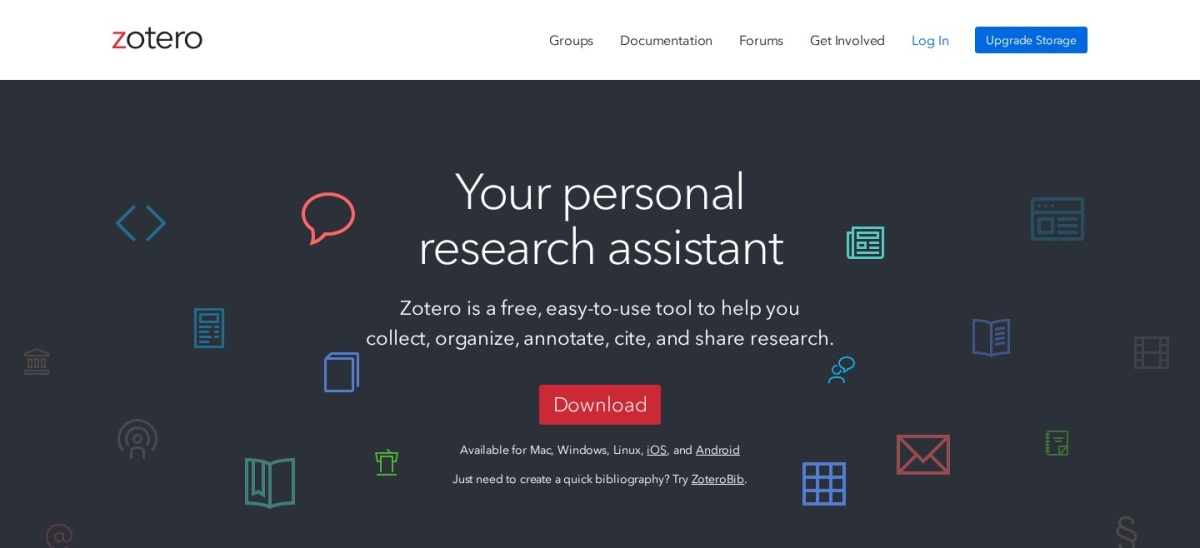
Zotero homepage, captured Nov 2026.
Zotero is a free, open-source reference manager for collecting research papers, organizing bibliographies and annotating PDFs. It supports browser-based reference capture, collections, tags, group libraries and citation generation in more than 9,000 styles. Free accounts receive 300 MB of synchronized attachment storage, while local reference management remains free.
The trade off is that Zotero does not include dedicated systematic review screening or advanced AI evidence extraction. Additional cloud storage costs $20 annually for 2 GB, $60 for 6 GB or $120 for unlimited storage. It suits students and researchers who want a reliable research library without paying for core citation management.
ReadCube is a research management platform for collecting, organizing, annotating and citing academic literature. Essentials costs $95 per user annually and includes PDF storage, cross-device synchronization, browser importing, SmartCite integration and 5 shared libraries. Its AI Assistant also supports conversations with individual research PDFs, subject to daily usage limits.
The trade off is that advanced research discovery, larger collaboration groups and library-wide AI conversations require Plus at $185 annually. Essentials costs $10 with monthly billing, compared with $95 annually. It suits researchers managing substantial reading libraries who want PDF annotations and citation tools together.
What we like
Centralized PDF and reference management
PDF annotation and synchronization
AI-assisted PDF reading
SmartCite integration with writing tools
Shared libraries on Essentials
Watch out for
No permanent free subscription
Advanced discovery requires Plus
AI usage limits apply
Specialized systematic review workflows require other plans
Plus adds advanced discovery, larger collaboration groups and expanded AI research features.Visit readcube.com
05
Paperpile
4.5/5on G2 (26 reviews, checked Nov 2026)
Starts at$8.30/mo
Best for collaborative reference management
Entry planRegular
Regular price$8.30/month annually
PDF storageUnlimited
Free trial30 days
paperpile.com
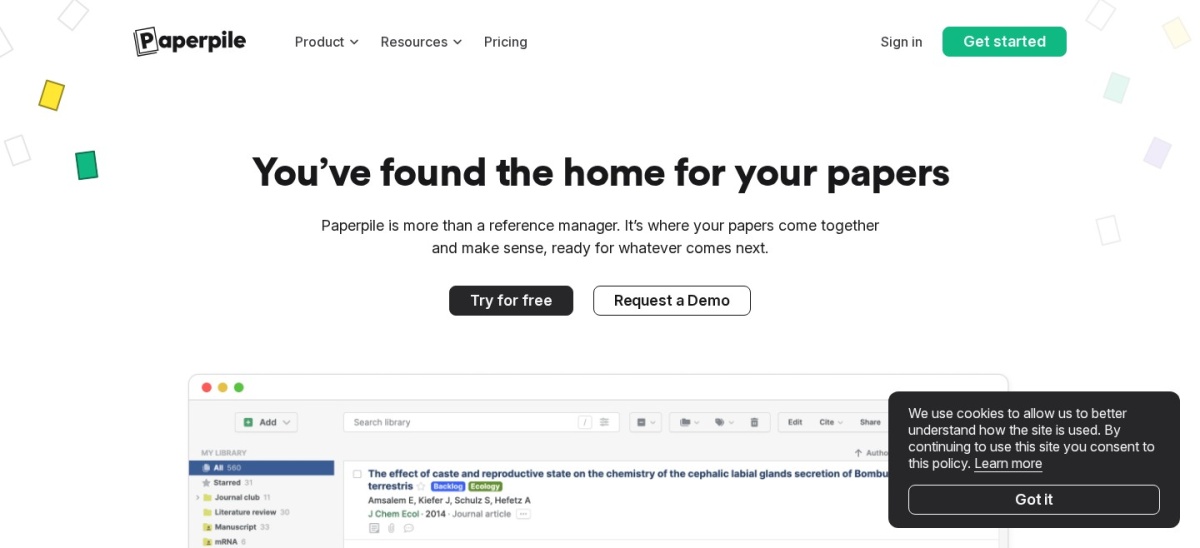
Paperpile homepage, captured Nov 2026.
Paperpile is a web-based reference manager for collecting academic publications, storing PDFs and generating citations. Regular costs $8.30 per month billed annually and includes unlimited PDF storage, reference organization, duplicate detection and citation integrations with Google Docs and Microsoft Word. Researchers can import references from academic databases and publisher websites.
The trade off is that advanced PDF annotations, full-text searching and shared libraries require Expert at $11.50 per month billed annually. Regular costs $99.60 annually before academic discounts. It suits researchers who prefer browser-based reference management and frequently write documents using Google Docs or Microsoft Word.
What we like
Unlimited research PDF storage
Google Docs and Word citation integrations
Automatic reference metadata extraction
Duplicate detection and merging
Browser-based library management
Watch out for
No permanent free plan
PDF annotations require Expert
Shared libraries require Expert
Subscriptions are billed annually
Expert adds PDF annotations, full-text search, shared libraries and advanced integrations.Visit paperpile.com
06
Paperpal
4.8/5on Trustpilot (579 reviews, checked Nov 2026)
Paid from$144/yr
Best for writing and refining literature reviews
Entry paid planPrime
Annual price$144
Free grammar edits200/month
Free library storage300 MB
paperpal.com
Paperpal homepage, captured Nov 2026.
Paperpal is an AI academic writing assistant that helps researchers search literature, work with sources, generate citations and improve scholarly writing. Its free plan includes 200 grammar edits monthly, limited research assistance and 300 MB of library storage. Prime costs $144 annually and expands research, writing and editing allowances.
The trade off is that Paperpal emphasizes research writing and document improvement rather than independent systematic review screening. Prime costs $12 per month with annual billing, while Pro costs $348 annually for more extensive research writing requirements. It suits students and academics preparing literature review chapters, manuscripts and research papers.
What we like
Academic writing and research assistance
Free plan with citation tools
Research library and PDF conversations
Grammar and consistency checking
Large Trustpilot review base
Watch out for
Not dedicated systematic screening software
Free research usage is restricted
AI-generated text requires verification
Advanced writing capabilities require Pro
Prime expands writing and research allowances; Pro adds higher-capacity academic tools.Visit paperpal.com
07
Jenni AI
3.7/5on Trustpilot (162 reviews, checked Nov 2026)
Paid from$12/mo
Best for AI-assisted literature review drafting
Entry planPlus
Annual billing$12/month
AI requests500/month on Plus
PDF uploadsUnlimited on Plus
jenni.ai
Jenni AI homepage, captured Nov 2026.
Jenni AI is an academic writing assistant for organizing research materials, generating cited text and drafting literature reviews. Its free plan includes 10 daily AI autocompletes, 5 AI requests, 10 PDF uploads and unlimited citations. Plus costs $12 per month billed annually and provides 500 monthly AI requests, unlimited PDF uploads and full document exports.
The trade off is that Jenni AI primarily supports drafting and citation management rather than reproducible systematic screening. Plus costs $144 annually, while Pro costs $29 per month billed annually for unlimited AI requests and workflows. It suits researchers who have already collected evidence and need structured assistance writing a literature review.
What we like
AI-assisted academic drafting
Citation generation and research library
Free entry plan
Unlimited PDF uploads on Plus
Research writing and document review workflows
Watch out for
Not a dedicated systematic screening platform
Free AI requests are limited
Generated citations and claims need checking
Mixed Trustpilot feedback
Plus expands AI requests and PDF uploads; Pro adds unlimited AI assistance and workflows.Visit jenni.ai
Which literature review software fits each research stage?
Start with research discovery. Paperguide can help search papers and organize findings, while Scite provides citation context that helps evaluate how publications relate to existing evidence.
Once relevant studies are identified, organize references in a dedicated library. Zotero, ReadCube and Paperpile support citation storage, document management and bibliography creation.
For systematic reviews, Paperguide offers structured review functionality with paper limits determined by the plan. Researchers should confirm whether their methodology requires independent reviewers, audit trails or additional screening capabilities.
During writing, Paperpal and Jenni AI can assist with academic language, source-based drafting and citation management. Their outputs should be checked against the original papers.
Some researchers benefit from combining a reference manager with an AI assistant. Choose complementary tools rather than purchasing multiple subscriptions that duplicate the same functions.
Can AI literature review software produce reliable research?
AI tools can identify relevant publications, summarize findings and help researchers organize extracted information. However, generated summaries may overlook limitations, confuse study designs or misrepresent conclusions.
Check important claims against original papers. Confirm the research question, methodology, sample, findings and limitations rather than relying exclusively on an AI-generated response.
For systematic reviews, maintain a documented search strategy, eligibility criteria and screening process. Automated recommendations should not replace the researcher's responsibility to explain which studies were included and excluded.
Citation management software also requires quality checks. Imported references can contain missing authors, incorrect dates or incomplete metadata that should be corrected before publication.
Treat AI as a research assistant rather than an independent reviewer. Final interpretations and conclusions should reflect critically evaluated evidence.
How we chose
We selected established literature review tools covering AI research assistance, citation analysis, reference management, PDF organization and academic writing. Products were evaluated through official documentation, published pricing and third-party customer reviews.
The publication snapshot is dated 22 Nov 2026, with official pricing and public review pages checked again on 23 Nov 2026. Every listed product has a numeric rating and review count from G2 or Trustpilot. Prices use published regular subscription rates rather than promotional or academic discounts.
We replaced Elicit, Rayyan, ResearchRabbit, Litmaps and Covidence because sufficient directly verifiable public review evidence was unavailable under the list's review requirements. We also excluded tools without confirmable official paid pricing and products outside the literature review workflow. No vendor paid for a place, and we do not claim testing for this list.
How to choose literature review software
Identify your review methodology and research bottlenecks before selecting software for discovery, evidence analysis and writing.
Define the type of review you are preparing. Determine whether your project is a narrative review, scoping review, systematic review or evidence synthesis. Different methodologies require different levels of search documentation, screening, extraction and reproducibility.
Choose tools for the most demanding research stage. Use AI assistants for discovery and evidence organization, reference managers for citations and PDFs, and specialized review tools for structured screening. Avoid paying for overlapping functions without a clear need.
Compare subscription costs and limits. Review annual prices, storage capacity, AI credits, paper allowances, collaboration features and export formats. Calculate the cost for all required users before upgrading from a free or entry-level plan.
Verify research accuracy and data portability. Confirm that the software supports source checking, reliable citations and appropriate reference exports. Maintain independent copies of important research records and verify AI-generated summaries against original publications.
FAQ
What is the best literature review software in 2026?
Paperguide is a strong overall choice for AI-assisted research, evidence organization and systematic reviews. Its Plus plan costs $96 annually and supports reviews of up to 1,000 papers. Scite is useful for citation analysis, while Zotero is a strong free option for organizing references.
Can I complete a literature review using free software?
Yes. Zotero offers free reference management, PDF annotations and citation generation. Paperguide provides a limited free AI research plan, while Paperpal and Jenni AI include free writing tools. Researchers can combine these products to support discovery, organization and writing.
Which software is best for systematic literature reviews?
Paperguide provides structured systematic review capabilities, including reviews of up to 1,000 papers on Plus and larger allowances on Pro. Its Evidence plan supports dual-reviewer screening. Researchers should confirm that the workflow meets their methodology's documentation and reproducibility requirements.
What is the difference between Zotero and Scite?
Zotero is primarily a reference manager that organizes publications, PDFs, annotations and bibliographies. Scite analyzes citation relationships and helps researchers assess how papers are supported or challenged by later studies. The platforms serve complementary purposes and can be used together.
Which software is best for managing research PDFs?
ReadCube, Paperpile and Zotero all support PDF management. ReadCube combines annotations, synchronization and AI-assisted reading, while Paperpile emphasizes browser-based organization and citation integrations. Zotero offers free local PDF management with optional paid cloud storage.
Can AI write a literature review automatically?
AI assistants can help organize findings, summarize papers and generate drafts. However, they cannot guarantee comprehensive research coverage or accurate interpretation. Researchers must verify citations, evaluate study quality and ensure that the finished review follows the appropriate scholarly methodology.
How much does literature review software cost?
Paid options in this comparison start at $20 annually for Zotero cloud storage. ReadCube Essentials costs $95 annually, Paperguide Plus costs $96 and Paperpile Regular costs $99.60. Scite Basic, Paperpal Prime and Jenni AI Plus each cost $144 annually.
Is Paperpal better than Jenni AI for literature reviews?
Paperpal focuses on research writing, academic editing, source-based assistance and citation checking. Jenni AI emphasizes drafting, autocomplete and working with uploaded research documents. Paperpal holds a higher Trustpilot score, but the better fit depends on whether editing or initial drafting is your priority.
Should I use more than one literature review tool?
Combining tools can be useful when they serve different purposes. A reference manager such as Zotero can organize citations, while Scite helps evaluate citation evidence and Paperguide supports AI-assisted synthesis. Start with essential functions before paying for additional subscriptions.