Best Legal Marketing Software in 2026: 9 Tools Compared
WLWPLegible EditorsLast verified 23 Nov 2026How we rank11 min read
★ Short answer
Lawmatics is the best legal marketing software for most firms, running intake, follow-up and ROI tracking in one legal CRM. Pick Clio Grow if your firm already runs on Clio, and CallRail if you need to prove which marketing brings in calls.
How we make this list: we compare pricing pages, product documentation and public user reviews, then re-check every price before each update. No product paid for a place. Disclosure.
Lawmatics is the only tool here built as a legal marketing platform, with intake, drip campaigns and ROI tracking in one system.
CallRail is the only tool with fully published pricing, from $50 a month with a 14-day free trial.
Birdeye has the most G2 reviews here at 4,264, but pricing is quote-based and charged per location.
Podium and Birdeye both need annual contracts, so get the all-in monthly cost in writing before signing.
MyCase and PracticePanther are the cheapest all-in-one options, from $49 to $50 a user a month.
What legal marketing software should do
Legal marketing software helps law firms win clients: capturing leads, following up fast, tracking which marketing produces signed cases, generating reviews and managing relationships.
Intake speed is the first bottleneck. The firm that replies first usually signs the client, so intake CRMs such as Lawmatics and Clio Grow pair forms and scheduling with automated follow-up.
Attribution is the second job. Call tracking shows which ads and campaigns produce calls, and ROI tracking shows which campaigns produce signed cases rather than just clicks. Our guide to legal CRM software covers the CRM side in detail.
Most of these tools are quote-based with annual contracts. Only CallRail, MyCase, PracticePanther and Constant Contact publish a price, so budget for a sales conversation on the rest.
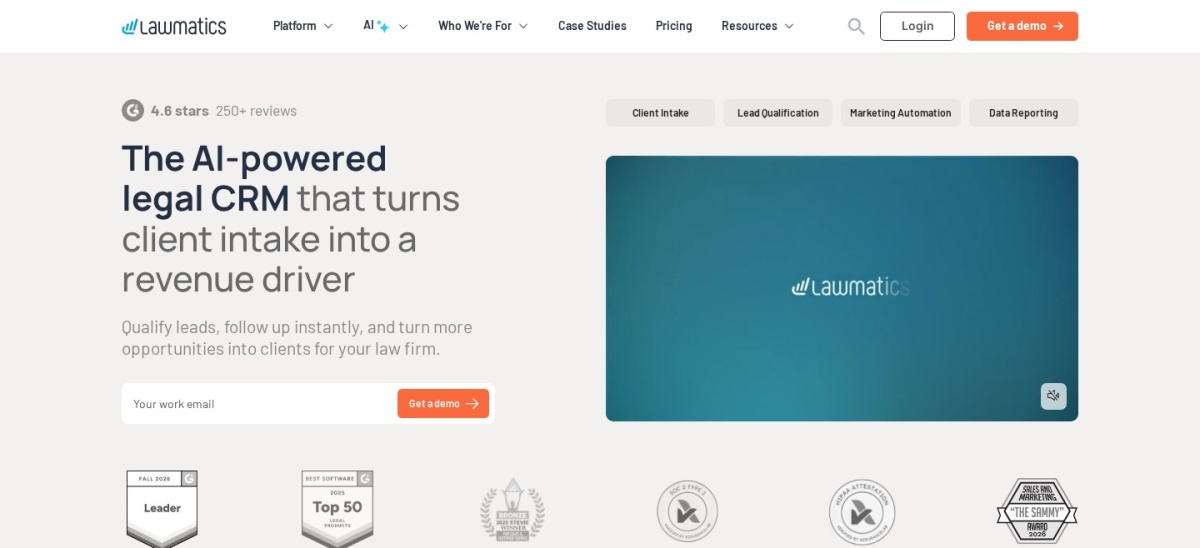
Lawmatics is a legal CRM built as a marketing platform. It runs the whole client journey: intake forms, automated email and text follow-up, appointment scheduling, e-signatures and conflict checks, so a lead who does not book the first time keeps hearing from the firm.
The trade off is price and setup. Lawmatics publishes no price, every quote runs through sales with a three-user minimum, and G2 reviewers warn of a learning curve during implementation. It suits growing firms that treat intake as a marketing function.
What we like
Purpose-built legal CRM with intake at the center
Strong automation for follow-up and drip campaigns
Clio Grow is the client-intake layer of the Clio world: online intake forms, appointment scheduling, automated follow-up and e-signature, all feeding straight into Clio Manage matters. Because the data never leaves the ecosystem, there is no double entry and no integration to babysit.
The trade off is lock-in. Grow has no public standalone price; it is included in the Elite plan and sold as an add-on for Core and Signature, with Clio plans starting at $49 a user a month. It suits firms already running Clio Manage.
Birdeye is the heavyweight option for online reputation: review monitoring across more than 200 sites, automated review requests, listings management, webchat and surveys as you move up tiers. Its newer AI coworkers push into AI search visibility and appointment booking.
The trade off is cost. Birdeye does not publish pricing and sells annual contracts, with third-party estimates around $299 per location a month. It suits multi-location firms that want centralized reputation control with per-location execution.
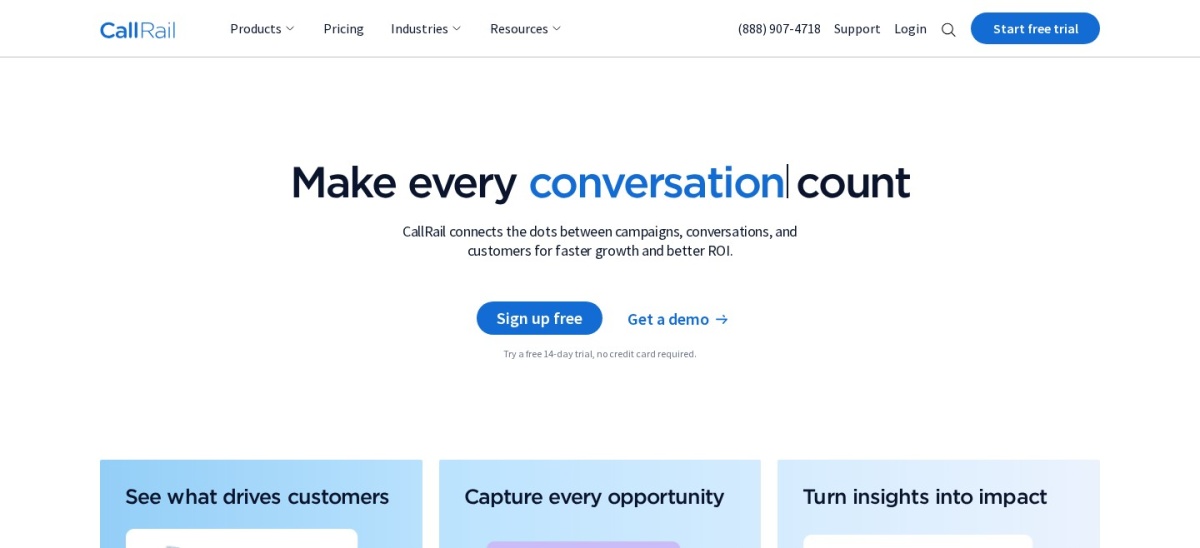
CallRail is the rare marketing tool in legal with its prices on the website: Lead Tracking starts at $50 a month with 5 numbers and 250 minutes, scaling through Complete at $95, Conversion at $150 and Conversion Complete at $195. Every account starts with a 14-day free trial.
The trade off is metered usage. Extra numbers, minutes and texts bill on top of the base fee, and conversation intelligence lives on the higher plans. It suits any firm spending on Google Ads or Local Services Ads that needs to know which campaigns produce calls.
Podium is a messaging and review platform that combines two jobs law firms care about: generating Google reviews and answering leads by text. Review requests go out automatically after matters close, and the unified inbox keeps texts, webchat and social messages in one thread.
The trade off is pricing. There are no public prices, annual contracts are standard, and add-ons such as extra phone seats and AI replies lift the real monthly cost. It suits firms that will use messaging daily, not firms that only want reviews.
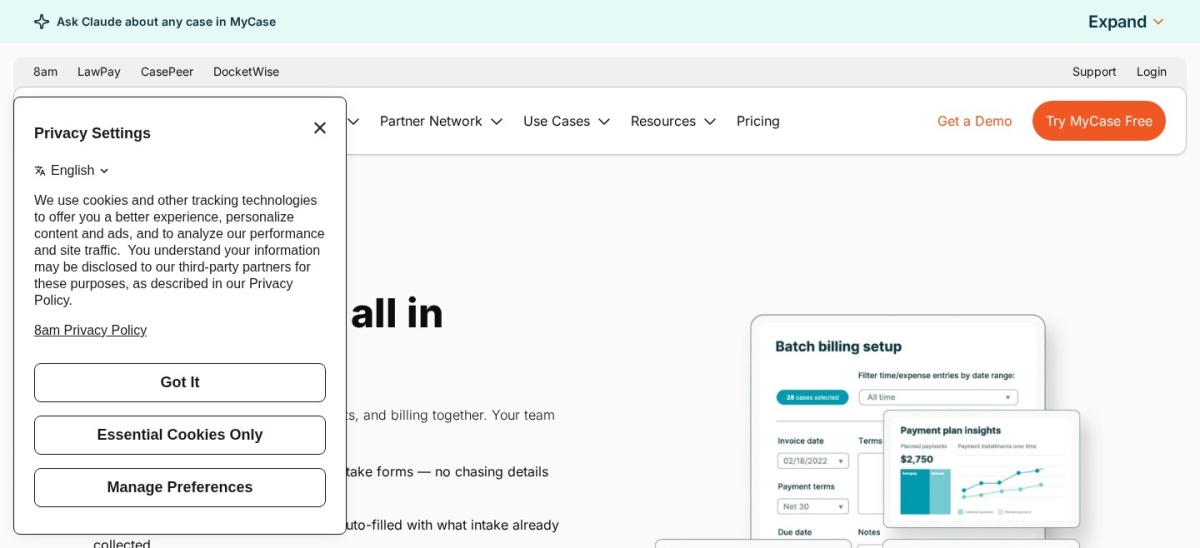
MyCase is an all-in-one platform that combines case management, billing, online payments and a client portal, and its Pro plan adds client intake forms, workflows and unlimited eSignature. Basic costs $50 a user a month billed annually, or $60 billed monthly, with no setup fee or long-term contract.
The trade off is the tier ladder. Intake automation and AI writing need Pro at $89 a user a month billed annually, and older MyCase pages disagree on the entry price. It suits small firms that want intake and case management in one subscription at a low price.
PracticePanther is the easiest system here to set up, with a 9.1 out of 10 ease-of-setup score on G2, live training included and two-way texting with clients. Solo costs $49 a user a month billed annually, or $59 billed monthly, and covers templates, workflows, trust ledgers and unlimited storage.
The trade off is the ladder. Intake and LEDES billing wait for Business at $89 a user a month, and full trust accounting needs Business Pro at $114. It suits solo attorneys and small firms that want automation for a one-person office.
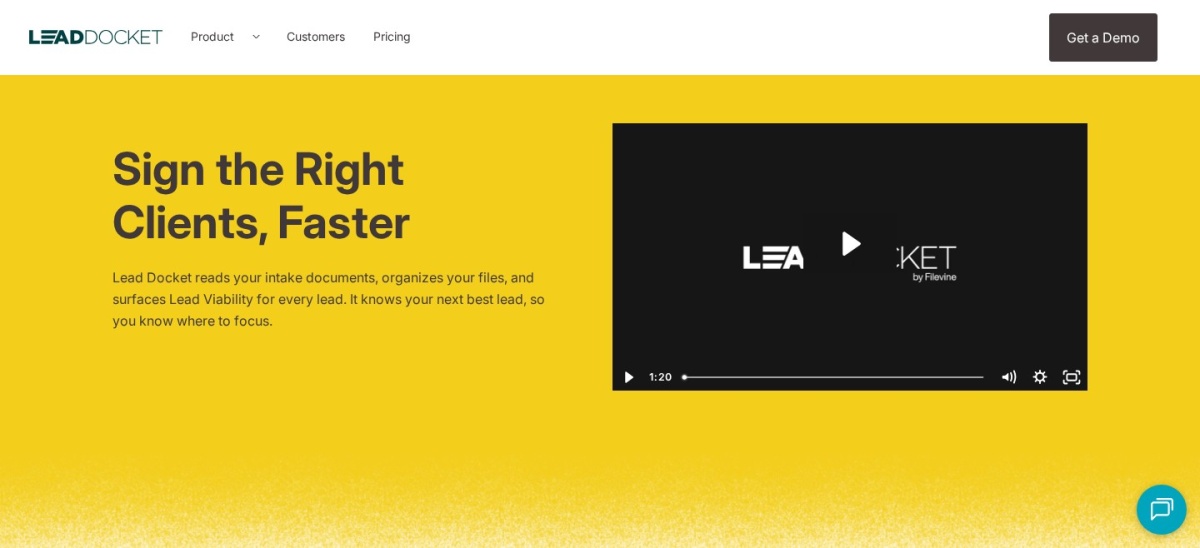
Lead Docket is built for high-volume personal injury intake. Every lead is tracked from source to signed case, with cost per lead and revenue by marketing source, custom intake scripts, lead scoring and automatic routing to the right intake staff.
The trade off is access. The vendor publishes no price, and there is no free trial to test with, though a third-party figure of $300 a month circulates. It suits personal injury and mass-tort firms with high lead volume that need source and conversion tracking.
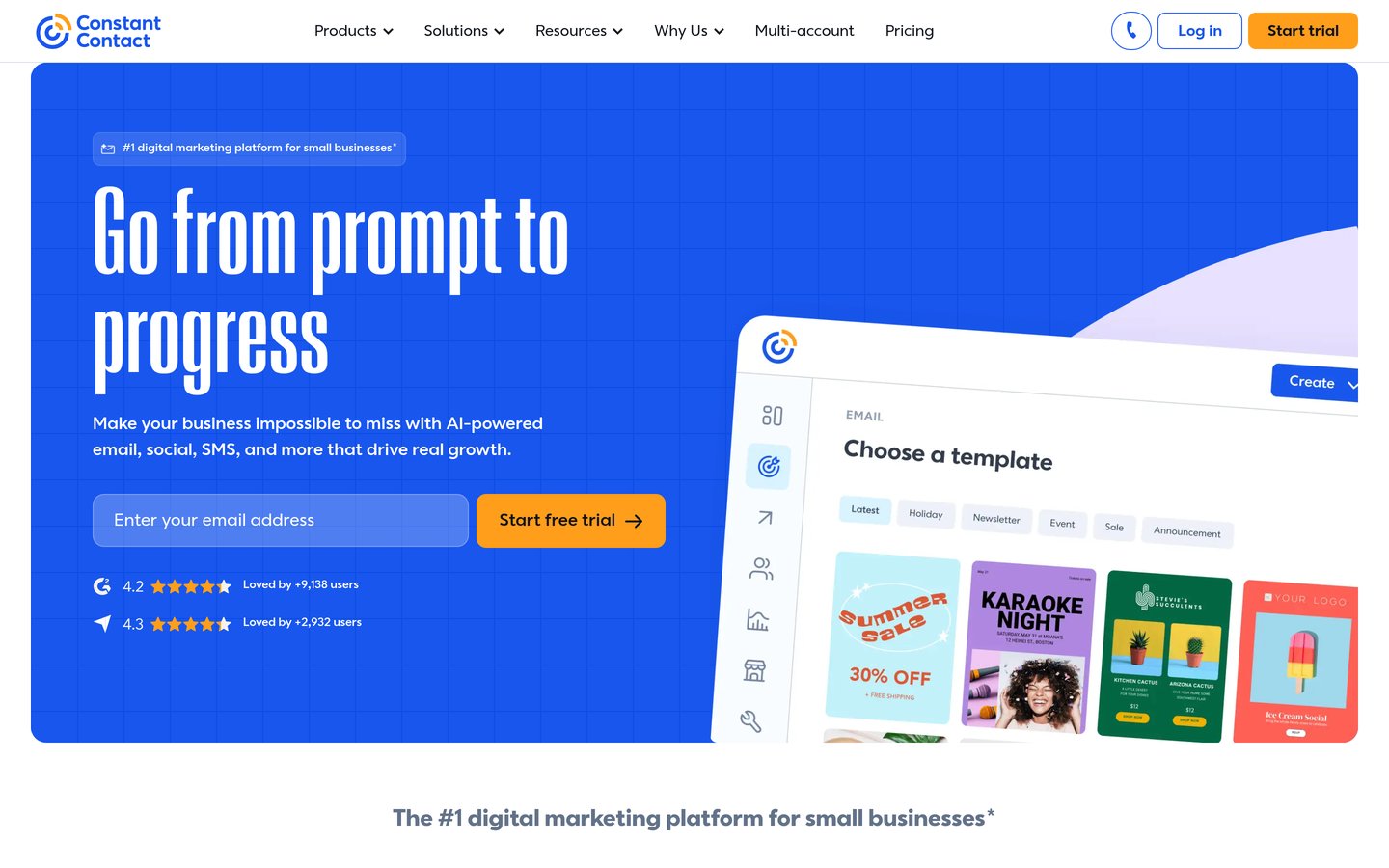
Constant Contact is an all-in-one email marketing suite that law firms use to stay in touch with past clients and referral sources. Lite starts at $12 a month, with list building, targeted campaigns and social posting tools in one place.
The trade off is scope. It is email marketing, not legal software, so it has no intake, matters or conflict checks, and pricing climbs as contact lists grow. It suits small firms that want simple email campaigns without a full marketing platform.
Five of these nine tools publish no price. Lawmatics, Clio Grow, Birdeye, Podium and Lead Docket all sell through demos and custom contracts, often annual.
The published prices that exist are far apart. Constant Contact starts at $12 a month, CallRail at $50, and PracticePanther and MyCase at $49 to $50 a user a month.
For quote-based tools, get the all-in monthly figure in writing, including add-ons, per-location fees and renewal terms, before signing an annual contract.
How we chose
We started from the legal marketing tools with G2 reviews and real adoption in 2026, then kept nine that cover intake, call tracking, reviews and email.
Prices come from each vendor's pricing page, checked on 23 November 2026. Ratings and review counts come from G2 on the same day. Where a vendor only sells on quote, the list shows Custom instead of a guessed number.
We left out tools with no G2 reviews at all. No vendor paid for a place, and this list is based on pricing, docs and reviews, not on using the tools ourselves.
How to choose legal marketing software
Start from the bottleneck, not the feature list, then match the tool to that gap.
Fix intake speed first. If leads go unanswered, buy intake speed: Lawmatics, Clio Grow or Lead Docket, with automated follow-up built in.
Buy attribution before more ads. CallRail's 14-day trial will show which campaigns produce calls, so you stop paying for clicks that never ring.
Add reviews only when leads flow. Podium or Birdeye convert steady lead flow into reviews, but they are annual contracts, so fix intake first.
Get the all-in cost in writing. Ask for the total monthly figure with add-ons, per-location fees and renewal terms before signing any annual contract.
FAQ
What is the best legal marketing software?
Lawmatics is the best pick for most firms. It runs intake, automated follow-up and ROI tracking in one legal CRM, and G2 rates it 4.6 out of 5 from 250 reviews.
How much does legal marketing software cost?
It ranges widely. Constant Contact starts at $12 a month and CallRail at $50, while Lawmatics, Clio Grow, Birdeye, Podium and Lead Docket are quote-based, often several hundred dollars a month.
Is Clio Grow or Lawmatics better?
Lawmatics is better as a standalone system, since it was built as a legal marketing platform with its own CRM. Clio Grow is better for firms already on Clio Manage, where intake feeds straight into matters.
Do I need a CRM and intake software?
They overlap. Intake-focused tools such as Lawmatics and Lead Docket combine both, capturing leads and managing the relationship through signing. Broader CRMs such as Nexl focus on business development across the firm.
What is the cheapest legal marketing software?
Constant Contact is the cheapest at $12 a month for email marketing. Among legal tools, PracticePanther Solo starts at $49 a user a month and MyCase Basic at $50 a user a month.
Should a small firm buy Podium or Birdeye?
Only if reviews are the actual bottleneck. Both are powerful but quote-based with annual contracts, which is a heavy commitment for a solo or small firm. Fix intake speed and attribution first.