Best Legal Billing Software in 2026: 7 Tools Compared
WLWPLegible EditorsLast verified 22 Nov 2026How we rank6 min read
★ Short answer
Clio leads legal billing software for firms wanting matter-linked invoicing across 300+ integrations, with plans starting at $49 per user per month. MyCase suits firms wanting trust accounting on the entry plan, while TimeSolv fits teams focused on dedicated time and billing without heavy case management.
How we make this list: we compare pricing pages, product documentation and public user reviews, then re-check every price before each update. No product paid for a place. Disclosure.
Clio starts at $49/user/mo and holds 4.7/5 on G2 across 1,167 reviews.
TimeSolv lists a regular Pro rate of $43/user/mo with a 25% first-year discount to $33/user/mo.
MyCase starts at $50/user/mo billed annually ($60 monthly) with trust accounting on Basic.
PracticePanther starts at $49/user/mo billed annually ($59 monthly) and saves $120/user/yr on yearly billing.
LawPay charges $19/mo plus transaction processing rates and serves 50,000+ law firms.
What to look for in legal billing software
Legal billing software ties billable hours, flat fees, contingency splits, and case expenses to client invoices while tracking trust balances. Unlike general invoicing apps, legal tools handle IOLTA trust compliance, retainer ledgers, and e-billing formats such as LEDES.
Decide first whether billing belongs inside a full practice management suite or in a standalone billing and time tracker. All-in-one suites keep matters, documents, and client portals together, while dedicated billing tools keep workflows focused on timers, pre-bills, and collections.
Check how each tool handles general ledger accounting and client payments. Some platforms build trust and business accounting natively, while others sync with QuickBooks Online or Xero and charge per-transaction card or ACH fees.
Compare monthly and annual seat pricing carefully before committing. Many legal vendors publish lower per-user rates for annual prepayment and offer short free trials without a credit card.
Best for broad practice workflows and integrations
Entry planStarter ($49/user/mo)
Free trial7 days, no card
Billing typesHourly, flat, contingency
Support24/5 live support
clio.com
Clio homepage, captured Nov 2026.
Clio is a cloud legal platform that connects matter management, time and expense capture, trust accounting, and online payments across 300+ integrations. Plans start at $49 per user per month on Starter, and Clio serves 400K+ legal professionals.
The trade off is that higher tiers with broader customization and AI workflows move to custom quotes, adding cost beyond the $588/yr per user entry rate. It suits firms that want one central hub for matters, client portals, and billing.
What we like
Tracks hourly, flat-fee, and contingency billing from matter terms
Supports LEDES e-billing exports and multiple payment options
Offers 300+ integrations and 24/5 live support
Watch out for
No permanent free plan
Upper-tier pricing is quote-based rather than listed flatly
Higher plans add broader matter workflows, AI tools, and enterprise governance.Visit clio.com
02
MyCase
4.5/5on G2 (454 reviews, checked Nov 2026)
Starts at$50/mo
Best for trust accounting on an entry plan
Entry planBasic ($50/user/mo annual)
Monthly rate$60/user/mo on Basic
Free trial10 days, no card
AccountingTrust on Basic; GL add-on
mycase.com
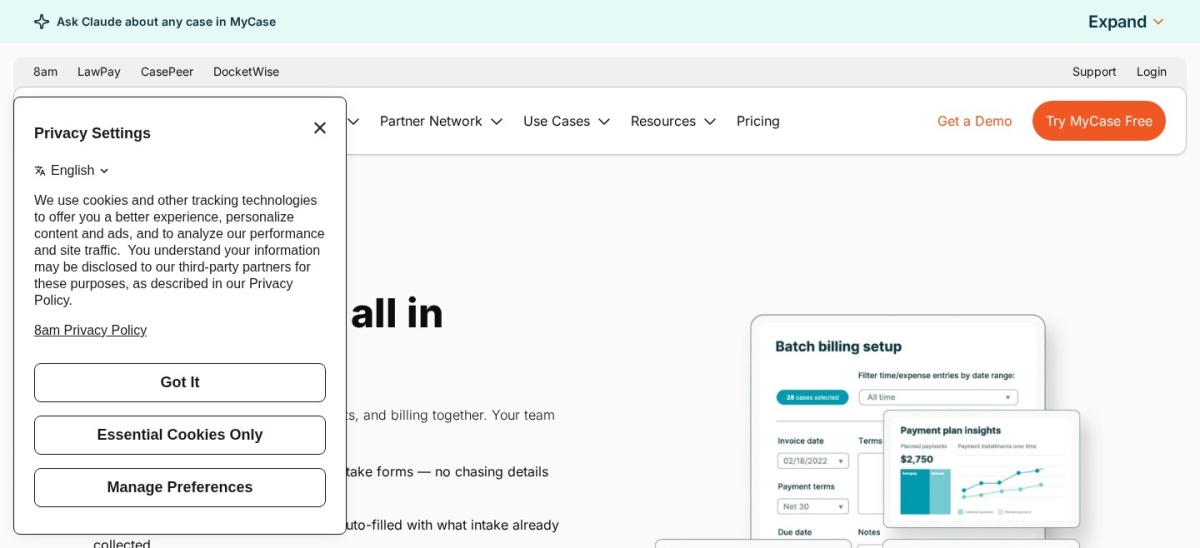
MyCase homepage, captured Nov 2026.
MyCase is legal practice management software combining case tracking, time and expense entry, invoicing, and trust accounting in one system. Its Basic plan is $50 per user per month billed annually ($60 billed monthly) and includes a 10-day trial.
The trade off is that CRM intake forms and automated workflows start on higher tiers, and full accounting is a separate add-on above the $600/yr per user annual Basic rate. It suits small firms wanting trust accounting and case files in one login.
What we like
Includes trust accounting on the Basic plan
Published annual ($50/user/mo) and monthly ($60/user/mo) rates
10-day free trial with no credit card required
Watch out for
Full accounting costs extra as an add-on
Workflow automation and intake forms require higher tiers
Pro and Advanced tiers add expanded automation, intake, and reporting.Visit mycase.com
03
TimeSolv
4.5/5on G2 (430 reviews, checked Nov 2026)
Starts at$43/mo
Best for dedicated time tracking and invoicing
Entry planTimeSolv Pro ($43/user/mo)
Promo note25% off first year ($33/mo)
Legal tierTimeSolv Legal ($58/user/mo)
IntegrationsQuickBooks, Xero, LawPay
timesolv.com
TimeSolv homepage, captured Nov 2026.
TimeSolv is a time tracking and billing platform for legal and professional firms with recurring billing, expense capture, and client portals. Its regular TimeSolv Pro rate is $43 per user per month ($516/yr), while a first-year 25% discount lowers it to $33 per user per month.
The trade off is that legal-specific trust accounting, ABA task codes, and LEDES billing sit on TimeSolv Legal at $58 per user per month. It suits firms focused on billable time capture and invoicing without heavy case management.
What we like
Lower regular starting rate ($43/user/mo) than many full suites
Supports recurring billing, batch invoicing, and client portals
Syncs with QuickBooks, Xero, and LawPay
Watch out for
Trust accounting and LEDES formats require the higher Legal tier
First-year promotional rate is higher after renewal
TimeSolv Legal adds trust compliance, ABA codes, and LEDES billing formats.Visit timesolv.com
04
PracticePanther
4.3/5on G2 (112 reviews, checked Nov 2026)
Starts at$49/mo
Best for task-driven small firms on annual billing
Entry planSolo ($49/user/mo annual)
Monthly rate$59/user/mo on Solo
Annual savingsSaves $120/user/yr
Free trial7 days
practicepanther.com
PracticePanther homepage, captured Nov 2026.
PracticePanther is cloud practice management software offering matter tracking, time entry, batch invoicing, and native payment processing. Its Solo plan starts at $49 per user per month billed annually ($59 monthly), saving $120 per user each year on annual plans.
The trade off is that LEDES billing starts on the $89/user/mo Business plan and full trust and operating accounting sit on higher tiers. It suits solo and small firms that want automated reminders and task workflows.
What we like
Starts at $49/user/mo billed annually with a 7-day free trial
Includes automated payment reminders and recurring payment plans
Offers batch time entries, expenses, and invoice generation
Watch out for
LEDES billing requires stepping up to the Business tier
Full trust and operating accounting are reserved for upper tiers
Essential, Business, and Business Pro add custom roles, LEDES billing, and accounting.Visit practicepanther.com
05
Bill4Time
4.7/5on G2 (36 reviews, checked Nov 2026)
Starts at$39/mo
Best for straightforward time and expense billing
Entry planTime & Billing ($39/user/mo yr)
Monthly rate$49/user/mo on entry plan
Legal Pro plan$59/user/mo billed annually
Free trial14 days, no card
bill4time.com
Bill4Time homepage, captured Nov 2026.
Bill4Time is a time tracking and billing platform with customizable invoices, expense tracking, and a 14-day free trial requiring no credit card. Its Time & Billing plan is $39 per user per month billed annually ($49 monthly), saving up to 25% annually.
The trade off is that trust accounting, conflict checking, and contingency billing require Legal Pro at $59 per user per month annually. It suits firms that want clean time and expense billing with a 14-day trial.
What we like
Lowest annual per-user starting rate on this list at $39/user/mo
Includes a 14-day free trial with no credit card required
Supports batch invoicing, client portals, and QuickBooks sync
Watch out for
Trust accounting and conflict checks are not on the base plan
Smaller G2 review count (36 reviews) than larger rivals
Legal Pro and Enterprise add trust accounting, conflict checks, and custom LEDES export.Visit bill4time.com
06
CosmoLex
4.2/5on G2 (339 reviews, checked Nov 2026)
Starts at$49/mo
Best for replacing separate legal accounting tools
Entry planLaunch ($49/user/mo annual)
Annual savingsSaves $120/user/yr
Higher tiersCore ($99) and Pro ($129)
Free trial10 days, no card
cosmolex.com
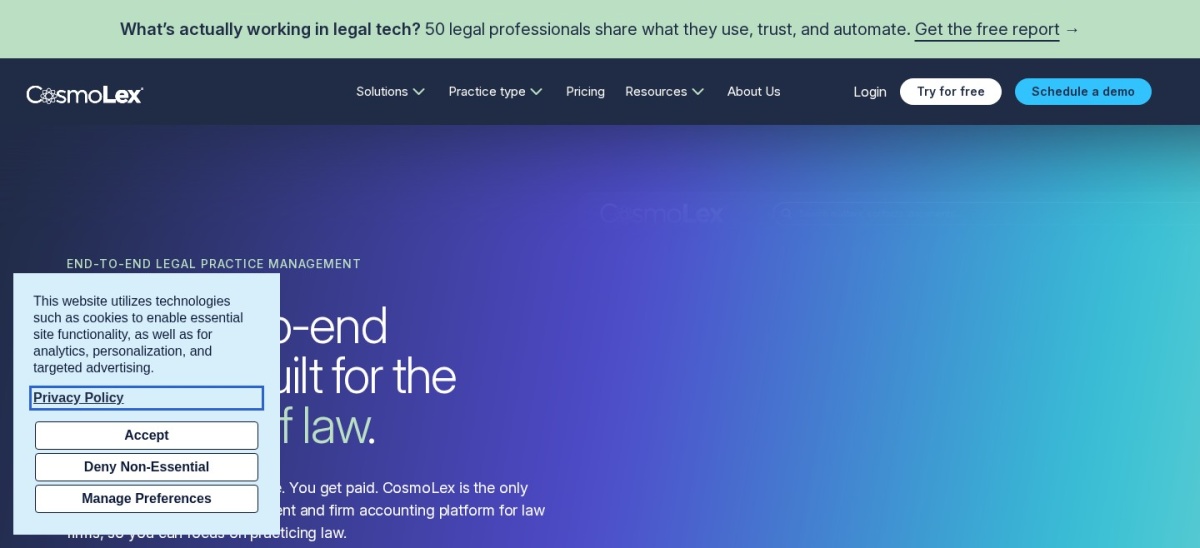
CosmoLex homepage, captured Nov 2026.
CosmoLex is a cloud legal platform that pairs billing and time tracking with built-in trust and business accounting. Its Launch plan starts at $49 per user per month billed annually, saving $120 per user per year over monthly billing.
The trade off is that full client management, AI document summaries, and deeper intake tools require Core ($99/user/mo) or Pro ($129/user/mo). It suits firms that want trust and general ledger accounting without QuickBooks.
What we like
Combines billing, retainers, and trust accounting on Launch
Eliminates the need for separate accounting software
10-day free trial with no credit card required
Watch out for
Core client management and AI tools sit on higher-priced tiers
Lower G2 rating (4.2/5) than several competing platforms
Core and Pro add full client management, AI document summaries, and deeper intake.Visit cosmolex.com
07
LawPay
4.7/5on G2 (232 reviews, checked Nov 2026)
Starts at$19/mo
Best for IOLTA-compliant legal payment collection
Base fee$19/mo subscription
Card rate2.99% + $0.30 (Visa/MC/Disc)
eCheck rate1% processing fee
Firms served50,000+ law firms
lawpay.com
LawPay homepage, captured Nov 2026.
LawPay is a legal payment and billing platform built for trust account separation and IOLTA compliance across 50,000+ law firms. Its monthly plan is $19/mo ($228/yr) plus 2.99% + $0.30 for Visa, Mastercard, and Discover, 3.90% + $0.30 for Amex, and 1% for eCheck.
The trade off is that card brand pass-through fees (listed at $7.99/mo currently) and transaction fees apply on top of the $19/mo base fee. It suits firms that want specialized legal payments alongside their billing or practice software.
What we like
Low $19/mo base subscription with no setup or cancellation fees
Designed for trust account protection and IOLTA compliance
Supports credit, debit, eCheck, Apple Pay, and client financing
Watch out for
Per-transaction processing fees and pass-through fees add to total cost
Not a full case or matter management suite on its own
Connects with practice management tools and supports scheduled or recurring payments.Visit lawpay.com
Trust accounting vs. general ledger accounting
Client retainers and settlement funds typically belong in a trust or IOLTA account rather than firm operating revenue until earned. Mixing earned fees and unearned trust funds creates compliance risks and messy reconciliations.
Some platforms handle trust accounting natively while relying on QuickBooks or Xero for broader bookkeeping, whereas tools like CosmoLex build business and trust accounting into the same platform. Confirm how a tool reconciles trust ledgers before migrating active retainers.
How we chose
This list covers established legal billing and payment platforms researched from vendor pricing pages, feature documentation, and G2 user reviews. All prices, ratings, and review counts were checked on 22 Nov 2026 using regular published rates and noting promotional discounts or transaction fees where applicable.
Tools without verifiable pricing or ratings from opened pages were excluded, and no testing is claimed. No vendor paid for a place, and we do not claim testing for this list.
How to choose legal billing software
Follow four practical steps to match a billing platform to how your firm tracks time and collects money.
Map your fee structures first. List whether you bill hourly, flat fees, contingency shares, or retainers so you confirm support for rate tables, split billing, and LEDES formats.
Decide between standalone billing and full suites. Choose a focused billing tool like TimeSolv or Bill4Time if you already manage cases elsewhere, or an all-in-one suite like Clio or MyCase if you want matters and billing together.
Check trust and ledger workflows. Verify how trust balances are tracked and whether the software syncs with your existing accounting tool or replaces it.
Calculate annual seat and payment costs. Compare annual versus monthly per-user pricing alongside card or eCheck processing rates and any higher-tier requirements.
FAQ
What is the cheapest annual starting price on this list?
LawPay has a $19/mo ($228/yr) base fee plus payment processing fees, while among per-user legal billing plans Bill4Time lists Time & Billing at $39/user/mo ($468/yr) when billed annually.
Do all legal billing tools include trust accounting on their entry plan?
No. For example, MyCase includes trust accounting on its $50/user/mo annual Basic plan, whereas Bill4Time puts trust accounting on its $59/user/mo annual Legal Pro plan.
Why do legal billing tools charge per user per month?
Most legal platforms price per active staff seat because time entry, matter access, and billing permissions scale with the number of attorneys, paralegals, and billing staff using the system.
Should a firm pick a standalone billing tool or an all-in-one suite?
Standalone billing tools fit teams that already have case tracking or want lower-overhead invoicing, while all-in-one suites fit firms that want client portals, documents, calendars, and billing in one place.
How do payment processing fees affect legal billing costs?
Platforms that process online payments typically charge percentage and flat fees per card transaction and a lower rate for eCheck or ACH, plus any applicable network pass-through fees.
Can you test these platforms before signing an annual plan?
Yes. Several listed tools advertise free trials without requiring a credit card, such as 7 days on Clio and PracticePanther, 10 days on MyCase and CosmoLex, and 14 days on Bill4Time.