Ansys HFSS is the best electromagnetic simulation software for high-frequency antennas and RF components. COMSOL Multiphysics is the best pick when electromagnetics couples to heat or structure, while Keysight ADS suits RF circuit design.
How we make this list: we compare pricing pages, product documentation and public user reviews, then re-check every price before each update. No product paid for a place. Disclosure.
Ansys HFSS remains the reference standard for high-frequency EM simulation, especially antennas and RF components.
CST Studio Suite has no G2, Capterra or Trustpilot rating we could verify, so it is not in this list despite being a leading tool.
COMSOL Multiphysics is the pick when electromagnetics couples to heat, structural mechanics or other physics.
Keysight ADS is the standard for RF and microwave circuit design, with harmonic balance and circuit-envelope solvers.
Every tool here prices by quote. Free ways to learn include the Ansys student version and the CST Learning Edition.
What electromagnetic simulation software covers
Electromagnetic simulation software models how fields behave in antennas, RF components, motors and whole platforms. Buying starts with naming the physics, because no tool covers everything well.
High-frequency problems, antennas, RF components and wave propagation belong to HFSS, CST, Tidy3D, Sonnet or XFdtd. Low-frequency problems, motors, transformers and actuators belong to Maxwell or EMWorks. Platform-scale problems, vehicles and aircraft, belong to Feko.
Coupled problems, where heat or mechanics interact with fields, belong to COMSOL. Circuit-level RF design belongs to ADS. Many large organizations own more than one tool.
Almost every vendor quotes prices privately. Our CAD software guide covers the design tools that feed geometry into these solvers.
The 7 best electromagnetic simulation software tools
01
Ansys HFSS
4.5/5on G2 (41 reviews, checked Nov 2026)
PricingCustom/yr
Best for high-frequency antennas and RF
SolverFinite element, full-wave
PricingQuote-based
Free optionStudent version
StrengthAdaptive meshing
ansys.com
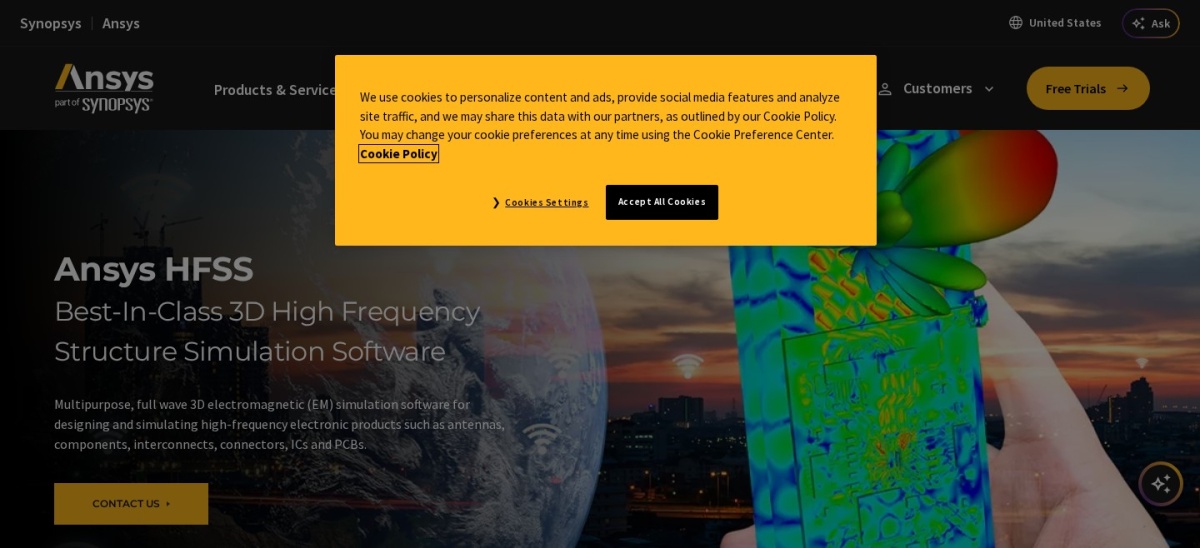
Ansys HFSS homepage, captured Nov 2026.
Ansys HFSS is a 3D full-wave electromagnetic field solver for antennas, RF and microwave components, connectors and high-speed interconnects. It uses the finite element method with adaptive meshing, and the industry treats its accuracy as a reference.
The trade off is cost and learning. There is no published price, and large models want workstation or HPC hardware plus real training time. It suits teams where antenna performance or signal integrity decides product success.
Keysight ADS is a design system for RF and microwave circuits, where amplifiers, mixers, oscillators, filters and full RF chains are simulated with harmonic balance, circuit envelope and transient solvers. The EM side comes through integrated planar and 3D solvers.
The trade off is scope. Full 3D EM requires add-on solvers, and pricing is enterprise and modular with no published price. It suits RF and microwave design teams for whom simulation must correlate with measurement on Keysight instruments.
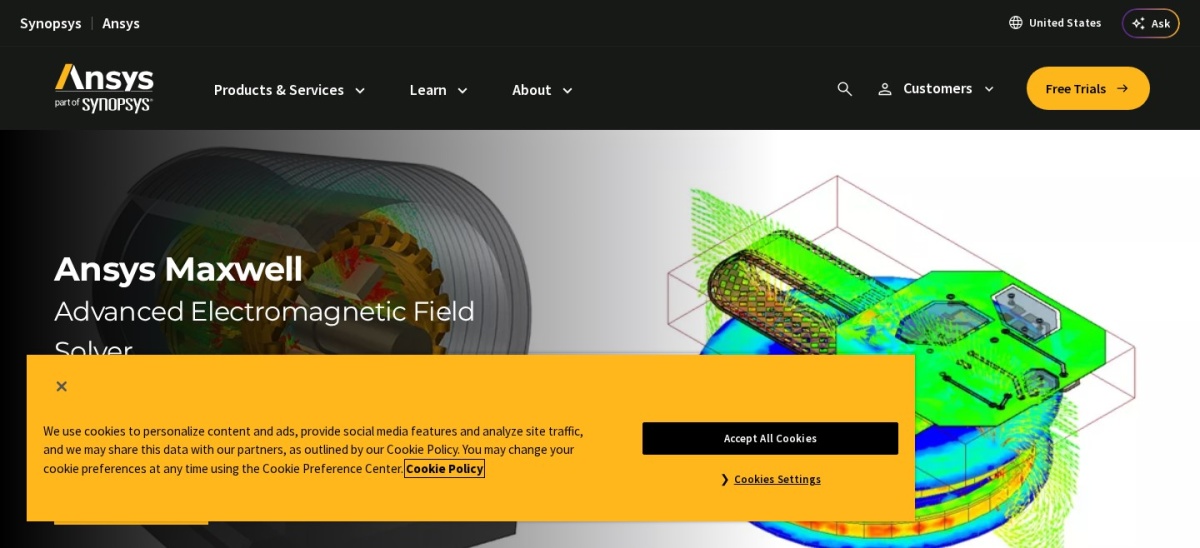
Ansys Maxwell is the low-frequency counterpart to HFSS in the Ansys portfolio, and it dominates its niche. Electric motors, transformers, actuators, sensors and magnetic devices are designed in Maxwell across automotive, industrial and energy sectors.
The trade off is focus. Maxwell is not the tool for antennas or wave propagation, and like all Ansys flagships it has no published price and needs real training. It suits teams whose product has windings and a magnetic circuit.
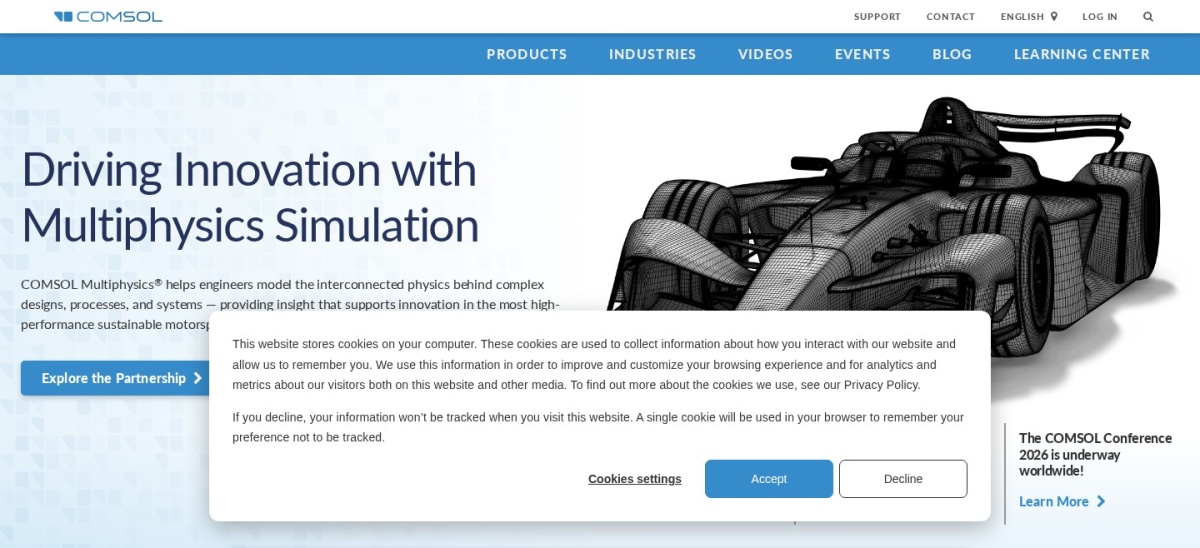
COMSOL Multiphysics is a simulation environment where electromagnetics couples to thermal, structural, acoustic and fluid physics in a single model. Electromagnetic losses feed the thermal model, thermal expansion feeds the structural model, all with one consistent interface.
The trade off is specialization. For pure high-frequency antenna work, specialists like HFSS or CST may be more efficient, and cost scales with add-on modules. It suits R&D teams and universities designing devices where physics interact.
Simcenter Feko is an electromagnetic solver for electrically large problems: an antenna on a vehicle, a radar on an aircraft, EMC across a whole platform. Its hybrid solvers combine method of moments, physical optics and other techniques to solve structures that pure finite element tools cannot touch at reasonable cost.
The trade off is branding. Siemens bought Altair, and the product is now Simcenter Feko, so naming and licensing have changed. It suits automotive, aerospace and defense teams working at platform scale.
Remcom XFdtd is a full-wave 3D FDTD solver covering antennas, microwave components, radar and EMC applications, with a distinctive strength in bio-electromagnetics. Its specific absorption rate analysis covers phones, wearables and medical devices.
The trade off is scale. Remcom is smaller than the enterprise giants, which shows in third-party resources and community size, and pricing is not published. It suits teams with bio-EM or compliance-driven antenna work.
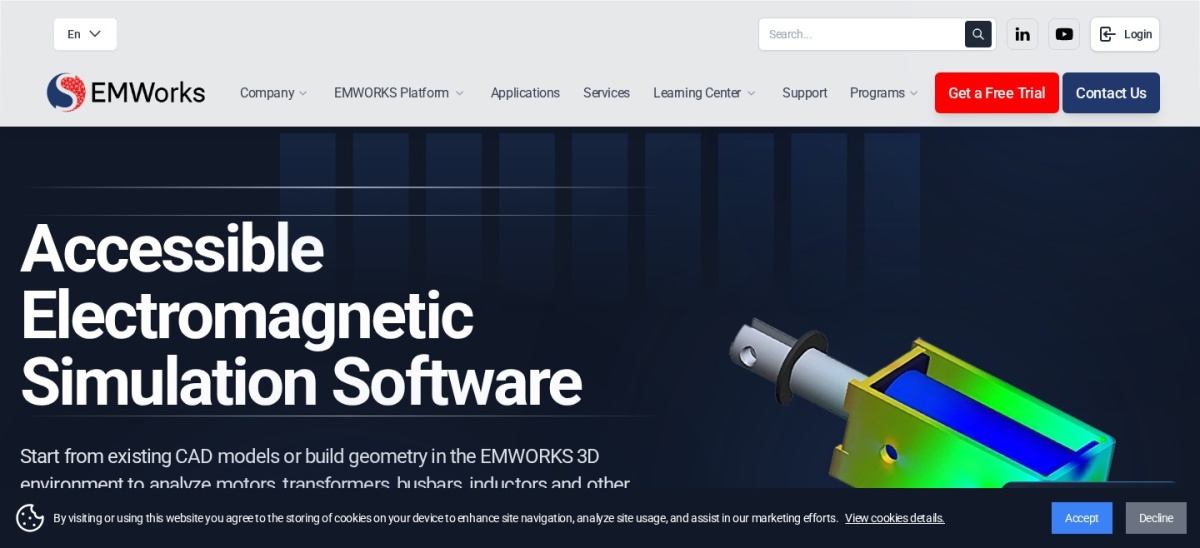
EMWorks is an electromagnetic simulation platform built for small and mid-size engineering teams, with modeling, simulation and post-processing in one environment. It started as a SOLIDWORKS partner and now runs standalone with built-in Autodesk Inventor CAD.
The trade off is validation depth. EMWorks is a smaller company with a narrower validation history, and the largest high-frequency problems belong to the big suites. It suits product teams designing electromechanical devices in CAD.
Finite element methods suit high-frequency components and antennas, which is why HFSS uses them. Time-domain methods suit broadband and transient work, which is CST's strength.
Method of moments and hybrid solvers suit electrically large structures, which is why Feko handles vehicles and aircraft. FDTD suits fast cloud runs, which is Tidy3D's bet.
Ask vendors to run a benchmark on a model like yours before buying. Reputable ones will, and the results tell you more than any datasheet.
How we chose
We started from the tools RF and antenna engineers actually buy, checked each vendor's product and pricing pages and compared solver methods, problem fit and free access. Every tool here has a G2 or Capterra rating with a review count, checked on 25 November 2026.
Prices come from each vendor's pricing page. Almost every vendor in this category quotes prices privately, so we list Custom rather than guessing. Sonnet is the only vendor with public prices, but it has no verifiable G2, Capterra or Trustpilot rating.
We left out CST Studio Suite, Sonnet and Tidy3D because no G2, Capterra or Trustpilot rating could be verified for them, even though CST is a leading tool. No vendor paid for a place, and we do not claim hands-on testing for this list.
How to choose electromagnetic simulation software
Name the physics first, then ask for a benchmark and budget the hardware too.
Name the physics first. High-frequency antennas belong to HFSS, motors belong to Maxwell, large platforms belong to Feko, coupled problems belong to COMSOL.
Ask for a benchmark. Give vendors a model like yours with frequency range, materials and accuracy targets, and compare solve time and mesh statistics.
Budget the hardware too. Large full-wave models want workstation-class CPUs, plenty of RAM and often GPU or HPC access. Cloud options like Tidy3D rent compute per simulation.
Model the three-year cost. Named-user, floating network, token-based and usage-based pricing all behave differently as teams grow. Confirm what happens to your models if you switch.
FAQ
What is the best electromagnetic simulation software?
Ansys HFSS is the best electromagnetic simulation software for high-frequency antennas and RF components, and it remains the reference standard. COMSOL Multiphysics is the best pick when electromagnetics couples to heat or structure.
What is the difference between HFSS, CST and Feko?
They are optimized for different problem classes. HFSS uses finite elements and excels at high-frequency component accuracy. CST offers multiple solvers including time-domain methods, and Feko uses hybrid methods for electrically large structures like vehicles and aircraft.
Do I need a supercomputer to run EM simulation?
Not necessarily. Small models run on engineering workstations, and cloud options rent high-performance compute per simulation. Large full-wave models of complex structures do benefit from HPC or GPU acceleration, so start with a benchmark of your typical model.
Can open-source tools replace commercial EM solvers?
For some problems, partially. Tools like openEMS and MEEP handle FDTD simulation competently for research and learning. Commercial tools add validated accuracy, technical support, CAD integration and the documentation trail that regulated industries require.
How long does it take to learn EM simulation software?
Expect weeks to become productive and months to become proficient, depending on your electromagnetics background. The physics knowledge matters as much as the tool skill, and vendor training courses meaningfully shorten the ramp.
How much does electromagnetic simulation software cost?
Almost every vendor prices by quote, based on modules, license type and team size, so expect a sales conversation. Sonnet is the only vendor with public prices, from $495 for Lite Plus, but it is not in this list because no review-site rating could be verified.
SaaS SEO and WordPress specialist with about 8 years of experience. Rakib compares WordPress plugins, themes, hosting and software using public pricing, documentation and user reviews. See how we rank.