Best Display Advertising Software in 2026: 9 Tools Compared
WLWPLegible EditorsLast verified 23 Nov 2026How we rank14 min read
★ Short answer
The Trade Desk is the best independent DSP for large advertisers, and StackAdapt is the easiest self-serve programmatic platform for mid-market teams. Google Ads remains the default starting point with no minimum spend, AdRoll and Criteo cover ecommerce retargeting, and Choozle, Quantcast, Adform, and Taboola serve agencies, audiences, Europe, and native reach.
How we make this list: we compare pricing pages, product documentation and public user reviews, then re-check every price before each update. No product paid for a place. Disclosure.
The Trade Desk is the best independent DSP for large advertisers with serious spend.
StackAdapt is the easiest self-serve DSP, with the highest rating here at 4.7 from 905 reviews.
Google Ads is the default starting point: no minimum spend, unmatched reach.
AdRoll and Criteo cover ecommerce retargeting; AdRoll charges no subscription fee.
Most DSPs publish no prices; Choozle's $99 a month is the only published plan price.
What display advertising software should cover
Display advertising software buys banner, native, and video ads across websites, apps, and connected TV, usually through a demand-side platform (DSP) that bids in real-time auctions. The market is tiered: enterprise DSPs expect meaningful monthly minimums and annual contracts, mid-market self-serve platforms work with campaign minimums in the hundreds, and Google Ads has no minimum at all.
The tools here split into three shapes. Enterprise DSPs such as The Trade Desk and Adform buy at scale with deep transparency and log-level reporting. Self-serve DSPs such as StackAdapt and Choozle let mid-market teams launch campaigns without a trading desk. Retargeting platforms such as AdRoll, Criteo, and Taboola win back visitors or reach native placements.
Pricing is mostly unpublished. DSPs charge a percentage of media spend written into your contract, so two buyers can pay different rates for the same inventory. Google Ads and AdRoll charge only for media, with no subscription fee. Choozle is the only tool here with a published plan price, $99 a month, and even that figure is disputed between sources.
Match the platform to your spend level first, because buying more platform than your budget can feed wastes money twice: once on fees, once on underpowered campaigns. Then interrogate transparency: ask what percentage of spend goes to media versus tech and data fees, and whether you get log-level reporting. If brand safety matters, ask for a live look at placement controls before you sign.
The Trade Desk is the largest independent demand-side platform, and its pitch is simple: buy media across the open internet without the conflicts of interest that come with owning the inventory. Big brands use it to run display, video, CTV, and audio from one seat, with data-driven decisioning and detailed log-level reporting. If your monthly media spend is serious, this is the default shortlist pick.
The trade off is access: The Trade Desk works through contracts and minimum spends that rule out small advertisers, and the platform assumes you know programmatic concepts already. Smaller teams usually enter through an agency trading desk rather than a direct seat. Buy it when your spend justifies dedicated programmatic expertise, not as a first experiment.
What we like
Massive reach across premium open-internet inventory
StackAdapt is the most accessible serious DSP in this list: a self-serve platform that buys display, native, video, CTV, audio, digital out-of-home, and in-game inventory from one login, with AI bid optimization and creative tools built in. There is no published minimum spend, accounts open after approval, and the Basic tier takes card payment. The interface is built for marketers rather than traders.
The trade off is price opacity: StackAdapt publishes no figures at all, and cost is negotiated as a percentage of media spend, so you only learn your rate in a sales conversation. Third-party data segments add their own usage-based costs on top. Power users who need exotic inventory deals or deep log-level data may find the ceiling lower than on The Trade Desk.
Google Ads is the default starting point for display because the Display Network puts your banners on millions of websites and apps, plus YouTube and Gmail, and there is no minimum spend to get in. You set a daily budget, choose CPC or viewable-CPM bidding, and let Smart Bidding adjust bids toward conversions. For a small business testing display for the first time, that mix of reach and no entry cost is unmatched.
The trade off is intent and transparency: people seeing a display ad are browsing, not searching, so prospecting campaigns convert far below search. Placement reports require digging, fee breakdowns are less open than on independent DSPs, and brand-safety settings need constant attention to avoid junk inventory. Audit placements regularly.
What we like
Unmatched reach across millions of sites and apps
Tight integration with Google Analytics and YouTube
AdRoll is the retargeting specialist in this list, and its pitch is simple: the self-service Ads plan has no subscription fee, so you pay only for the media you buy. One dashboard runs retargeting and brand-awareness campaigns across display, native, video, and connected TV, and dynamic ads pull products straight from your store feed, so a shopper who abandons a cart sees that exact product again.
The trade off is that the base plan is deliberately thin: social ads and cross-channel attribution are paid add-ons, and the Advanced Package with managed services needs a sales conversation. G2 reviewers also warn that the reporting can look rosier than their own CRM numbers. For an ecommerce store that wants to win back visitors without a platform fee, AdRoll is the cheapest serious option here.
What we like
Retargeting plus email and social ads in one platform
Criteo is the commerce retargeting specialist: its AI is trained on shopper data from its retail media network, and its dynamic ads pull products from your catalog and update as prices and stock change. One platform covers web, social, video, and CTV, so a retailer can run the whole retargeting program, prospecting included, without stitching tools together.
The trade off is that Criteo publishes no pricing, costs are CPC/CPM-based and negotiated, and small budgets get little attention from the sales team. Its models learn from your traffic, so small sites with thin visitor numbers see weaker results. It is also firmly a retail play; B2B or lead-gen advertisers will find the targeting less suited to their funnels.
What we like
Commerce data network improves retargeting relevance
Dynamic creative handles large catalogs well
Managed service option for hands-off teams
Watch out for
Performance depends heavily on site traffic volume
Quantcast is an AI-powered advertising platform paired with audience measurement tools that many marketers use for free. Its models build lookalikes and predictive audiences from large-scale web data, and it has invested early in cookieless targeting as third-party cookies fade. Agencies like it for mid-funnel prospecting where audience quality matters more than raw reach.
The trade off is breadth: if you need CTV buying, retail media, or deep custom integrations, a larger DSP covers more ground. Pricing is custom-quoted with no published figures, and the best results come with meaningful spend. For advertisers that want smarter prospecting audiences with straightforward execution, though, the combination of free measurement and AI-driven buying is a practical package.
What we like
AI-driven audience modeling from large data assets
Choozle is a self-serve DSP built for small and mid-market agencies: display, video, CTV, audio, native, and digital out-of-home from one platform, with managed-service help when a campaign needs it. It connects to premium DSPs including The Trade Desk, Amazon Ads, and Walmart Connect, and G2 reviewers consistently praise the support team and the absence of minimums.
The trade off is pricing opacity: Choozle publishes no prices on its own site, so every comparison starts with a demo and a negotiation. Serpastra's November 2026 programmatic guide lists $99 a month, while its display guide lists custom quote, so confirm the figure on a sales call. Reviewers also say reporting is thin for analysts and that occasional glitches interrupt campaign work.
What we like
Built for agency multi-account management
Self-serve with training and support included
CRM and data onboarding integrations
Watch out for
Smaller brand recognition can raise client questions
Adform is Europe's independent answer to the big DSPs, offering media buying, data management, and ad serving in a single integrated platform. Its transparency pitch resonates with advertisers tired of black-box fees: you see what you pay for media, data, and tech separately. For brands with strict data governance needs, the European base and GDPR posture are genuine advantages.
The trade off is that the platform is enterprise through and through, with contracts and minimums rather than self-serve signup. US-focused advertisers may find inventory depth and support coverage thinner than on American platforms. The Capterra rating rests on only 2 reviews, so treat the 4.5 as thin evidence. If you buy media primarily in Europe, Adform deserves a serious look.
What we like
Independent European ad tech with transparent fees
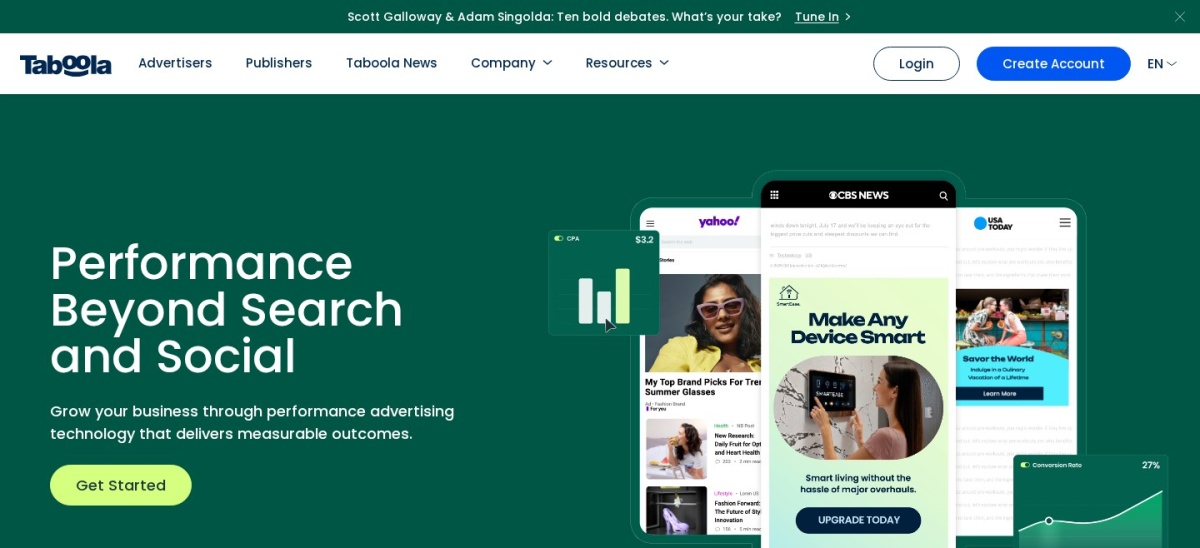
Taboola is a native display platform, now called Realize, that buys placements across premium publisher sites: the content-recommendation boxes at the bottom of news articles. Taboola says the network reaches 600 million daily active users, and Realize adds Maximize Conversions automated bidding plus GenAI AdMaker creative tools, so campaigns can run largely on autopilot once the pixel is in.
The trade off is traffic quality: it varies by placement, and reviewers say the worst placements need manual blocking. There is no fixed minimum, but Taboola recommends $50 a day per campaign, and its own guidance says the automation needs ten to fifteen times your target CPA to work properly. Treat Realize as a reach play for content and ecommerce, not a precision tool.
What we like
Realize reaches 600M daily active users, per Taboola
Maximize Conversions bidding and GenAI AdMaker built in
Self-serve signup with site-level placement controls
Display platforms split into two buying models, and picking the wrong one is the most common regret. Self-serve seats give you control and lower fees, but they assume someone on your team knows programmatic: audience building, bid strategies, placement audits, and creative testing. Without that skill in-house, a self-serve DSP becomes an expensive dashboard nobody opens.
Managed services flip the trade. The vendor or agency runs the campaigns, which gets you expertise immediately, but you pay higher fees and see less of the machinery. For teams spending under mid five figures a month, managed or hybrid models usually outperform a neglected self-serve seat. As spend grows and you hire programmatic talent, migrating to self-serve cuts fees and increases control.
How we chose
We evaluated display advertising software actively sold in 2026, from enterprise DSPs to retargeting platforms and native networks. Research covered vendor sites and product documentation, G2 and Capterra user reviews, and independent comparison guides published in October and November 2026. We weighted reach, transparency, self-serve access, retargeting quality, and fit for different spend levels.
Most DSPs publish no prices, so the honest figure is Custom or pay-for-media. The Trade Desk, StackAdapt, Criteo, Quantcast, and Adform all charge a percentage of media spend or a negotiated quote. Choozle's $99 a month comes from serpastra's November 2026 programmatic guide, while its display guide lists custom quote; we used $99 and flagged the conflict. Google Ads and AdRoll charge only for media, with no subscription fee.
No vendor paid for a place, and we do not claim hands-on testing for this list. Ratings come from G2 or Capterra, with the date we checked them, and every price in this list was checked on 23 November 2026.
How to choose display advertising software
Start with your monthly spend, then match the platform to your team.
Match the platform to your spend. Enterprise DSPs expect meaningful monthly minimums; mid-market self-serve platforms work with campaign minimums in the hundreds; Google Ads has no minimum. Buying more platform than your budget can feed wastes money twice.
Interrogate transparency. Ask what percentage of your spend goes to media versus tech and data fees, whether you get log-level reporting, and how placement lists work. Independent DSPs tend to be more open; walled gardens less so.
Plan your data connections. Retargeting needs site tags or an app SDK in place, CRM-based targeting needs data onboarding, and measurement needs conversion tracking wired correctly. Audit your tags and feeds during the trial period.
Choose self-serve or managed. Self-serve seats give control and lower fees but need in-house programmatic skill. Managed services give expertise immediately but cost more and show less. Pick the model that matches the team you have today.
FAQ
What is the best display advertising software?
The Trade Desk is the best independent DSP for large advertisers, and StackAdapt is the easiest self-serve platform for mid-market teams. Google Ads is the default starting point with no minimum spend, while AdRoll and Criteo cover ecommerce retargeting.
How much does display advertising software cost?
Most DSPs charge a percentage of media spend or a negotiated quote, so there is no list price. Google Ads and AdRoll charge only for media, with no subscription fee. Choozle lists $99 a month, and Taboola recommends $50 a day per campaign.
What is a DSP?
A demand-side platform buys display, video, and connected TV ads across the open internet through real-time auctions. You set audiences, budgets, and bids, and the DSP buys impressions one at a time. The Trade Desk, StackAdapt, Choozle, and Adform are DSPs; Google Ads and AdRoll are not full DSPs.
Is Google Ads the best place to start with display?
Yes, for most small businesses. The Display Network reaches millions of sites and apps, plus YouTube and Gmail, with no minimum spend and no sales call. Start there to test creative and audiences, then consider an independent DSP when transparency becomes a procurement requirement.
What is the difference between retargeting and prospecting?
Retargeting shows ads to people who already visited your site, using tags or a pixel; AdRoll and Criteo specialize in it. Prospecting finds new audiences through lookalikes, interests, or contextual targeting. Retargeting usually converts better, but it only works once you have real site traffic.
Do I need a minimum spend for display advertising?
It depends on the platform. Google Ads has no minimum spend at all. StackAdapt and Choozle work with low campaign minimums. The Trade Desk and Adform expect enterprise minimums and contracts. Taboola recommends $50 a day per campaign for its automation to work properly.