Best Direct Mail Automation Software in 2026: 9 Tools Compared
WLWPLegible EditorsLast verified 23 Nov 2026How we rank15 min read
★ Short answer
Lob and PostGrid lead for API-driven mail, while Postalytics and Stannp suit marketers who want a dashboard and CRM triggers, and the no-fee tools charge only per piece, so irregular senders pay nothing monthly. Sendoso, PebblePost, and Postie are managed or quote-only, so they fit teams with real budgets and volume.
How we make this list: we compare pricing pages, product documentation and public user reviews, then re-check every price before each update. No product paid for a place. Disclosure.
Lob and PostGrid are the API-first picks; Postalytics and Stannp are the marketer-first picks.
Per-piece cost is the number that matters: roughly $0.64 to $1.05 per postcard, all in.
Thanks.io and Click2Mail charge no platform fee, so irregular senders pay only for what they mail.
Sendoso, PebblePost, and Postie publish no pricing and need a sales conversation.
Free tiers carry the highest per-piece rates, so they suit testing more than scale.
What direct mail automation software should cover
Direct mail automation splits into two kinds of tool. API-first platforms such as Lob and PostGrid let developers trigger mail from a product or CRM, while marketer-first platforms such as Postalytics, Stannp, and Thanks.io give non-technical teams a dashboard, templates, and triggers. The right type depends on who will operate it day to day.
Pricing has two parts, and vendors mix them differently. The first part is the platform fee: a monthly subscription, or nothing at all for Click2Mail, Thanks.io, and PostGrid's Starter tier. The second part is the per-piece cost, which should bundle printing, processing, and USPS postage, and which drops sharply on paid plans and at higher volumes.
Per-piece pricing is the number that decides a budget. For standard postcards through automation platforms, expect roughly $0.64 to $1.05 per piece all in, including print and postage. USPS raised rates in July 2026, with a domestic postcard stamp at $0.65, so any all-in price under about $0.60 deserves a careful look at what is actually included.
Self-serve platforms let a team sign up and send the same day with no minimums and no contract. Managed platforms usually require a sales call, an onboarding period, and a volume commitment, which fits growth teams with real budgets but not teams that mail in bursts around product launches or holidays.
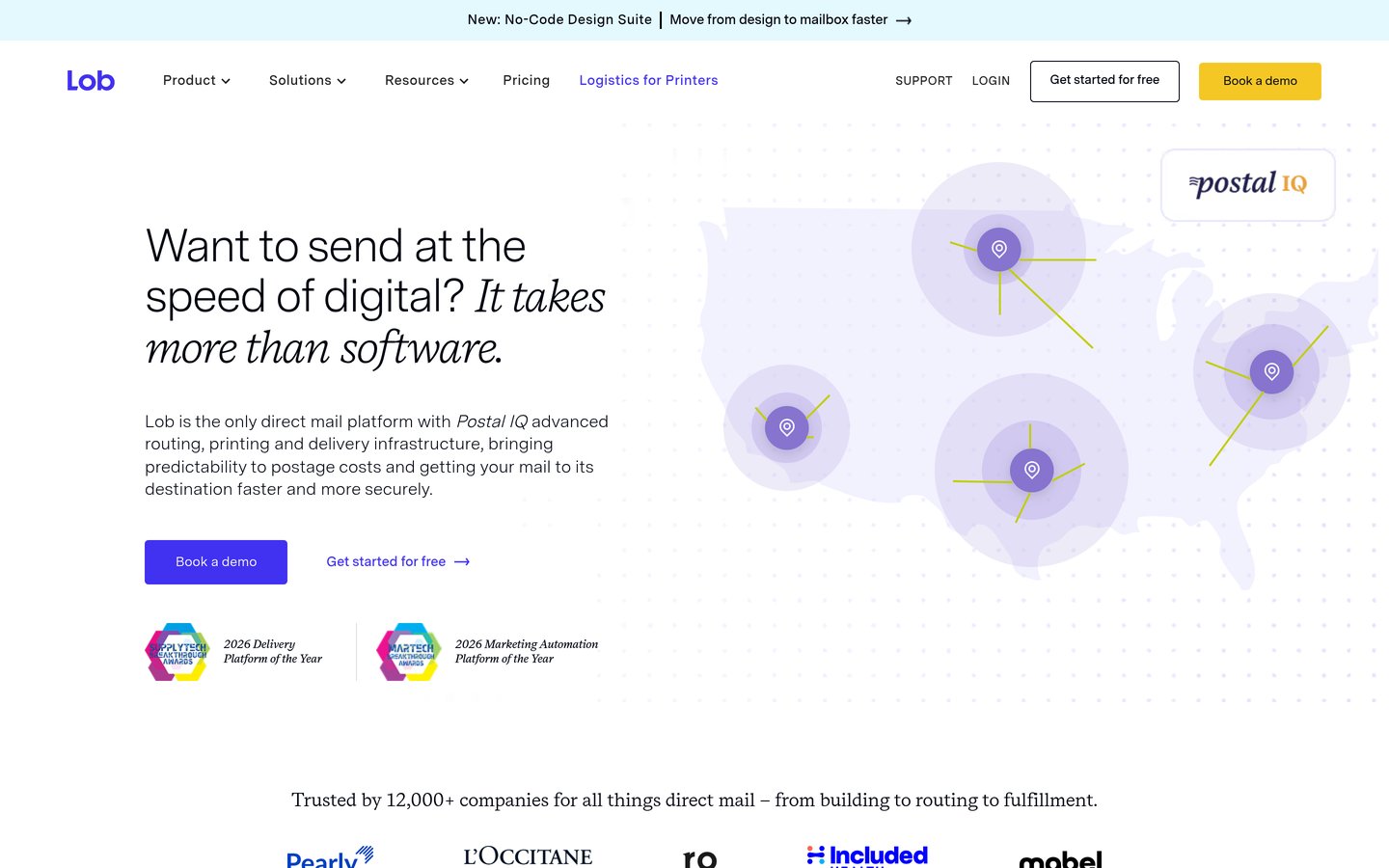
Lob is an API-first direct mail platform that lets engineering teams send postcards, letters, and checks from code, with test keys that simulate the full mail lifecycle for free. Its print delivery network routes each piece through an efficient USPS entry point and prints near the destination, which keeps delivery times predictable. The free Developer plan covers 500 mailings a month, and the $260 Startup plan drops the postcard rate from $0.905 to $0.55.
The trade off is that per-piece rates are highest on the free plan, and the $260 monthly platform fee only pays off once you mail at real volume. Address verification costs extra, and HIPAA mailings and custom envelopes need the Enterprise tier. Teams that mail occasionally, or that want a visual campaign builder, will find Postalytics or Thanks.io cheaper and simpler.
What we like
Well-documented APIs with test keys
Postal IQ routing picks efficient USPS entry points
Nationwide print delivery network
Supports HIPAA, GDPR, and CCPA workflows
Watch out for
Per-piece rates are highest on the free plan
Monthly platform fees start at $260
HIPAA mailings and custom envelopes require Enterprise
Free Developer plan covers 500 mailings a monthVisit lob.com
02
PostGrid
4.9/5on G2 (232 reviews, checked Nov 2026)
PriceFree
Best mail API with address verification
Mail typesLetters, postcards, checks, self-mailers
Address verification245+ countries
APIPrint and mail plus verification APIs
TrackingReal-time delivery tracking
postgrid.com
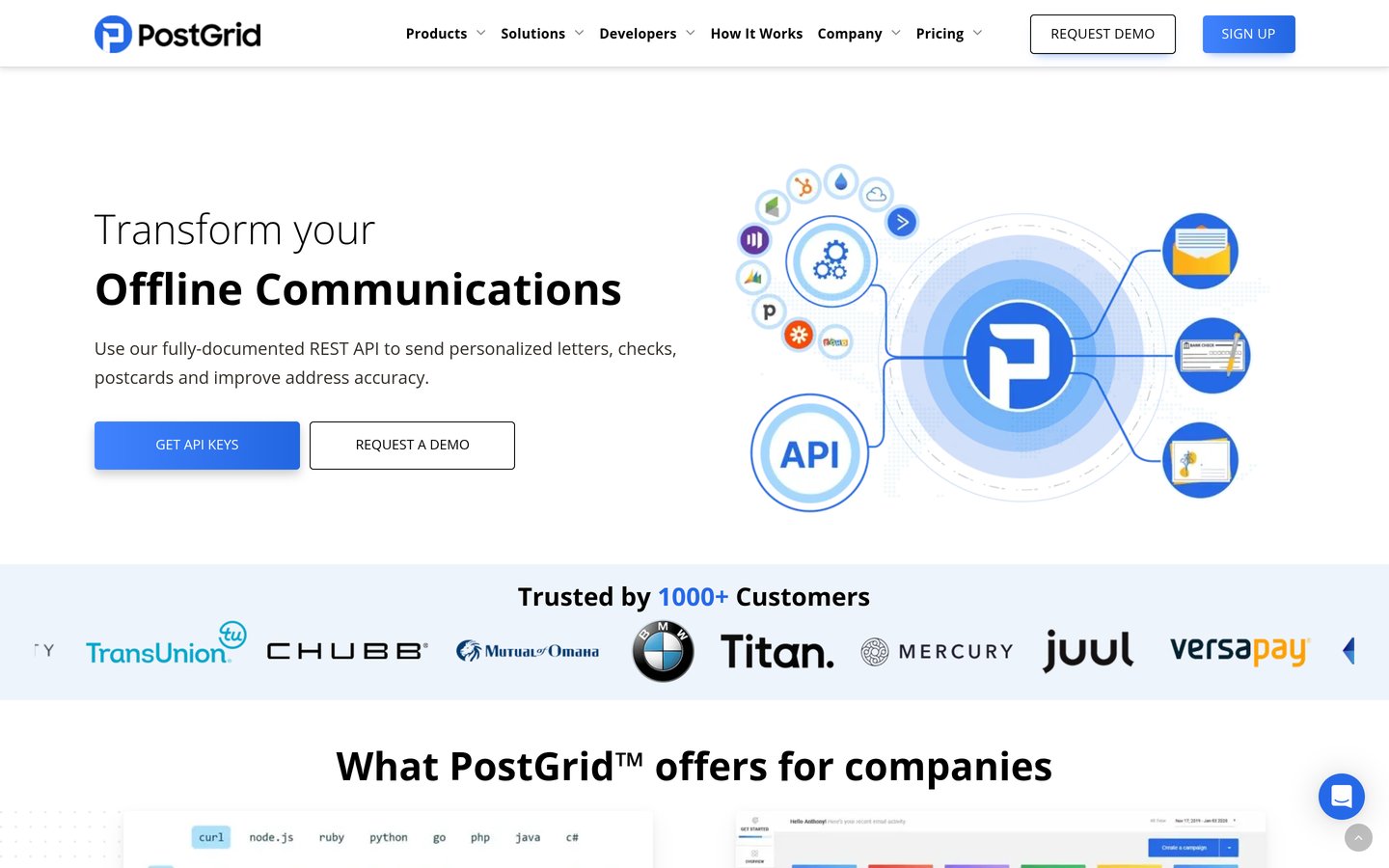
PostGrid homepage, captured Nov 2026.
PostGrid is a print-and-mail API that also verifies addresses, so teams solve two problems with one vendor instead of stitching together a mail provider and a verification service. It checks US, Canadian, and international addresses against postal standards, which cuts undeliverable pieces that cost full postage. The free Starter tier covers up to 500 mailings a month, with postcards from about $0.902 and letters from about $1.059 per piece.
The trade off is that per-piece rates sit above some competitors, and the paid Enterprise plan is quote-only, so larger teams cannot see a price without a sales conversation. Address verification plans are billed separately, from $18 a month for 2,000 US and Canada lookups, and SSO and express mailing also need the Enterprise tier.
What we like
Print and mail API plus address verification in one account
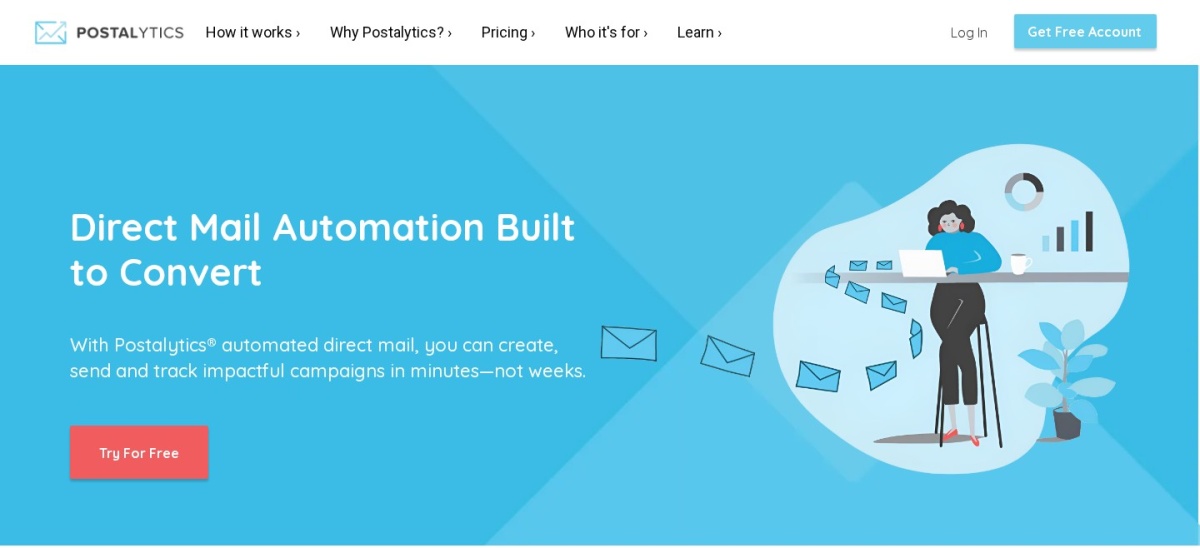
Postalytics is a marketer-first platform that makes direct mail behave like email automation, with a visual editor, CRM triggers, and QR codes or pURLs on every piece. You set triggers for birthdays, abandoned carts, or lifecycle stages, and the platform tracks each piece with Intelligent Mail barcodes. The free plan includes the API and triggered drips, while the $199 Marketer plan adds one user login and most integrations.
The trade off is that the free plan carries the highest per-piece cost, about $1.05 for a 6x9 postcard, so pilots are cheap but scale is not. Full Salesforce integration needs the $399 Pro or Agency plans, mailing lists are sold separately, and mail goes only to the US and Canada.
What we like
Built for marketers, not developers
HubSpot and Salesforce integrations
Unlimited IMB tracking plus personalized QR codes and pURLs
Free plan includes the API and triggered drips
Watch out for
Free plan has the highest per-piece cost (about $1.05 for a 6x9 postcard)
Full Salesforce integration needs the $399/mo Pro and Agency plans
Stannp is a self-serve direct mail platform with a free tier and monthly plans from $12, so small teams can automate postcards and letters without a sales call or volume commitment. It covers personalized postcards and letters with address verification, live tracking, and webhooks, plus integrations for common CRMs and ecommerce tools. The $12 Starter plan and the $48 Growth plan keep the platform fee far below the API-first vendors.
The trade off is that per-piece costs sit on top of the plan fee, so the monthly total depends on volume rather than a flat number. The free tier is limited, the $315 Premium tier is the only route to the deepest automation and tracking features, and enterprise-grade support needs a conversation with the team.
What we like
Free tier plus low monthly plans
Address verification, live tracking, and webhooks
No sales call to start
Strong G2 advocacy signals (4.8/5 from 44 reviews)
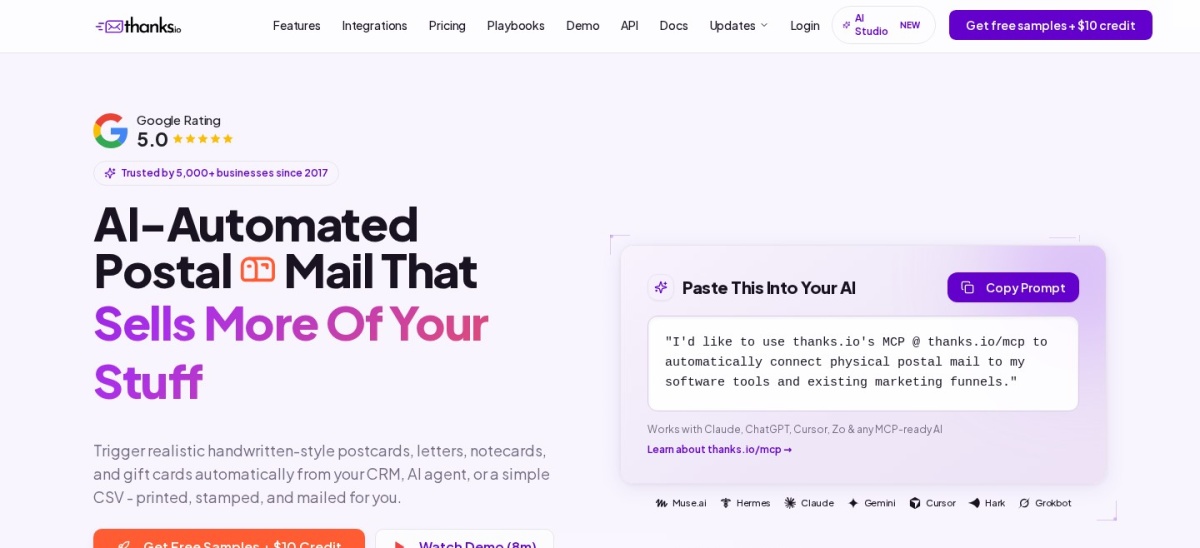
Thanks.io is a handwritten-style mail platform with no minimums and no monthly platform fee on its pay-as-you-go plan, so a team can send one piece or ten thousand. Its engine produces postcards, letters, and notecards that read as personally written, with QR tracking and automated drip campaigns for birthdays and milestones. Postcards start at $1.18 pay as you go, and the $49 Business plan cuts that to $0.77.
The trade off is that the handwritten style limits design flexibility, and gift card sends need Business plans or higher. The G2 review base is only four reviews, so the 4.8 rating is thin evidence, and there is no free tier, though the lack of a platform fee keeps small sends cheap.
What we like
No minimums, send one piece or ten thousand
All-in per-piece pricing with postage included
Handwritten-style postcards, letters, and notecards
QR tracking and automated drip campaigns
Watch out for
Handwritten style limits design flexibility
Gift card sends need Business plans or higher
No free tier, though there is no platform fee either
No minimums; postcards from $0.64 on ProfessionalVisit thanks.io
06
Sendoso
4.6/5on G2 (2,016 reviews, checked Nov 2026)
PricingCustom/yr
Best gifting plus mail for sales teams
Mail typesDirect mail, gifts, handwritten notes
CRMSalesforce, Marketo
FulfillmentIn-house with custom packaging
AddressingAddress confirmation included
sendoso.com
Sendoso homepage, captured Nov 2026.
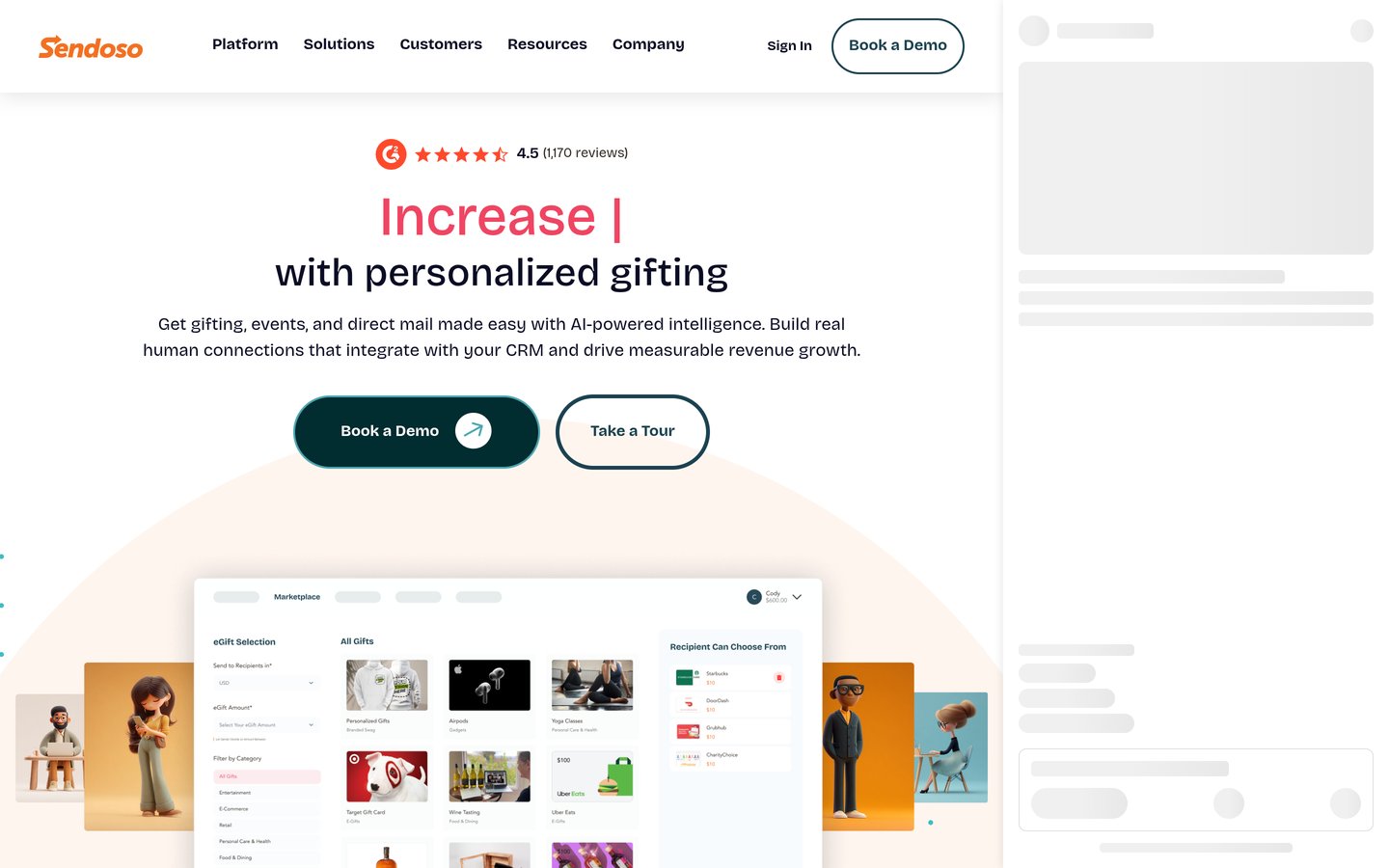
Sendoso is a sending platform that combines eGifts, branded merchandise, handwritten notes, and direct mail in one place, with address confirmation so packages do not go to stale addresses. Sales and marketing teams use it to send thoughtful packages to target accounts, and the Salesforce integration sends engagement data back into the CRM for pipeline reporting. Its G2 base of 2,016 reviews is the deepest in this list.
The trade off is that pricing is demo-gated, so you will not see a number without a sales conversation, and the platform is broader than pure direct mail, so you pay for gifting features you may not use. Per-send costs add up on large campaigns, and teams that only need postcards will find the API platforms cheaper and simpler.
What we like
Combines gifting, direct mail, and handwritten notes in one platform
Native Salesforce and Marketo integrations
Address confirmation improves deliverability
In-house fulfillment with custom packaging
Watch out for
No published pricing
Broader than pure direct mail, so you pay for features you may not use
Mail typesPostcards, letters, certified mail, EDDM
PricingNo platform fee; from $0.73/pc
VerificationFree CASS validation and NCOA updates
SupportMon-Fri, 9 AM-8 PM Eastern
click2mail.com
Click2Mail homepage, captured Nov 2026.
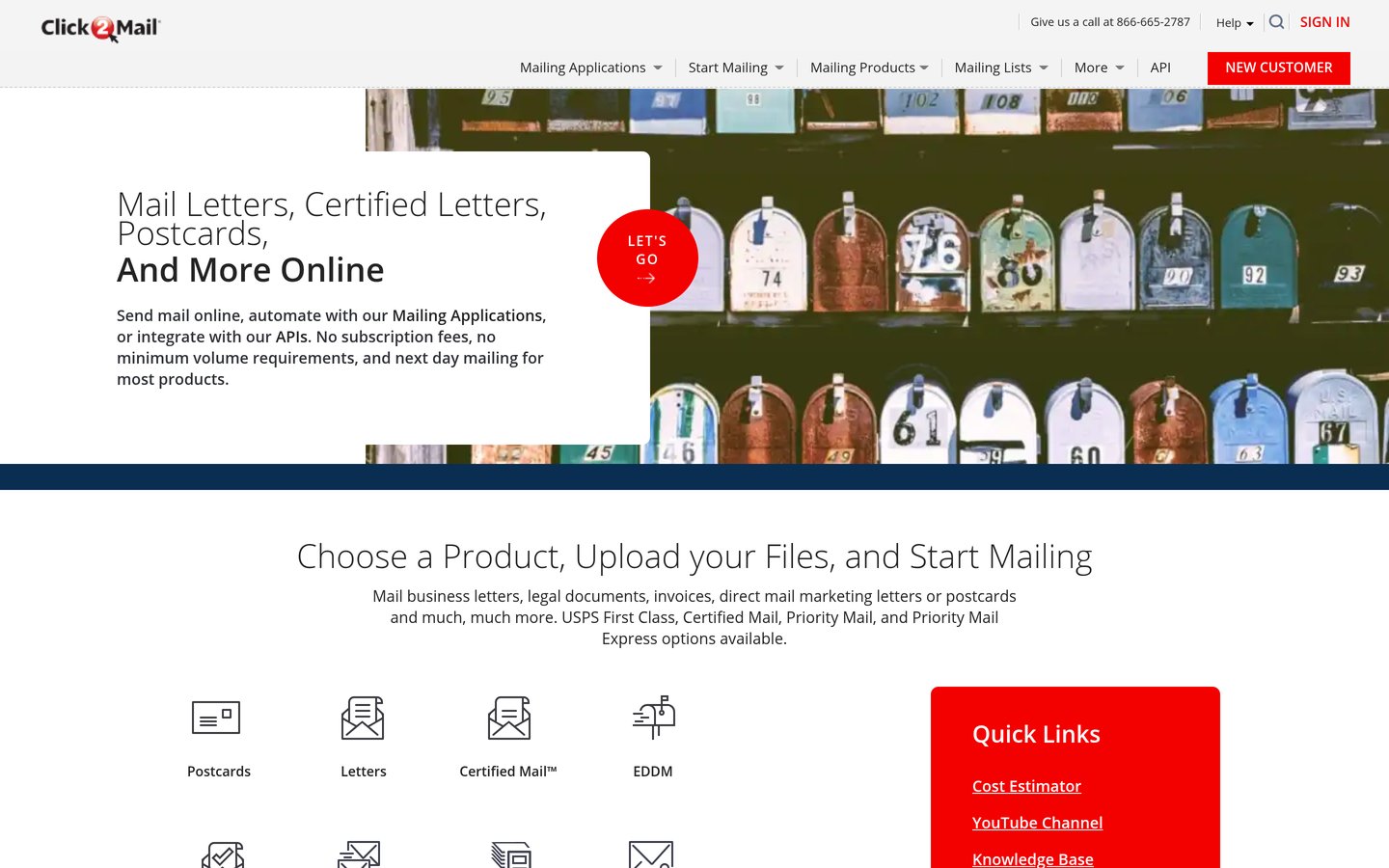
Click2Mail is a no-subscription mail service that charges only when mail goes out, which suits businesses mailing statements, invoices, legal notices, and marketing postcards without another monthly bill. The range is wide: postcards, letters, certified mail with proof of delivery, EDDM neighborhood saturation, flyers, booklets, and reply mail. A 6x11 postcard starts at $0.73 per piece, with volume discounts applied automatically.
The trade off is that campaign automation is thinner than the marketer-first tools, and the interface shows its age. The G2 base is only four reviews, so the 4.1 rating is thin evidence, and design services cost extra. It fits operational mail better than triggered marketing campaigns.
What we like
No subscription fees and no minimum volumes
Next-day mailing for most products
Certified mail, EDDM, and priority mail options
Free CASS-certified address validation and NCOA updates
Watch out for
Campaign automation is thinner than marketer-first tools
PebblePost is a programmatic direct mail platform that watches digital intent signals and mails postcards to people who browsed but did not buy, usually within a day or two of the visit. For brands spending heavily on retargeting ads, it extends the same logic to the mailbox, where attention is less divided. Deals are structured around performance, which can work well at serious volume.
The trade off is that PebblePost publishes no pricing, offers no free tier, and runs as a managed service rather than a self-serve dashboard, so everything starts with a custom deal. Smaller senders should expect to be steered toward more accessible platforms, and the G2 base is only five reviews.
What we like
Programmatic direct mail triggered by online browsing and purchase intent
Postie is a direct mail platform that pitches mail the way media buyers think about paid social, with audiences, lookalikes, triggers, and attribution in one place. Its machine-learning engine builds lookalike models from your best customers, and identity resolution lets you mail people who visited your site without logging in. Campaign dashboards track cost per acquisition and return on ad spend in real time.
The trade off is that Postie publishes no pricing and the feature set assumes enough volume for lookalike modeling and A/B testing to be meaningful, so it is overkill for simple batch postcard sends. The G2 base is only six reviews, and smaller senders will get faster answers from the self-serve platforms above.
What we like
Machine-learning lookalike audiences from your customer data
Identity resolution matches anonymous site visitors to home addresses
What to check before you pick a direct mail platform
Start with your mail type, because the category splits cleanly. If developers will trigger mail from your product or CRM, you want an API-first platform like Lob or PostGrid with test environments and webhooks. If marketers will run campaigns, you want a marketer-first platform like Postalytics, Postie, or Thanks.io with visual editors, templates, and CRM integrations.
If you mail statements, notices, or legal documents, reliability and compliance matter more than creative tools, and Click2Mail's range of mail classes fits well. If you mail in healthcare or finance, you need HIPAA-friendly workflows and audit trails, which Lob supports on its higher tiers, and you should confirm the vendor will sign a business associate agreement before you commit.
How we chose
We started with the full field of direct mail automation vendors and narrowed it to tools that are selling today. One legacy name, Inkit, has pivoted to document management and no longer offers direct mail, so it was replaced. Prices come from vendor pricing pages where they show figures; Lob and PostGrid prices come from guides citing those pages, as both tables are JavaScript-rendered. Where a vendor publishes no pricing we wrote Custom.
We compared the tools across the dimensions buyers ask about: per-piece costs with postage included, platform fees and minimums, API quality and documentation, CRM and ecommerce integrations, delivery tracking, address verification, compliance support, and how the sales process works, self-serve versus sales call. We also read public reviews on G2, Capterra, and Trustpilot to see where users report surprises around setup time, support responsiveness, and billing.
No vendor paid for a place, and we do not claim hands-on testing for this list. Ratings come from G2, Capterra, or Trustpilot, with the date we checked them, and every price in this list was checked on 23 November 2026.
How to choose direct mail automation software
Start with who will operate it, then count the real per-piece cost before you compare platform fees.
Decide who will operate it If developers will trigger mail from your product or CRM, pick an API-first platform like Lob or PostGrid. If marketers will run campaigns, pick a dashboard tool like Postalytics or Stannp.
Count the real per-piece cost Confirm the rate includes printing, processing, and postage, since some vendors quote print-only prices that look cheap until postage lands. Ask how the rate changes at your actual volume.
Check minimums and contracts Self-serve platforms let you sign up and send the same day with no minimums. Managed platforms usually need a sales call, an onboarding period, and a volume commitment.
Verify data, integrations, and tracking Check the platform integrates with the CRM or ecommerce tool you use, and confirm what tracking you get: Intelligent Mail barcode scans, delivery webhooks, and QR or pURL attribution.
FAQ
How much does direct mail cost per piece in 2026?
For standard postcards through automation platforms, expect roughly $0.64 to $1.05 per piece all in, including print and postage. Thanks.io lists postcards from $0.64, Lob's Startup plan starts around $0.55, and Postalytics' free plan runs about $1.05 for a 6x9 postcard. Managed platforms and dimensional mailers cost more.
Do I need my own mailing list?
It depends on the platform. Lob, PostGrid, and Click2Mail expect you to upload your own list. Postie and PebblePost can build audiences from your customer data or site visitors. Some vendors sell lists separately, and Click2Mail's EDDM service lets you saturate a neighborhood with no list at all.
How long does direct mail take to arrive?
Production plus USPS delivery usually runs 5 to 12 business days for standard mail. Lob cites two to three days to get a piece printed and into the mail stream, and platforms that print near the destination trim transit time. First-class options arrive faster but cost more per piece.
Can I track direct mail like a digital campaign?
Mostly, yes. Platforms offer Intelligent Mail barcode tracking, delivery webhooks, and personalized QR codes or pURLs that tie responses back to campaigns. Postie and Postalytics build dashboards around these metrics, and Thanks.io sends real-time notifications when recipients scan codes. You will not get open rates the way email does, but scan and response tracking comes close.
Is direct mail automation HIPAA compliant?
Some platforms support it. Lob offers HIPAA-compliant mailings with the security practices to back them, but only on its Enterprise plan. If you mail in healthcare, confirm the vendor will sign a business associate agreement and ask which plan level compliance features require before you commit.
Should I choose an API platform or a marketer platform?
Choose based on who will operate it. API platforms like Lob and PostGrid fit engineering teams embedding mail into products or workflows, with test environments and webhooks. Marketer platforms like Postalytics and Stannp fit marketing teams running campaigns, with visual editors and CRM integrations. Picking the wrong type means paying for power your team will not use.