Best Digital Experience Platforms in 2026: 7 Tools Compared
WLWPLegible EditorsLast verified 22 Nov 2026How we rank6 min read
★ Short answer
Webflow leads for visual site design and CMS workflows, starting at $15/mo billed yearly on its Basic Site plan with a free Starter option. Sanity suits developer-led composable content at $15/seat/mo on Growth, while Storyblok fits visual component editing from $90.75/mo billed yearly.
How we make this list: we compare pricing pages, product documentation and public user reviews, then re-check every price before each update. No product paid for a place. Disclosure.
#2 Best for devs
Sanity
Composable content platform with customizable Studio
Webflow Basic starts at $15/mo billed yearly ($25/mo monthly) with a free Starter tier.
Sanity Growth starts at $15 per seat/mo with a free plan supporting up to 20 seats and 2 public datasets.
Storyblok Growth costs $90.75/mo billed yearly ($99/mo monthly) and includes 5 seats and 400 GB traffic.
Umbraco Cloud Starter begins at $55/mo with managed hosting on Azure.
Directus Team costs $499/mo billed annually ($599/mo monthly) with self-hosting available on every tier.
What to look for in a digital experience platform
Choosing a digital experience platform comes down to whether your team prefers visual site assembly, API-driven headless delivery, or full self-hosted control. Visual platforms speed up marketing page edits, while headless systems let developers feed content into web apps, mobile clients, and custom frontends.
Watch how vendors meter usage and seats as your site grows. Some platforms charge per editor seat, while others add charges for API requests, bandwidth, locales, or extra environments.
Check whether hosting, staging environments, and content versioning are included in the entry tier. A low starting rate can rise quickly once you add editors, custom domains, or scheduled publishing.
Match the platform to your internal technical skills. Teams with frontend engineers can handle custom schemas and API queries, while smaller marketing teams often want visual previews and built-in hosting from day one.
For complex enterprise portals, intranets, and B2B commerce
Custom/yr
No free plan
4.5/5
Price ladder: cheapest paid plan per year
List prices, USD, checked Nov 2026
JahiaCustom
LiferayCustom
WebflowFREE$180
SanityFREE$180
UmbracoFREE$660
StoryblokFREE$1,089
DirectusFREE$5,988
The 7 best digital experience platforms
01
Webflow
4.4/5on G2 (997 reviews, checked Nov 2026)
Paid from$15/mo
Best for visual site design and marketer-friendly CMS updates
Free tierStarter (webflow.io)
Entry paid planBasic Site ($15/mo yearly)
Monthly rate$25/mo on Basic
CMS tierPremium Site ($25/mo yearly)
webflow.com
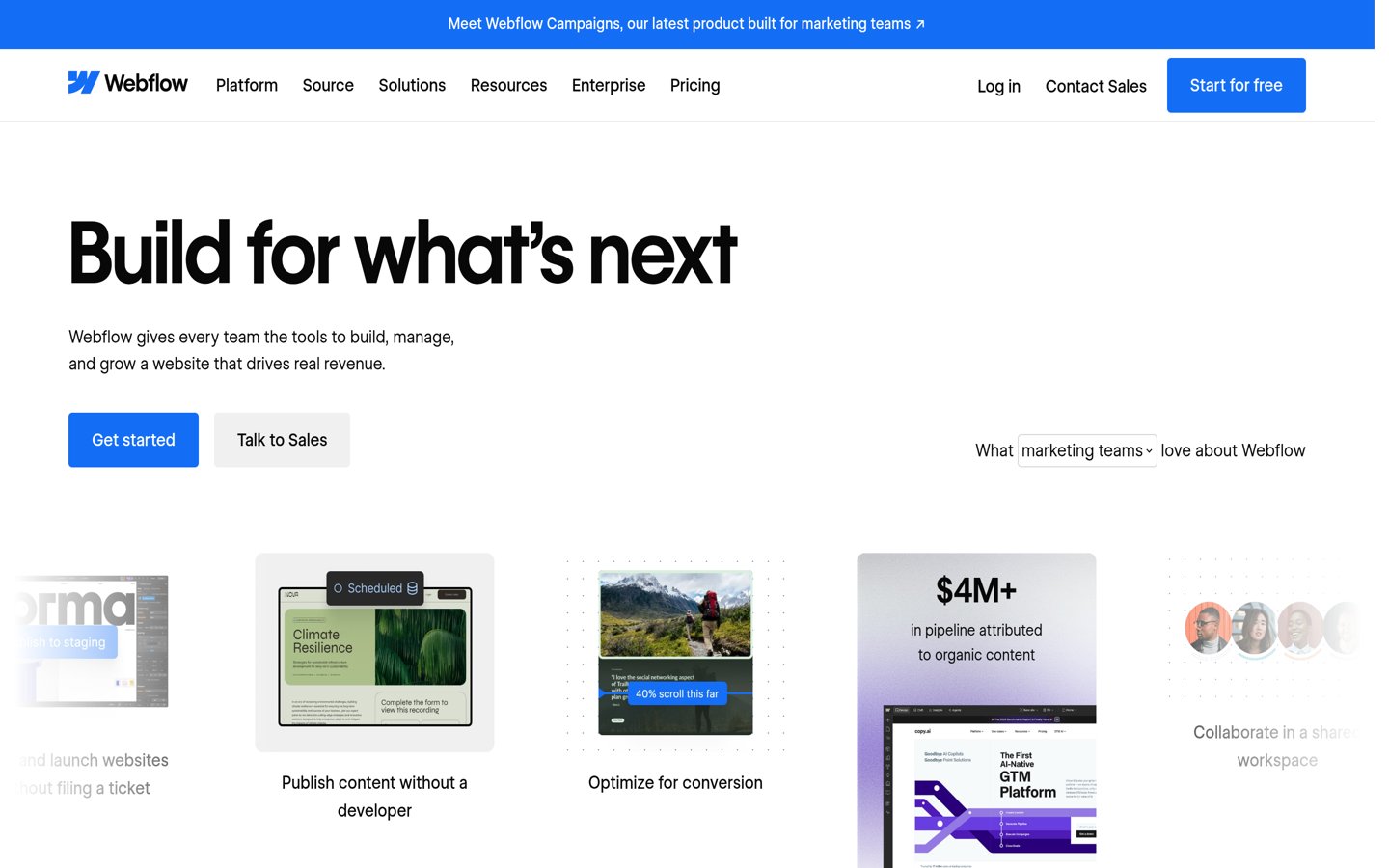
Webflow homepage, captured Nov 2026.
Webflow is a visual web design and content management platform with built-in hosting and reusable components. Its free Starter plan lets you test builds on a webflow.io domain with 2 pages and 50 CMS items.
The trade off is that Basic at $15/mo billed yearly ($180/yr, or $25/mo monthly) omits the CMS, while extra seats and add-ons raise costs. It suits marketing and design teams that want visual control without managing servers.
What we like
Combines visual page building, reusable components, and managed hosting.
Free Starter plan available for initial site builds and testing.
Lets marketers update pages and content without developer deployments.
Watch out for
Basic plan lacks CMS collections needed for blogs or dynamic lists.
Extra seats, localization, and analytics add recurring costs.
Paid Site plans unlock custom domains, higher page limits, and CMS collections.Visit webflow.com
02
Sanity
4.7/5on G2 (968 reviews, checked Nov 2026)
Paid from$15/mo
Best for developer-led composable content and custom Studio workflows
Free tierUp to 20 seats, 2 public datasets
Entry paid planGrowth ($15 per seat/mo)
Growth seat capUp to 50 user seats
Growth documents25,000 included
sanity.io
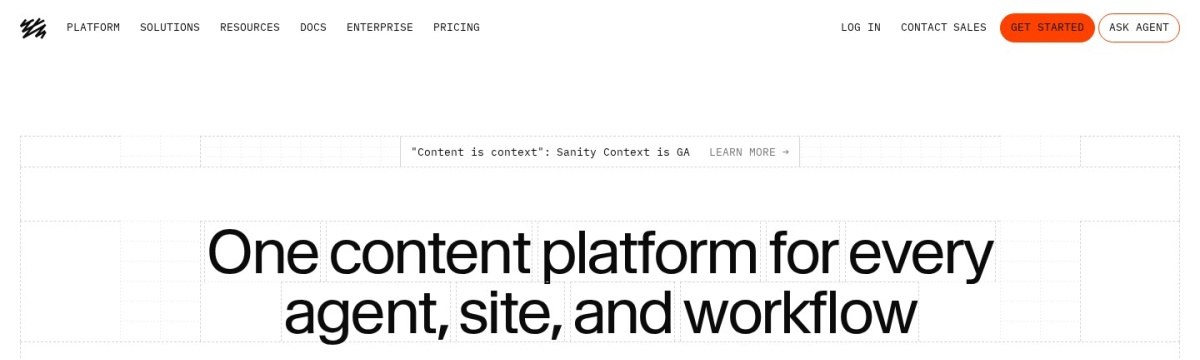
Sanity homepage, captured Nov 2026.
Sanity is a composable content platform built around a structured content lake and a customizable React-based Studio. Its free plan includes up to 20 seats, 2 public datasets, 10,000 documents, and 100 GB bandwidth.
The trade off is that Growth starts at $15 per seat/mo ($180/yr per seat) plus usage overages and a steeper developer learning curve. It suits engineering teams building custom frontends and tailored editorial tools.
What we like
Generous free tier with up to 20 seats and unlimited content types.
Supports GROQ and GraphQL queries plus visual editing in Studio.
Growth adds private datasets, up to 50 seats, and 90-day draft history.
Watch out for
Per-seat pricing and metered overages can climb as teams and traffic scale.
Initial schema and query setup requires developer familiarity.
Growth adds private datasets, 25,000 documents, up to 50 seats, and 90-day draft history.Visit sanity.io
03
Umbraco
4.5/5on G2 (1,130 reviews, checked Nov 2026)
Paid from$55/mo
Best for .NET teams wanting self-hosted or managed cloud flexibility
Free tierOpen-source Umbraco CMS
Entry paid planCloud Starter ($55/mo)
Starter storage5 GB included
Starter bandwidth50 GB included
umbraco.com
Umbraco homepage, captured Nov 2026.
Umbraco is an open-source CMS and digital experience platform with a free core edition and managed cloud plans. Its Cloud Starter plan starts at $55/mo ($660/yr) with Azure hosting and a Live environment.
The trade off is that Starter includes 5 GB storage and 50 GB bandwidth, while API SLAs require Standard at $330/mo. It suits organizations and agencies standardized on .NET workflows.
What we like
Free open-source CMS foundation with optional managed cloud hosting.
Editor-friendly back office paired with flexible developer customization.
Starter includes a Live environment that connects to local development.
Watch out for
Entry cloud storage and bandwidth allowances are modest at 5 GB and 50 GB.
Jumping from Starter ($55/mo) to Standard ($330/mo) is a large step up.
Best for component-based visual editing on headless frontends
Free tierStarter (1 space, 100 GB traffic)
Entry paid planGrowth ($90.75/mo yearly)
Monthly rate$99/mo on Growth
Growth seats5 included (up to 10)
storyblok.com
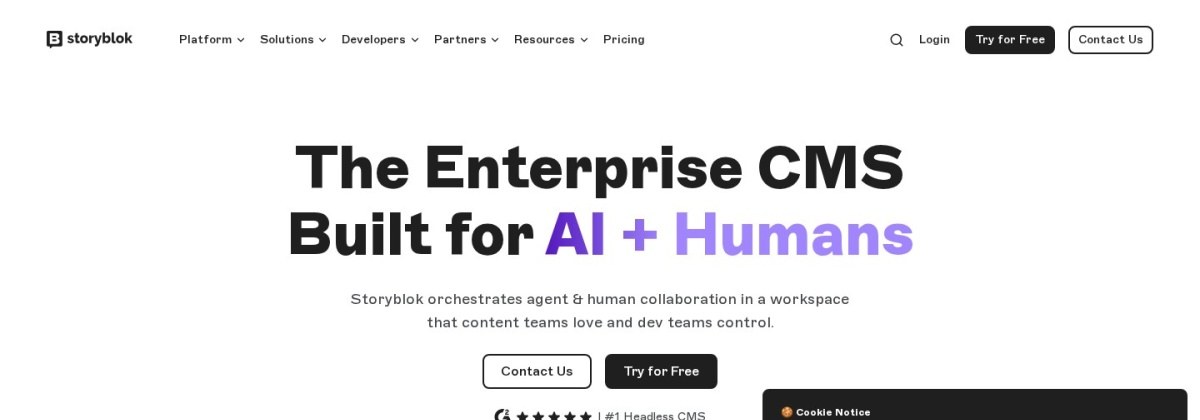
Storyblok homepage, captured Nov 2026.
Storyblok is a headless CMS known for its visual block editor that lets marketers preview and assemble pages. Its free Starter plan covers 1 space, 100 GB traffic, and 100,000 monthly API requests.
The trade off is that Growth costs $90.75/mo billed yearly ($1,089/yr, or $99/mo monthly) and you still host your own frontend. It suits teams pairing modern frontend frameworks with visual page authoring.
What we like
Visual Editor helps non-technical editors build pages from reusable blocks.
Free Starter plan lets small projects test APIs and content modeling.
Growth raises limits to 5 seats, 400 GB traffic, and 1M API requests.
Watch out for
Starter caps seats tightly and lacks scheduled publishing.
Extra seats, locales, traffic, and frontend hosting add to total cost.
Growth adds 5 seats, 400 GB included traffic, 1M API requests, and 30-day version history.Visit storyblok.com
05
Directus
4.8/5on G2 (50+ reviews, checked Nov 2026)
Paid from$499/mo
Best for SQL-backed data modeling and self-hosted control
Free tierSelf-hosted / Open Innovation Grant
Entry paid planTeam ($499/mo yearly)
Monthly rate$599/mo on Team
Team seats10 SSO seats included
directus.io
Directus homepage, captured Nov 2026.
Directus wraps SQL databases with instant REST and GraphQL APIs, workflows, and an admin studio. You can self-host for free, and qualifying small organizations can use the Open Innovation Grant.
The trade off is that the Team plan runs $499/mo billed annually ($5,988/yr, or $599/mo monthly) with extra seats at $50/seat/mo. It suits technical teams that want SQL database ownership and granular permissions.
What we like
Self-hosting is available across tiers so you keep control of your data.
Provides auto-generated APIs, role permissions, and workflow automation.
Team plan includes 10 SSO seats, 50 collections, and 20 flows.
Watch out for
Paid Team pricing is a steep jump from free self-hosting.
Additional seats cost $50/seat/mo on the Team tier.
Team unlocks 10 SSO seats, 50 collections, 20 flows, and SAML or OIDC sign-on.Visit directus.io
06
Jahia
4.4/5on G2 (603 reviews, checked Nov 2026)
PricingCustom/yr
Best for enterprise multi-site portals and hybrid headless delivery
Free tierNone (enterprise platform)
Pricing modelCustom quote
ArchitectureHybrid CMS with GraphQL API
Key strengthMulti-site & personalization
jahia.com
Jahia homepage, captured Nov 2026.
Jahia is a Java-based digital experience platform combining multi-site content management, portals, and personalization. It supports hybrid delivery with GraphQL APIs alongside visual editing and governance workflows.
The trade off is custom enterprise pricing without a self-serve entry tier or public rate card. It suits mid-market and enterprise teams managing multilingual sites and personalized journeys.
What we like
Supports hybrid headless and traditional page authoring across multiple sites.
Built-in personalization, audience segmentation, and governance controls.
Strong fit for complex multilingual and multi-brand organizations.
Watch out for
No public self-serve pricing, requiring sales scoping.
Can feel heavy for small sites or lean teams.
Enterprise licensing is tailored to deployment scope, sites, and support requirements.Visit jahia.com
07
Liferay
4.5/5on G2 (276 reviews, checked Nov 2026)
PricingCustom/yr
Best for complex enterprise portals, intranets, and B2B commerce
Free tierNone (commercial DXP)
Pricing modelCustom quote
DeploymentCloud, PaaS, or self-managed
Key strengthPortals, permissions & APIs
liferay.com
Liferay homepage, captured Nov 2026.
Liferay is a modular digital experience platform built for customer portals, intranets, websites, and B2B workflows. It offers headless APIs, granular roles and permissions, and flexible cloud or self-managed deployment.
The trade off is custom enterprise pricing and a steep learning curve for new developers. It suits large organizations with complex integrations, portals, and governance rules.
What we like
Strong role-based access controls, workflows, and portal capabilities.
Offers headless APIs alongside structured content and custom objects.
Flexible deployment across cloud, PaaS, and customer-managed infrastructure.
Watch out for
Requires custom quotes rather than transparent self-serve tiers.
Steep technical learning curve and heavy overhead for small projects.
Enterprise subscriptions cover deployment options, support SLAs, and platform modules.Visit liferay.com
Visual builders vs. headless DXPs
Visual-first platforms like Webflow and Storyblok focus on letting designers and marketers assemble layouts and preview pages quickly. That speeds up campaign launches when marketing teams do not want to wait on code deploys.
Headless and composable platforms such as Sanity and Directus separate content storage and APIs from the frontend presentation layer. That gives developers freedom over frameworks and channels, though it requires more engineering setup.
How we chose
We selected established digital experience platforms by reviewing category listings, vendor documentation, and user feedback across G2 and official pricing pages.
All ratings, review counts, and plan prices were checked on 22 Nov 2026 using regular non-sale rates where public pricing is listed.
We excluded unmaintained tools, products without public pricing confirmation where required, and single-purpose widgets that do not cover broader digital experience workflows. No vendor paid for a place, and we do not claim testing for this list.
How to choose a digital experience platform
Follow four practical steps to narrow down the right platform for your team.
Map your team's technical workflow first. Decide whether editors need a visual page canvas or developers need APIs, custom schemas, and framework freedom.
Model your real seat and usage limits. Check how plans charge for extra editors, API calls, bandwidth, locales, or environments beyond the entry tier.
Verify hosting and environment needs. Confirm whether managed cloud hosting, staging environments, and version history are included or billed separately.
Test a pilot before committing long term. Use free tiers, trials, or sandbox projects to check content modeling speed and day-to-day editor ergonomics.
FAQ
What is a digital experience platform?
A digital experience platform manages, personalizes, and delivers content across websites, apps, and digital touchpoints. Depending on the vendor, it combines content modeling, visual editing, APIs, workflows, and hosting.
Do any digital experience platforms have a free plan?
Yes. Webflow, Sanity, Storyblok, Umbraco, and Directus offer free tiers or open-source and self-hosted options, though limits on seats, bandwidth, APIs, or hosting apply.
When should we choose a headless DXP over a visual builder?
Choose a headless platform when you need to push structured content into multiple apps or custom frontends via APIs. Choose a visual builder when marketers want faster page layout control without engineering work.
Why do some DXPs use custom pricing instead of public plans?
Enterprise platforms like Jahia and Liferay tailor contracts around deployment model, traffic scale, security needs, and support SLAs. That makes upfront budget estimation harder for smaller teams.
What hidden costs should buyers watch for on DXP plans?
Watch for extra editor seats, API or bandwidth overages, additional locales, staging environments, and separate frontend hosting costs. Small add-ons can quickly exceed the base subscription price.
Is self-hosting better than managed cloud for a DXP?
Self-hosting gives you direct control over infrastructure and data storage, while managed cloud reduces maintenance and upgrade work. Pick based on whether your team wants infrastructure control or hands-off operations.