Best Customizable Ecommerce Platform in 2026: 7 Tools Compared
WLWPLegible EditorsLast verified 22 Nov 2026How we rank6 min read
★ Short answer
WooCommerce is the top pick for deep store customization, with 7+ million active WordPress installations and zero platform fees. Shopify fits fast-scaling hosted stores with extensive themes and apps, while BigCommerce suits stores needing built-in APIs and multi-storefront tools.
How we make this list: we compare pricing pages, product documentation and public user reviews, then re-check every price before each update. No product paid for a place. Disclosure.
#2 Best hosted
Shopify
Hosted commerce platform with broad apps and themes
WooCommerce has 7+ million active WordPress installations and a 4.5 out of 5 rating from 4,834 reviews on WordPress.org.
Shopify starts at $39/mo billed monthly ($29/mo billed yearly) on Basic and holds 4.4/5 across 5,171 G2 reviews.
BigCommerce Core starts at $39/mo monthly ($29/mo annual) with zero platform fees on embedded payment providers.
SureCart holds 4.8 out of 5 on WordPress.org across 70,000+ active installations and offers a $199/yr Pro plan.
Ecwid Venture starts at $35/mo monthly ($29/mo billed annually) and rates 4.7/5 across 404 G2 reviews.
What to look for in a customizable ecommerce platform
Store customization spans two distinct layers: visual storefront design and backend checkout, catalog, or billing logic. Open-source WordPress tools let developers edit code and swap extensions freely, while hosted SaaS builders trade raw code access for managed infrastructure.
Check how a platform handles payment processing fees, staff seats, and product variants before committing. Some hosted plans add extra percentage charges if you skip their native payment gateway, whereas self-hosted stacks shift server and maintenance duties onto your team.
Catalog complexity also separates platforms early. Stores with large SKU counts, custom pricing rules, or digital subscriptions need native support or vetted extensions rather than rigid templates.
The 7 best customizable ecommerce platform options
01
WooCommerce
4.5/5on WordPress.org (4,834 reviews, checked Nov 2026)
PriceFree
Best for full open-source store customization
HostingSelf-hosted WordPress
Revenue share0% platform fee
VariantsUnlimited
ExtensionsPaid à la carte
woocommerce.com
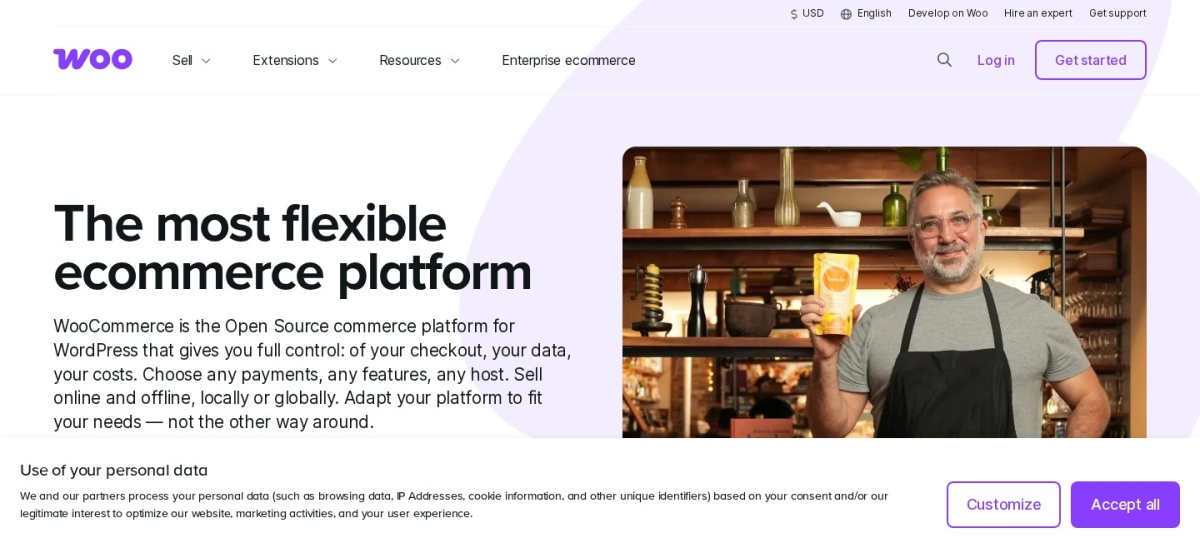
WooCommerce homepage, captured Nov 2026.
WooCommerce is a free open-source ecommerce plugin for WordPress with 7+ million active installations and unlimited products, orders, and APIs. You keep full ownership of store data and can customize themes, checkout fields, and store logic.
The trade off is paying separately for hosting, domain, and optional extensions, which typically run $29 to $299/year per add-on. It suits developers and store owners who want complete code control.
What we like
No platform revenue share or plan feature paywalls on core commerce
Full codebase and database ownership on self-hosted WordPress
Supports unlimited product variants and custom checkout workflows
Watch out for
Requires separate web hosting, security, and update management
Paid extensions can increase total annual store costs
Core plugin is free; optional official extensions and hosting cost extra.Visit woocommerce.com
02
Shopify
4.4/5on G2 (5,171 reviews, checked Nov 2026)
Starts at$39/mo
Best for hosted storefronts with app customization
HostingManaged SaaS
Basic monthly$39/mo ($29/mo annual)
Basic card rate2.9% + 30¢ online
Third-party fee2% on Basic
shopify.com
Shopify homepage, captured Nov 2026.
Shopify is a hosted ecommerce platform rated 4.4 out of 5 across 5,171 G2 reviews, offering themes, Liquid templates, APIs, and a large app ecosystem. The regular Basic plan is $39/month billed monthly, or $29/month billed annually.
The trade off is extra monthly app bills, no staff accounts on Basic, and a 2% fee on third-party gateways. It suits merchants wanting managed hosting with customizable storefronts.
What we like
Managed hosting, security, and storefront performance out of the box
Extensive theme library, Liquid customization, and app marketplace
Scales from solo stores to high-volume multi-market operations
Watch out for
Basic plan lacks staff accounts and charges 2% on non-Shopify gateways
Recurring app subscriptions can raise monthly operating costs
Paid plans start at $39/mo monthly ($29/mo yearly) with added apps and processing fees.Visit shopify.com
03
BigCommerce
4.2/5on G2 (598 reviews, checked Nov 2026)
Starts at$39/mo
Best for API-driven and multi-storefront setups
HostingManaged SaaS
Core monthly$39/mo ($29/mo annual)
Catalog supportUp to 600 SKUs/product
Platform fee$0 on embedded gateways
bigcommerce.com
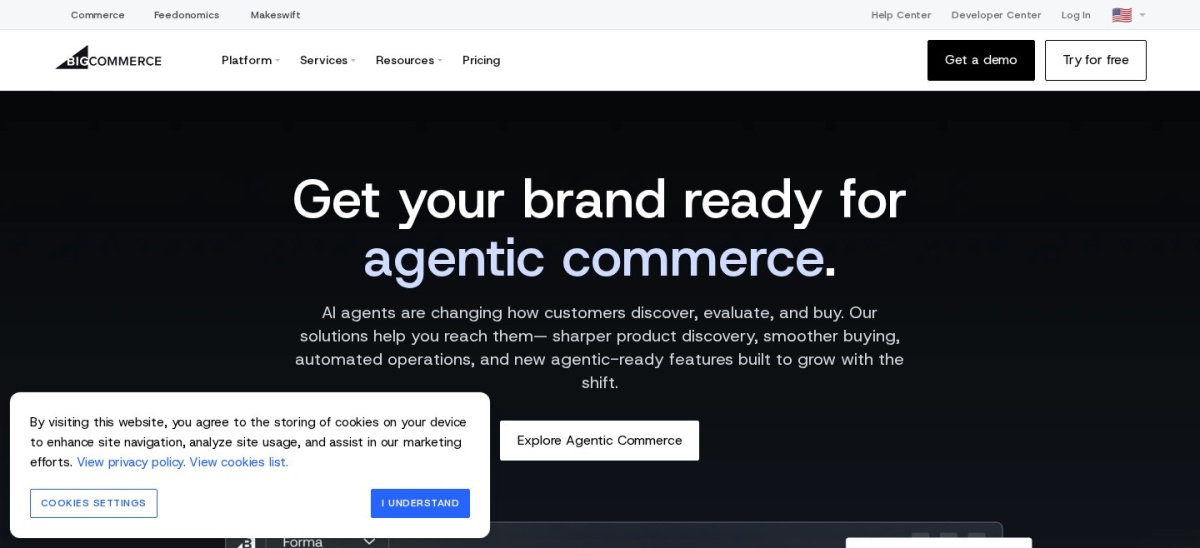
BigCommerce homepage, captured Nov 2026.
BigCommerce is a hosted ecommerce platform holding 4.2 out of 5 across 598 G2 reviews with GraphQL Storefront, checkout, and payment APIs. Its regular Core plan costs $39/month billed monthly, or $29/month billed annually.
The trade off is sales volume thresholds that push stores into higher tiers and a learning curve for custom frontends. It suits growing brands needing open APIs and multi-storefront options.
What we like
Built-in APIs support headless and composable storefront architectures
Zero platform transaction fees when using embedded payment providers
Handles complex product catalogs and multi-storefront expansion
Watch out for
Plan tiers tie to trailing twelve-month sales volume thresholds
Customizing beyond standard themes takes technical development work
Core starts at $39/mo monthly ($29/mo yearly) for up to $30K annual sales.Visit bigcommerce.com
04
SureCart
4.8/5on WordPress.org (289 reviews, checked Nov 2026)
Paid from$199/yr
Best for modern WordPress checkouts and subscriptions
PlatformWordPress plugin
Free Launch fee2.9% transaction fee
Pro annual$199/yr (0% platform fee)
Lifetime option$699 one-time
surecart.com
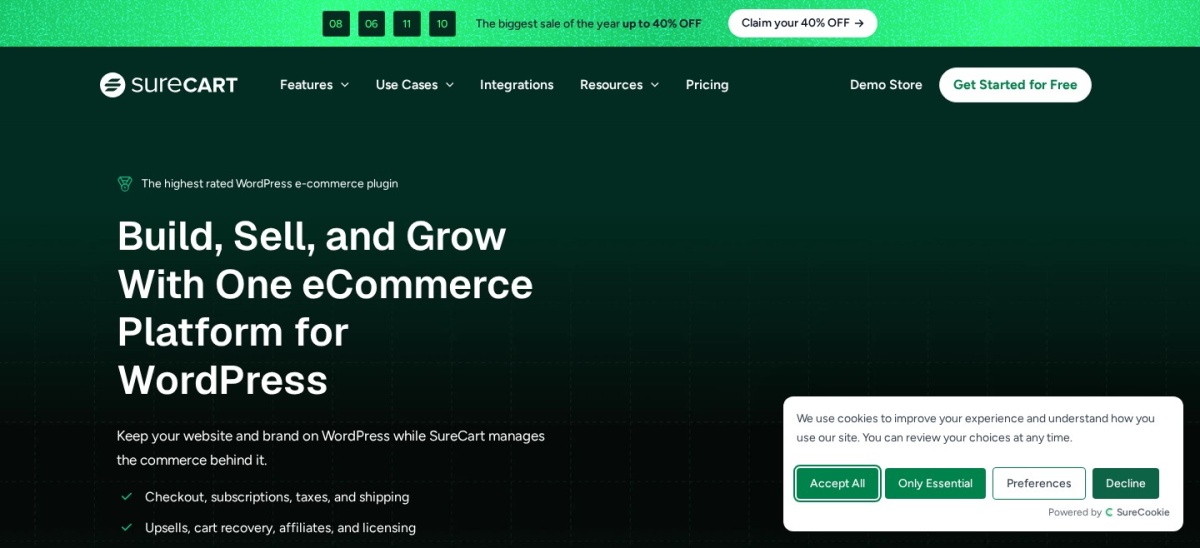
SureCart homepage, captured Nov 2026.
SureCart is a WordPress ecommerce plugin with 70,000+ active installations and a 4.8 out of 5 rating on WordPress.org. Its free Launch tier includes subscriptions, order bumps, and upsells with a 2.9% platform fee.
The trade off is paying a 2.9% fee on the free plan or $199/year for Pro to remove that fee. It suits WordPress sites wanting modern checkout flows without heavy plugin stacks.
What we like
Includes subscriptions, order bumps, and upsells without separate plugins
High 4.8 out of 5 rating across 70,000+ WordPress installations
Pro plan at $199/year removes the 2.9% platform transaction fee
Watch out for
Free Launch plan charges a 2.9% platform fee per transaction
Requires an existing or self-managed WordPress site
Pro costs $199/yr and removes the 2.9% platform fee found on the free plan.Visit surecart.com
05
Ecwid
4.7/5on G2 (404 reviews, checked Nov 2026)
Paid from$35/mo
Best for embedding a store into existing websites
HostingHosted widget & site
Venture monthly$35/mo ($29/mo annual)
Venture catalogUp to 100 products
APIsJavaScript & REST API
ecwid.com
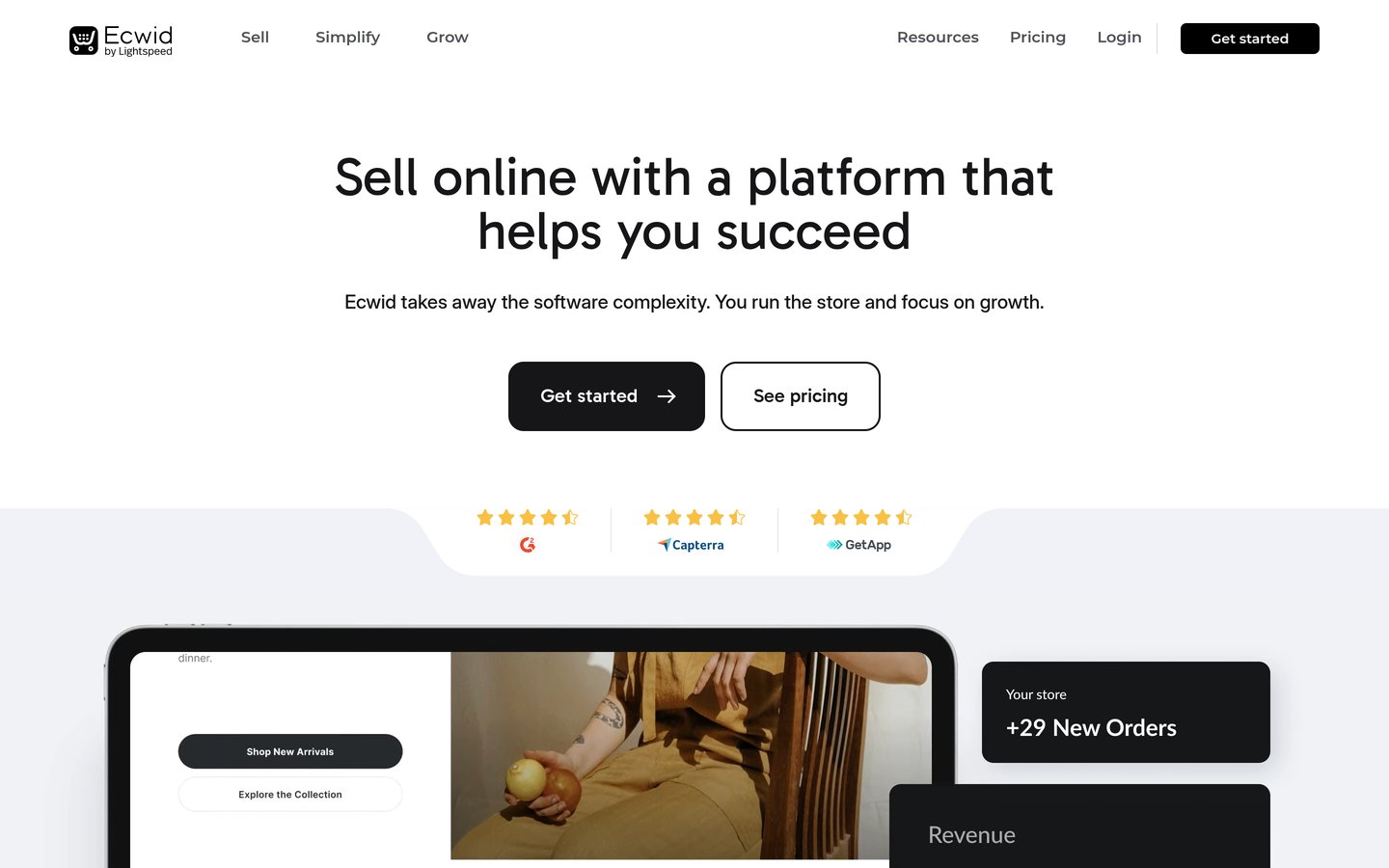
Ecwid homepage, captured Nov 2026.
Ecwid is an embeddable ecommerce platform rated 4.7 out of 5 across 404 G2 reviews that adds a store to existing sites or Instant Sites. Its Venture plan costs $35/month billed monthly, or $29/month billed annually, with up to 100 products.
The trade off is product caps on lower tiers—10 on Starter and 100 on Venture—before upgrading. It suits site owners embedding a customizable cart into an existing site.
What we like
Embeds into WordPress, Wix, Squarespace, or custom websites
Offers JavaScript and REST API access for custom storefront tweaks
Zero platform transaction fees charged by Ecwid across plans
Watch out for
Product limits cap Starter at 10 items and Venture at 100 items
Venture costs $35/mo monthly ($29/mo yearly) and raises the limit to 100 products.Visit ecwid.com
06
PrestaShop
4.3/5on G2 (160 reviews, checked Nov 2026)
Paid from$29/mo
Best for self-hosted modular store builds
DeploymentSelf-hosted or Hosted
Hosted monthly€29/mo (€24/mo annual)
Currencies20 currencies on Hosted
ExtensibilityMarketplace modules
prestashop.com
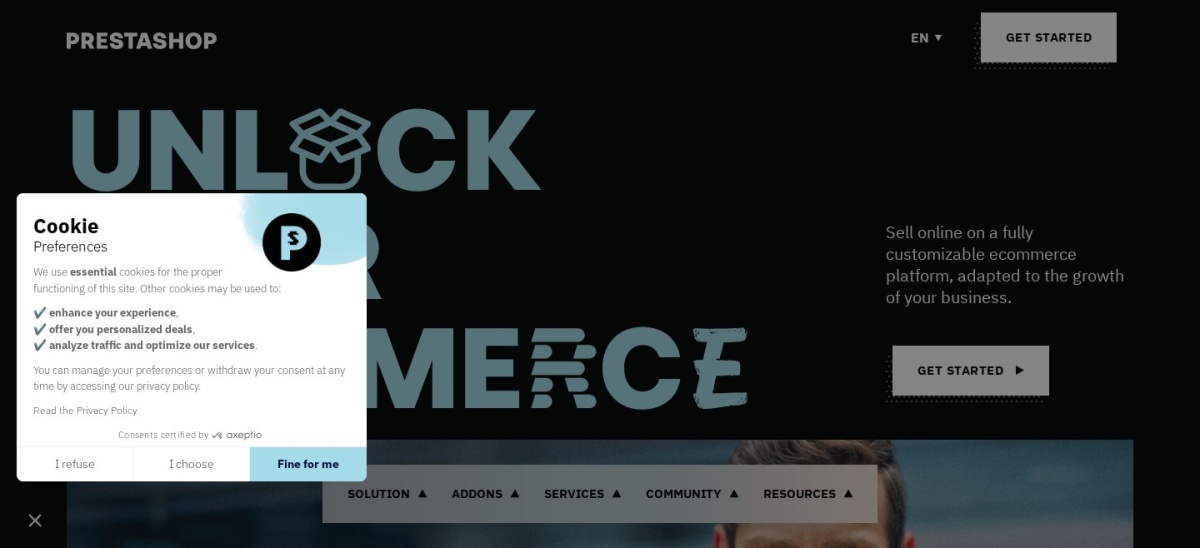
PrestaShop homepage, captured Nov 2026.
PrestaShop is a modular ecommerce platform rated 4.3 out of 5 across 160 G2 reviews, with a free self-hosted download and a hosted plan. The Hosted offer starts at €29/month without commitment or €24/month paid annually.
The trade off is technical setup for self-hosting and mixed feedback on documentation depth. It suits technical teams and agencies building modular multi-currency stores.
What we like
Free open-source Classic download gives full code control
Hosted plan bundles 50 GB hosting, automatic VAT, and 20 currencies
Large add-on marketplace covers marketing, shipping, and checkout modules
Watch out for
Self-hosted installation and customization require technical skill
Some G2 reviewers point to uneven technical documentation
Hosted starts at €29/mo monthly (€24/mo yearly) with hosting and setup included.Visit prestashop.com
07
Wix
4.2/5on G2 (1,943 reviews, checked Nov 2026)
Paid from$36/mo
Best for visual drag-and-drop store design
HostingManaged SaaS
Core monthly$36/mo ($29/mo annual)
Core storage50 GB storage
Design editorVisual drag-and-drop
wix.com
Wix homepage, captured Nov 2026.
Wix is a hosted site builder rated 4.2 out of 5 across 1,943 G2 reviews with a visual editor and integrated ecommerce tools. Accepting payments starts on Core at $36/month billed monthly, or $29/month billed yearly.
The trade off is platform lock-in and the inability to switch a site template after creation. It suits small businesses wanting visual design control without managing servers.
What we like
Visual drag-and-drop editor makes layout changes fast without code
Combines website pages, bookings, and store management in one dashboard
Core plan includes 50 GB storage, 5 collaborators, and a first-year domain voucher
Watch out for
Lower Light plan does not support online payments or ecommerce
Site templates cannot be swapped once a site is built
Core starts at $36/mo monthly ($29/mo yearly) to enable online payments and store features.Visit wix.com
Open-source vs. hosted platforms
Self-hosted and open-source platforms like WooCommerce and PrestaShop give you direct access to store code, databases, and server configuration. That freedom avoids platform revenue caps, but requires you to pick hosting, apply updates, and monitor site performance.
Hosted platforms like Shopify, BigCommerce, Ecwid, and Wix bundle servers, security patches, and uptime into a subscription. They launch faster and reduce maintenance overhead, though deep logic changes depend on supported APIs, apps, or higher plan tiers.
How we chose
We selected established ecommerce platforms and WordPress commerce tools that offer visual storefront design, APIs, extensions, or open-source code access. Every entry met baseline adoption thresholds and matched a distinct store workflow.
All prices, ratings, review counts, and active install figures were checked on 22 Nov 2026 from vendor pricing pages, WordPress.org, and G2. We recorded regular monthly pricing where available alongside annual rates, noting promotional offers without using discounted rates as regular prices.
We excluded platforms without verifiable public pricing or active recent maintenance, as well as tools built strictly for closed templates with minimal customization. No vendor paid for a place, and we do not claim testing for this list.
How to choose a customizable ecommerce platform
Follow four practical steps to match a platform's customization model to your team and budget.
Decide who owns code and hosting. Pick a self-hosted open-source tool like WooCommerce if you want full code access, or a hosted platform like Shopify or BigCommerce if you prefer managed infrastructure.
Map out payment and transaction fees. Compare processor rates, third-party gateway surcharges, and platform transaction fees against your expected monthly order volume.
Check product, variant, and staff limits. Verify SKU caps, variant rules, and included staff accounts on entry plans so your catalog and team do not force an early upgrade.
Audit required integrations and APIs. Confirm whether your ERP, accounting, fulfillment, or marketing tools connect natively, via plugins, or through documented APIs before building your store.
FAQ
Which customizable ecommerce platform has no platform transaction fees?
WooCommerce charges no platform fee or revenue share on its core plugin, though payment gateways charge their own processing rates. BigCommerce also charges zero platform fees when you use its embedded payment providers.
Is WooCommerce better than Shopify for customization?
WooCommerce gives deeper access to WordPress code, databases, and custom plugins on self-hosted servers. Shopify offers faster hosted setup, themes, and apps, though deep backend logic is more constrained outside supported APIs and higher tiers.
Do hosted platforms charge extra fees for external payment gateways?
Yes, some hosted plans add a surcharge when you bypass their built-in gateway. For example, Shopify Basic charges a 2% third-party payment gateway fee on top of processor charges.
Can I add ecommerce to an existing website instead of rebuilding?
Yes, Ecwid lets you embed a shopping cart and storefront into existing WordPress, Wix, or Squarespace sites. SureCart and WooCommerce also run directly inside existing WordPress websites.
What should I watch for with free ecommerce plans?
Free tiers often limit product counts, require a subdomain, or add a per-transaction platform fee. Always check both ongoing add-on costs and payment processing rates before launching.
How important are APIs for custom storefronts?
APIs matter when you need custom frontends, headless commerce, or tight syncs with external inventory and fulfillment systems. Platforms like BigCommerce, WooCommerce, and Ecwid expose APIs for custom integrations.