Best Composable Commerce Platform in 2026: 7 Tools Compared
WLWPLegible EditorsLast verified 22 Nov 2026How we rank14 min read
★ Short answer
Elastic Path is our top composable commerce platform for complex businesses, with an API-first architecture and published entry pricing of $49,500 annually. BigCommerce offers a more accessible hosted commerce foundation with headless capabilities, while Medusa gives development teams an open-source commerce framework and cloud hosting from $29 monthly.
How we make this list: we compare pricing pages, product documentation and public user reviews, then re-check every price before each update. No product paid for a place. Disclosure.
Elastic Path starts at $49,500 annually for an entry package supporting up to 15,000 orders or $5 million in annual GMV, with commerce and experience modules included.
BigCommerce starts at a regular $39 per month for Core, with headless APIs and a Catalyst storefront framework available for custom experiences.
Medusa offers an open-source commerce framework and cloud hosting from $29 per month, although production-focused Launch hosting starts at $99 monthly.
Swell's Starter plan costs $29 monthly when billed annually, includes 2 administrators and has a $50,000 annual sales ceiling before overage charges.
Shopify Basic starts at $29 monthly with annual billing, and Hydrogen provides a developer framework for custom storefronts.
Saleor Cloud starts at $1,599 monthly for Select, while Crystallize Atom costs $949 monthly plus metered usage.
What makes a commerce platform composable?
Composable commerce means building an ecommerce system from interchangeable services rather than relying on one tightly connected application. Businesses can select separate products for checkout, product information, content, search and customer experiences.
The central requirement is an API-first architecture. Commerce functions should be accessible to custom storefronts, mobile apps and connected systems without depending on a vendor-controlled frontend.
Not every headless platform is equally composable. Some provide a complete hosted commerce backend with a detachable storefront. Others expose modular services that developers can assemble and replace independently.
Consider ownership and operational complexity before choosing. More architectural freedom can mean additional integration work, monitoring responsibilities, hosting expenses and developer maintenance.
Compare published subscription prices alongside the total cost of implementation. Custom storefront development, content management, payment integrations and ongoing technical support can outweigh the platform's advertised starting fee.
Elastic Path is an enterprise composable commerce platform for businesses with complex catalogs, buying journeys and backend integrations. Its Entry package starts at $49,500 annually and supports up to 15,000 annual orders or $5 million in GMV, depending on the pricing model. Included capabilities cover search, a visual builder, CMS, frontend hosting, product experience management and promotions.
The trade off is the $49,500 annual starting commitment and the engineering work required to integrate specialized business systems. It suits manufacturers, distributors and enterprise retailers that need adaptable product catalogs, complex purchasing workflows and independently managed commerce services.
What we like
Designed around modular, API-first commerce
Published enterprise entry pricing
Includes frontend hosting and visual-building tools
Supports complex B2B and B2C business models
Pricing can follow order volume or GMV
Watch out for
Substantial annual entry cost
Requires technical planning and integration expertise
Higher-volume plans require a sales quote
Professional and Enterprise expand capacity with negotiated volume-based pricingVisit elasticpath.com
02
BigCommerce
4.2/5on G2 (598 reviews, checked Nov 2026)
Starts at$39/mo
Best for hosted composable commerce
Entry planCore
Regular entry price$39/mo annually advertised
Core GMV threshold$30K trailing annual GMV
Headless frameworkCatalyst
bigcommerce.com
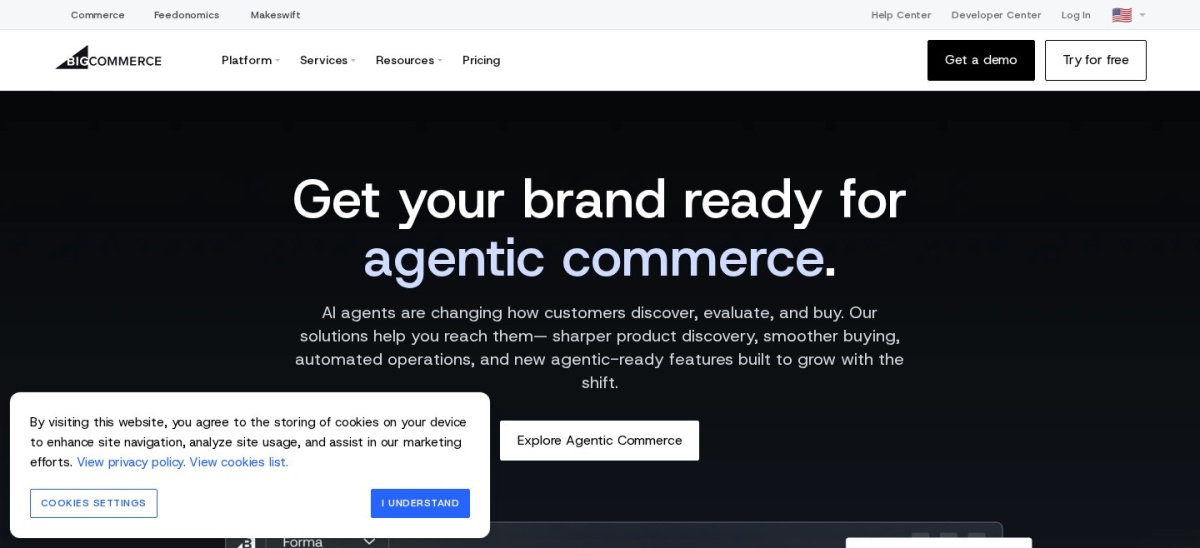
BigCommerce homepage, captured Nov 2026.
BigCommerce is a hosted ecommerce platform that supports traditional, headless and composable storefront architectures. Its Core plan has a published regular price of $39 monthly on the annual pricing display, with a $30,000 trailing annual GMV threshold. Developers can use its APIs and Catalyst framework to build custom shopping experiences while retaining a managed commerce backend.
The trade off is that published entry tiers have revenue thresholds, and larger operations may need higher plans or additional services. At the displayed regular $39 monthly rate, it suits businesses that want customizable storefronts and established commerce operations without managing an entirely self-hosted backend.
What we like
Hosted commerce infrastructure
Headless APIs and Catalyst storefront framework
Supports conventional and custom storefronts
Published entry-tier pricing
Extensive integrations and payment options
Watch out for
Revenue thresholds affect plan eligibility
More complex B2B capabilities may require higher tiers
Custom frontend development adds implementation costs
Payment-provider fees need separate evaluation
Growth adds higher sales capacity; Scale and Performance support larger operationsVisit bigcommerce.com
03
Medusa
4.5/5on G2 (1 reviews, checked Nov 2026)
Paid from$29/mo
Best for developer-owned commerce architecture
Commerce frameworkOpen source
Cloud entry planDevelop, from $29/mo
Production planLaunch, from $99/mo
Commerce GMV fee0%
medusajs.com
Medusa homepage, captured Nov 2026.
Medusa is an open-source commerce framework for developers building custom ecommerce applications and modular business workflows. The framework can be self-hosted, while Medusa Cloud's Develop plan starts at $29 monthly and includes storefront and backend hosting, GitHub deployment and previews. Its commerce features have no GMV-based platform fee, with unlimited products and orders.
The trade off is that Develop lacks some production-oriented infrastructure, including the autoscaling and custom domains available with Launch from $99 monthly. It suits JavaScript and TypeScript teams that want source-code ownership, customizable business logic and control over their commerce integrations.
What we like
Open-source framework with code ownership
No GMV-based commerce platform fees
Modular workflows and extensible architecture
Cloud hosting available without self-managing infrastructure
Supports custom storefronts and integrations
Watch out for
Requires experienced developers
Entry cloud tier is development-focused
Custom implementations need ongoing maintenance
G2 rating is based on a very small review sample
Launch adds autoscaling, custom domains, backups and webhook eventsVisit medusajs.com
04
Swell
4.2/5on G2 (8 reviews, checked Nov 2026)
Starts at$29/mo
Best for smaller headless ecommerce projects
Entry planStarter
Annual billing price$29/mo
Admin users2
Annual sales ceiling$50K
swell.is
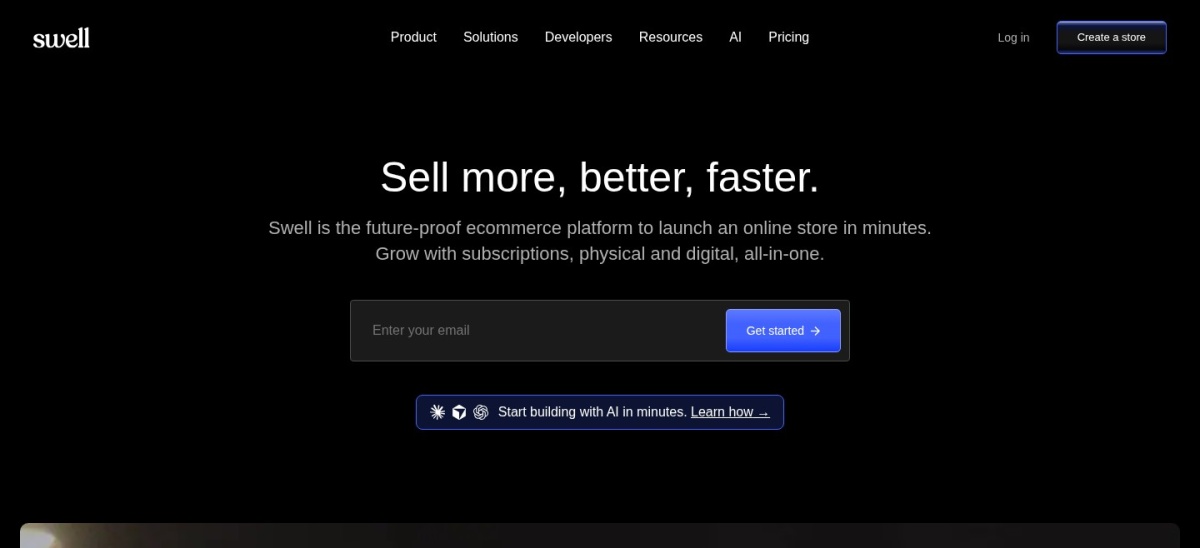
Swell homepage, captured Nov 2026.
Swell is an API-first ecommerce platform for building custom storefronts and commerce experiences. Its Starter plan costs $29 monthly with annual billing, supports up to 2 administrator accounts and carries a $50,000 annual sales ceiling. The platform provides product merchandising, order operations and headless APIs for teams building frontend experiences independently.
The trade off is that Starter applies a 2% fee on sales above its annual revenue ceiling, and larger operations require a higher subscription. It suits smaller development teams and emerging ecommerce brands that need flexible product models without committing to an enterprise commerce contract.
What we like
Affordable published entry subscription
Headless architecture with API access
Supports flexible product and commerce models
Hosted backend reduces infrastructure work
Higher plans accommodate larger sales volumes
Watch out for
Starter has a low annual sales ceiling
Overage charges apply above the ceiling
Limited administrator accounts on entry tier
Public G2 review sample is small
Basic increases administrator capacity to 5 and the annual sales ceiling to $250KVisit swell.is
05
Shopify
4.4/5on G2 (5,172 reviews, checked Nov 2026)
Starts at$29/mo
Best for established brands adopting headless storefronts
Entry planBasic
Annual billing price$29/mo
Headless frameworkHydrogen
Storefront hostingOxygen
shopify.com
Shopify homepage, captured Nov 2026.
Shopify is a hosted ecommerce platform that supports custom headless storefronts through its Storefront API and Hydrogen framework. Basic starts at $29 monthly with annual billing and includes core commerce administration, product management and checkout. Developers can build storefront experiences independently while Shopify manages the underlying commerce services.
The trade off is that Shopify is not a fully interchangeable collection of commerce microservices, and some checkout and B2B customization needs require higher plans. At $348 annually for Basic, it suits established Shopify merchants introducing custom frontend experiences without replacing their order and payment infrastructure.
What we like
Established hosted ecommerce ecosystem
Hydrogen framework for custom storefronts
Managed checkout and order operations
Large app and integration ecosystem
Accessible starting subscription
Watch out for
Less backend modularity than fully composable platforms
Advanced B2B capabilities require higher plans
Custom storefronts still need engineering resources
Apps and payment fees can increase total costs
Higher plans expand staff, commerce and operational features; Plus adds advanced B2B capabilitiesVisit shopify.com
06
Saleor
4/5on G2 (1 reviews, checked Nov 2026)
Paid from$1,599/mo
Best for GraphQL-first commerce implementations
ArchitectureHeadless GraphQL API
Cloud entry planSelect, $1,599/mo
Included monthly GMV$200K
GMV overage0.8%
saleor.io
Saleor homepage, captured Nov 2026.
Saleor is a GraphQL-first, open-source commerce platform for custom retail, B2B and marketplace applications. Its free development sandboxes support testing, while the managed Select plan costs $1,599 monthly and includes up to $200,000 in monthly GMV. Saleor Cloud bundles the commerce engine, hosting, essential applications and engineering support.
The trade off is that production Cloud pricing begins at $1,599 monthly, with a 0.8% fee on orders exceeding the included GMV threshold. It suits engineering-led commerce teams that value a GraphQL architecture, code ownership and a managed infrastructure partnership.
What we like
Open-source commerce core
GraphQL-first API architecture
Free development sandboxes
Managed hosting and essential applications
Supports custom B2B and marketplace experiences
Watch out for
High starting Cloud subscription
Additional fees above the monthly GMV allowance
Custom storefront development remains necessary
Very limited public review sample
Volume increases the monthly GMV allowance to $1M and reduces the overage rateVisit saleor.io
07
Crystallize
4.9/5on G2 (8 reviews, checked Nov 2026)
Paid from$949/mo
Best for content-rich composable commerce
Entry paid planAtom
Base subscription$949/mo
Billing modelBase fee plus metering
Included usersUnlimited
crystallize.com
Crystallize homepage, captured Nov 2026.
Crystallize is a headless commerce platform that brings product information, rich content and commerce operations into a connected data model. Its Particle tier provides free access with metered usage, while Atom starts at $949 monthly plus metering. Atom includes a tenant, unlimited users, unlimited languages and the full platform feature set.
The trade off is that Atom's $949 monthly base price excludes metered usage charges, so total spending depends on consumption. It suits content-heavy commerce teams that need product storytelling, structured data and subscription commerce connected through APIs.
What we like
Combines PIM, CMS and commerce functionality
GraphQL APIs support custom frontends
Free development and experimentation tier
Unlimited users on Atom
Supports complex product and subscription models
Watch out for
Usage metering adds variable costs
Requires frontend development expertise
High base cost for smaller production projects
Limited public G2 review volume
Atom adds a paid production-oriented subscription; Crystal offers tailored enterprise arrangementsVisit crystallize.com
Headless commerce vs composable commerce: what changes?
A headless commerce platform separates the storefront from the commerce backend. Developers can create shopping interfaces using their preferred frontend frameworks while the backend manages products, carts and orders.
Composable commerce goes further by allowing independent services to handle different business functions. A company might combine one commerce engine with another vendor's search system, product information manager and content platform.
BigCommerce and Shopify provide managed commerce backends with headless storefront options. Elastic Path emphasizes enterprise composability, while Medusa and Saleor offer developer-extensible commerce foundations.
Choose based on the degree of independence your business actually needs. A custom storefront does not automatically require a fully modular backend, and adopting numerous independent services can increase operating expenses.
How to calculate the real cost of composable commerce
Subscription fees are only one part of a composable commerce budget. A production implementation may require frontend engineering, integration development, content migration, hosting, observability and ongoing maintenance.
Check whether the quoted price includes checkout, search, product information management and order management. Some vendors package these capabilities, while others require separate services or third-party agreements.
Revenue-based pricing also matters. A lower entry subscription can become more expensive when transaction volume increases, and hosted platforms may impose additional processing or overage charges.
Prepare a total-cost estimate covering implementation and recurring expenses before comparing proposals. Include the expected staff time required to operate the architecture after launch.
How we chose
We shortlisted established commerce platforms that document API-based architectures, headless storefront support or modular commerce services. The selection includes enterprise-focused composable platforms, hosted ecommerce systems with headless capabilities and developer-owned commerce frameworks.
Pricing and public ratings were checked against official vendor pricing pages and G2 listings during preparation for the 22 Nov 2026 comparison date. Where providers publish annual, monthly or usage-based terms, we distinguish base subscription costs from volume charges. Review counts vary substantially, and smaller samples should be interpreted cautiously.
We excluded quote-only platforms without a verifiable paid entry price and products whose commerce functionality or pricing could not be confirmed. Rankings prioritize architectural flexibility, documented features, pricing clarity and suitability for different engineering teams. No vendor paid for a place, and we do not claim testing for this list.
How to choose a composable commerce platform
Define your business architecture and identify which commerce services need independent control before comparing vendors. Use these four steps to narrow the options.
Decide how much composability your business needs. Determine whether a custom frontend on a managed commerce backend is sufficient or whether individual services must be independently replaceable. Full composability can provide additional freedom but also demands more integration ownership.
Map your existing technology stack. Identify the CMS, PIM, ERP, payment providers, inventory systems and customer applications you need to retain. Check API documentation, authentication methods, available integrations and webhooks before committing to a platform.
Calculate platform and development costs. Compare recurring subscriptions alongside infrastructure expenses, usage charges, engineering resources and support contracts. Account for vendor sales thresholds and the costs of independently hosted frontend applications.
Plan implementation and long-term maintenance. Confirm who will manage deployments, security patches, monitoring, testing and integration updates. Choose an architecture that your engineering team or implementation partner can maintain as business requirements change.
FAQ
What is the best composable commerce platform in 2026?
Elastic Path is our overall recommendation for enterprise teams that need modular commerce capabilities, complex business workflows and flexible integrations. Its published Entry package starts at $49,500 annually. BigCommerce offers a more accessible hosted foundation, while Medusa appeals to teams that want ownership of an open-source commerce framework.
What is composable commerce?
Composable commerce is an approach to building ecommerce systems from independently selected services. Rather than relying on a single application for every function, businesses can connect commerce APIs, content management, search, payments and other specialized products. The goal is to retain control over individual components and replace them when requirements change.
What is the difference between headless and composable commerce?
Headless commerce separates the customer-facing interface from the backend commerce system. Composable commerce extends that separation by allowing different backend capabilities to be supplied by independently managed services. A headless implementation can therefore be part of a composable architecture without necessarily being fully composable itself.
How much does a composable commerce platform cost?
Published starting costs vary substantially. Medusa Cloud starts at $29 monthly, Swell Starter also lists $29 monthly with annual billing, and Elastic Path starts at $49,500 annually. These prices cover different platform capabilities and commercial arrangements. Custom development, hosting and integrations can considerably increase total expenses.
Are there free composable commerce platforms?
Yes. Medusa provides an open-source framework, while Saleor offers an open-source commerce core and free development sandboxes. Crystallize also offers a free Particle tier with usage metering. Production deployments can still involve infrastructure expenses, developer labor, paid extensions and vendor subscriptions.
Is Shopify a composable commerce platform?
Shopify supports headless commerce through its Storefront API and Hydrogen framework, allowing merchants to build custom storefronts. However, its managed commerce backend is not designed as a fully interchangeable collection of independent microservices. It is better suited to organizations that want frontend flexibility while retaining Shopify's managed commerce operations.
Which composable commerce platform is best for B2B ecommerce?
Elastic Path is a strong option for complex B2B purchasing and catalog requirements. Saleor and Medusa can support tailored B2B implementations through their extensible architectures. The most appropriate choice depends on account hierarchies, customer-specific pricing, approval workflows, ERP integrations and available engineering resources.
Do I need developers to use composable commerce?
Most composable implementations benefit from experienced developers or a specialist implementation partner. Integrating independent services, managing API connections and maintaining custom storefronts require technical expertise. Hosted platforms such as BigCommerce can reduce infrastructure responsibilities, but custom headless experiences still involve engineering work.
What should I check before migrating to composable commerce?
Review product-data migration, existing checkout requirements, integrations, search functionality, content ownership and operational responsibilities. Confirm API capabilities and create a migration plan that includes testing, monitoring and fallback procedures. Comparing total implementation and maintenance costs is as important as comparing subscription prices.