Best Deep Learning Software in 2026: 7 Tools Compared
WLWPLegible EditorsLast verified 22 Nov 2026How we rank8 min read
★ Short answer
PyTorch is the best deep learning software for most teams, combining a free open-source framework, dynamic computation graphs, and a 4.6 out of 5 rating on G2. TensorFlow suits multi-platform production deployment, while Weights & Biases adds managed experiment tracking from $60 per month.
How we make this list: we compare pricing pages, product documentation and public user reviews, then re-check every price before each update. No product paid for a place. Disclosure.
PyTorch, TensorFlow, and Keras are completely free open-source frameworks with G2 ratings of 4.5 to 4.6 out of 5.
Hugging Face Hub hosts over 3 million models and offers a Pro plan at $9 per month ($108 per year) with $2 in monthly inference credits.
ClearML provides self-hosted open-source MLOps and a hosted Pro tier starting at $15 per user per month ($180 per year).
Comet starts at $19 per user per month ($228 per year) for up to 10 users, 1,500 training hours, and 500 GB of storage.
Weights & Biases Pro starts at $60 per month ($720 per year) for teams under 50 employees, while MATLAB individual licenses cost $1,050 per year.
What to look for in deep learning software
Deep learning software splits into two layers: core numerical frameworks that build and train neural networks, and MLOps or model-hub platforms that track runs, store weights, and manage compute. Most teams pair a free Python library like PyTorch or Keras with a hosted workspace for experiment logging and deployment.
Hardware acceleration and backend flexibility matter early. Check whether the software supports multi-GPU distributed training, TPUs, or Apple Silicon without rewriting model code, and verify how easily trained weights export to production runtimes like ONNX, mobile devices, or browsers.
Pay close attention to seat caps, storage quotas, and compute billing on commercial platforms. Free tiers often limit team size or active storage, while paid plans may charge extra for GPU hours, data ingestion overages, or enterprise compliance features like SSO.
Foundation tierFree Associate (academic); $5,000+/yr corporate
pytorch.org
PyTorch homepage, captured Nov 2026.
PyTorch is an open-source deep learning framework governed by the Linux Foundation that lets developers build and train neural networks in standard Python. Its dynamic computation graph allows step-by-step debugging, and built-in torch.distributed primitives scale training across multiple GPUs and nodes at zero software cost.
The trade off is that PyTorch provides no managed cloud UI, so you pay separately for GPU compute and handle deployment tooling yourself. Commercial organizations can optionally join the PyTorch Foundation starting at $5,000 per year for 1 to 49 employees. It suits research engineers, LLM fine-tuners, and teams building custom architectures.
What we like
Completely free open-source framework with no seat or usage fees
Dynamic computation graphs simplify Python debugging and experimentation
Default backend for major ecosystems including Hugging Face and vLLM
Supports distributed multi-GPU training and native hardware acceleration
Watch out for
No built-in hosted experiment dashboard or managed compute
Production serving requires pairing with external tools like TorchServe or vLLM
No paid software tier; optional corporate foundation membership starts at $5,000/yr.Visit pytorch.org
02
TensorFlow
4.5/5on G2 (135 reviews, checked Nov 2026)
PriceFree
Best for cross-platform production deployment
LicenseApache 2.0 open-source
VisualizationBuilt-in TensorBoard metrics suite
Edge runtimesTensorFlow Lite and TensorFlow.js
HardwareCPU, GPU, and Google Cloud TPU
tensorflow.org
TensorFlow homepage, captured Nov 2026.
TensorFlow is an open-source machine learning platform originally developed by Google that covers model building, visualization, and multi-device deployment under an Apache 2.0 license. It bundles TensorBoard for training metrics, TFX for production pipelines, and runtimes for servers, browsers, and mobile hardware at no software cost.
The trade off is a steeper learning curve and more verbose low-level APIs than PyTorch, with zero paid vendor support tiers unless you run workloads on Google Cloud. It suits engineering teams shipping models across web, mobile, and edge devices or training on Google TPUs.
What we like
Free Apache 2.0 platform with built-in TensorBoard visualization
Mature deployment runtimes for mobile, embedded, and browser targets
Native support for distributed training across GPUs and Google TPUs
Large ecosystem of production pipeline components via TFX
Watch out for
Steeper learning curve and more verbose syntax for custom research code
Fewer new academic research models release TensorFlow weights first
Completely free open-source platform; users only pay for underlying cloud or local compute.Visit tensorflow.org
03
Hugging Face
4.4/5on G2 (92 reviews, checked Nov 2026)
Paid from$9/mo
Best for pretrained open-weight models and datasets
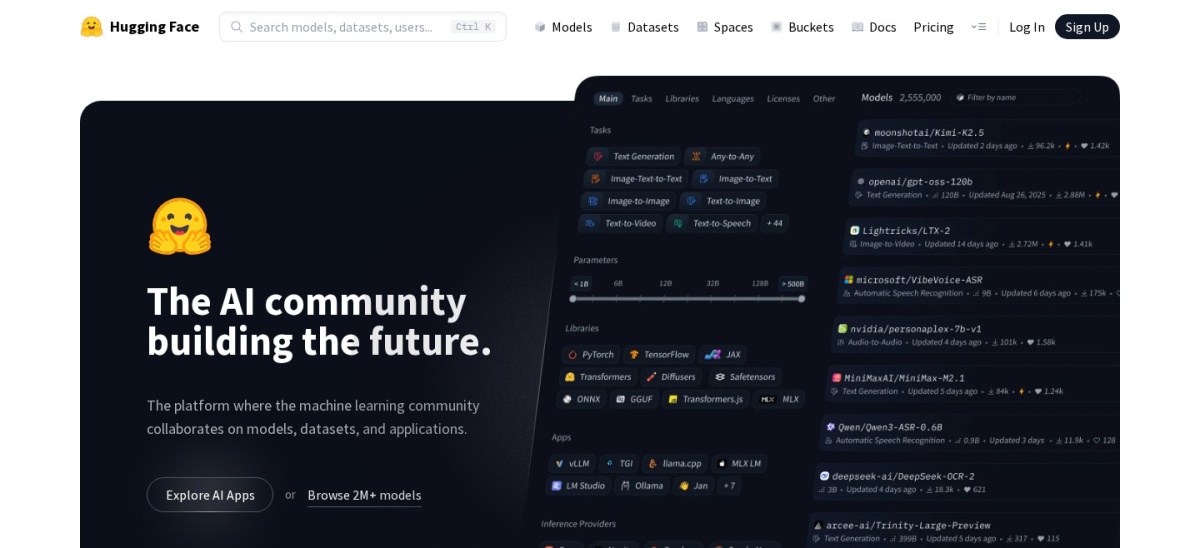
Hugging Face is an open-source AI platform and model hub hosting over 3.1 million models alongside Python libraries like Transformers, Diffusers, and PEFT for LoRA fine-tuning. Its free account includes unlimited public repositories, dataset hosting, and basic CPU Spaces demos.
The trade off is that dedicated GPU inference endpoints bill hourly on top of subscription fees, starting at $0.50 per hour for a T4 GPU. Upgrading to Pro costs $9 per month ($108 per year) and adds $2 in monthly inference credits, 10x private storage, and 8x ZeroGPU quota. It suits teams fine-tuning or deploying open-weight models.
What we like
Largest public repository of pretrained models and open datasets
Open-source Transformers and PEFT libraries integrate cleanly with PyTorch
Low $9/mo Pro entry price with included ZeroGPU priority and credits
On-demand Spaces and Inference Endpoints simplify model hosting
Free inference credits are minimal and throttle quickly under peak traffic
Pro ($9/mo) adds $2/mo inference credits, 10x private storage, and higher ZeroGPU limits.Visit huggingface.co
04
Keras
4.6/5on G2 (65 reviews, checked Nov 2026)
PriceFree
Best for rapid multi-backend neural network prototyping
BackendsJAX, TensorFlow, and PyTorch (Keras 3)
Model APIsSequential, Functional, and Subclassing
Pretrained hubKerasHub presets for vision and text models
LicenseApache 2.0 open-source
keras.io
Keras homepage, captured Nov 2026.
Keras is an open-source, high-level Python deep learning API that runs a single neural network codebase across JAX, TensorFlow, or PyTorch backends. It offers Sequential and Functional model builders plus KerasHub pretrained checkpoints for vision and language tasks with zero licensing fees.
The trade off is that Keras abstracts away low-level tensor operations, which can make custom non-standard research layers harder to debug than writing native PyTorch or JAX. It suits developers and applied ML teams who want clean, readable code and the freedom to switch execution backends without rewriting models.
What we like
Single codebase runs on JAX, TensorFlow, or PyTorch without changes
Clean Sequential and Functional APIs reduce boilerplate code
Free Apache 2.0 license with no paid tiers or usage caps
Compatible with PyTorch DataLoaders, tf.data, and NumPy arrays
Watch out for
High-level abstractions can obscure low-level debugging details
No hosted experiment tracking or cloud training environment included
Completely free open-source API with no paid plans or commercial tiers.Visit keras.io
05
ClearML
4.7/5on G2 (13 reviews, checked Nov 2026)
Paid from$15/mo
Best for open-source MLOps and job orchestration
Free hosted tierUp to 3 users, 100 GB artifact storage
Self-hostingApache 2.0 open-source server and agents
Pro plan$15/user/mo for up to 10 users + usage
AutomationHyperparameter tuning and cloud autoscaling
clear.ml
ClearML homepage, captured Nov 2026.
ClearML is an open-source MLOps platform that combines experiment tracking, dataset management, hyperparameter optimization, and GPU job orchestration. Its free hosted Community plan supports up to 3 users with 100 GB of artifact storage and 1 million API calls per month, and the server can also be self-hosted free under Apache 2.0.
The trade off is usage-based overage fees on hosted plans once you pass included storage or metric limits, plus extra setup time if you self-host. Hosted Pro starts at $15 per user per month ($180 per year) for up to 10 users and adds cloud autoscaling and pipeline triggers. It suits teams automating multi-GPU training queues.
What we like
Open-source Apache 2.0 core can be self-hosted with no user limits
Generous free hosted tier with 100 GB artifact storage for 3 users
Includes remote GPU agent queuing and hyperparameter optimization
Integrates with PyTorch, TensorFlow, Keras, and scikit-learn
Watch out for
Fewer public G2 reviews than older tracking platforms
Hosted Pro charges metered overages for storage, metrics, and API calls
Pro ($15/user/mo) supports up to 10 users, cloud autoscaling, and automated pipelines.Visit clear.ml
06
Comet
4.1/5on G2 (37 reviews, checked Nov 2026)
Paid from$19/mo
Best for collaborative experiment and dataset versioning
Free plan1 user, 100 GB data storage, model registry
Pro plan$19/user/mo up to 10 users, 1,500 training hrs
Pro storage500 GB included ($3 per extra 100 GB/mo)
Academic accessFree plans for students and researchers
comet.com
Comet homepage, captured Nov 2026.
Comet is an experiment management and model registry platform that logs hyperparameters, code versions, metrics, and artifacts across deep learning frameworks. Its MLOps Free plan supports 1 user with 100 GB of data storage, dataset versioning, and a model registry at no cost.
The trade off is that free workspaces inactive for 90 days face automatic deletion after email notice, and team collaboration requires upgrading. Pro costs $19 per user per month ($228 per year) for up to 10 users, 1,500 included training hours, and 500 GB of storage. It suits small ML teams comparing training runs.
What we like
Free individual tier includes 100 GB storage and model registry
Predictable $19/user/mo entry price for teams up to 10 seats
Supports visual metric comparison, artifact lineage, and LLM tracing
Free academic access available for university researchers
Watch out for
Free workspaces are deleted after 90 days of UI inactivity
Overages apply above 1,500 training hours ($1/hr) and 500 GB storage
Pro ($19/user/mo) unlocks 10-user collaboration, 500 GB storage, and email support.Visit comet.com
07
Weights & Biases
4.5/5on G2 (83 reviews, checked Nov 2026)
Paid from$60/mo
Best for real-time training dashboards and sweeps
Free planUp to 5 seats, 5 GB storage/mo (personal)
Pro planFrom $60/mo up to 10 seats, 100 GB storage
Pro eligibilityLimited to teams with fewer than 50 employees
Core featuresLive loss curves, hyperparameter sweeps, registry
wandb.ai
Weights & Biases homepage, captured Nov 2026.
Weights & Biases is an AI developer platform for logging deep learning training runs, visualizing loss curves, and running automated hyperparameter sweeps with a few lines of Python. Its Free tier supports personal projects with up to 5 model seats, 5 GB of monthly storage, and 1 GB of Weave data ingestion.
The trade off is a strict 50-employee company cap on self-serve plans, forcing larger organizations onto custom Enterprise contracts. Pro starts at $60 per month ($720 per year) for up to 10 model seats and 100 GB of monthly storage, with storage overages billed at $0.03 per GB. It suits early-stage AI teams needing polished experiment dashboards.
What we like
Fast, clean real-time dashboards for comparing loss curves and gradients
Built-in automated hyperparameter sweeps and model artifact registry
Flat $60/mo Pro starting price covers up to 10 seats for small teams
Integrates seamlessly with PyTorch, TensorFlow, Keras, and Hugging Face
Watch out for
Organizations with 50 or more employees must upgrade to custom Enterprise pricing
Weave ingestion overages ($0.10/MB) can add up on heavy trace workloads
Pro ($60/mo) expands storage to 100 GB/mo and supports up to 10 team seats.Visit wandb.ai
Core frameworks vs. MLOps platforms
Core frameworks like PyTorch, TensorFlow, and Keras execute the math: tensor operations, automatic differentiation, and GPU gradient updates. They are free open-source Python packages that run on your own laptop, on-premises cluster, or rented cloud GPUs.
MLOps and hub platforms like Weights & Biases, ClearML, Comet, and Hugging Face sit around those frameworks. They store model checkpoints, compare hyperparameter runs across teammates, and host inference APIs, which is why they carry monthly seat or storage pricing.
How we chose
To build this list, we reviewed public G2 ratings, open-source documentation, and vendor pricing pages across deep learning frameworks, model hubs, and experiment-tracking platforms. We prioritized actively maintained tools with established adoption and transparent documentation.
Every rating, review count, and regular subscription price was verified on 22 Nov 2026 against G2 product profiles and official vendor pricing pages. Where commercial tools offer monthly billing, annual equivalents were calculated at 12 times the regular monthly rate.
We excluded legacy libraries that are no longer actively developed, niche tools with fewer than 10 public reviews, and enterprise-only platforms such as Dataiku or SAS Viya that withhold public entry pricing. No vendor paid for a place, and we do not claim testing for this list.
How to choose deep learning software
Match your modeling stack, hardware setup, and team size before committing to a framework or paid MLOps plan.
Pick your core training framework first. Start with PyTorch if you want the widest research ecosystem and Pythonic debugging, TensorFlow if you need mobile or browser runtimes, or Keras 3 if you want one API that switches between JAX, PyTorch, and TensorFlow.
Check pretrained model availability before training from scratch. Browse Hugging Face Hub for existing open-weight checkpoints in vision, audio, or language. Fine-tuning an existing model with PEFT or LoRA saves weeks of GPU compute compared to pretraining.
Separate software fees from GPU compute costs. Open-source libraries cost $0 to install, while cloud GPU instances and dedicated inference endpoints bill by the hour. Estimate monthly training and serving hours before choosing hosted compute.
Verify team seat caps and storage overages on tracking tools. Compare free storage limits and employee headcount rules across ClearML, Comet, and Weights & Biases so a growing team does not hit an unexpected tier jump.
FAQ
Is deep learning software free to use?
Yes. Core deep learning frameworks including PyTorch, TensorFlow, and Keras are completely free under open-source licenses. You only pay for the local hardware or cloud GPU instances used to train and run your models, plus optional hosted MLOps tools.
Should beginners choose PyTorch or TensorFlow in 2026?
PyTorch is usually easier for beginners because its dynamic execution lets you inspect tensors and debug errors using standard Python tools. Keras 3 is another approachable option since it provides a clean high-level API on top of PyTorch, TensorFlow, or JAX.
Why do MLOps platforms charge monthly fees when PyTorch is free?
PyTorch handles model math on your machine, whereas MLOps tools like Weights & Biases, Comet, and ClearML host shared dashboards, artifact storage, model registries, and team permissions in the cloud. ClearML also offers an open-source server you can self-host for free.
What is the cheapest paid deep learning platform on this list?
Hugging Face Pro is the lowest-priced paid tier at $9 per month ($108 per year), adding $2 in monthly inference credits and expanded private storage. For dedicated experiment tracking, ClearML Pro starts at $15 per user per month ($180 per year).
Do I need proprietary software like MATLAB for deep learning?
Most AI teams use free Python libraries rather than proprietary suites, though MATLAB remains popular in engineering and control-system simulation. An individual commercial MATLAB license costs $1,050 per year, which is much higher than open-source Python stacks.