Best Day Trading Platforms in 2026: 7 Tools Compared
WLWPLegible EditorsLast verified 22 Nov 2026How we rank5 min read
★ Short answer
Interactive Brokers leads for active day traders who need multi-asset routing, futures, options, and global market access. TradingView fits chart-first traders who connect a separate broker, while Webull and moomoo appeal to low-cost equity and options traders.
How we make this list: we compare pricing pages, product documentation and public user reviews, then re-check every price before each update. No product paid for a place. Disclosure.
Interactive Brokers supports stocks, ETFs, options, futures, and forex with $0 commissions on IBKR Lite for US stocks and ETFs.
TradingView paid plans start at $12.95/mo billed annually ($14.95/mo monthly) alongside a free Basic tier.
NinjaTrader offers a $0 monthly plan with $0.39 per micro contract commission, a $99/mo plan, and a $1,499 one-time Lifetime plan.
Webull and moomoo advertise $0 commissions on US stocks, ETFs, and equity options, with margin rates starting around 5.75% and 6.8%.
Direct-access brokers like TradeStation and Cobra Trading pair active execution tools with monthly platform fees or volume-based waivers.
What to look for in a day trading platform
Day trading platforms vary sharply between full-service brokerages that execute orders directly and charting software that routes orders through a connected broker. Checking where order execution happens prevents surprise fees or missed connections.
Active intraday traders should separate base software subscriptions from per-share or per-contract commissions, exchange and clearing charges, market data feeds, and margin interest. A $0 commission headline can still carry options contract fees, routing charges, or minimum activity rules.
Market coverage and order tools matter as much as fees. Some platforms focus on US equities and options with extended-hours access, while others specialize in futures contracts, tick charts, automated scripts, or direct market access.
Risk controls and account structure also shape daily workflows. Traders should verify intraday buying-power rules, pattern day-trading requirements, stop-order behavior during fast markets, and data entitlements before funding an account.
3/5on Trustpilot (6,000 reviews, checked Nov 2026)
PriceFree
Best for multi-asset day trading
Base plan$0 subscription
MarketsStocks, ETFs, options, futures
Options fee$0.65/contract benchmark
Trustpilot3.0/5 (6K reviews)
interactivebrokers.com
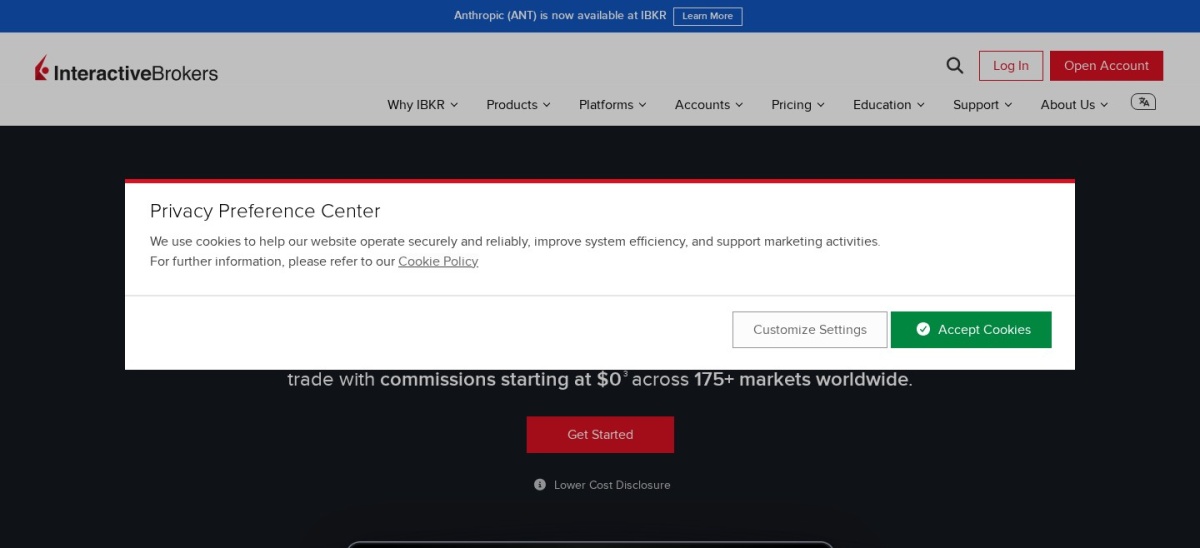
Interactive Brokers homepage, captured Nov 2026.
Interactive Brokers is a multi-asset brokerage offering IBKR Lite with $0 commissions on US exchange-listed stocks and ETFs, plus APIs and market depth tools. Traders can access stocks, ETFs, options, futures, and global markets from one account.
The trade off is interface complexity and fee structure nuance, with no base subscription fee on standard accounts while options contract fees and market data add-ons apply. It suits experienced traders who want wide asset selection and custom order routing.
What we like
Covers stocks, ETFs, options, futures, and international markets
Offers IBKR Lite with $0 commissions on US stocks and ETFs
Includes APIs, paper trading, and configurable order tools
Watch out for
Steeper learning curve than app-first retail brokers
Market data subscriptions and options fees can add up
IBKR Pro and optional market data subscriptions tailor routing, margin, and real-time feeds to active accounts.Visit interactivebrokers.com
02
TradingView
4.5/5on G2 (77 reviews, checked Nov 2026)
Paid from$155/yr
Best for charting and technical analysis
Cheapest paid$12.95/mo annual ($155.40/yr)
Free tierBasic $0 plan
Billing cycleAnnual or $14.95/mo monthly
G2 rating4.5/5 (77 reviews)
tradingview.com
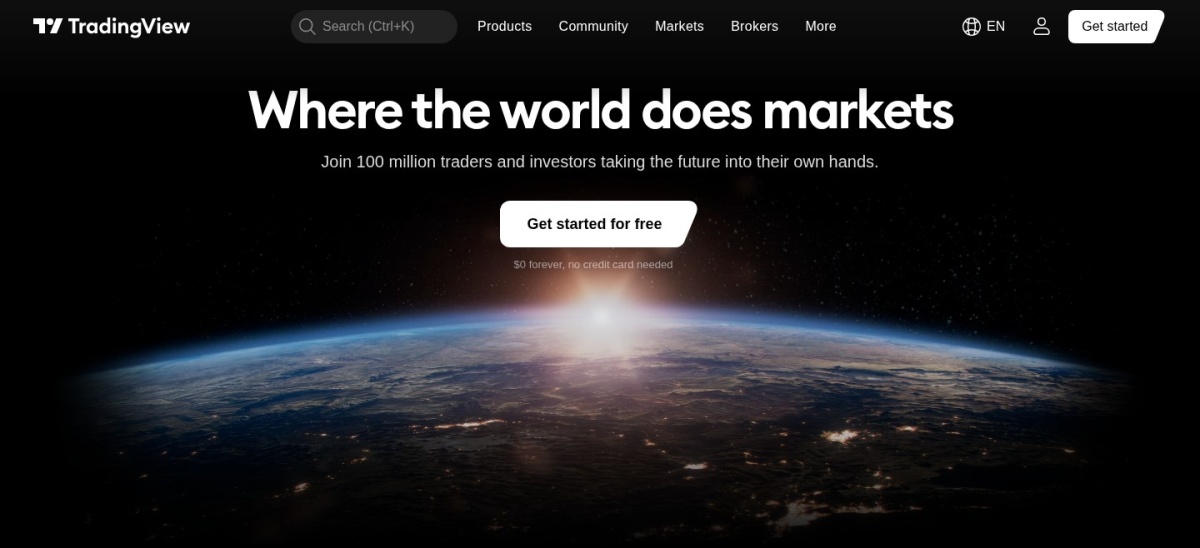
TradingView homepage, captured Nov 2026.
TradingView is a charting and market-analysis platform used by more than 100 million traders, starting with a $0 Basic plan and paid Essential plans at $12.95 per month billed annually. Paid tiers expand indicators per chart, chart layouts, alerts, and historical bars.
The trade off is that paid plans start at $12.95 per month billed annually ($14.95 per month if billed monthly) and require a supported broker connection plus real-time exchange data subscriptions for live execution. It suits chart-driven traders who analyze setups across multiple timeframes and assets.
What we like
Clean charts, Pine Script indicators, and multi-timeframe analysis
Free Basic plan lets traders test layouts and basic tools first
Connects with supported brokers for chart-based order execution
Watch out for
Not a standalone brokerage account on its own
Real-time exchange data and higher alert limits require paid tiers or add-ons
Essential, Plus ($29.95/mo annual), Premium ($59.95/mo annual), and Ultimate ($199.95/mo annual) add more charts, alerts, and data.Visit tradingview.com
03
NinjaTrader
3.8/5on Trustpilot (1,000+ reviews, checked Nov 2026)
Paid from$1,188/yr
Best for futures day trading
Paid monthly$99/mo ($1,188/yr) or $1,499 lifetime
Free plan$0/mo ($0.39 micro commission)
Micro margins$50 day-trading margins
Trustpilot3.8/5 (1K reviews)
ninjatrader.com
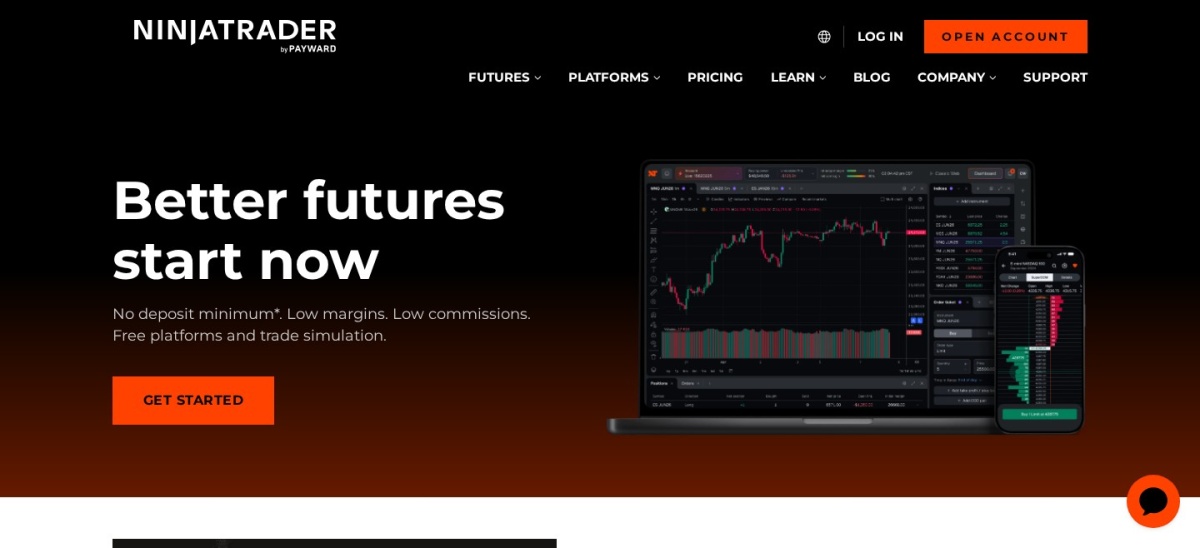
NinjaTrader homepage, captured Nov 2026.
NinjaTrader is a futures trading platform and brokerage serving more than 800,000 traders, featuring a $0 monthly plan with $0.39 per-side micro commissions and $50 intraday micro margins. It includes market replay, order flow tools, and simulation.
The trade off is a $99 per month ($1,188 per year) Monthly plan or $1,499 one-time Lifetime fee for lower per-contract rates, plus exchange, NFA, clearing, and potential inactivity fees. It suits active futures traders who trade micro or standard contracts frequently.
What we like
Low $50 intraday day-trading margins on eligible micro contracts
Includes market replay, simulation, and custom strategy tools
Offers a $0 monthly plan before committing to lower-commission tiers
Watch out for
Focused on futures rather than equities or spot forex
Exchange, NFA, clearing, and market data fees apply on top of commissions
The $99/mo Monthly plan lowers commissions to $0.29 micro / $0.99 standard per side, and the $1,499 Lifetime plan lowers them further to $0.09 / $0.59.Visit ninjatrader.com
04
Webull
4/5on Trustpilot (425 reviews, checked Nov 2026)
PriceFree
Best for low-cost US stock and options trading
Base plan$0 subscription
Equity/ETF fee$0 commission
Day-trade buyingUp to 4x on $2,000+ margin
Trustpilot4.0/5 (425 reviews)
webull.com
Webull homepage, captured Nov 2026.
Webull is an online brokerage offering $0 commissions on US stocks, ETFs, and options, alongside desktop and mobile apps with trading simulators. Margin accounts provide up to 4x day-trade buying power starting from a $2,000 equity minimum.
The trade off is no base platform subscription fee while margin borrowing, index options fees, and regulatory charges apply depending on account balance and order type. It suits active US stock and options traders who want a streamlined interface and practice tools.
What we like
$0 commissions on US stocks, ETFs, and options
Up to 4x day-trade buying power on qualifying margin accounts
Accessible desktop and mobile apps with trade simulation
Watch out for
Narrower international and futures depth than institutional brokers
Margin interest and index options fees apply on leveraged or index trades
Optional Webull Premium membership adds lower margin rates and higher yield on uninvested cash.Visit webull.com
05
moomoo
3.8/5on Trustpilot (735 reviews, checked Nov 2026)
PriceFree
Best for low-rate margin and screeners
Base plan$0 subscription
Stock/option fee$0 commission
Margin rateFrom 6.8% (≤$25K balance)
Trustpilot3.8/5 (735 reviews)
moomoo.com
moomoo homepage, captured Nov 2026.
moomoo is a trading platform offering $0 commissions on US stocks and options, margin rates starting at 6.8% for balances up to $25,000, and built-in screeners with 100+ indicators. It pairs mobile and desktop tools with Level 2 market data and real-time risk alerts.
The trade off is no base platform subscription fee while index options contract fees, regulatory fees, and margin interest apply on active positions. It suits day traders who want screening depth, Level 2 quotes, and competitive margin pricing in one app.
What we like
$0 commissions on US stocks and options with $2,000 margin minimum
Includes screeners with 100+ indicators and Level 2 market data
Competitive margin rates starting at 6.8% on balances up to $25,000
Watch out for
Less suited to traditional long-term retirement accounts like IRAs
Exchange, clearing, and index option contract fees still apply
Membership tiers and optional market data packages expand screening, options analysis, and research tools.Visit moomoo.com
06
TradeStation
4.3/5on Trustpilot (1,000+ reviews, checked Nov 2026)
Starts at$1,200/yr
Best for strategy scripting and backtesting
Platform add-on$99.99/mo ($1,199.88/yr)
Futures rate$0.25–$1.75/side by volume
Asset classesEquities, options, futures
Trustpilot4.3/5 (1K reviews)
tradestation.com
TradeStation homepage, captured Nov 2026.
TradeStation is a self-clearing broker and trading platform for equities, options, and futures, with the RadarScreen platform listed at $99.99 per month ($1,199.88 per year) for non-professionals. It supports custom strategy development and backtesting across active markets.
The trade off is a $99.99 per month ($1,199.88 per year) platform fee for RadarScreen plus per-contract or direct-routing charges on options and futures. It suits systematic and technical day traders who build custom indicators and scan markets continuously.
What we like
Built for strategy coding, backtesting, and real-time radar scanning
Supports equities, options, and futures on a self-clearing broker
Tiered volume pricing on futures and options contracts
Watch out for
Monthly platform and backtesting add-on fees apply ($99.99/mo RadarScreen)
Routing, clearing, and index option fees add complexity to cost math
Portfolio Maestro backtesting is listed at $59.95/mo, while volume tiers reduce per-contract futures and options fees.Visit tradestation.com
07
Cobra Trading
3.2/5on Trustpilot (1 reviews, checked Nov 2026)
Starts at$1,500/yr
Best for direct-access equity day trading
Cheapest platform$125/mo ($1,500/yr) DAS Trader
Share commission$0.0015–$0.003/share
Fee waiver200,000 shares/month
Trustpilot3.2/5 (1 review)
cobratrading.com
Cobra Trading homepage, captured Nov 2026.
Cobra Trading is a broker built around active equity and options day trading, with DAS Trader Pro priced at $125 per month ($1,500 per year) and equity commissions from $0.003 down to $0.0015 per share. It includes short locate monitoring and phone desk support during market hours.
The trade off is a $125 per month ($1,500 per year) DAS Trader Pro fee (or $150 per month for Sterling Trader Pro) unless you trade 200,000 shares per month to waive the software fee. It suits high-frequency equity day traders who need direct-access execution and short locates.
What we like
Direct-access platforms like DAS Trader Pro and Sterling Trader Pro
200,000-share monthly volume waives the software platform fee
Dedicated short locate monitor and free broker-assisted trades
Watch out for
Monthly software fees apply below the 200,000-share monthly threshold
Higher capital requirements for day-trading accounts than casual apps
Reaching 200,000 shares per month waives the software platform fee and unlocks Cobra PRIME software credits.Visit cobratrading.com
Execution vs. charting tools
Some day traders need a broker that holds funds, extends margin, and routes orders directly to exchanges or dark pools, such as Interactive Brokers, Webull, moomoo, TradeStation, or Cobra Trading.
Other traders prefer specialized charting and scripting environments like TradingView, then connect a supported broker account to place orders. Splitting charting and execution can improve chart ergonomics while requiring attention to order routing and data feeds.
How we chose
We built this list from established day trading platforms across multi-asset brokerages, charting suites, futures brokers, and direct-access equity platforms that remain actively maintained.
Pricing plans, commission schedules, and public review ratings were checked on 22 Nov 2026 using official vendor pages and third-party review directories.
We excluded platforms without verifiable public pricing details or clear day-trading workflows, and we weighed total fee structures rather than headline claims alone. No vendor paid for a place, and we do not claim testing for this list.
How to choose a day trading platform
Follow four practical steps to match a day trading platform to your markets and order volume:
Pick the markets you trade every day. Confirm whether the platform supports US stocks, options, micro or standard futures, or multi-asset routing before comparing fee tables.
Add up all recurring and per-trade costs. Compare base monthly fees against per-share or per-contract commissions, exchange and clearing charges, market data feeds, and margin interest.
Check order tools and execution speed. Look for hotkeys, bracket or stop orders, level 2 depth, or strategy scripts that match how fast you enter and exit intraday trades.
Test the workflow in simulation first. Use paper trading or simulated accounts to verify chart layouts, order entry rules, and risk settings before committing live capital.
FAQ
Do day trading platforms always charge a monthly subscription?
No. Several brokerages charge no monthly platform subscription and instead earn money through options contract fees, margin interest, routing or ancillary charges, or volume-based schedules, while software-first tools like TradingView or TradeStation charge monthly or annual fees.
What is the difference between a broker and a charting platform?
A broker holds your account, clears trades, and provides margin or market access, whereas a charting platform focuses on technical indicators, layouts, and alerts. Some platforms combine both roles, while others connect to a broker for order execution.
Why do futures platforms list commissions per side?
Futures schedules often quote commissions per side (entry or exit) before exchange, NFA, and clearing fees. A full round turn includes both opening and closing a contract, so check all-in round-turn costs when estimating daily expenses.
Can software platform fees be waived by trading volume?
Yes, on certain active-trader brokers. For example, Cobra Trading waives its software fee when you reach 200,000 shares traded per month, while other platforms lower per-contract rates as monthly volume rises.
Should I rely on simulated trading before trading live?
Yes. Simulated trading helps you learn order tickets, hotkeys, chart alerts, and risk limits without financial loss, though simulated fills do not always reflect live liquidity, slippage, or fast-market gaps.
What hidden costs should day traders watch besides commissions?
Watch for real-time market data subscriptions, exchange and clearing fees, margin interest rates, wire or transfer charges, inactivity fees, and short locate costs.