Best Data Mapping Software in 2026: 8 Tools Compared
WLWPLegible EditorsLast verified 22 Nov 2026How we rank10 min read
★ Short answer
Skyvia is the best data mapping software overall, pairing a 4.8/5 G2 rating across 326 reviews with visual bi-directional field mapping across 200+ connectors and a free tier. For developer-heavy XML, EDI, and XBRL conversions, Altova MapForce offers perpetual desktop licenses, while Airbyte suits engineering teams wanting open-source ELT pipelines.
How we make this list: we compare pricing pages, product documentation and public user reviews, then re-check every price before each update. No product paid for a place. Disclosure.
Skyvia tops our list with a 4.8/5 G2 rating (326 reviews) and paid plans starting at $99/mo ($79/mo billed annually).
Four of the eight tools offer permanent free tiers, including Skyvia (10,000 records/mo), Coupler.io (1 source), Dataddo (100,000 rows/mo), and Estuary (10 GB/mo).
Altova MapForce is the only tool here with one-time perpetual licensing, starting at $349 for the Basic Edition.
Flat-rate unlimited volume pricing starts at $1,999/mo with Integrate.io, avoiding per-row or per-record overages.
Entry-level cloud ELT pipelines start at $20/mo on Airbyte Cloud Standard for 5 monthly credits.
What to look for in data mapping software
Data mapping software connects fields from one schema to another so records move cleanly between CRMs, databases, spreadsheets, and cloud warehouses. Without visual field matching and type conversion, teams spend hours fixing broken CSV imports, mismatched date formats, and failed API payloads.
Pricing models vary sharply across this category. Some vendors meter by records, rows, or events per month, which keeps entry bills low for small syncs but can spike during historical backfills. Others charge per active connector instance, per seat, or offer flat monthly subscriptions for predictable budgeting.
Before choosing a tool, match its transformation depth and refresh schedule to your workflow. Marketing and operations teams often need no-code visual mappers that push data to spreadsheets or BI dashboards, while data engineers look for schema drift handling, SQL or Python transforms, and self-hosted deployment options.
Skyvia is a cloud data integration platform that maps fields visually between CRMs, ERPs, databases, and CSV files without code. Its permanent free tier covers up to 10,000 records per month, two scheduled integrations, and daily sync runs across its library of over 200 connectors.
The trade off is that sync frequency and advanced mapping features are gated by tier, with the Basic plan starting at $99/mo ($79/mo billed annually) for daily runs and Standard at $199/mo for hourly syncs. It suits RevOps and small IT teams needing quick, bi-directional app syncs.
What we like
Visual drag-and-drop field mapping with expressions and lookups
Supports bi-directional synchronization between CRMs and databases
Permanent free tier with 10,000 monthly records
Highest G2 rating among broad integration tools at 4.8/5
Watch out for
1-minute sync intervals require the $499/mo Professional tier
Overage fees apply once monthly record caps are exceeded
Basic ($99/mo) raises volume to 5M records/mo and removes 30-day schedule expiration.Visit skyvia.com
02
Altova MapForce
4.5/5on G2 (23 reviews, checked Nov 2026)
Starts at$349 one-time
Best for complex XML, EDI, and XBRL schemas
FormatsXML, JSON, EDI, XBRL, SQL, Excel
Code exportXSLT, XQuery, Java, C++, C#
License typePerpetual desktop license
Trial30-day free trial
altova.com
Altova MapForce homepage, captured Nov 2026.
Altova MapForce is a graphical desktop mapping tool built for any-to-any conversion across XML, JSON, relational databases, EDI, Excel, and XBRL files. The entry Basic Edition costs $349 one-time and handles XML-to-XML mappings with auto-generated XSLT 1.0, 2.0, and 3.0 code.
The trade off is that database, JSON, and EDI mapping require upgrading to the Professional ($679) or Enterprise ($1,099) editions, and automated server execution is sold separately. It suits developers and integration specialists working with strict regulatory or EDI file formats.
Generates royalty-free Java, C#, C++, and XSLT code
Interactive debugger lets you inspect intermediate mapping steps
Deep native support for X12, EDIFACT, and XBRL standards
Watch out for
Desktop authoring software runs on Windows only
Automated background scheduling requires separate MapForce Server software
Professional Edition ($679) unlocks database, JSON, CSV, and flat-file mapping.Visit altova.com
03
Airbyte
4.4/5on G2 (81 reviews, checked Nov 2026)
Paid from$20/mo
Best open-source ELT and schema mapping
Connectors700+ prebuilt & custom CDK
Free optionSelf-hosted Airbyte Core
Cloud trial14 days with 400 credits
Sync speedHourly on Standard, 15-min on Plus
airbyte.com
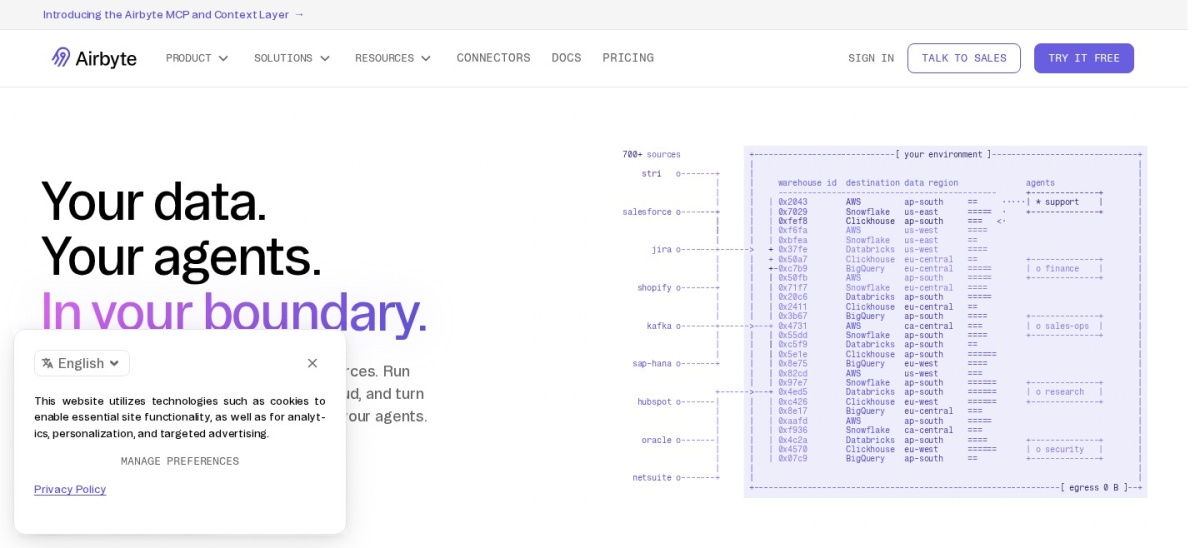
Airbyte homepage, captured Nov 2026.
Airbyte is an open-source data integration platform that automates schema mapping and replication from over 700 sources into cloud warehouses and lakes. Teams can self-host Airbyte Core for free or start on Airbyte Cloud Standard at $20/mo, which includes 5 monthly credits (roughly 1 GB of syncs) and hourly schedules.
The trade off is a steep price jump from usage-based Standard credits to the Plus tier at $189/mo (40 credits) and custom annual Pro contracts for high volume. It suits engineering teams wanting open-source control and custom API connector building.
What we like
Free self-hosted edition with no per-row licensing
Massive catalog of 700+ connectors plus a Python CDK for custom sources
Self-hosted deployment requires Kubernetes and DevOps maintenance
Community-maintained long-tail connectors vary in stability
Cloud Plus ($189/mo) adds SSO, 15-minute sync intervals, and a 24-hour support SLA.Visit airbyte.com
04
Coupler.io
4.8/5on G2 (104 reviews, checked Nov 2026)
Paid from$32/mo
Best for spreadsheet and BI dashboard mapping
Sources400+ marketing, CRM & finance apps
Free tier1 user, 1 source, manual refresh
DestinationsSheets, Excel, Looker, Power BI, BigQuery
TransformJoin, append, filter & formula fields
coupler.io
Coupler.io homepage, captured Nov 2026.
Coupler.io is a no-code data integration and reporting tool that blends, maps, and schedules app data into spreadsheets, BI tools, and warehouses. Its free plan supports one user, one source, and one destination with manual refreshes across 400+ connectors.
The trade off is that automated scheduling requires upgrading to Starter at $32/mo ($24/mo billed annually), which caps runs at 5,000 rows and daily refreshes. It suits marketing analysts and finance teams building automated client or executive dashboards.
What we like
Built-in data blending lets you join and append multiple sources before export
All 400+ data sources are unlocked even on the free plan
Includes 100+ prebuilt dashboard templates for Looker Studio and Power BI
Affordable $32/mo entry plan with no credit card required to test
Watch out for
Hourly refreshes require the $259/mo Pro plan ($199/mo billed annually)
Not designed for high-frequency database change data capture
Dataddo is a no-code data integration platform that maps and routes data between cloud apps, databases, BI tools, and AI assistants. Its free tier includes three data flows and up to 100,000 rows per month with no credit card required.
The trade off is that full warehouse and dashboard sync plans start at $99/mo billed annually ($129/mo monthly), and complex multi-step transformations are basic compared to dedicated ETL suites. It suits small data teams and analysts needing fast SaaS-to-BI or MCP connectivity.
What we like
Generous free tier covers 3 active flows and 100,000 rows monthly
Dedicated Data to AI plan ($13.99/seat/mo) serves governed data over MCP
Supports European data residency and hybrid deployment options
Responsive customer support praised across 185 G2 reviews
Watch out for
In-pipeline transformations are limited to basic filtering and field mapping
Standard plans do not include formal uptime SLAs
Data Anywhere ($99/mo billed annually) unlocks unlimited destinations and scheduled syncs.Visit dataddo.com
06
Hevo Data
4.4/5on G2 (297 reviews, checked Nov 2026)
Paid from$299/mo
Best for automated schema drift handling
Connectors190+ SaaS, DB & streaming sources
Free tier1M events/mo across 50 sources
TransformPython pre-load & SQL post-load
Support24/7 live chat support included
hevodata.com
Hevo Data homepage, captured Nov 2026.
Hevo Data is a managed no-code ELT platform that automatically maps source schemas and detects column changes before loading data into cloud warehouses. Its permanent free tier includes up to 1 million events per month across 50 free connectors and up to five users.
The trade off is a steep jump to the Starter plan at $299/mo ($265/mo billed annually) for 5 million events and full access to 190+ connectors. It suits mid-market analytics teams wanting hands-off warehouse ingestion with 24/7 live support.
What we like
Automatic schema mapper handles new columns and data type mismatches
Supports Python transformations during ingestion and dbt Core post-load
Free tier includes 1 million monthly events and 1-hour scheduling
24/7 live support is available even on entry plans
Watch out for
Starter tier jumps to $299/mo once you exceed 1M events or need database CDC
On-demand event overages can add up during large historical reloads
Estuary is a real-time data integration platform that combines log-based change data capture (CDC) with batch ELT and in-flight schema transformations. Its free Developer plan includes up to 10 GB of data per month and two active connector instances with no credit card required.
The trade off is per-instance pricing on the Cloud tier, which charges $100/mo per connector instance ($50/mo after six) plus $0.50 per GB moved. It suits data engineering teams needing sub-second database replication without paying per-row fees.
What we like
Sub-second streaming CDC with exactly-once delivery guarantees
In-flight SQL and TypeScript transformations reshape data before storage
Per-GB pricing is often far cheaper than per-row billing for wide tables
Free Developer tier covers 10 GB/mo and 2 connectors indefinitely
Watch out for
Adding many low-volume connectors gets pricey at $100/mo per instance
Historical backfills bill at $0.50/GB in the month they execute
Cloud pay-as-you-go removes the 10 GB and 2-connector caps at $0.50/GB plus instance fees.Visit estuary.dev
08
Integrate.io
4.4/5on G2 (213 reviews, checked Nov 2026)
Starts at$1,999/mo
Best for flat-rate unlimited data volume
Connectors150+ native + universal REST API
Transforms220+ low-code visual operators
Volume capUnlimited rows, pipelines & users
Trial14-day free trial, no credit card
integrate.io
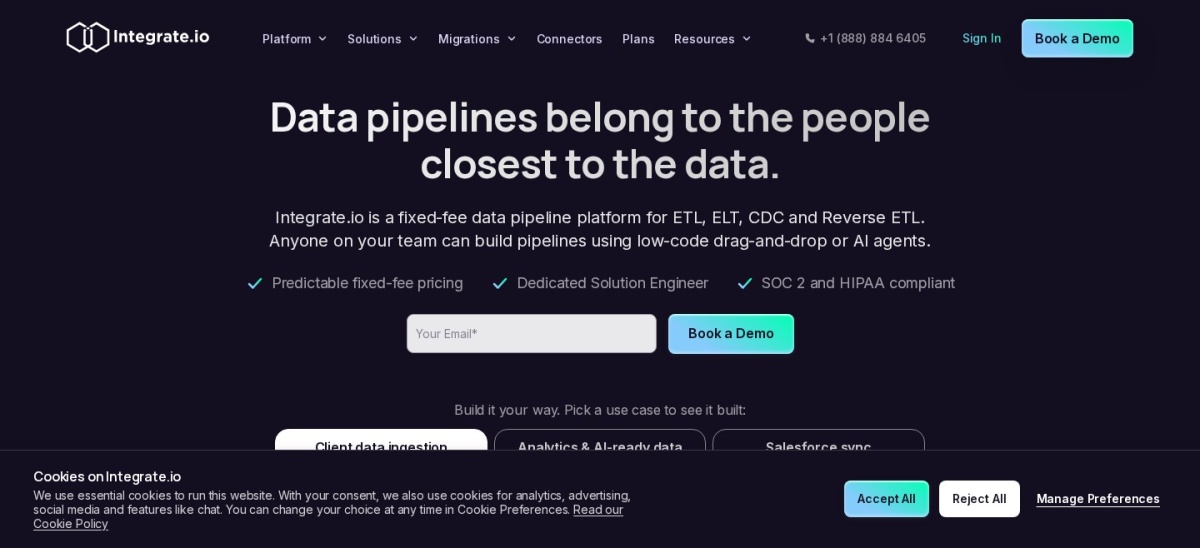
Integrate.io homepage, captured Nov 2026.
Integrate.io is a low-code ETL, ELT, and reverse ETL platform offering a visual pipeline designer with over 220 drag-and-drop data transformations. Its Core plan costs a flat $1,999/mo and includes unlimited data volume, pipelines, connectors, users, and 24/7 support.
The trade off is the high $1,999/mo entry floor, which makes it expensive for small teams moving only a few hundred thousand rows. It suits mid-market organizations with heavy data volumes that want zero overage surprises.
What we like
Flat $1,999/mo pricing includes unlimited rows, connectors, and users
Over 220 built-in low-code transformations for complex field prep
Includes 30-day guided onboarding with a dedicated Solutions Engineer
Supports ETL, ELT, CDC, and reverse ETL in one workspace
Watch out for
No free tier or low-cost starter plan below $1,999/mo
Advanced security features like HIPAA readiness require a custom tier
Core ($1,999/mo) includes full platform access, unlimited volume, and 24/7 support.Visit integrate.io
How data mapping pricing models compare
Row and record meters (used by Skyvia and Hevo Data) work best when your tables are narrow and daily change rates stay predictable. Watch out for full-table reloads or schema resets, which re-bill every row in a table.
Volume and capacity models (used by Estuary and Airbyte) meter by gigabytes or compute credits rather than row counts, making them more economical for wide JSON payloads. If your volume fluctuates wildly each month, flat-rate plans like Integrate.io eliminate billing spikes altogether.
How we chose
We built this list by evaluating established data mapping, ETL, and schema transformation platforms across G2 reviews, vendor documentation, and public pricing pages. Every candidate had to support visual field mapping or automated schema conversion across multiple databases, files, or SaaS applications.
All prices, free tier limits, G2 ratings, and review counts were verified on 22 Nov 2026 directly from official vendor pricing pages and G2 product listings. Where vendors offer both monthly and annual billing, we list the regular monthly rate alongside annual discounts in the text.
We excluded enterprise-only platforms that hide all pricing behind sales quotes (such as Informatica, Boomi, and Tamr), discontinued open-source tools like Talend Open Studio, and niche importers with fewer than 20 verified reviews. No vendor paid for a place, and we do not claim testing for this list.
How to choose the right data mapping tool
Follow these four steps to match a data mapping platform to your schemas, team skills, and budget.
Audit your source and target formats first. List every database, SaaS API, spreadsheet, or EDI standard you need to connect, and verify whether the tool supports nested JSON or multi-table joins natively.
Decide where transformations should happen. Choose an ETL tool like Skyvia or Integrate.io if you need to clean and reshape fields before loading, or an ELT tool like Airbyte if you transform data inside your warehouse with SQL.
Model your monthly row or gigabyte volume. Estimate both steady-state daily syncs and one-time historical backfills so you do not get surprised by per-record or per-GB overages.
Test schema drift and error handling on a free tier. Use a free plan or 14-day trial to rename a source column and see whether the mapper adapts automatically or breaks your pipeline.
FAQ
What is data mapping software?
Data mapping software connects fields from a source system to matching fields in a destination system. It handles data type conversions, formatting rules, and schema changes so records transfer accurately without manual spreadsheet cleanup.
Is there free data mapping software?
Yes. Skyvia, Coupler.io, Dataddo, Hevo Data, and Estuary all offer permanent free plans with monthly row or gigabyte caps, while Airbyte Core is free to self-host on your own infrastructure.
What is the difference between ETL and ELT data mapping?
ETL tools map and transform data on an intermediate server before writing it to the target database. ELT tools load raw mapped tables into a cloud warehouse first, then use SQL or dbt to transform the data.
Which data mapping tool is best for non-developers?
Skyvia and Coupler.io are the easiest options for non-technical users, offering visual drag-and-drop field mappers, prebuilt templates, and no-code scheduling into CRMs, Google Sheets, and BI dashboards.
Which tool handles EDI and XML file mapping best?
Altova MapForce specializes in complex file-to-file conversions, supporting X12, EDIFACT, XBRL, XML, and JSON schemas with visual debugging and one-time perpetual desktop licensing.