WLWPLegible EditorsLast verified 22 Nov 2026How we rank9 min read
★ Short answer
Databricks is the best overall data lake tool for most engineering and AI teams, combining Delta Lake ACID storage with pay-as-you-go compute from $0.15 per DBU and a 4.6/5 G2 rating across 1,426 reviews. Snowflake fits SQL-heavy analytics teams at $2.00 per credit, while Dremio suits open Apache Iceberg querying with a permanent free tier.
How we make this list: we compare pricing pages, product documentation and public user reviews, then re-check every price before each update. No product paid for a place. Disclosure.
Databricks holds a 4.6/5 G2 rating across 1,426 reviews and starts at $0.15 per DBU for classic jobs compute.
Snowflake separates storage at $23/TB per month from compute starting at $2.00 per credit on Standard.
Dremio and Starburst Galaxy both offer permanent free tiers alongside usage billing at $0.20 per DCU and $0.50 per credit.
Object storage foundations like Amazon S3 ($0.023/GB-month) and Azure Data Lake Storage ($0.019/GB-month) keep raw storage costs low.
Telemetry-focused Cribl Lake pairs a free 50 GB lake tier with self-managed storage pricing at $0.02 per GB.
What to look for in a data lake tool
Modern data lake tools have largely evolved into open lakehouses that combine low-cost object storage with transactional table formats like Apache Iceberg and Delta Lake. When evaluating platforms, separate the storage layer from the query and compute engines so you can scale each independently without migrating petabytes of raw files.
Governance and open-format compatibility matter more than raw ingestion speed. Look for centralized catalog controls, column-level permissions, and support for standard Parquet, Iceberg, or Delta tables so multiple BI, SQL, and machine learning engines can read the same dataset without creating duplicate copies.
Usage-based billing is standard across cloud data lakes, yet the meter behaves very differently by vendor. Some platforms bill per-second compute credits on top of underlying cloud VMs, while others charge per terabyte scanned or reserved capacity units, making workload predictability the main driver of annual spend.
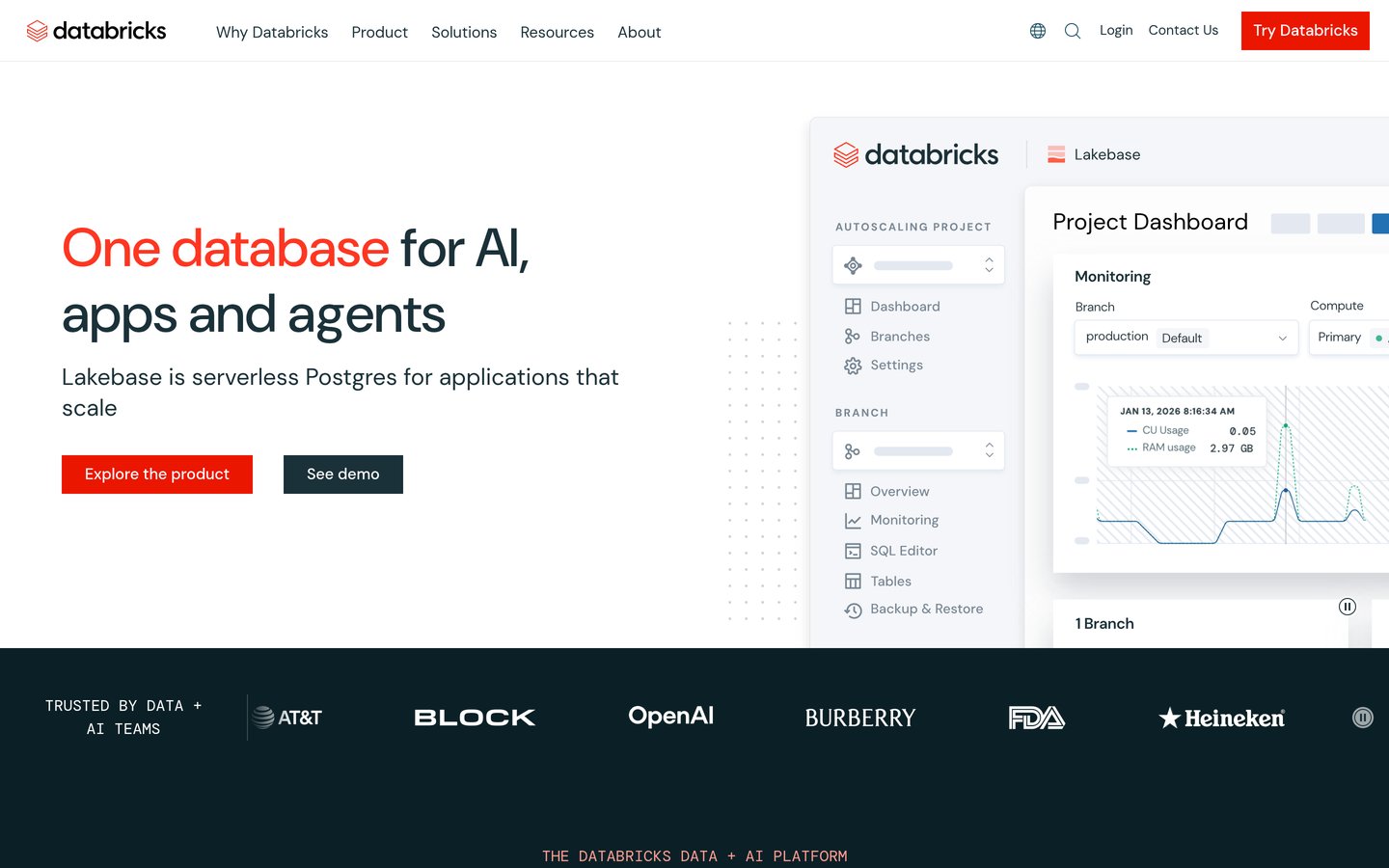
Databricks is a unified data lakehouse platform built around Delta Lake, Apache Spark, and Unity Catalog for data engineering, SQL warehousing, and machine learning. Its Community Edition gives individuals a free sandbox to learn Spark, while pay-as-you-go production billing starts at $0.15 per DBU for classic jobs compute on AWS.
The trade off is that classic DBU rates exclude underlying cloud virtual machines and storage, and serverless SQL climbs to $0.70 per DBU. It suits engineering-led teams running heavy batch, streaming, and AI pipelines across multi-cloud object storage.
What we like
Combines ETL pipelines, SQL analytics, notebooks, and ML in one platform
Unity Catalog governs tables, files, and AI models across clouds
Per-second billing with no mandatory annual upfront commitment
Watch out for
Underlying EC2 or cloud VM charges are billed separately on classic clusters
Steeper learning curve for pure SQL analysts than warehouse-first tools
Paid plans add production clusters, Unity Catalog governance, and enterprise SLAs.Visit databricks.com
02
Snowflake
4.5/5on G2 (824 reviews, checked Nov 2026)
Starts at$2.00/cr/credit
Best for SQL analytics and data sharing
Entry compute rate$2.00 / credit (Standard)
Storage rate$23.00 / TB per month
Trial$400 credits for 30 days
CloudsAWS, Azure, Google Cloud
snowflake.com
Snowflake homepage, captured Nov 2026.
Snowflake is a managed cloud data platform that pairs separated storage and compute with support for structured, semi-structured, and Apache Iceberg lakehouse tables. There is no permanent free tier, though new accounts receive $400 in free credits for 30 days, and Standard edition starts at $2.00 per credit plus $23.00 per TB of monthly storage.
The trade off is that virtual warehouses bill with a 60-second minimum on start and jump to $3.00 per credit on Enterprise for features like 90-day data recovery. It suits SQL-centric analytics teams that want minimal infrastructure tuning and live cross-account data sharing.
What we like
Independent compute warehouses prevent BI queries from blocking ETL loads
Zero-copy cloning, time travel, and live data sharing simplify workflows
Auto-suspend shuts down idle compute after configurable inactivity
Watch out for
No ongoing free tier once the 30-day $400 trial expires
Unmonitored large warehouses can burn credits rapidly
Standard edition unlocks elastic SQL compute, AI search, and live data sharing.Visit snowflake.com
03
Dremio
4.6/5on G2 (71 reviews, checked Nov 2026)
Paid from$0.20/DCU/DCU
Best for Apache Iceberg BI queries
Entry compute rate$0.20 / DCU (Cloud)
Smallest engineXS (32 DCUs = $6.40/hr)
Core standardApache Iceberg & Arrow
DeploymentManaged Cloud or Kubernetes
dremio.com
Dremio homepage, captured Nov 2026.
Dremio is an open data lakehouse platform built on Apache Iceberg and Apache Arrow that accelerates interactive SQL and BI queries directly on object storage. Dremio Cloud includes a permanent free tier with no time limit, while paid on-demand engines bill at $0.20 per Dremio Compute Unit, starting at $6.40 per hour for an XS engine.
The trade off is that paid support and enterprise self-hosted Kubernetes deployments require custom contracts, and heavy ETL pipelines still rely on external Spark or Flink jobs. It suits teams standardizing on Apache Iceberg that want fast dashboard queries without copying data into a proprietary warehouse.
What we like
Permanent free tier on Dremio Cloud with no expiration date
Reflections automatically materialize and accelerate recurring BI queries
Queries Iceberg tables and external databases without data movement
Watch out for
Paid support tiers and Enterprise Edition require custom quotes
Less suited for heavy Python or machine learning model training
Starburst is an enterprise distribution of open-source Trino designed to run federated ANSI SQL queries across cloud data lakes, warehouses, and operational databases in place. Its managed Starburst Galaxy service includes a permanent free tier supporting up to three clusters, while paid Pro plans start at $0.50 per credit with a $500 30-day trial.
The trade off is that Enterprise features like attribute-based access control and AWS PrivateLink raise the rate to $0.75 per credit, and ingestion compute adds separate charges. It suits organizations with fragmented data across multiple clouds or databases that want one SQL access layer.
What we like
Permanent free tier on Galaxy plus $500 in 30-day trial credits
Joins data across S3, Iceberg, Delta Lake, and relational databases in one query
Available as managed SaaS or self-hosted Starburst Enterprise
Watch out for
Query speed across external databases depends on source system limits
Advanced security and private networking require higher credit tiers
Pro tier unlocks streaming ingest, flexible execution modes, and advanced cluster controls.Visit starburst.io
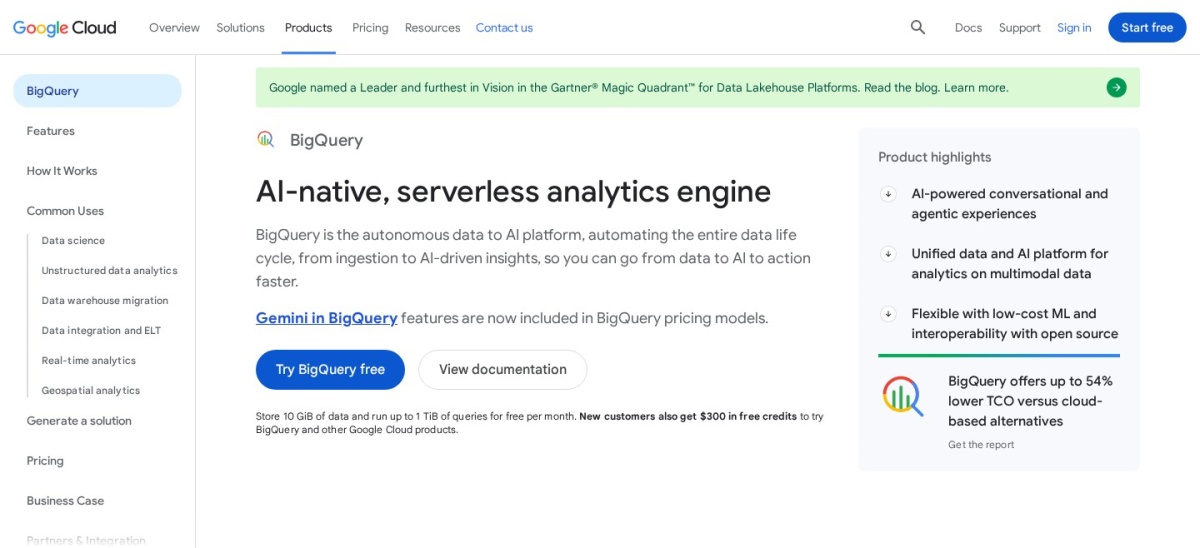
Google BigQuery is a serverless data warehouse and lakehouse engine that queries managed storage and open Apache Iceberg tables in Cloud Storage without cluster administration. Every account gets 1 TiB of on-demand query processing free each month, after which on-demand queries cost $6.25 per TiB scanned, or $0.04 per slot-hour on Standard capacity.
The trade off is that unpartitioned SELECT * queries scan entire columns and can generate steep on-demand bills if teams skip partitioning or byte caps. It suits teams in Google Cloud that want zero-infrastructure SQL analytics with a generous monthly free tier.
What we like
First 1 TiB of on-demand query data scanned each month is free
Zero cluster sizing or server maintenance required for SQL workloads
Queries external Iceberg and Parquet files directly in Cloud Storage
Watch out for
Broad queries on unpartitioned tables quickly run up per-TiB charges
Deepest governance and BI integrations remain centered on Google Cloud
Paid usage scales beyond the monthly 1 TiB query allowance with per-TiB or slot billing.Visit cloud.google.com
Egress allowanceFirst 100 GB/mo free, then $0.09/GB
aws.amazon.com
Amazon S3 homepage, captured Nov 2026.
Amazon S3 is the foundational object storage layer behind most AWS data lakes, pairing 99.999999999% durability with native S3 Tables support for Apache Iceberg. S3 Standard starts at $0.023 per GB-month for the first 50 TB in US East, with automated lifecycle tiers dropping to $0.00099 per GB-month in Glacier Deep Archive.
The trade off is that S3 is storage only, meaning you must pair it with AWS Lake Formation, Athena, EMR, or third-party query engines, while internet egress costs $0.09 per GB after 100 GB free. It suits AWS-centric organizations building a decoupled, multi-engine storage foundation.
What we like
Supported out of the box by virtually every analytics, ETL, and ML engine
Same-region transfers to AWS analytics services carry zero egress fees
Watch out for
Requires separate services for SQL querying, cataloging, and governance
Small-file workloads in infrequent access tiers trigger minimum size fees
Pay-as-you-go storage scales from single gigabytes to exabytes with lifecycle tiering.Visit aws.amazon.com
07
Azure Data Lake Storage
4.5/5on G2 (40 reviews, checked Nov 2026)
Starts at$0.019/GB/GB/mo
Best for Microsoft and Azure data estates
Hot storage rate$0.019 / GB-month (first 50 TB)
Premium tier$0.15 / GB-month
Key featureHierarchical namespace & POSIX ACLs
IntegrationsFabric, Databricks, Synapse, Purview
azure.microsoft.com
Azure Data Lake Storage homepage, captured Nov 2026.
Azure Data Lake Storage Gen2 combines Azure Blob object storage with a hierarchical namespace so analytics engines can run atomic directory renames and file operations at scale. Hot LRS storage starts at $0.019 per GB-month for the first 51,200 GB, while high-throughput Premium storage is $0.15 per GB-month.
The trade off is that transaction fees, query acceleration scans, and early deletion penalties on Cool or Archive tiers add complexity to monthly bills, and separate compute engines are still required. It suits enterprises standardized on Azure, Microsoft Fabric, and Entra ID security.
What we like
Hierarchical directory structure speeds up Spark and Hadoop file operations
Fine-grained POSIX and Entra ID access control at folder and file levels
Direct integration with Azure Databricks, Microsoft Fabric, and Synapse
Watch out for
Storage-only service requiring external compute engines for SQL and ML
Transaction and metadata operations incur separate per-request charges
Cribl Lake is a turnkey data lake purpose-built for IT observability and security telemetry, storing data in open JSON and Parquet formats without vendor lock-in. Its free plan includes 50 GB of lake capacity alongside 1 TB per day of Cribl Stream ingestion, while paid Bring Your Own Storage starts at $0.02 per GB and Cribl-managed storage at $0.05 per GB.
The trade off is that it targets log and telemetry retention rather than general-purpose relational BI modeling, and unused annual cloud credits cap rollover at 20%. It suits security and DevOps teams offloading high-volume logs from expensive SIEM platforms.
What we like
Free tier includes 50 GB of lake storage plus 1 TB/day of Stream routing
Stores telemetry in open Parquet and JSON formats queryable by external tools
Bring Your Own Storage option lowers management fees to $0.02 per GB
Watch out for
Built for observability and security logs rather than general BI warehousing
Credit rollover is capped at 20% at the end of an annual term
Paid credit plans remove the 50 GB free capacity cap and unlock multi-workspace RBAC.Visit cribl.io
Object storage vs. managed lakehouse platforms
Raw object stores like Amazon S3 and Azure Data Lake Storage cost around $0.019 to $0.023 per GB-month, making them the cheapest place to land petabytes of logs, images, and Parquet files. However, they do not execute SQL queries or enforce ACID transactions on their own, so you must assemble and govern separate query engines on top.
Managed lakehouse platforms like Databricks, Snowflake, Dremio, and Starburst wrap compute, metadata catalogs, and governance around open table formats such as Apache Iceberg and Delta Lake. You pay higher compute rates per hour or credit, but gain instant SQL access, automated compaction, and row-level security without managing clusters manually.
How we chose
We built this shortlist by comparing widely adopted cloud data lake storage layers, open lakehouse platforms, and federated SQL query engines used in production data stacks. Every candidate had to support open file or table formats—such as Parquet, Apache Iceberg, or Delta Lake—and hold verified user reviews on G2.
All pricing figures, free-tier allowances, G2 star ratings, and review counts were verified directly from official vendor pricing pages and G2 product listings on 22 Nov 2026. Because data lake tools bill by usage rather than flat seat licenses, the price ladder reflects normalized annual entry estimates based on published unit rates.
We excluded legacy on-premises-only Hadoop distributions without transparent self-serve cloud pricing, as well as proprietary data warehouses that cannot query open lake formats in place. No vendor paid for a place, and we do not claim testing for this list.
How to choose the right data lake tool
Follow these four steps to match a data lake platform to your cloud stack, query patterns, and budget:
Anchor storage to your primary cloud provider. Keep your raw object storage in the same cloud and region as your compute engines to avoid cross-cloud egress fees like Amazon S3's $0.09/GB transfer rate.
Standardize on an open table format early. Choose tools with first-class Apache Iceberg or Delta Lake support so you can switch or combine query engines later without rewriting underlying Parquet files.
Match the billing meter to your workload shape. Pick per-second auto-suspending compute like Databricks or Snowflake for spiky jobs, and on-demand per-TiB pricing like BigQuery for infrequent ad-hoc SQL.
Validate governance before ingesting production data. Confirm whether column-level permissions, data lineage, and private networking are included in the entry tier or gated behind Enterprise credit rates.
FAQ
What is the difference between a data lake and a data lakehouse?
A data lake stores raw structured and unstructured files in low-cost object storage like Amazon S3. A data lakehouse adds a metadata and transaction layer—such as Apache Iceberg or Delta Lake—so SQL and AI engines can run ACID queries directly on those files.
Which data lake tool has the best free tier?
Google BigQuery offers 1 TiB of free on-demand queries every month, while Dremio Cloud and Starburst Galaxy provide permanent free tiers for open lakehouse querying. Cribl Lake also includes 50 GB of free lake capacity alongside 1 TB/day of telemetry routing.
How much does a cloud data lake cost per month?
Storing 1 TB of raw data costs about $19 to $23 per month on Azure Data Lake Storage, Amazon S3, or Snowflake. Compute makes up most of the bill, ranging from under $150/month for scheduled reporting jobs to several thousand dollars for continuous clusters.
Should I choose Databricks or Snowflake for a data lake?
Choose Databricks if your team relies heavily on Python, Apache Spark, streaming pipelines, and custom machine learning models. Choose Snowflake if your workloads are primarily SQL analytics, business intelligence dashboards, and governed cross-team data sharing.
Why are Apache Iceberg and Delta Lake important?
Both are open table formats that bring ACID transactions, schema evolution, and time travel to plain Parquet files on object storage. Using open formats prevents vendor lock-in because multiple engines can read and write the same tables concurrently.