Best Data Integration Tools in 2026: 8 Tools Compared
WLWPLegible EditorsLast verified 22 Nov 2026How we rank10 min read
★ Short answer
Fivetran is our #1 pick for managed data integration with 750+ prebuilt connectors and a 500,000 MAR free tier. Choose Airbyte if you want an open-source self-hosted option or $20/mo entry cloud pricing, or Estuary for real-time CDC streaming.
How we make this list: we compare pricing pages, product documentation and public user reviews, then re-check every price before each update. No product paid for a place. Disclosure.
Fivetran covers 750+ sources with a free plan up to 500,000 MAR, while paid Standard connections carry a $5/mo base charge.
Airbyte starts at $20/mo on Cloud for 5 credits (~1 GB) and offers a free self-hosted Core edition with 700+ connectors.
Skyvia and Coupler.io offer the lowest entry barriers for SMBs, starting at $24/mo (billed annually) and $79/mo (billed annually).
Estuary combines real-time CDC and batch pipelines at $0.50/GB plus $100/mo per connector after a 10 GB free Developer tier.
Integrate.io eliminates row-based billing surprises with a flat $1,999/mo plan for unlimited data volume, pipelines, and connectors.
What to look for in a data integration tool
Data integration tools move, replicate, and transform records between SaaS apps, operational databases, spreadsheets, and cloud warehouses. The right platform depends on whether your team prioritizes hands-off managed connectors, open-source customization, or real-time Change Data Capture (CDC).
Pricing metrics shape your total bill more than the starting sticker price. Row-based platforms like Fivetran, Hevo Data, and Stitch charge per active row or event, so high-churn tables or frequent re-syncs can multiply costs quickly. Volume-based tools like Airbyte and Estuary bill by gigabytes or credits moved, while Coupler.io and Integrate.io rely on account caps or flat-rate tiers.
Sync frequency and transformation depth also vary across entry plans. Many low-cost tiers limit schedules to once every 24 hours, whereas warehouse-focused ELT tools offer 15-minute or sub-minute replication alongside built-in dbt or SQL orchestration.
Fivetran is a fully managed ELT service with more than 750 prebuilt connectors, automated schema drift handling, and log-based database CDC. Its Free plan includes Standard features up to 500,000 monthly active rows (MAR) for connections, 3,500 activation MAR, and 5,000 monthly model runs.
The trade off is per-connection MAR billing, where every paid Standard connection carries a $5/mo base charge plus $495 per million MAR up to 1M rows, and deletes count toward paid usage. It suits warehouse-first teams that want zero connector maintenance.
What we like
750+ prebuilt SaaS and database connectors
Automated schema migration and incremental syncs
Permanent free tier up to 500,000 MAR/mo
Built-in dbt transformations and reverse ETL activations
Watch out for
MAR is calculated separately per connection, not pooled
High-churn tables and deletes can spike monthly bills
1-minute syncs require the higher Enterprise tier
Standard removes the 500K MAR cap with pay-as-you-go usage from $5/mo per active connection.Visit fivetran.com
02
Airbyte
4.4/5on G2 (79 reviews, checked Nov 2026)
Paid from$20/mo
Best for open-source flexibility and custom APIs
Connectors700+ sources + CDK
Free tierSelf-hosted Core (ELv2)
Billing metricData volume / credits
Min sync interval1 hr (Standard)
airbyte.com
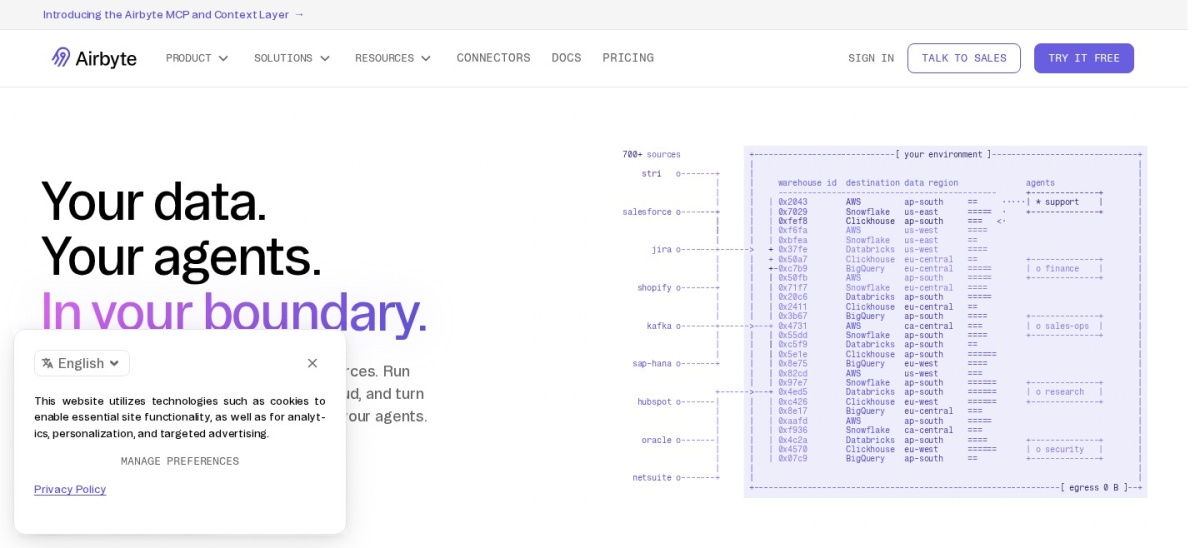
Airbyte homepage, captured Nov 2026.
Airbyte is an open-core data integration platform offering 700+ connectors, database CDC, and a low-code Connector Builder. You can self-host the open-source Core edition for free, or test Airbyte Cloud with a 14-day trial that includes 400 credits (~100 GB of syncs).
The trade off is that Cloud Standard starts at $20/mo for only 5 credits (~1 GB) with hourly syncs, while 15-minute syncs and SSO require Plus at $189/mo, and community connectors vary in maturity. It suits engineering teams wanting an open-source escape hatch.
Supports vector database destinations for AI pipelines
Watch out for
Long-tail community connectors can be less stable
Airbyte Cloud has no permanent free tier after 14 days
Self-hosting requires managing your own infrastructure
Cloud Standard ($20/mo) provides managed hosting with 5 monthly credits (~1 GB of synced data).Visit airbyte.com
03
Coupler.io
4.8/5on G2 (104 reviews, checked Nov 2026)
Paid from$24/mo
Best for spreadsheet and BI reporting without a warehouse
Connectors400+ apps & warehouses
Free tier1 account, manual refresh
Billing metricConnected accounts
Min sync intervalDaily (Starter) / Hourly (Pro)
coupler.io
Coupler.io homepage, captured Nov 2026.
Coupler.io is a no-code data integration and reporting platform that connects 400+ marketing, finance, and sales apps directly to Google Sheets, Excel, Looker Studio, Power BI, and cloud warehouses. Its Free plan supports 1 user, 1 source account, and 1 destination with manual refresh.
The trade off is per-account limits and daily refresh on Starter ($24/mo billed annually, or $32/mo monthly), which caps runs at 5,000 rows and requires Pro ($199/mo annual) for hourly updates. It suits marketing, finance, and agency teams building automated reports.
What we like
All 400+ connectors unlocked on every tier
Predictable per-account billing instead of row counts
230+ prebuilt dashboard templates and AI analysis
Direct loading into spreadsheets and BI tools
Watch out for
Starter plan limits imports to 5,000 rows per run
Hourly refreshes require upgrading to the $199/mo Pro tier
No log-based database CDC for real-time replication
Best budget cloud ETL, reverse ETL, and SaaS backup
Connectors~200 cloud apps & DBs
Free tier10,000 records/mo
Billing metricRecords per month
Min sync intervalDaily (Basic) / 1 hr (Standard)
skyvia.com
Skyvia homepage, captured Nov 2026.
Skyvia is a browser-based no-code data platform supporting ETL, ELT, bidirectional sync, reverse ETL, and cloud-to-cloud backups across ~200 apps and databases. Its Free plan provides 10,000 records per month and 2 scheduled integrations running once daily.
The trade off is sync speed tied strictly to tier: Basic ($79/mo billed annually, or $99/mo monthly for 5M records) runs only once a day, while hourly syncs require Standard ($159/mo annual). It suits small businesses needing affordable bi-directional CRM and database syncs.
What we like
Supports ETL, reverse ETL, and bi-directional syncs
Generous 5M records/mo on the $79/mo Basic annual plan
Includes visual data mapping and SQL query builder
Separate modules available for SaaS backup and OData endpoints
Watch out for
Daily sync cap on Free and Basic plans
1-minute syncs require the $399/mo Professional annual plan
Backup and automation modules are billed separately
Basic ($79/mo billed annually) raises the monthly quota from 10,000 to 5 million records.Visit skyvia.com
05
Estuary
4.7/5on G2 (35 reviews, checked Nov 2026)
Paid from$100/mo
Best for sub-second streaming and real-time CDC
LatencyMillisecond streaming CDC
Free tier10 GB/mo + 2 connectors
Billing metric$0.50/GB + $100/connector
DeploymentCloud, Private, BYOC
estuary.dev
Estuary homepage, captured Nov 2026.
Estuary is a real-time DataOps platform that unifies sub-second log-based CDC and batch SaaS ingestion in one streaming architecture. Its free Developer tier includes up to 10 GB of data moved per month across any 2 connectors with millisecond latency and no credit card required.
The trade off is per-connector instance fees on Cloud ($100/mo per connector for the first 6, plus $0.50/GB moved), meaning idle staging connectors still incur monthly charges. It suits data teams needing low-latency operational replication alongside warehouse loading.
What we like
True millisecond streaming CDC and batch in one tool
Permanent free tier up to 10 GB/mo and 2 connectors
Linear $0.50/GB volume pricing without row-churn spikes
Supports Cloud, Private, and Bring Your Own Cloud (BYOC)
Watch out for
$100/mo per connector fee adds up with many small sources
Smaller third-party connector catalog than Fivetran or Airbyte
Large historical backfills bill at $0.50/GB in one cycle
Cloud pay-as-you-go removes the 2-connector and 10 GB limits at $100/mo per connector plus $0.50/GB.Visit estuary.dev
06
Stitch
4.4/5on G2 (68 reviews, checked Nov 2026)
Starts at$100/mo
Best for straightforward row-quota ELT
Connectors100+ standard sources
Free tierNone (14-day trial)
Billing metricRows replicated/mo
ComplianceSOC 2 Type II, ISO 27001
stitchdata.com
Stitch homepage, captured Nov 2026.
Stitch is a Qlik-owned managed ELT service built on open-source Singer taps that replicates data from 100+ SaaS apps and databases into cloud warehouses. It offers a 14-day free trial, with Standard starting at $100/mo for 5 million rows, 10 standard sources, 1 destination, and 5 users.
The trade off is the lack of a permanent free tier and a sharp price jump from Standard ($100–$1,250/mo) to Advanced ($1,500/mo billed annually) for enterprise sources or multiple destinations. It suits small teams wanting predictable monthly row tiers.
What we like
Transparent starting price at $100/mo for 5 million rows
Simple setup backed by open-source Singer tap extensibility
SOC 2 Type II and ISO 27001 compliance on all plans
Supports up to 5 users on the entry Standard tier
Watch out for
No permanent free tier after the 14-day trial
Standard tier restricts accounts to 1 data destination
Full-table reloads count toward the monthly row allowance
Standard ($100/mo) includes 5 million replicated rows per month across up to 10 sources.Visit stitchdata.com
07
Hevo Data
4.4/5on G2 (297 reviews, checked Nov 2026)
Paid from$265/mo
Best no-code event-metered ELT with 24/7 support
Connectors170+ sources & DB CDC
Free tier1M events/mo (50 sources)
Billing metricEvents (insert/update/delete)
Support24/7 chat & email (paid)
hevodata.com
Hevo Data homepage, captured Nov 2026.
Hevo Data is a no-code data pipeline platform with 170+ connectors, automated schema handling, Python transformations, and dbt integration. Its Free tier includes 1 million events per month across 50 free sources with hourly syncs and up to 5 users.
The trade off is a steep step up to Starter at $265/mo billed annually ($299/mo monthly) for 5 million events, and once you upgrade you cannot downgrade back to Free without contacting support. It suits mid-market analytics teams needing responsive 24/7 live chat.
What we like
1 million free events/mo across 50 sources with 5 users
24/7 live chat and email support on all paid plans
Built-in Python transformations and dbt Core scheduling
Zero-maintenance schema drift resolution
Watch out for
Large price jump from Free to $265/mo Starter
Professional ($750/mo annual) is required for API access
Cannot self-downgrade back to the Free tier once upgraded
Starter ($265/mo billed annually) unlocks all 170+ connectors, dbt integration, and 5M monthly events.Visit hevodata.com
08
Integrate.io
4.4/5on G2 (213 reviews, checked Nov 2026)
Starts at$1,999/mo
Best flat-rate unlimited volume ETL and CDC
Connectors150+ native + REST API
Free tierNone (14-day trial)
Billing metricFlat rate (unlimited data)
Min sync interval60 seconds
integrate.io
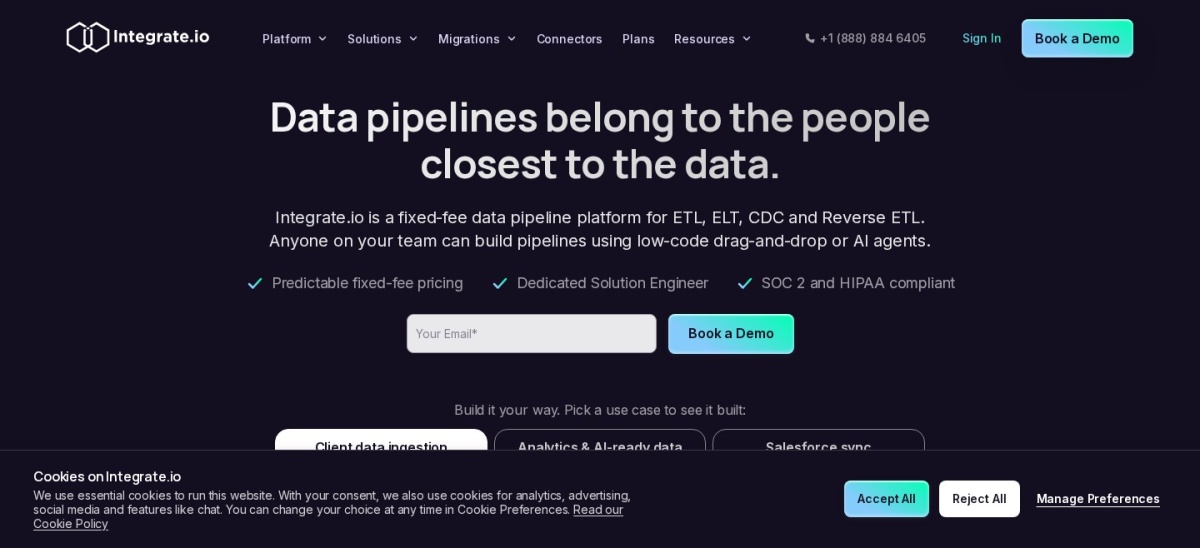
Integrate.io homepage, captured Nov 2026.
Integrate.io is a low-code data integration platform combining drag-and-drop ETL transformations, ELT, 60-second database CDC, and reverse ETL. It offers a 14-day free trial with no credit card, followed by a single fixed-fee plan at $1,999/mo.
The trade off is the $1,999/mo ($23,988/yr) entry floor, which is overkill for small datasets under 10 million rows. It suits mid-market and enterprise teams in e-commerce or finance that want predictable bills with unlimited rows, pipelines, and connectors.
What we like
Flat $1,999/mo fee with zero row or volume overages
Includes 60-second CDC, ETL, and reverse ETL in one plan
Visual low-code transformation builder with 200+ functions
30-day white-glove onboarding and 24/7 support included
Watch out for
High $23,988/yr minimum commitment for smaller teams
No free tier after the 14-day trial expires
Smaller prebuilt SaaS catalog than Fivetran or Airbyte
The $1,999/mo plan includes unlimited data volumes, connectors, pipelines, and users.Visit integrate.io
How data integration pricing models impact your bill
Consumption-based tools measure usage in three main ways: Monthly Active Rows (Fivetran), total rows or events processed (Stitch, Hevo Data, Skyvia), or data volume in gigabytes and credits (Airbyte, Estuary). When a source table updates millions of existing rows daily—common with ad platforms and CRM webhooks—row-metered bills climb rapidly even if your total database size barely grows.
Per-connection and flat-rate pricing flip that dynamic. Fivetran charges a $5/mo base fee per active connection on top of per-connection MAR tiers, while Estuary charges $100/mo per connector instance plus $0.50/GB. If you run dozens of low-volume connectors, per-account pricing (Coupler.io) or flat unlimited pricing (Integrate.io) often yields lower total cost.
How we chose
We evaluated leading cloud ETL, ELT, CDC, and reporting integration platforms listed on G2 with established user bases and active product releases in 2026. We prioritized tools that publish transparent entry pricing on their official websites rather than hiding every tier behind enterprise sales quotes.
All G2 ratings, review counts, free tier limits, and regular annual or monthly entry prices were verified directly against G2 and vendor pricing pages on 22 Nov 2026. Where vendors offer both monthly and annual billing without lock-in, we listed the lowest regular monthly rate annualized for fair comparison.
Enterprise-only suites that withhold public pricing—such as Informatica IDMC, Workato, Matillion, and Qlik Talend Cloud—as well as open-source libraries without hosted pricing were excluded so buyers can compare verifiable baseline costs. No vendor paid for a place, and we do not claim testing for this list.
How to choose the right data integration tool
Match your destination, sync latency, and data volume profile to the right billing model before signing an annual contract.
Define your destination and transformation workflow. Pick a warehouse-first ELT tool like Fivetran, Airbyte, or Stitch if you transform data in Snowflake, BigQuery, or Databricks with dbt. Choose Coupler.io or Skyvia if you want data delivered directly into spreadsheets, BI dashboards, or operational CRMs.
Audit row churn versus total gigabytes moved. Check how often your source tables update existing records. High-churn sources favor volume-based pricing (Estuary at $0.50/GB) or flat plans (Integrate.io), whereas append-only tables fit row-metered tiers cleanly.
Verify minimum sync intervals on the entry tier. Entry plans often restrict schedules to once every 24 hours (Coupler.io Starter, Skyvia Basic) or 1 hour (Airbyte Standard, Hevo Free). Confirm whether your dashboards or operational apps need 15-minute or sub-second CDC updates.
Run a 14-day pilot on your heaviest connector. Use free tiers or 14-day trials to sync your largest database or ad account first, then multiply the measured MAR, events, or gigabytes across all planned sources to forecast your true monthly spend.
FAQ
What is the difference between ETL and ELT data integration tools?
ETL tools transform and clean data on a staging server before loading it into your target system. ELT tools load raw data directly into a cloud data warehouse first, letting you transform tables inside the warehouse using SQL or dbt.
Which data integration tool has the best free plan?
Fivetran offers the highest free row allowance at 500,000 monthly active rows across 750+ connectors. Airbyte is completely free if you self-host its open-source Core edition, while Estuary provides 10 GB per month and 2 real-time connectors for free.
How does Monthly Active Rows (MAR) pricing work?
MAR counts each unique primary key row inserted, updated, or deleted in a destination table during a calendar month. Even if a single row is updated twenty times in one month, it only counts once toward your MAR total for that connection.
When is flat-rate data integration cheaper than usage-based pricing?
Flat-rate platforms like Integrate.io ($1,999/mo) typically become cheaper once your pipelines exceed 15 to 25 million active rows per month or span dozens of high-churn connectors, where per-connection MAR or event overages surpass $2,000 monthly.
Do I need a data warehouse to use a data integration tool?
No. While Fivetran and Stitch target cloud warehouses and lakes, tools like Coupler.io and Skyvia load data directly into Google Sheets, Microsoft Excel, Looker Studio, Power BI, and operational CRM or ERP apps without a warehouse.