Best Customer Service Ecommerce Tools in 2026: 7 Platforms Compared
WLWPLegible EditorsLast verified 22 Nov 2026How we rank6 min read
★ Short answer
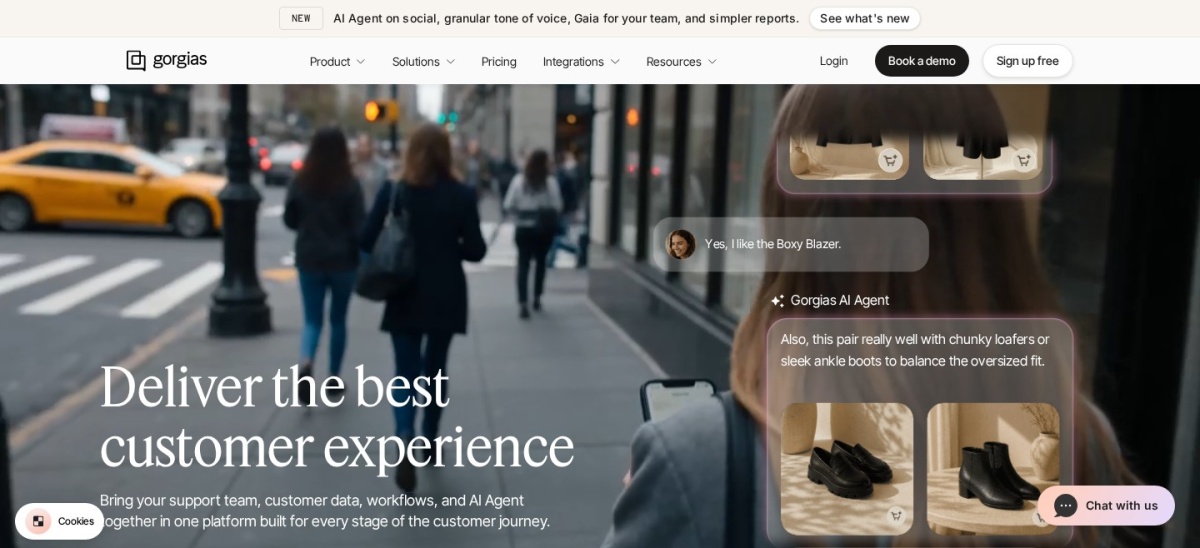
Gorgias leads for direct-to-consumer stores with native order actions and plans starting at $10/month for 50 tickets. Tidio fits smaller stores needing live chat and Lyro AI automation on a free tier or from $33/month billed annually, while eDesk suits sellers across Amazon, eBay, and Walmart.
How we make this list: we compare pricing pages, product documentation and public user reviews, then re-check every price before each update. No product paid for a place. Disclosure.
Gorgias starts at $10/mo for 50 tickets and holds a 4.6/5 rating across 582 G2 reviews.
Tidio offers a free plan for 50 monthly conversations and paid Starter plans from $33/mo billed annually.
eDesk centralizes marketplace tickets across Amazon, eBay, and Walmart from $45/seat/mo billed yearly.
Help Scout includes a free plan for up to 5 users and paid Standard plans from $25/user/mo.
Freshdesk starts at $19/agent/mo billed annually across 4,020 G2 reviews at 4.4/5.
What to look for in ecommerce support software
Ecommerce support queues are heavy on order lookups, address edits, refunds, returns, and shipping status checks. A generic inbox forces agents to switch tabs into your storefront or fulfillment system on every ticket unless order context and actions sit right beside the message.
Pricing models vary sharply across vendors. Some tools bill per ticket or per conversation, while others bill per agent seat, and many charge extra per AI resolution or automated outcome.
Check how a platform handles seasonal volume spikes and multi-channel messages. Stores selling across marketplaces or social channels need unified threading without hidden per-channel markups.
Gorgias is an ecommerce helpdesk built around storefront orders, starting at $10/month for 50 tickets on the monthly Starter plan with 3 seats. Higher tiers scale ticket allowances up to 5,000/month and support refunds, cancellations, and revenue tracking.
The trade off is that ticket overages and automated AI interactions can add extra charges beyond the $120/year entry tier. It suits direct-to-consumer stores that process frequent order changes.
What we like
Order lookup, refunds, and edits sit inside support tickets
Low $10/month entry tier for small ticket volume
Tracks revenue tied to support conversations
Watch out for
Ticket overages and AI resolutions add variable costs
Starter limits users to 3 seats and excludes actions
Paid plans start at $10/mo for 50 tickets, with AI Agent and voice/SMS add-ons extra.Visit gorgias.com
02
Tidio
4.6/5on G2 (2,164 reviews, checked Nov 2026)
Paid from$33/mo
Best for live chat and Lyro AI on small stores
Free plan50 conversations/mo, 10 seats
Paid entryStarter ($33/mo annual)
AI agentLyro (separate tiers)
Trial7-day free trial
tidio.com
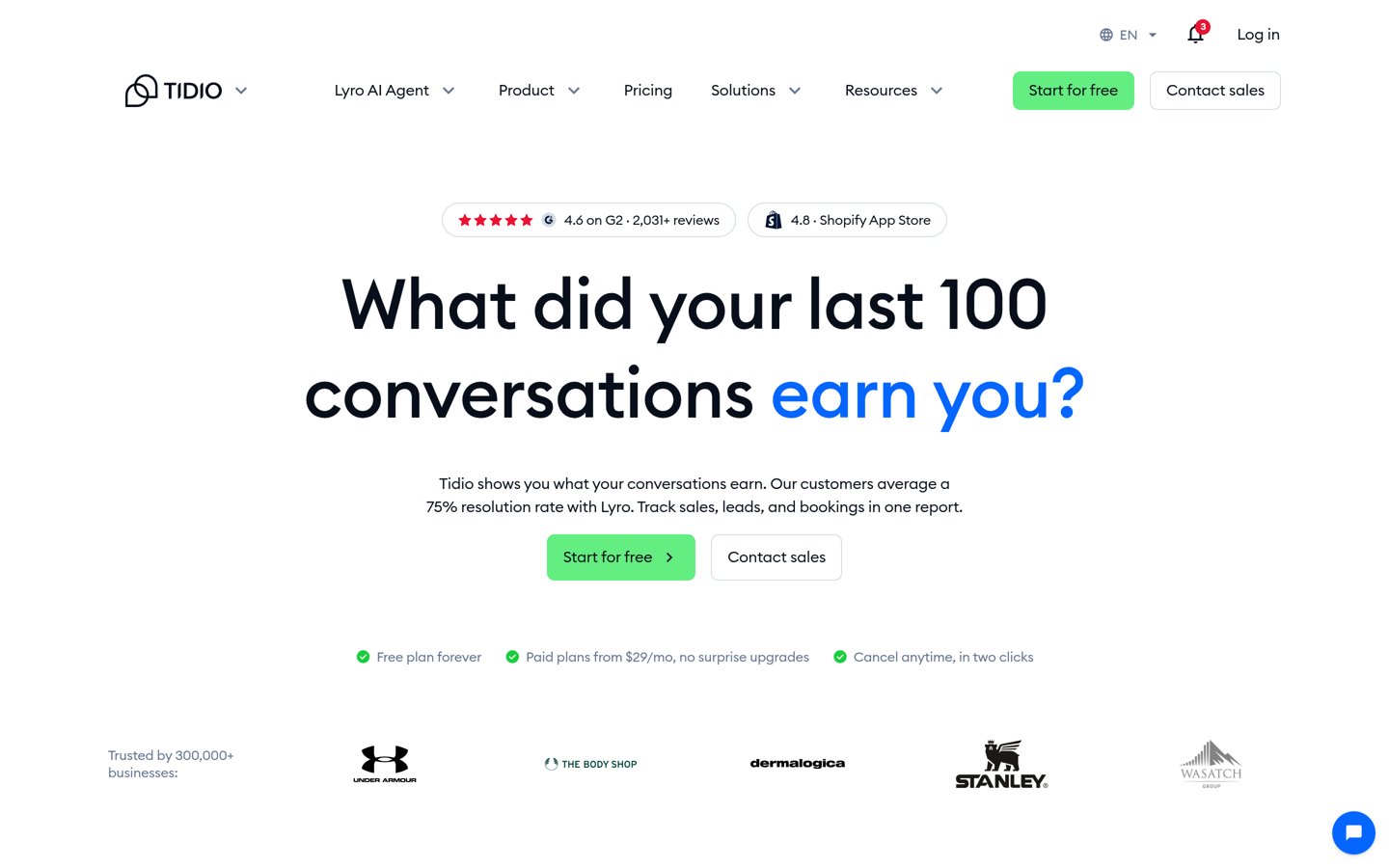
Tidio homepage, captured Nov 2026.
Tidio is a live chat and shared inbox platform with a free plan covering 50 monthly conversations and up to 10 seats, while annual Starter starts at $33/month for 100 conversations. It pairs a chat widget with Lyro AI and visual Flows automation.
The trade off is that Lyro AI conversation bundles and Flows add-ons cost extra above the $390/year Starter rate. It suits small online stores that want fast chat setup and automated answers.
What we like
Includes a free tier for up to 50 conversations monthly
Quick setup for website chat and FAQ-driven Lyro AI
Supports up to 10 seats on Free, Starter, and Growth plans
Watch out for
Higher AI chat volumes increase monthly costs quickly
Less suited to complex multi-marketplace operations
Starter adds 100 monthly conversations and more Smart Actions than the free tier.Visit tidio.com
03
Help Scout
4.4/5on G2 (435 reviews, checked Nov 2026)
Paid from$25/mo
Best for email-first teams wanting a clean shared inbox
Free plan5 users, 1 Inbox, 1 Docs
Paid entryStandard ($25/user/mo)
Envoy AI$0.75 per resolution
Add-on inbox$10/mo billed annually
helpscout.com
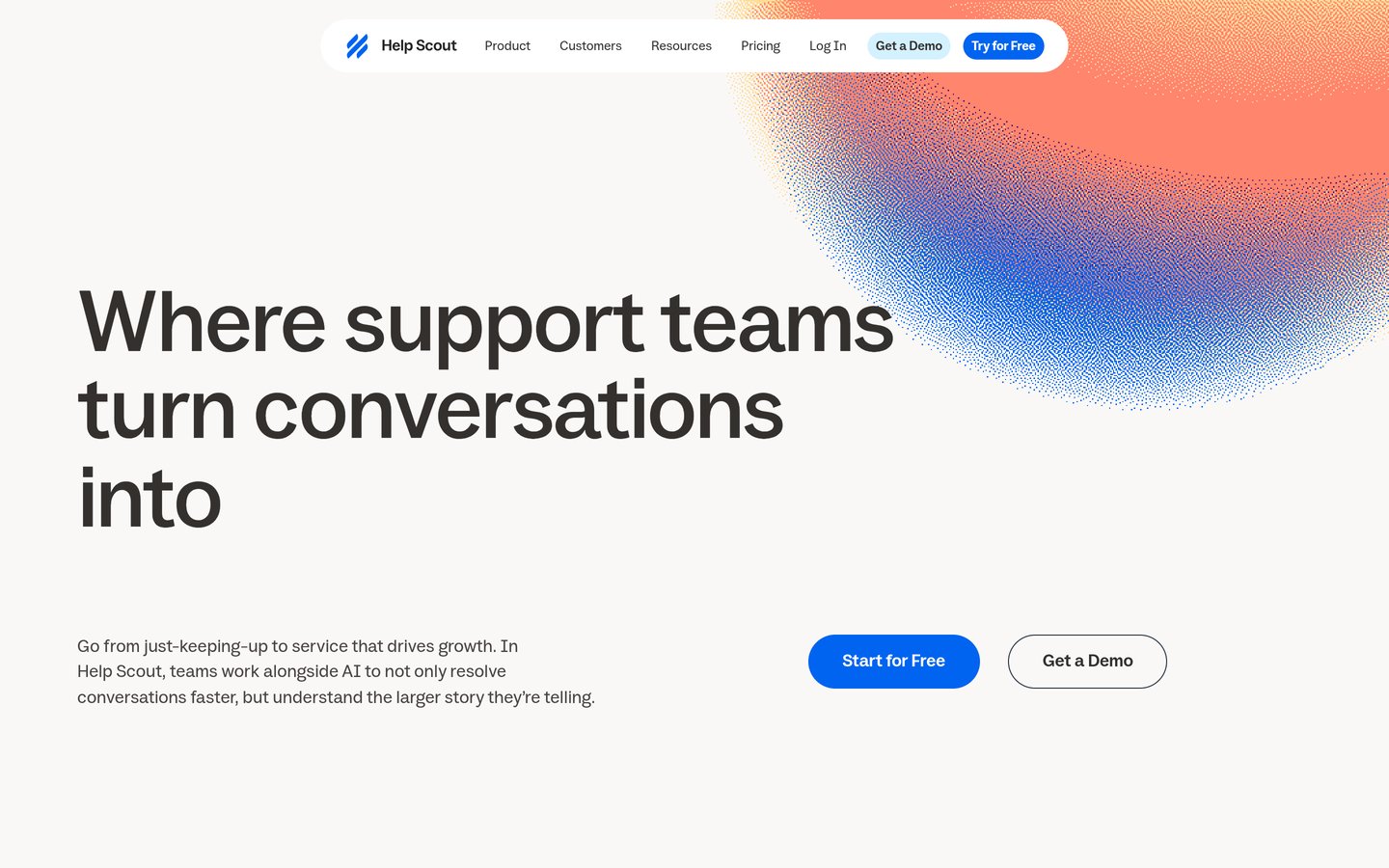
Help Scout homepage, captured Nov 2026.
Help Scout is a shared inbox and help-center platform with a free tier for 5 users, 1 Inbox, and 1 Docs site, while annual Standard starts at $25/user/month. It keeps customer threads organized with private notes, saved replies, and Envoy AI resolutions.
The trade off is per-user pricing plus $0.75 per Envoy AI resolution after the 3-month trial, starting at $300/year for one user. It suits email-led support teams that prefer personal threads over heavy ticket queues.
What we like
Generous free plan for up to 5 users and 1 Inbox
Clean inbox interface with collision detection and notes
Includes a 3-month trial of unlimited Envoy resolutions
Watch out for
Free plan caps you at 1 Inbox and 1 Docs site
Per-seat costs scale as team headcount grows
Standard unlocks multiple inboxes, live chat, SMS, social messaging, and workflows.Visit helpscout.com
04
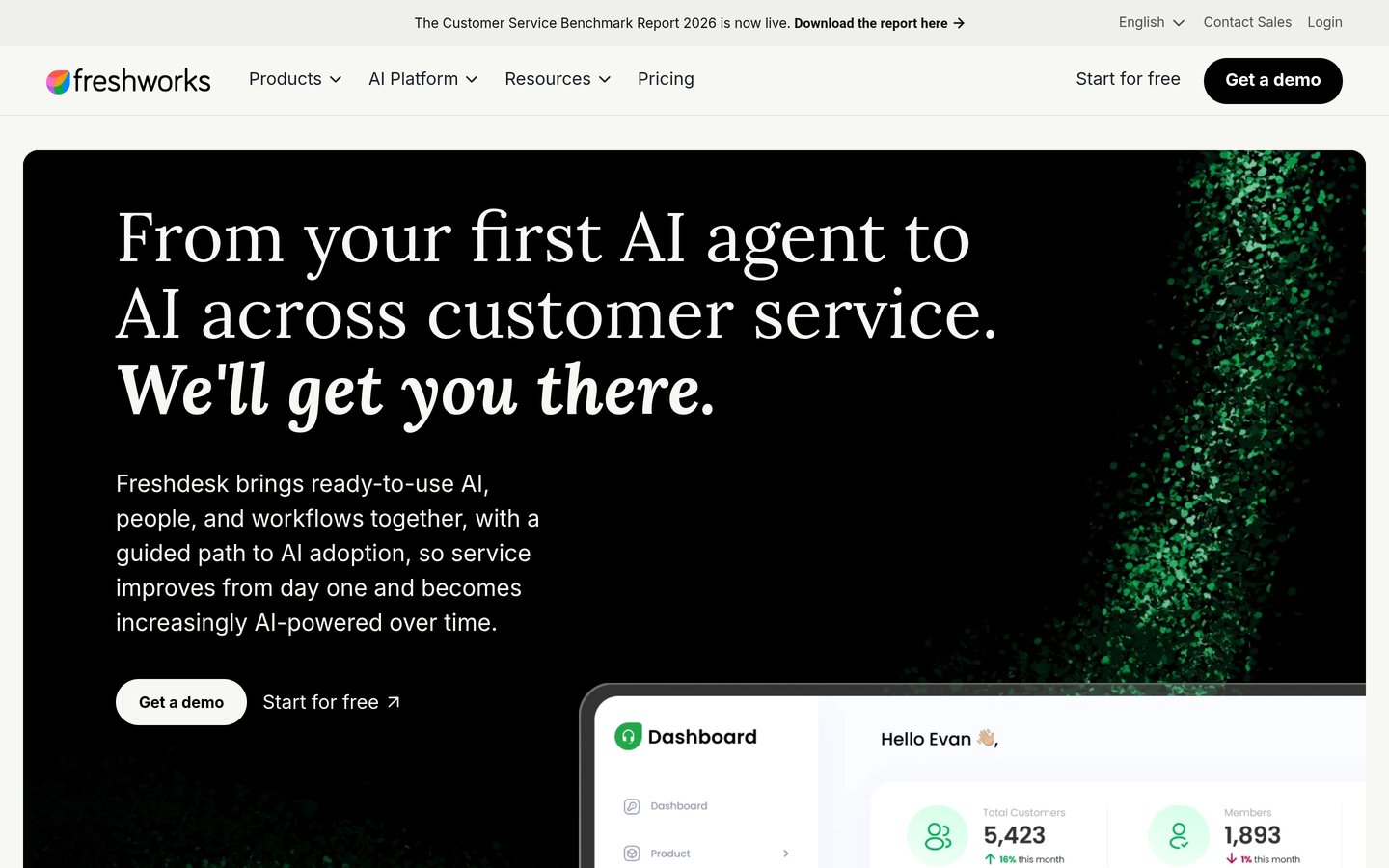
Freshdesk
4.4/5on G2 (4,020 reviews, checked Nov 2026)
Starts at$19/mo
Best for value-conscious multichannel support teams
Entry planGrowth ($19/agent/mo annual)
Next tierPro ($55/agent/mo annual)
AI Agent500 free once; $49/100
AI Copilot$29/agent/mo on Pro+
freshworks.com
Freshdesk homepage, captured Nov 2026.
Freshdesk is a multichannel ticketing helpdesk starting at $19/agent/month billed annually on the Growth plan. It provides ticket routing, automation, a knowledge base, and one-time access to 500 Freddy AI Agent sessions.
The trade off is that extra AI Agent blocks cost $49 per 100 sessions and Copilot is a paid add-on above the $228/year per-agent base. It suits small and mid-market teams seeking affordable ticketing.
What we like
Low $19/agent/month annual starting rate for core ticketing
Broad multichannel support across email, chat, phone, and social
Straightforward setup for teams without dedicated admins
Watch out for
Freddy AI sessions and Copilot add extra line items
Basic reporting can feel shallow on complex workflows
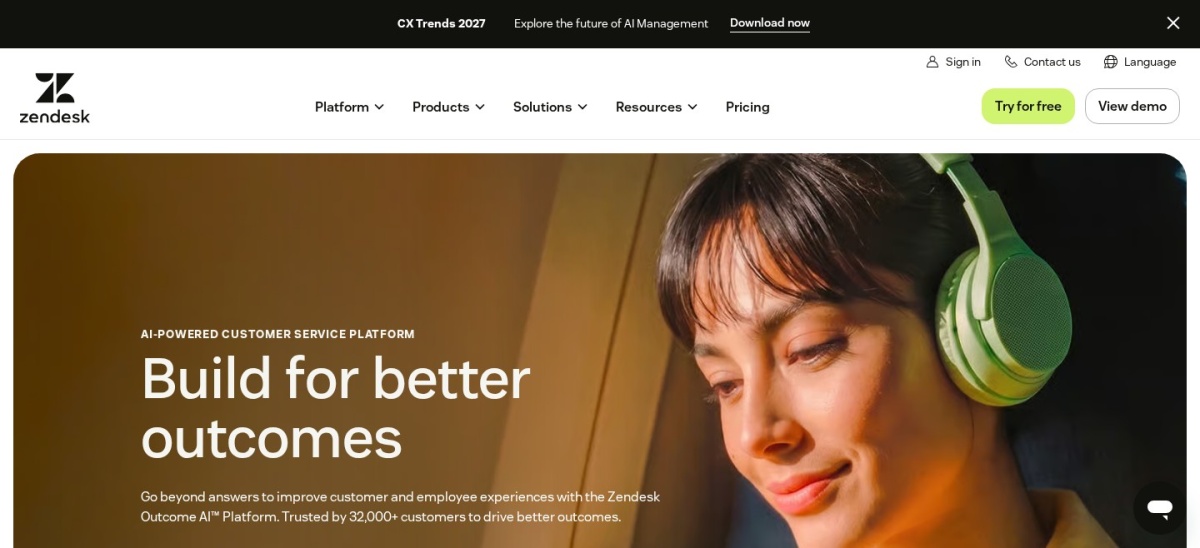
Zendesk is a large-scale customer service platform starting at $19/agent/month billed annually on Support Team for email ticketing, routing, and triggers. Moving to Suite Team at $55/agent/month adds messaging, live chat, voice, and AI agents.
The trade off is that live chat, messaging, and AI agents sit above the $228/year entry plan and require more initial setup. It suits growing and enterprise teams that need strict routing, SLAs, and reporting.
What we like
Mature routing, triggers, SLAs, and reporting for larger teams
Extensive app marketplace and APIs for custom integrations
Scales across complex multi-agent support hierarchies
Watch out for
Entry plan lacks messaging, chat, and AI agents
Initial configuration takes more effort than lightweight inboxes
Suite Team and higher tiers unlock omnichannel messaging, live chat, telephony, and AI agents.Visit zendesk.com
06
Re:amaze
4.6/5on G2 (140 reviews, checked Nov 2026)
Starts at$26.10/mo
Best for multi-store teams wanting flat or seat pricing
Annual entryBasic ($26.10/user/mo annual)
Monthly Basic$29/user/mo
Flat optionStarter ($59/mo, 500 convs)
AI overage$0.85 per extra resolution
reamaze.com
Re:amaze homepage, captured Nov 2026.
Re:amaze is a shared inbox and live chat tool for ecommerce teams, starting at $26.10/user/month billed annually ($29 monthly) on Basic. It combines email, social channels, FAQs, order bots, and order lookups in one workspace.
The trade off is that multi-brand support requires Pro or Plus and per-seat fees add up as headcount grows, starting at $313.20/year per user. It suits small-to-midsize stores managing chat and orders across storefronts.
What we like
Combines live chat, email, social, FAQs, and order data
Offers a $59/month flat option for up to 500 conversations
Includes a 14-day free trial with Plus features
Watch out for
Basic limits you to 1 brand and fewer AI resolutions
Per-seat pricing gets costly for larger support teams
Pro and Plus unlock multiple brands, staff roles, shifts, and higher AI resolution allowances.Visit reamaze.com
07
eDesk
4.5/5on G2 (73 reviews, checked Nov 2026)
Starts at$45/mo
Best for sellers across Amazon, eBay, and Walmart
Annual entryEssential ($45/seat/mo yearly)
Monthly Essential$55/seat/mo
Store allowance1 store/marketplace on Essential
AI Agent$0.99 per outcome
edesk.com
eDesk homepage, captured Nov 2026.
eDesk is a helpdesk built for online sellers across marketplaces and webstores, starting at $45/seat/month billed yearly ($55 monthly) on Essential. It pulls order and buyer messages from Amazon, eBay, Walmart, Shopify, and other channels into one queue.
The trade off is per-seat pricing starting at $540/year plus $0.99 per AI Agent outcome, while Essential covers only 1 connected store or marketplace. It suits multichannel sellers whose volume spans marketplaces and webstores.
What we like
Built to centralize marketplace messages alongside order data
Includes unlimited tickets on user-based plans
Offers a 14-day free trial with no credit card required
Watch out for
Essential covers just 1 store or marketplace and lacks SLA timers
AI Agent outcomes, AI Assist, and Translate add extra fees
Growth and Professional raise connected store limits to 5 and 10 and add SLAs and reporting.Visit edesk.com
How ticket-based vs. per-seat pricing affects ecommerce bills
Ticket-based helpdesks like Gorgias charge by monthly ticket volume rather than agent count, which can save money for larger teams with low ticket counts but creates overage fees during busy sales periods.
Per-seat tools like Help Scout, Freshdesk, Zendesk, and eDesk charge per user, keeping costs predictable as ticket volume rises while increasing bills when you add staff or AI add-ons.
How we chose
We built this shortlist by reviewing established customer service platforms used by ecommerce merchants across storefront helpdesks, live chat tools, shared inboxes, and marketplace desks.
We checked pricing pages, product documentation, and public G2 ratings and review counts on 22 Nov 2026 to record regular entry pricing, billing units, and platform trade-offs.
We excluded tools that lacked transparent public pricing or clear ecommerce support fit, and we used regular published prices rather than promotional discounts. No vendor paid for a place, and we do not claim testing for this list.
How to choose an ecommerce support tool in 4 steps
Follow these four steps to match your support queue to the right billing model and feature set.
Map where your customer messages originate. List how many inquiries come from your storefront chat, email, social channels, or marketplaces like Amazon and eBay so you pick native integrations.
Model your monthly tickets against team headcount. Compare ticket-metered plans against per-seat plans, factoring in seasonal spikes and potential overage fees.
Separate base seat or ticket fees from AI charges. Check whether AI agents are billed per resolution or per outcome and whether copilot or translation features cost extra.
Verify order actions and self-service workflows. Confirm whether agents can view orders, issue refunds, or handle returns without leaving the ticket view.
FAQ
Which customer service tool is best for a small Shopify store?
Gorgias fits stores that want order actions inside tickets and starts at $10/month for 50 tickets, while Tidio offers a free plan for 50 monthly conversations and paid Starter plans from $33/month billed annually.
Are there free plans for ecommerce customer support software?
Yes, Tidio offers a free plan for 50 monthly conversations and up to 10 seats, and Help Scout includes a free tier for up to 5 users with 1 Inbox.
Why do AI support charges surprise some buyers?
Many platforms charge per automated resolution, conversation, or outcome on top of base ticket or seat fees, so high AI deflection can raise your bill.
What should marketplace sellers look for in a helpdesk?
Sellers on Amazon, eBay, or Walmart need centralized marketplace messaging, order sync, and multi-store support, which is why tools like eDesk are built around marketplace workflows.
Is per-seat or per-ticket pricing better for a growing store?
Per-ticket pricing often costs less for small teams with low ticket volume, whereas per-seat pricing is easier to forecast when ticket volume swings with seasonal promotions.
Do shared inboxes work well for ecommerce support?
Shared inboxes like Help Scout and Re:amaze work well for collaborative replies and order lookups, though specialized ecommerce helpdesks offer deeper storefront actions and marketplace queues.