Best CRM Software for Enterprise in 2026: 7 Tools Compared
WLWPLegible EditorsLast verified 22 Nov 2026How we rank8 min read
★ Short answer
Salesforce Sales Cloud is the best enterprise CRM software in 2026, backed by a 4.4/5 G2 rating across 27,560+ reviews and 7,000+ AppExchange integrations. HubSpot Sales Hub fits teams prioritizing fast onboarding and marketing alignment, while Zoho CRM delivers the lowest per-seat entry cost at $168/yr.
How we make this list: we compare pricing pages, product documentation and public user reviews, then re-check every price before each update. No product paid for a place. Disclosure.
Salesforce Sales Cloud leads enterprise deployments with 7,000+ AppExchange integrations, starting at $25/user/mo ($300/yr) on Starter Suite.
HubSpot Sales Hub offers a free CRM tier and regular Starter pricing at $20/seat/mo ($240/yr), scaling up to $150/seat/mo for Enterprise.
Microsoft Dynamics 365 Sales starts at $65/user/mo ($780/yr) on annual billing and integrates directly into Outlook, Teams, and Power BI.
Zoho CRM provides the lowest regular paid entry point at $14/user/mo ($168/yr) billed annually, plus a free plan for up to 3 users.
Creatio combines no-code workflow automation with composable CRM modules, starting at $40/user/mo ($480/yr) for Growth platform access.
What to look for in enterprise CRM software
Enterprise CRM buying decisions revolve around data governance, customization depth, and total cost of ownership rather than sticker price alone. While entry plans start between $14 and $65 per user per month, large organizations typically need custom objects, territory hierarchies, sandbox environments, and granular role permissions found on higher tiers.
Integration architecture is equally critical at enterprise scale. A CRM must sync reliably with ERP platforms, billing systems, data warehouses, and identity providers without hitting tight daily API ceilings or concurrency caps.
Finally, evaluate admin overhead and mandatory add-ons before signing multi-year contracts. Platforms with deep configurability often require dedicated administrators or implementation partners, while lower-priced tiers may gate essential reporting, sequence limits, or AI credits behind separate upgrades.
Salesforce Sales Cloud homepage, captured Nov 2026.
Salesforce Sales Cloud is a cloud CRM platform built for complex, multi-team revenue operations. Its Free Suite covers basic contact and deal tracking, while the entry paid Starter Suite costs $25/user/mo ($300/yr) and includes lead, account, and opportunity management plus standard reporting.
The trade off is steep configuration complexity and high tier jumps, with modern enterprise Sales bundles running from $195 to $550/user/mo billed annually alongside dedicated admin needs. It suits large enterprises requiring custom data models, territory rules, and deep compliance controls.
What we like
Unmatched customization via Flow Builder, Apex, and custom objects
Over 7,000 third-party integrations on AppExchange
Granular role permissions, audit trails, and sandbox environments
Advanced collaborative forecasting and multi-currency support
Watch out for
Steep learning curve that typically requires a dedicated administrator
Enterprise-grade features and AI credits raise total spend sharply
Implementation and consulting fees often exceed first-year license costs
Higher tiers unlock custom objects, advanced forecasting, territory management, and Agentforce AI credits.Visit salesforce.com
02
HubSpot Sales Hub
4.4/5on G2 (14,382 reviews, checked Nov 2026)
Paid from$20/mo
Best for fast adoption and marketing alignment
Entry Paid Plan$20/seat/mo ($240/yr)
Enterprise Plan$150/seat/mo ($1,800/yr)
Workflow LimitUp to 1,000 workflows (Enterprise)
Free TierFree CRM tools included
hubspot.com
HubSpot Sales Hub homepage, captured Nov 2026.
HubSpot Sales Hub is a sales engagement and pipeline CRM built on the unified HubSpot Smart CRM database. The free tier includes contact management and deal tracking, while the regular Starter plan costs $20/seat/mo ($240/yr) and adds multiple deal pipelines, task queues, and basic automation.
The trade off is cost escalation at scale, as Enterprise rises to $150/seat/mo ($1,800/yr) plus mandatory one-time onboarding fees, and promotional new-customer discounts expire at renewal. It suits enterprise teams prioritizing rapid rep adoption and tight marketing-to-sales alignment.
What we like
Intuitive interface that minimizes sales rep training time
Native shared database with Marketing, Service, and Operations hubs
Built-in sequences, meeting links, and call transcription on upper tiers
Custom objects and hierarchical team permissions on Enterprise
Watch out for
Mandatory non-refundable onboarding fees on Professional and Enterprise
Per-seat costs climb quickly when bundling multiple hubs
Less flexible for deeply bespoke relational data models than Salesforce
Enterprise adds custom objects, predictive lead scoring, conversation intelligence, and up to 1,000 workflows.Visit hubspot.com
03
Microsoft Dynamics 365 Sales
3.8/5on G2 (1,624 reviews, checked Nov 2026)
Starts at$65/mo
Best for Microsoft 365 and Azure enterprises
Entry Paid Plan$65/user/mo ($780/yr)
Enterprise Plan$105/user/mo ($1,260/yr)
Premium Plan$150/user/mo ($1,800/yr)
Free TierNo (30-day free trial)
microsoft.com
Microsoft Dynamics 365 Sales homepage, captured Nov 2026.
Microsoft Dynamics 365 Sales is an enterprise CRM designed to operate directly inside Outlook, Teams, Excel, and Power BI. There is no free plan, and the entry Sales Professional tier starts at $65/user/mo ($780/yr) on an annual commitment for core lead, opportunity, and quote management.
The trade off is licensing complexity and partner-heavy setup, with Sales Enterprise costing $105/user/mo ($1,260/yr) and custom Power Platform flows often requiring separate licenses. It suits organizations standardized on Microsoft 365 and Azure seeking unified identity and ERP connectivity.
What we like
Direct sidebar integration inside Outlook and Microsoft Teams
Built on Microsoft Dataverse with native Power BI analytics
Discounted attach licensing when paired with qualifying Dynamics ERP plans
Enterprise-grade security, compliance, and Azure Active Directory controls
Watch out for
No free plan and strict annual billing commitments
Complex licensing rules across Power Apps, Dataverse storage, and Copilot credits
Steep administrative learning curve often requiring external consultants
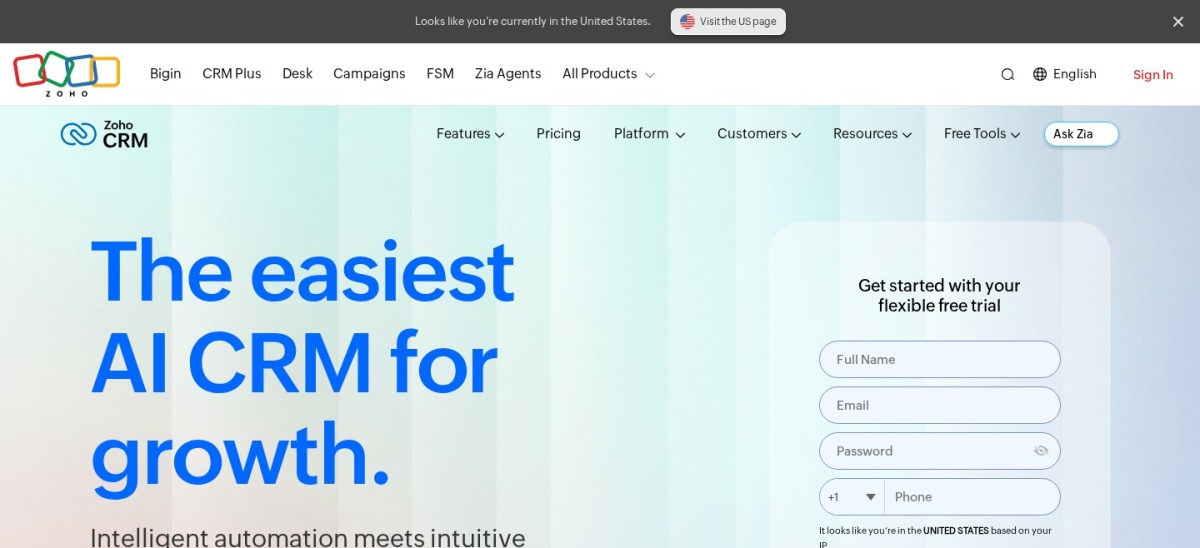
Zoho CRM is a multi-channel sales platform offering workflow automation, territory management, and AI-assisted forecasting at a fraction of legacy enterprise rates. Its free edition supports up to 3 users, while the paid Standard plan starts at $14/user/mo ($168/yr) billed annually with custom pipelines and scoring rules.
The trade off is administrative setup effort and daily API credit limits, with Enterprise priced at $40/user/mo ($480/yr) to unlock custom modules and territory hierarchies. It suits mid-to-large companies seeking broad CRM capabilities without high per-seat enterprise fees.
What we like
Significantly lower per-seat pricing than Salesforce or Dynamics 365
Canvas UI builder and Blueprint process management on higher tiers
Tight native integration across 45+ Zoho finance, desk, and HR apps
Free forever edition available for small pilot teams up to 3 users
Watch out for
Interface and deep configuration menus require dedicated setup time
Daily API credit budgets and concurrency caps affect heavy integrations
Advanced support tiers and extra storage carry additional charges
Enterprise ($40/user/mo) adds custom modules, territory management, multi-user portals, and Zia AI tools.Visit zoho.com
05
Creatio
4.6/5on G2 (383 reviews, checked Nov 2026)
Starts at$40/mo
Best for no-code BPM and custom workflows
Entry Paid Plan$40/user/mo ($480/yr)
Enterprise Platform$75/user/mo ($900/yr)
CRM App Add-ons$15/user/mo each (Sales/Service/Mktg)
Free TierNo (14-day free trial)
creatio.com
Creatio homepage, captured Nov 2026.
Creatio is an enterprise CRM and business process management platform built around no-code application design and agentic workflows. There is no free plan, and entry Growth platform access starts at $40/user/mo ($480/yr) with core contact, lead, and pipeline tools.
The trade off is composable add-on pricing and annual minimums, as Enterprise platform access costs $75/user/mo ($900/yr) plus $15/user/mo for the Sales module. It suits regulated enterprises in banking, insurance, and telecom needing custom no-code workflows.
What we like
Visual no-code studio lets non-developers build custom apps and workflows
Strong business process management (BPM) engine for complex approvals
Composable licensing lets teams mix Sales, Marketing, and Service modules
High G2 user satisfaction score of 4.6/5 across mid-market and enterprise teams
Requires an annual spend commitment that excludes very small teams
Smaller third-party app marketplace than Salesforce or HubSpot
Enterprise ($75/user/mo) unlocks the full no-code Studio, advanced BPM engine, and unlimited API access.Visit creatio.com
06
SugarCRM
4/5on G2 (1,169 reviews, checked Nov 2026)
Starts at$68/mo
Best for ERP-connected manufacturing and distribution
Entry Paid Plan$68/user/mo ($816/yr)
Advanced+ Plan$98/user/mo ($1,176/yr)
Premier+ Plan$155/user/mo ($1,860/yr)
Free TierNo (7-day free trial)
sugarcrm.com
SugarCRM homepage, captured Nov 2026.
SugarCRM (Sugar Sell) is a customer lifecycle CRM offering both cloud and on-premise deployment options for mid-market and enterprise accounts. There is no free tier, and its entry Sugar Sell Standard+ plan starts at $68/user/mo ($816/yr) billed annually for pipeline management, process automation, and mobile offline access.
The trade off is that forecasting and native email sync require upgrading to Advanced+ at $98/user/mo ($1,176/yr), while Premier+ reaches $155/user/mo ($1,860/yr). It suits manufacturing, wholesale, and distribution enterprises needing deep ERP integrations and flexible hosting.
What we like
Supports both cloud and on-premise or private-cloud deployments
Over 180 pre-built ERP and back-office connectors for order and invoice sync
Native iOS and Android apps with full offline record caching
No-code layout and workflow configuration with open REST/SOAP APIs
Watch out for
No free plan and high $68/user/mo starting price for entry sales seats
Forecasting and email/calendar sync are gated behind the $98/user/mo tier
Out-of-the-box reporting can feel dated without custom configuration
Advanced+ ($98/user/mo) adds sales forecasting, native email/calendar sync, and AI summaries.Visit sugarcrm.com
07
Pipedrive
4.3/5on G2 (5,130 reviews, checked Nov 2026)
Starts at$14/mo
Best for high-velocity outbound sales pipelines
Entry Paid Plan$14/seat/mo ($168/yr)
Ultimate Plan$79/seat/mo ($948/yr)
Integrations500+ marketplace apps
Free TierNo (14-day free trial)
pipedrive.com
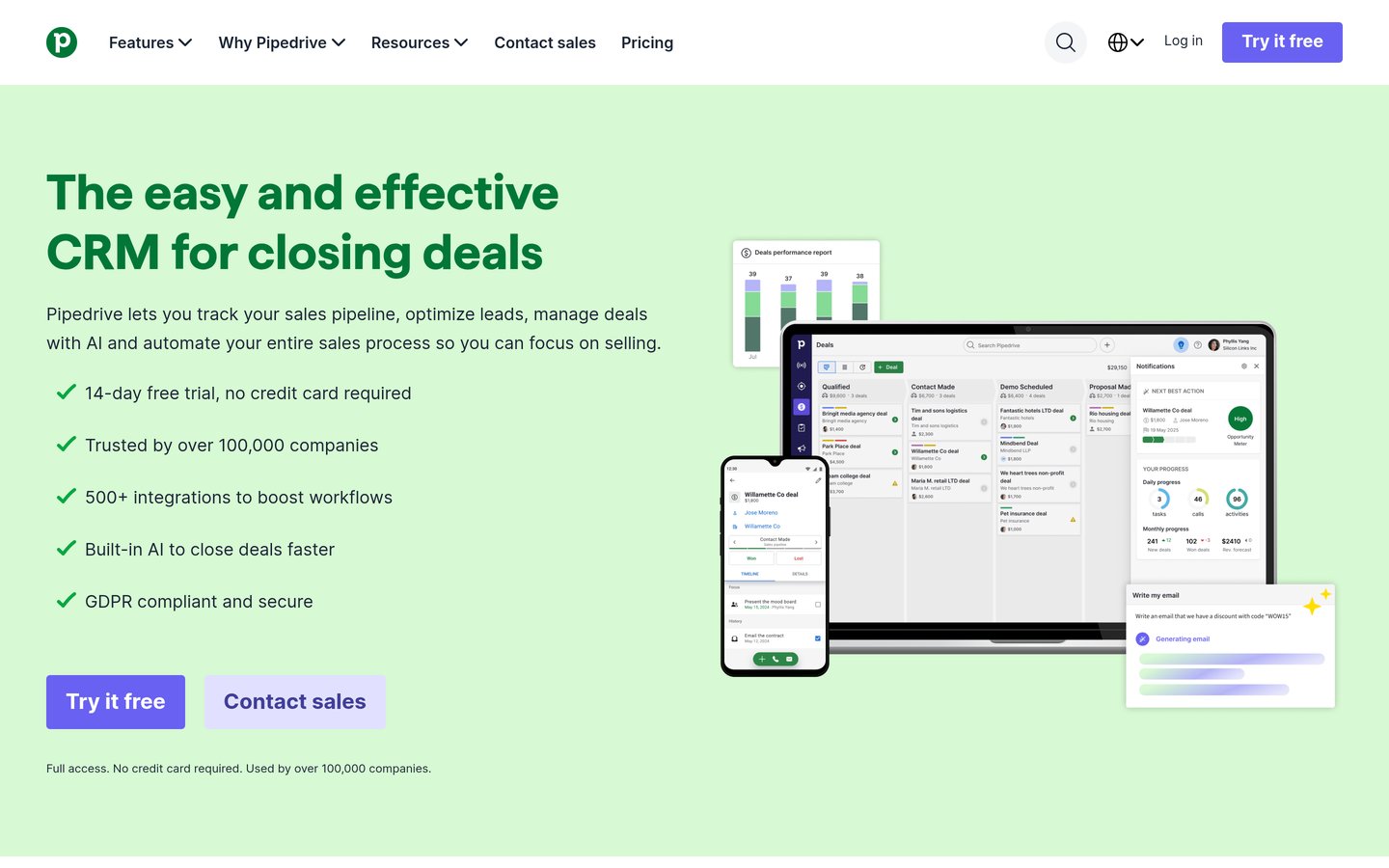
Pipedrive homepage, captured Nov 2026.
Pipedrive is a pipeline-centric sales CRM designed for high-velocity B2B sales teams that prioritize visual deal tracking and fast onboarding. It has no free tier, and its entry Lite plan starts at $14/seat/mo ($168/yr) billed annually with unlimited customizable pipelines, API access, and 500+ integrations.
The trade off is lighter enterprise governance and custom object depth compared to Salesforce, even on its top Ultimate tier at $79/seat/mo ($948/yr) billed annually. It suits enterprise sales divisions or regional subsidiaries wanting a fast, focused deal tracker.
What we like
Clear drag-and-drop pipeline interface that drives high daily rep adoption
Rapid setup with minimal administrative overhead compared to legacy CRMs
Over 500 native marketplace integrations plus open webhooks and API
Predictable per-seat pricing up to $79/seat/mo on annual billing
Watch out for
Lacks custom objects and deep multi-entity enterprise data modeling
Two-way email sync and workflow automations require Growth ($39/seat/mo) or higher
Lead generation and document signing tools cost extra on lower tiers
Ultimate ($79/seat/mo) adds security alerts, phone/email enrichment, maximized limits, and a sandbox account.Visit pipedrive.com
What drives enterprise CRM total cost beyond seat prices
Published per-seat prices rarely reflect your final enterprise invoice. Most vendors reserve custom objects, sandbox testing environments, and granular field-level permissions for Enterprise tiers costing $75 to $550 per user per month, while charging extra for API burst limits, database storage overages, and AI consumption credits.
Implementation and ongoing administration also represent a major share of three-year ownership costs. Platforms like Salesforce and Microsoft Dynamics 365 typically require external implementation partners for data migration and ERP integration, plus at least one full-time internal CRM administrator once live.
How we chose
To build this list of enterprise CRM platforms, we evaluated established vendors with strong G2 review volume, enterprise security controls, custom permissions, and API extensibility.
All regular per-seat prices, annual billing rates, G2 ratings, and review counts were verified on 22 Nov 2026 directly against official vendor pricing pages and G2 product profiles.
We excluded SMB-only contact managers lacking role-based access controls, tools without transparent public entry pricing, and platforms with fewer than 100 verified G2 reviews. No vendor paid for a place, and we do not claim testing for this list.
How to choose enterprise CRM software
Follow four practical steps to shortlist and validate an enterprise CRM before signing a multi-year agreement.
Map your data model and permission rules first. Document how many custom objects, business units, currencies, and role hierarchies your sales organization requires, since lower tiers often cap custom fields and force expensive tier upgrades.
Audit your core ERP and identity stack. Check native connectors for your existing ERP, billing system, and SSO provider, and verify daily API call limits so nightly warehouse syncs do not trigger overage fees.
Calculate three-year total cost of ownership. Add base Enterprise seat licenses, mandatory onboarding fees, sandbox add-ons, AI credit packs, and internal administrator headcount rather than comparing entry-tier sticker prices.
Run a structured pilot with frontline reps. Test daily deal updates, email logging, and forecast rollups with a cross-section of account executives and sales managers to confirm adoption before enterprise-wide rollout.
FAQ
Which CRM is best for large enterprises?
Salesforce Sales Cloud is the top choice for large enterprises because it offers unmatched customization, 7,000+ AppExchange integrations, granular security permissions, and multi-currency forecasting at global scale.
How much does enterprise CRM software cost per user?
Entry-level paid plans start between $14 and $68 per user per month billed annually, while true Enterprise editions typically range from $40 to $550 per user per month depending on AI credits and modules.
Do enterprise CRMs offer free plans?
Yes, Salesforce, HubSpot, and Zoho CRM offer free tiers for basic contact and pipeline tracking, though large enterprises must upgrade to paid Enterprise editions for custom permissions, sandboxes, and advanced automation.
What is the best enterprise CRM for Microsoft 365 users?
Microsoft Dynamics 365 Sales is the best fit for Microsoft-centric organizations because it embeds directly inside Outlook and Teams, connects natively to Power BI, and shares the Dataverse layer with Dynamics ERP.
How long does an enterprise CRM implementation take?
Simple departmental rollouts on HubSpot or Pipedrive can launch in a few weeks, while multi-region Salesforce or Microsoft Dynamics 365 deployments with ERP integrations typically take three to nine months.