Best CRM Software for Commercial Real Estate in 2026: 7 Tools Compared
WLWPLegible EditorsLast verified 22 Nov 2026How we rank10 min read
★ Short answer
AscendixRE is the best CRM software for commercial real estate in 2026, bundling a Salesforce license with built-in property, lease, and commission tracking starting at $79 per user per month. Solo brokers needing LightBox property records can pick ClientLook at $1,068 per year, while teams wanting a free entry tier should consider HubSpot Sales Hub.
How we make this list: we compare pricing pages, product documentation and public user reviews, then re-check every price before each update. No product paid for a place. Disclosure.
AscendixRE leads CRE-specific CRMs at $79/user/month ($948/yr) with a Salesforce license included.
ClientLook pairs a 155M+ LightBox property database with virtual assistant data entry at $1,068/user/year.
Pipedrive offers the lowest regular annual entry price for deal pipelines at $168/seat/year ($14/mo).
HubSpot Sales Hub is the only platform on this list with a permanent free tier before paid plans start at $15/seat/month.
Salesforce Sales Cloud starts at $25/user/month ($300/yr) for brokerages building custom workflows from scratch.
What to look for in commercial real estate CRM software
Commercial real estate deals involve more moving parts than standard B2B sales. A single transaction often links a landlord, tenant, lender, property record, lease expiration date, and tiered commission split, so a spreadsheet or basic contact book breaks down quickly.
Buyers face a core choice between CRE-specific CRMs and general sales CRMs. Dedicated tools such as AscendixRE and ClientLook ship with property objects, stacking plans, and comp databases ready on day one, while general platforms like Pipedrive, HubSpot, and Salesforce cost less per seat at entry tiers but require custom fields to track buildings and leases.
Pay close attention to annual billing versus monthly billing and add-on fees. Several platforms advertise low per-seat monthly rates that require annual upfront payment, seat minimums, or paid add-ons for email campaigns, document generation, and AI features.
The 7 best crm software for commercial real estate
01
AscendixRE
4.3/5on G2 (9 reviews, checked Nov 2026)
Starts at$79/mo
Best overall CRE brokerage CRM
Entry planxRE Foundations ($79/mo)
CRE objectsProperties, leases, comps, listings
Platform baseIncludes Salesforce license
Free tierNo (free trial available)
ascendix.com
AscendixRE homepage, captured Nov 2026.
AscendixRE is a commercial real estate CRM built on Salesforce that includes the underlying Salesforce license in its subscription. Its entry xRE Foundations plan covers property, listing, lease, availability, and capital source tracking alongside prebuilt CRE fields, reports, and mobile apps.
The trade off is a steeper interface learning curve and higher starting cost at $79 per user per month ($948 per year), plus extra fees for xRE Enterprise ($99 per month) or the xRE AI Suite add-on (from $39 per month). It suits commercial brokerages and capital markets teams that want Salesforce customization without building CRE objects from zero.
What we like
Includes a full Salesforce license with prebuilt CRE property, lease, and deal objects
Upgrading to xRE Enterprise unlocks stacking plans, commission calculations, and Ascendix Search
Offers dedicated onboarding training and 24/7 in-house support
Watch out for
No free plan and limited verified review volume on G2 (9 reviews)
Interface takes time for non-Salesforce users to learn
ClientLook is a commercial real estate CRM from LightBox designed for quick adoption by individual brokers and small leasing teams. Its single subscription bundles contact and deal pipelines, sale and lease comps, a 155M+ LightBox property database, real-time client collaboration portals, and remote virtual assistant data entry.
The trade off is lighter workflow automation and limited back-office customization compared to Salesforce-based systems, at $1,068 per user per year billed upfront ($129 per user per month if billed monthly). It suits solo brokers and boutique CRE firms that value fast setup and outsourced data entry over complex custom objects.
What we like
Includes access to 155M+ LightBox commercial property records and comps
Built-in virtual assistant team handles routine contact and listing data entry
Simpler interface than Salesforce-based CRE platforms
Watch out for
Fewer workflow automation and customization options than AscendixRE or Salesforce
Lower average G2 user rating (3.6 out of 5 across 12 reviews)
Single all-inclusive tier; monthly billing is available at $129/user/month.Visit lightboxre.com
03
Pipedrive
4.3/5on G2 (5,130 reviews, checked Nov 2026)
Starts at$14/mo
Best value visual deal pipeline
Entry planLite ($14/seat/mo billed annually)
Pipeline viewCustomizable Kanban deal boards
Integrations500+ marketplace apps
Free tierNo (14-day free trial)
pipedrive.com
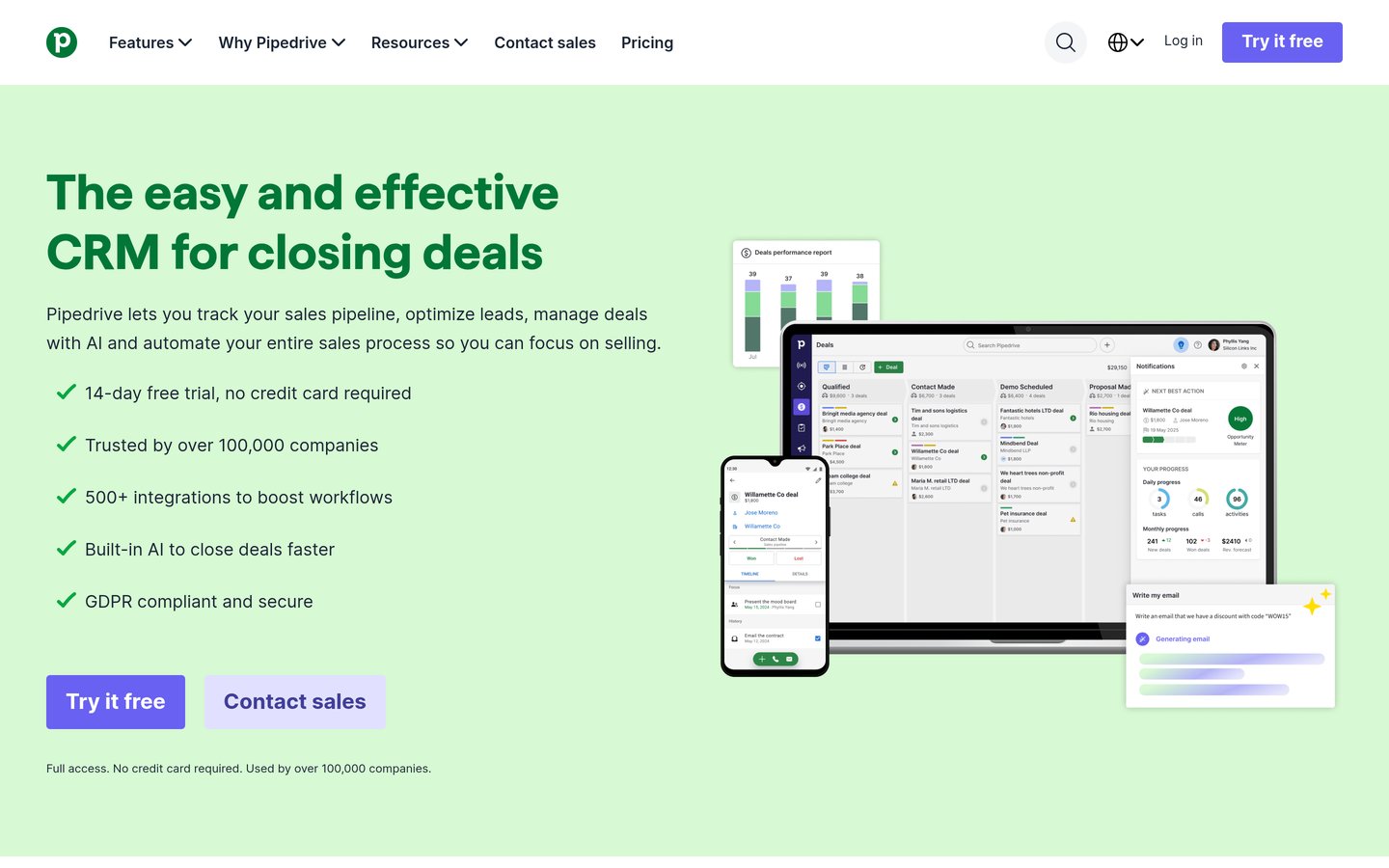
Pipedrive homepage, captured Nov 2026.
Pipedrive is a pipeline-focused CRM that lets commercial brokers organize acquisitions, tenant rep assignments, and listings across multiple drag-and-drop Kanban boards. The entry Lite plan costs $168 per seat per year ($14 per seat per month billed annually) and includes lead and calendar management, AI-generated reports, and 500+ integrations.
The trade off is the absence of native CRE property records, stacking plans, or built-in email automations on the entry tier, which starts at $468 per seat per year on Growth ($24 per seat per month if billed monthly on Lite). It suits small CRE teams that want an affordable, easy-to-learn pipeline tracker.
What we like
Lowest annual entry cost on this list at $168 per seat per year
Multiple customizable pipelines let brokers separate leasing, sales, and portfolios
High adoption rate with 5,130 G2 reviews and 500+ integrations
Watch out for
No built-in property database, lease tracking, or commission splits
Email sync, sequences, and document tools require higher tiers or paid add-ons
Growth ($468/seat/yr) adds full email sync, automations, and forecast reports.Visit pipedrive.com
04
HubSpot Sales Hub
4.4/5on G2 (14,407 reviews, checked Nov 2026)
Paid from$15/mo
Best free entry CRM and marketing sync
Free planYes (core CRM and deal pipeline)
Entry paid planSales Hub Starter ($15/seat/mo)
App ecosystem2,000+ integrations
Custom objectsEnterprise tier only
hubspot.com
HubSpot Sales Hub homepage, captured Nov 2026.
HubSpot Sales Hub pairs a permanent free CRM with optional sales and marketing hubs for investor and tenant outreach. Its free tier tracks contacts, companies, and deal stages, while Sales Hub Starter ($15 per seat per month, or $180 per year) removes HubSpot branding and adds email tracking, templates, and simple automation.
The trade off is a steep jump to Sales Hub Professional at $90 to $100 per seat per month for sequences and custom reporting, while custom property objects require Enterprise ($150 per seat per month). It suits CRE teams prioritizing investor email marketing and a zero-cost starting point.
What we like
Permanent free tier makes it risk-free for solo brokers starting out
Connects directly with HubSpot marketing emails, landing pages, and forms
Backed by 14,407 G2 reviews and over 2,000 third-party integrations
Watch out for
Custom objects for properties and leases are locked behind the $150/seat/month Enterprise tier
Pricing escalates sharply once teams need automated sequences
Sales Hub Professional ($90-$100/seat/mo) unlocks sequences and custom reporting.Visit hubspot.com
05
Salesforce Sales Cloud
4.4/5on G2 (27,593 reviews, checked Nov 2026)
Starts at$25/mo
Best for custom enterprise CRE workflows
Entry planStarter Suite ($25/user/mo)
CustomizationCustom objects, fields, and flows
AppExchangeThousands of CRE add-on apps
Free tierNo (free trial available)
salesforce.com
Salesforce Sales Cloud homepage, captured Nov 2026.
Salesforce Sales Cloud is the underlying engine behind several CRE platforms and serves large brokerages that want total control over data architecture. Its Starter Suite costs $25 per user per month ($300 per year) and provides lead, account, contact, and opportunity tracking with out-of-the-box email integration.
The trade off is that Starter lacks custom objects and deep automation, pushing CRE firms toward Pro Suite ($100 per user per month) or Enterprise ($165 per user per month) plus admin setup time. It suits mid-sized and national brokerages with dedicated operations staff.
What we like
Unmatched customizability for multi-market teams, capital markets, and asset management
Direct access to AppExchange CRE apps, mapping tools, and enterprise security
Proven scale across 27,593 verified G2 reviews
Watch out for
Requires admin configuration or consulting to model CRE properties and leases
Full automation and custom objects start at $100 to $165 per user per month
Pro Suite ($100/user/mo) and Enterprise ($165/user/mo) unlock forecasting and custom objects.Visit salesforce.com
06
Zoho CRM
4.1/5on G2 (2,962 reviews, checked Nov 2026)
Paid from$14/mo
Best low-cost customizable CRM
Entry planStandard ($14/user/mo billed annually)
Free tierYes (Free Edition for basics)
AutomationWorkflow rules and scoring rules
EcosystemConnects with Zoho Books and Campaigns
zoho.com
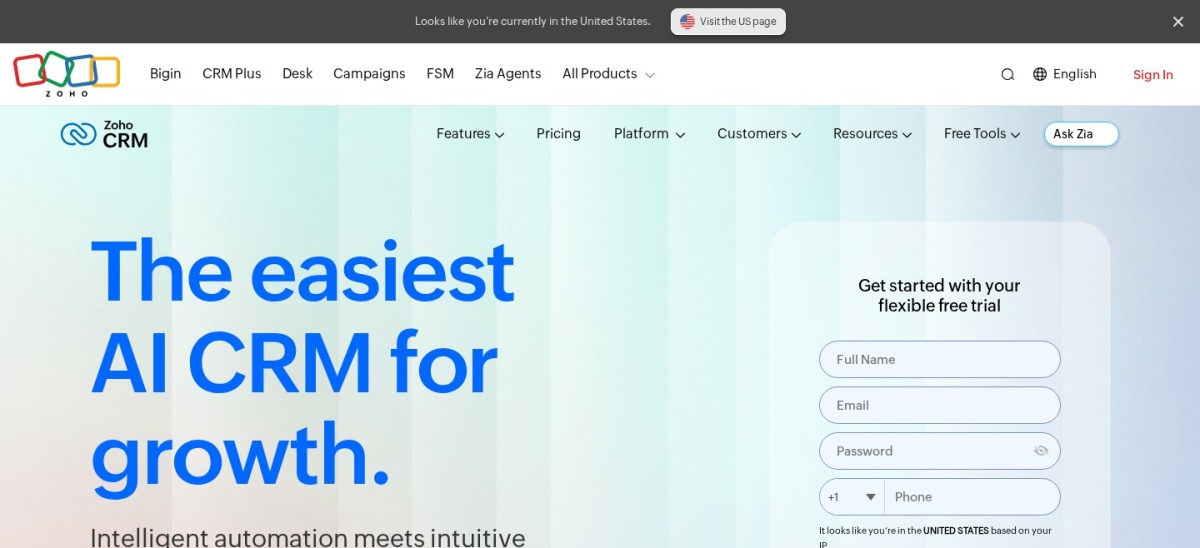
Zoho CRM homepage, captured Nov 2026.
Zoho CRM gives small commercial real estate teams custom fields, workflow rules, and reporting without enterprise per-seat fees. Alongside a basic Free Edition, the Standard plan costs $14 per user per month ($168 per year billed annually) and includes mass email, custom dashboards, and sales forecasting.
The trade off is a dated interface in spots and a noticeable setup curve when building custom property modules from scratch, while Enterprise ($40 per user per month) is required for custom modules and Zia AI tools. It suits budget-conscious teams already using Zoho apps.
What we like
Low $168 per user per year entry price with workflow rules included
Offers a permanent Free Edition for very small teams
Integrates tightly with Zoho Books, Sign, and Campaigns
Watch out for
No native commercial real estate templates or property comp feeds
Custom modules require upgrading to the $40/user/month Enterprise edition
Professional ($23/user/mo) adds SalesSignals and inventory; Enterprise ($40/user/mo) adds custom modules.Visit zoho.com
07
monday CRM
4.5/5on G2 (1,988 reviews, checked Nov 2026)
Starts at$12/mo
Best for flexible deal and project boards
Entry planBasic ($12/seat/mo billed annually)
Seat minimumSold in 3-seat buckets minimum
ViewsKanban, timeline, table, and dashboards
Free tierNo (14-day free trial)
monday.com
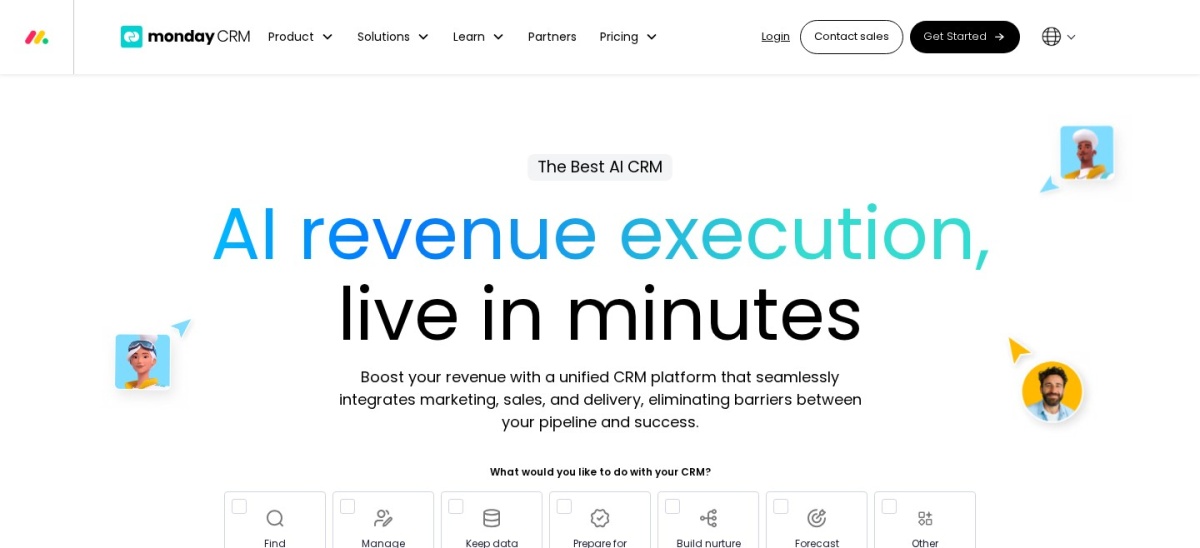
monday CRM homepage, captured Nov 2026.
monday CRM adapts visual work boards to commercial real estate deal pipelines, due diligence checklists, and tenant onboarding timelines. Its Basic plan starts at $12 per seat per month ($144 per seat per year billed annually, or $18 per seat billed monthly) with unlimited contacts, boards, and mobile apps.
The trade off is a three-seat minimum purchase ($432 per year minimum on Basic) and the lack of two-way email sync or automations until Standard ($17 per seat per month billed annually). It suits small CRE teams that want CRM pipelines and transaction task boards in one place.
What we like
Highest G2 rating on this list at 4.5 out of 5 across 1,988 reviews
Combines deal pipelines with post-LOI due diligence and closing task boards
Highly visual custom columns for property size, cap rate, and lease dates
Watch out for
Minimum 3-seat purchase makes it less economical for solo brokers
Two-way Gmail/Outlook sync and automations require the Standard tier ($17/seat/mo)
Standard ($17/seat/mo annually) unlocks two-way email sync, activity tracking, and 250 automations/mo.Visit monday.com
Dedicated CRE CRMs vs. general sales CRMs
Dedicated commercial real estate CRMs such as AscendixRE and ClientLook cost between $948 and $1,068 per user per year, roughly four to six times the entry price of general CRMs like Pipedrive ($168/yr) or Zoho CRM ($168/yr). That premium pays for prebuilt property, suite, and lease objects, stacking plans, commission calculators, and commercial comp databases.
General CRMs work well when a brokerage focuses primarily on lead outreach, investor relations, or simple acquisition pipelines. Once a team needs to track multi-tenant buildings, upcoming lease expirations across hundreds of suites, and house-split commission vouchers, a CRE-native platform saves dozens of hours of custom database work.
How we chose
We compiled this list by evaluating commercial real estate software directories, brokerage technology guides, and verified user reviews on G2. We focused on actively maintained platforms that support multi-party CRE deal pipelines, property tracking, and commercial broker workflows.
All pricing, ratings, and review counts were verified directly against official vendor pricing pages and G2 product profiles on 22 Nov 2026. Where vendors offer both monthly and annual billing, we listed the regular annual per-user rate for the cheapest paid plan and noted monthly pricing or seat minimums in each review.
We excluded residential-only real estate CRMs, discontinued tools such as legacy Apto builds no longer receiving updates, and CRE suites like Buildout, RealNex, and SharpLaunch that do not publish clear self-serve entry pricing on their official pricing pages. No vendor paid for a place, and we do not claim testing for this list.
How to choose commercial real estate CRM software
Follow four practical steps to match a CRM to your brokerage size, asset focus, and budget.
Decide whether you need native property and lease objects. If you track multi-tenant buildings, stacking plans, and lease expirations, pick a CRE-specific CRM like AscendixRE or ClientLook instead of building custom tables from scratch.
Calculate the real annual cost per broker. Check whether advertised monthly rates require annual upfront payment, three-seat minimums like monday CRM, or higher tiers to unlock email sequences and custom fields.
Verify data entry and comp integrations. Look for built-in property records like ClientLook's LightBox integration, email-to-CRM parsing, or virtual assistant support so brokers spend less time typing contact and building details.
Run a trial with live deal data before migrating. Import a sample of 50 contacts, 20 properties, and active deals during a free trial or demo to verify that mobile access, Outlook or Gmail sync, and pipeline stages match your daily workflow.
FAQ
What is the best CRM software for commercial real estate?
AscendixRE is the top overall choice for commercial real estate brokerages because it includes a Salesforce license alongside prebuilt property, lease, listing, and commission tracking starting at $79 per user per month.
Is there a free CRM for commercial real estate?
HubSpot Sales Hub and Zoho CRM both offer permanent free plans that handle basic contact and deal tracking. However, neither free plan includes native commercial property databases, lease expiration alerts, or stacking plans.
How much does commercial real estate CRM software cost?
General CRMs adapted for CRE start between $144 and $300 per user per year on annual plans. Purpose-built commercial real estate CRMs with property records and lease tracking typically cost $948 to $1,068 per user per year.
What is the best CRM for a solo commercial real estate broker?
ClientLook is tailored for solo brokers and small teams at $1,068 per user per year, bundling 155M+ LightBox property records and virtual assistant data entry. Solo brokers on a tighter budget can start with HubSpot's free plan or Pipedrive Lite at $168 per year.
Why are Buildout and RealNex not ranked with fixed prices?
Buildout and RealNex are established commercial real estate platforms, but neither publishes transparent self-serve entry pricing on its official pricing page. Both require custom quotes and demos based on team size and selected modules.