Best CRM Software for Banks in 2026: 8 Tools Compared
WLWPLegible EditorsLast verified 22 Nov 2026How we rank14 min read
★ Short answer
Creatio is the best CRM software for banks in 2026, combining a 4.6/5 G2 rating with no-code workflow automation and a $40/user/month starting price. Large enterprises needing deep household modeling should consider Salesforce Financial Services Cloud, while smaller institutions can start free with HubSpot Sales Hub or Zoho CRM.
How we make this list: we compare pricing pages, product documentation and public user reviews, then re-check every price before each update. No product paid for a place. Disclosure.
Creatio leads for mid-size and enterprise banks with a 4.6/5 G2 rating across 383 reviews and composable plans starting at $40/user/month.
Salesforce Financial Services Cloud is the deepest banking data model on the market (4.3/5 on G2, 431 reviews) at $325/user/month billed annually.
HubSpot Sales Hub (4.4/5 on G2, 14,407 reviews) and Zoho CRM (4.1/5 on G2, 2,962 reviews) both offer permanent free tiers for small teams.
Wealthbox (4.6/5 on G2, 109 reviews) and Redtail Technology (4.3/5 on G2, 269 reviews) serve bank wealth and advisory divisions from $65 and $39/user/month.
Microsoft Dynamics 365 Sales (3.8/5 on G2, 1,624 reviews) starts at $65/user/month for banks standardized on Microsoft 365.
What banks should look for in a CRM platform
Retail, commercial, and private banks operate differently from standard B2B sales teams. A single client often holds checking accounts, mortgages, commercial lines of credit, and wealth portfolios across multiple legal entities or household members. Generic contact lists break down when relationship managers cannot see total household exposure or cross-sell eligibility on one screen.
Compliance and auditability are non-negotiable in financial services. Look for granular role-based permissions, field-level security, immutable activity logs, and compliant communication archiving before evaluating marketing bells and whistles. If your bank operates an advisory or brokerage arm, verify whether the vendor supports SEC and FINRA recordkeeping rules out of the box.
Total cost of ownership extends well beyond headline per-seat prices. Purpose-built financial platforms like Salesforce Financial Services Cloud often require partner-led implementations and middleware to connect core banking ledgers. General CRMs cost far less per seat, though your operations team will need to configure custom objects for loans, deposits, and onboarding stages.
Creatio is a composable CRM and no-code workflow platform built to automate loan origination, customer onboarding, and cross-sell journeys across retail and corporate banking. Its Growth platform tier starts at $40 per user per month, giving operations teams visual process designers, AI agents, and customizable customer 360 views without heavy engineering.
The trade off is modular pricing, since adding individual Sales, Marketing, or Service modules costs $15 per user per month each on top of the $40 platform base ($480/year base). It suits regional and mid-market banks that want tailored lending and service workflows without paying enterprise Salesforce license rates.
What we like
Visual no-code workflow builder lets bank operations teams adjust loan and onboarding stages quickly
Dedicated banking vertical templates and AI agents included on the platform
4.6/5 rating across 383 G2 reviews with strong praise for customization
Watch out for
Sales, Marketing, and Service apps are priced separately at $15/user/month each
Enterprise tier jumps to $75/user/month before CRM product add-ons
Growth ($40/user/mo) unlocks the core Business & AI Studio; add Sales, Marketing, or Service at $15/user/mo each.Visit creatio.com
02
Salesforce Financial Services Cloud
4.3/5on G2 (431 reviews, checked Nov 2026)
Starts at$325/mo
Best for large retail and commercial banks
Entry planSales or Service Core $325/mo
Combined suite$350/user/mo (billed annually)
Free tierNone (free trial available)
Core strengthHousehold & entity data model
salesforce.com
Salesforce Financial Services Cloud homepage, captured Nov 2026.
Salesforce Financial Services Cloud is an enterprise banking CRM built on Salesforce that maps multi-generational households, business entities, deposit accounts, and lending pipelines out of the box. Single-cloud Sales or Service Core editions start at $325 per user per month billed annually, featuring Actionable Relationship Center views and compliance audit trails.
The trade off is steep licensing at $3,900 per user per year alongside mandatory partner implementation costs that routinely add tens of thousands of dollars. It suits large national banks and multi-branch institutions with dedicated Salesforce administrators.
What we like
Purpose-built financial data model tracks households, trusts, and commercial entities natively
Deep compliance controls, audit histories, and financial goal tracking
Massive ecosystem of core banking connectors via AppExchange and MuleSoft
Watch out for
Highest seat cost on this list at $325/user/month billed annually
Complex setup almost always requires an external implementation partner
Core ($325/user/mo) covers single-cloud Sales or Service; Sales & Service bundle starts at $350/user/mo.Visit salesforce.com
03
HubSpot Sales Hub
4.4/5on G2 (14,407 reviews, checked Nov 2026)
Paid from$20/mo
Best for fast deployment and digital marketing
Free plan$0/mo for up to 2 users
Entry paid planStarter at $20/seat/mo
Professional plan$90/seat/mo + $1,500 onboarding
Core strengthEase of use & inbound alignment
hubspot.com
HubSpot Sales Hub homepage, captured Nov 2026.
HubSpot Sales Hub is a cloud CRM that pairs clean contact and deal pipelines with native marketing and service tools. Its free tier supports up to 2 users at no cost, while Sales Hub Starter costs $20 per seat per month and removes HubSpot branding while adding basic deal-stage task automation.
The trade off is a sharp jump to $90 per seat per month plus a $1,500 one-time onboarding fee for Professional if you need custom workflows or sales sequences, even though Starter is just $240 per year. It suits community banks, credit unions, and fintech lenders prioritizing fast rep adoption.
What we like
Generous permanent free plan for up to 2 users with core contact and deal tracking
4.4/5 G2 score across 14,407 reviews, widely praised for fast onboarding
Tightly connects branch sales teams with digital marketing campaigns
Watch out for
Steep price jump from Starter ($20/mo) to Professional ($90/mo + $1,500 onboarding)
Lacks native core banking or household relationship schemas out of the box
Starter ($20/seat/mo) removes branding and adds simple automation and conversation routing.Visit hubspot.com
04
Zoho CRM
4.1/5on G2 (2,962 reviews, checked Nov 2026)
Paid from$14/mo
Best budget customization for small banks
Free plan$0/mo for up to 3 users
Entry paid planStandard at $14/user/mo (annual)
Enterprise plan$40/user/mo (field encryption)
Core strengthCustom modules at low cost
zoho.com
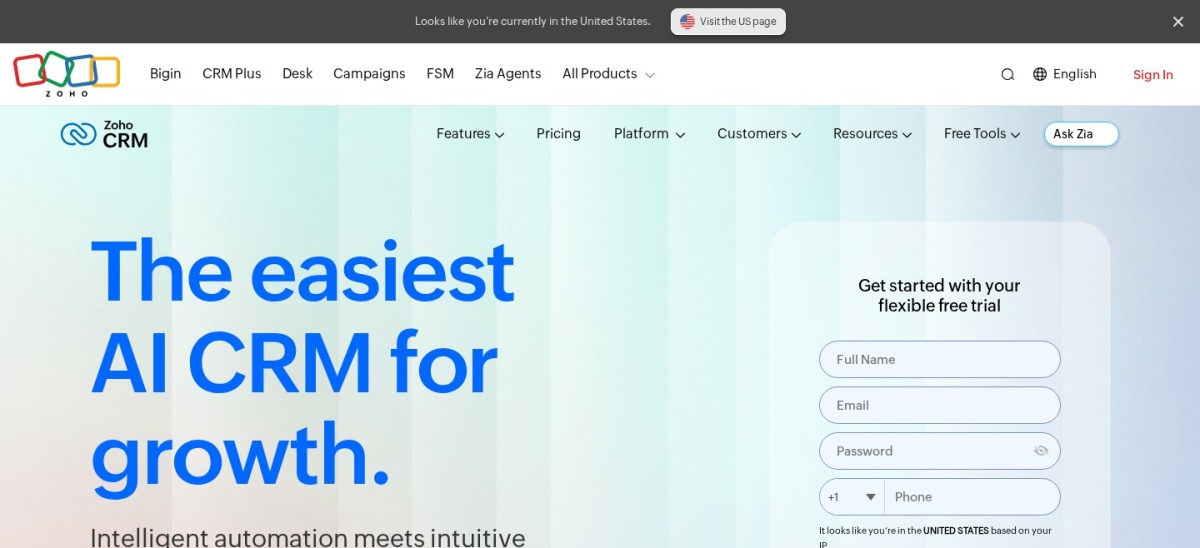
Zoho CRM homepage, captured Nov 2026.
Zoho CRM is a configurable sales and relationship platform that lets smaller financial institutions build custom loan and account modules without enterprise licensing. It includes a free plan for up to 3 users and 5,000 records, while the Standard edition costs $14 per user per month billed annually ($20 monthly) for 100,000 records, scoring rules, and 5 pipelines.
The trade off is a denser interface and the need to reach the $40 per user per month Enterprise tier for field-level encryption and approval processes, though Standard costs only $168 per year. It suits small banks and commercial lending teams seeking high configurability on a tight budget.
What we like
Free tier covers up to 3 users and 5,000 records with no credit card required
Custom modules and up to 5 pipelines included in the $14/user/month Standard plan
Connects natively with Zoho Books, Sign, and Desk for back-office operations
Watch out for
Field-level encryption and developer sandboxes require the $40/user/month Enterprise tier
Busy admin menus require more configuration time than HubSpot or Pipedrive
Standard ($14/user/mo annual) raises storage to 100,000 records and adds forecasting and 5 pipelines.Visit zoho.com
05
Microsoft Dynamics 365 Sales
3.8/5on G2 (1,624 reviews, checked Nov 2026)
Starts at$65/mo
Best for banks on Microsoft 365
Entry planSales Professional $65/user/mo
Enterprise plan$105/user/mo (billed annually)
Free tierNone (30-day free trial)
Core strengthNative Microsoft 365 & Azure
microsoft.com
Microsoft Dynamics 365 Sales homepage, captured Nov 2026.
Microsoft Dynamics 365 Sales is Microsoft's core CRM application, allowing relationship managers to log emails, schedule client reviews, and track commercial opportunities directly inside Outlook and Teams. Sales Professional starts at $65 per user per month billed annually and includes core opportunity management, reporting dashboards, and Microsoft 365 interoperation.
The trade off is a steeper learning curve and add-on licensing—Enterprise rises to $105 per user per month for AI insights and territory management—while Professional costs $780 per user per year. It suits banks already standardized on Microsoft 365, Azure, and Power BI.
What we like
Direct integration with Outlook, Teams, Excel, SharePoint, and Power BI
Backed by Microsoft's enterprise cloud security and Azure compliance certifications
Extensible via Power Platform and Microsoft Cloud for Financial Services
Watch out for
3.8/5 G2 rating across 1,624 reviews reflects a steeper learning curve and complex UI
AI agents, forecasting, and territory rules require upgrading to the $105/user/month Enterprise tier
Sales Professional ($65/user/mo annual) unlocks core sales force automation and Microsoft 365 sync.Visit microsoft.com
06
Wealthbox
4.6/5on G2 (109 reviews, checked Nov 2026)
Starts at$65/mo
Best for bank wealth & private advisory arms
Entry planBasic at $65/user/mo
Pro plan$85/user/mo
Free tierNone (14-day free trial)
Core strengthHousehold & custodial sync
wealthbox.com
Wealthbox homepage, captured Nov 2026.
Wealthbox is a web-based CRM designed specifically for wealth management teams, private bankers, and registered investment advisors. Its Basic plan starts at $65 per user per month and includes contact and household management, collaborative activity streams, and integrations with major custodians and portfolio accounting tools.
The trade off is that automated workflows and two-way email sync require upgrading to the $85 per user per month Pro tier, while Basic costs $780 per user per year. It suits private banking and wealth advisory divisions that want a clean interface without Salesforce complexity.
What we like
4.6/5 G2 rating across 109 reviews for its modern, social-style activity feed
Purpose-built household records and native integrations with custodial platforms
Fast self-service setup compared to legacy financial CRMs
Watch out for
Two-way email sync and automated workflows are gated behind the $85/user/mo Pro tier
Focused on wealth advisory rather than retail branch deposit or loan origination
Basic ($65/user/mo) provides household relationship tracking and custodian integrations.Visit wealthbox.com
07
Redtail Technology
4.3/5on G2 (269 reviews, checked Nov 2026)
Starts at$39/mo
Best for compliance-heavy advisory teams
Entry planLaunch at $39/user/mo (annual)
Growth plan$59/user/mo (unlimited users)
Free tierNone (30-day free trial)
Core strengthSEC/FINRA compliant notes
redtailtechnology.com
Redtail Technology homepage, captured Nov 2026.
Redtail Technology (by Orion) is a financial services CRM centered on compliant client recordkeeping, seminar tracking, and advisor workflows. Its Launch plan costs $39 per user per month billed annually ($45 monthly) for up to 5 users, providing contact and account management, compliant note archiving, and over 100 financial integrations.
The trade off is a 5-user cap on Launch and extra fees for compliant texting (Redtail Speak) and document imaging unless you upgrade to Growth at $59 per user per month ($468/year on Launch). It suits bank-affiliated broker-dealers and advisory desks.
What we like
Immutable, compliance-friendly client notes and activity archiving built in
Connects natively with Orion Portfolio Solutions and major financial planning tools
30-day free trial and complimentary database conversions on paid plans
Watch out for
Launch tier is capped at 5 users; larger teams must move to Growth at $59/user/mo
Interface feels more traditional than Wealthbox or HubSpot
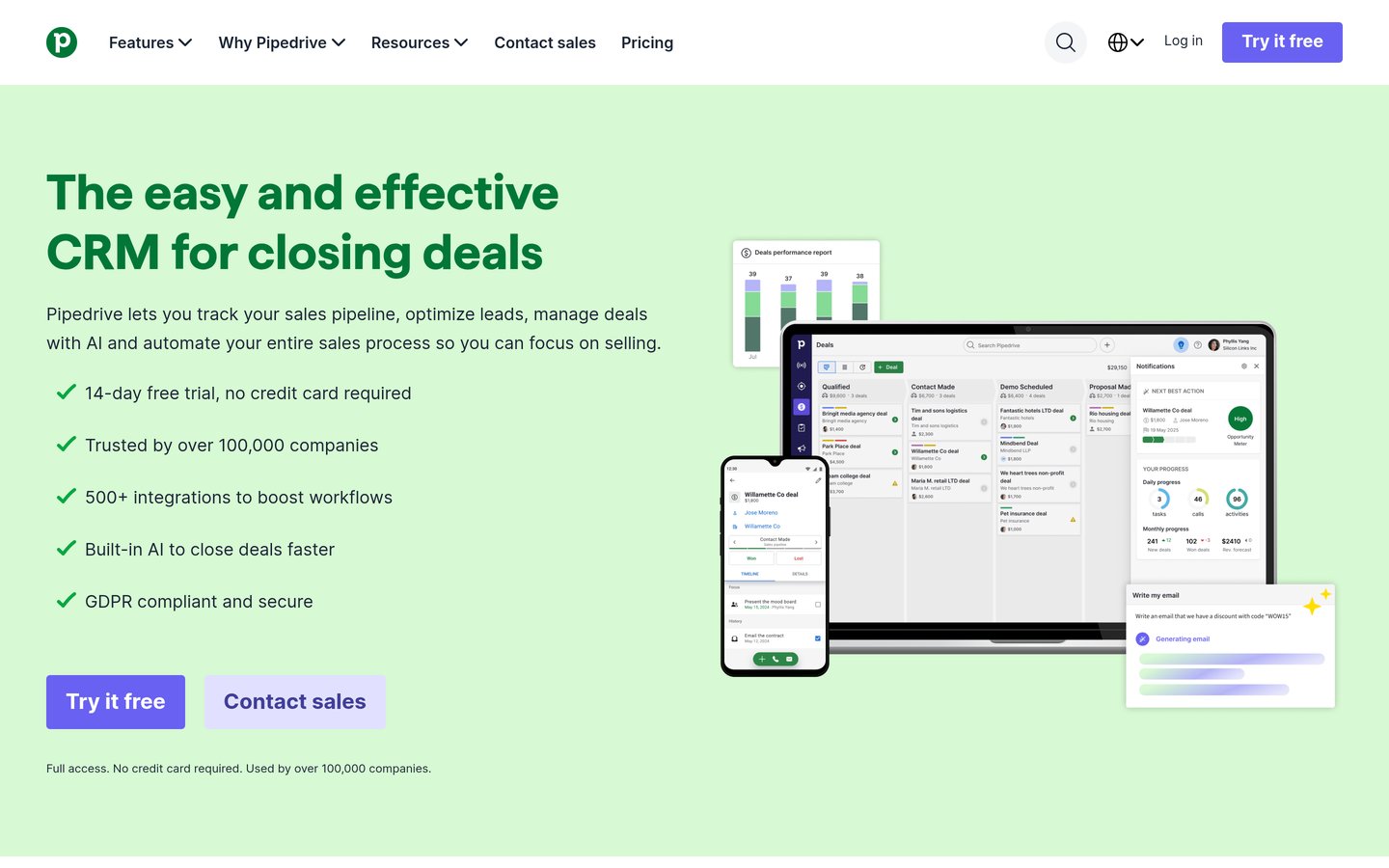
Pipedrive is a pipeline-first sales CRM that helps commercial loan officers and business development reps move prospects from application to closing. Its Lite plan starts at $14 per seat per month billed annually ($24 billed monthly), including customizable kanban deal pipelines, activity reminders, AI-generated reports, and 500+ integrations.
The trade off is that full two-way email sync, tracking, and workflow automations require the $39 per seat per month Growth tier, though Lite costs just $168 per seat per year. It suits commercial lending desks and treasury sales teams focused on deal velocity.
What we like
Clear visual pipeline boards make loan stage bottlenecks easy to spot
4.3/5 rating across 5,130 G2 reviews with minimal training required
Affordable $14/seat/month annual entry point with a 14-day no-card trial
Watch out for
Two-way email sync and automated sequences require upgrading to Growth ($39/seat/mo)
No native household banking hierarchy or compliance archiving
Lite ($14/seat/mo annual) provides visual deal pipelines, calendar sync, and AI sales reports.Visit pipedrive.com
Banking-specific CRMs vs. general sales CRMs
Banking-specific platforms like Salesforce Financial Services Cloud, Creatio, Wealthbox, and Redtail model relationships around households, multi-account ownership, and regulatory audit trails. When a customer calls a branch or private banker, the system links their checking, mortgage, and investment accounts automatically.
General sales CRMs such as HubSpot, Zoho CRM, Dynamics 365, and Pipedrive model leads and deals well at a fraction of the per-seat cost. They work best for commercial loan origination, treasury sales, or smaller institutions willing to configure custom fields rather than buy prebuilt core-banking schemas.
How we chose
We built this list by evaluating dedicated financial services CRMs alongside enterprise and mid-market platforms widely deployed by retail banks, commercial lenders, credit unions, and bank wealth divisions.
All pricing figures, review scores, and review counts were verified directly against official vendor pricing pages and G2 product profiles on 22 Nov 2026, using regular annual per-user rates converted to yearly USD.
We excluded enterprise suites that withhold all public pricing behind custom quotes—such as Oracle, Pegasystems, ServiceNow, Total Expert, and BUSINESSNEXT—as well as tools with fewer than 20 verified public reviews. No vendor paid for a place, and we do not claim testing for this list.
How to choose CRM software for your bank
Follow these four steps to narrow down the right CRM platform for your institution's size, compliance obligations, and core banking stack.
Map your relationship model first. Decide whether your teams need multi-entity household views across deposits, loans, and wealth (Creatio, Salesforce FSC, Wealthbox) or straightforward commercial deal pipelines (Pipedrive, HubSpot).
Verify compliance and archiving rules. Check whether your division falls under SEC, FINRA, or strict banking audit mandates requiring immutable notes, field-level encryption, and archived client messaging.
Audit core banking and custodial integrations. Confirm how customer balances and loan statuses will sync from your core processor—via native connectors, APIs, or middleware—before signing multi-year contracts.
Calculate full three-year seat and build costs. Compare base annual licenses alongside mandatory onboarding fees, add-on modules, and external implementation quotes so per-seat math does not hide setup expenses.
FAQ
What is the best CRM software for banks overall?
Creatio is our top pick for most banks in 2026 because it combines a 4.6/5 G2 rating with no-code loan and onboarding workflows starting at $40 per user per month. Large institutions needing prebuilt household schemas often choose Salesforce Financial Services Cloud.
How much does banking CRM software cost per user?
Entry-level general CRMs like HubSpot Sales Hub Starter ($20/seat/month), Zoho CRM Standard ($14/user/month), and Pipedrive Lite ($14/seat/month) cost $168 to $240 per user per year. Purpose-built financial platforms range from $39/user/month for Redtail to $325/user/month for Salesforce Financial Services Cloud.
Are there free CRM options suitable for small financial teams?
Yes. HubSpot Sales Hub offers a free CRM plan for up to 2 users, and Zoho CRM offers a free edition for up to 3 users and 5,000 records. Both work well for small commercial lending or advisory teams testing pipeline tracking before upgrading.
Why is Salesforce Financial Services Cloud so much more expensive than general CRMs?
At $325 per user per month billed annually, Salesforce Financial Services Cloud includes a specialized financial data model for households, trusts, and accounts, plus regulatory compliance controls and Actionable Relationship Center visualizations that general CRMs require custom engineering to replicate.
Which CRM is best for a bank's wealth management or advisory division?
Wealthbox ($65/user/month, 4.6/5 on G2) and Redtail Technology ($39/user/month, 4.3/5 on G2) are built specifically for financial advisors and private bankers, offering household views, compliant note archiving, and direct integrations with custodians and portfolio tools.