ContentStudio is the best content syndication platform for marketers distributing articles and social content, with a Standard plan supporting 5 social accounts and unlimited posting. Missinglettr is better for automatically promoting existing blog articles over time, while SocialBee suits teams that want categorized, recurring content distribution.
How we make this list: we compare pricing pages, product documentation and public user reviews, then re-check every price before each update. No product paid for a place. Disclosure.
ContentStudio supports publishing to social channels and blogs, including WordPress and Medium. Its Standard plan has a regular listed price of $29 per month.
Missinglettr Solo costs $15 per month and includes 3 social profiles, 1 workspace and 100 AI post generations.
SocialBee Bootstrap costs $348 per year at its regular annual price and supports 5 profiles, 10 content categories and 10 content sources.
Publer Professional starts at $5 per month for 1 account and includes unlimited RSS automations for distributing newly published content.
Planable Basic costs $33 per workspace monthly, includes unlimited users and allows 60 posts per workspace each month.
Buffer Free supports 3 social channels and 10 scheduled posts per channel, while Essentials starts at $60 annually for 1 channel.
What content syndication platforms actually do
Content syndication means distributing existing content through additional channels to reach readers beyond the original website. It can involve republishing complete articles, sharing excerpts, promoting links or placing sponsored recommendations on publisher websites.
There are different approaches. Dedicated B2B syndication networks distribute assets to targeted prospects, while paid native advertising networks buy exposure through publisher inventory. Content distribution tools help website owners publish or promote material through their own connected accounts.
This comparison focuses on software with publicly verifiable entry pricing. Several established enterprise syndication networks use custom quotes or variable advertising spend, making their costs difficult to compare using a fixed annual subscription.
Look for multi-channel publishing, RSS automation, recurring campaigns, content approval controls and analytics. Blog-focused teams should also check whether a tool can publish directly to external websites rather than merely posting links on social networks.
Syndicating complete articles requires additional care. Editorial agreements, canonical URLs and attribution policies can affect how syndicated content appears in search results. Social sharing tools generally distribute links or adapted posts rather than duplicate the complete original article.
ContentStudio is a content marketing platform for discovering, organizing and distributing articles across social channels and connected blogs. Its Standard plan supports 5 social accounts, unlimited posting, 1 workspace and 1 user. It combines a content discovery workspace, publishing calendar, reusable content library and automation features.
The trade off is pricing and plan limits. Standard has a regular listed price of $29 per month, although the official page advertises a discounted $19 monthly rate on annual billing. Approval workflows and more advanced campaign management require higher plans. It suits marketers who need coordinated distribution across blogs and social networks.
What we like
Supports social channels and blog publishing
Content discovery and distribution in one platform
Unlimited posting on the entry plan
Reusable content library and scheduling automation
Marketing calendar and social analytics included
Watch out for
Entry plan supports only 1 user
Approval workflows require Advanced
Advertised promotional pricing differs from the regular price
Missinglettr is a content distribution platform that converts existing blog articles into social media campaigns. Its Solo plan supports 3 social profiles, 1 workspace and 100 AI post generations. The Drip Campaigns feature helps extend article promotion beyond publication day, while its Curate functionality supports content discovery and sharing.
The trade off is that Solo costs $15 per month and supports fewer accounts and workspaces than its higher plans. Its emphasis is social promotion rather than republishing complete articles across independent publisher websites. It suits bloggers and small content teams that regularly publish evergreen articles and want continued exposure.
What we like
Creates social campaigns from existing blog content
SocialBee is a social media management platform that organizes content into reusable publishing categories. Bootstrap includes 5 social profiles, 10 content categories, 10 content sources and unlimited AI content generation. Marketers can maintain separate queues for blog posts, educational resources, promotions and other evergreen material.
The trade off is that Bootstrap regularly costs $348 per year, although the official pricing page currently advertises a Black Friday discount. More advanced reporting and approval functionality require higher plans. It suits businesses with a growing library of reusable articles that need a consistent social distribution schedule.
What we like
Category-based content scheduling
Useful for promoting evergreen articles repeatedly
Multiple content sources supported
AI content creation included
Connects with external automation tools
Watch out for
No permanent free plan
Bootstrap has limited collaboration features
Does not replace dedicated B2B lead syndication networks
Accelerate adds more profiles, content categories and post approvalsVisit socialbee.com
04
Publer
4.7/5on G2 (554 reviews, checked Nov 2026)
Paid from$5/mo
Best for RSS-based content distribution
Free accounts3, excluding X
Free scheduled posts10 per account
Paid RSS automationUnlimited
Paid planProfessional, from $5/mo
publer.com
Publer homepage, captured Nov 2026.
Publer is a social publishing platform that can distribute new website content through RSS feed automations. Its free plan supports 3 social accounts and 10 scheduled posts per account. Professional adds unlimited scheduling, drafts, workspaces and RSS automations, making it useful for automatically sharing articles as they appear in connected feeds.
The trade off is that Professional starts at $5 per month for 1 social account, with costs increasing as accounts and members are added. Its main purpose is social distribution rather than external editorial placement. It suits publishers and bloggers who want new articles shared automatically without building separate campaigns manually.
What we like
RSS feed automation on Professional
Free plan for basic social distribution
Supports WordPress publishing
Unlimited scheduling and drafts on paid plans
Bulk scheduling and recurring content options
Watch out for
Entry paid price covers only 1 account
More accounts increase subscription costs
Advanced recycling and reporting require Business
Professional adds RSS automations, unlimited scheduling and bulk postingVisit publer.com
05
Planable
4.6/5on G2 (1,137 reviews, checked Nov 2026)
Paid from$33/mo
Best for collaborative distribution approvals
Free allowance50 posts total
Basic post allowance60/workspace/month
Basic social pages4 per workspace
Paid planBasic, $33/workspace/mo
planable.io
Planable homepage, captured Nov 2026.
Planable is a collaborative content management platform for preparing, reviewing and scheduling distribution across connected channels. Its free allowance covers 50 posts, while Basic supports 60 posts monthly, 4 social pages and unlimited users per workspace. Shared previews, comments and Optional Approval help teams check content before publication.
The trade off is workspace-based pricing at $33 per month, with separate charges for extra workspaces and analytics. Basic also lacks mandatory approval workflows and has monthly publishing limits. It suits agencies and brand teams that need stakeholder feedback before distributing articles, excerpts and promotional posts.
What we like
Visual previews for planned social content
Unlimited users per workspace
Client-friendly comments and review process
Shared calendar and campaign organization
Supports planning non-social marketing content
Watch out for
Basic limits posts and connected pages
Analytics costs extra
Required approval workflows need Pro
Basic adds recurring publishing capacity and optional approvalsVisit planable.io
06
CoSchedule
4.4/5on G2 (226 reviews, checked Nov 2026)
Starts at$29/mo
Best for marketing calendar distribution
User seats1 on Starter
Social profiles3 on Starter
PublishingUnlimited scheduling
Paid planStarter, $29/mo annually
coschedule.com
CoSchedule homepage, captured Nov 2026.
CoSchedule is a marketing calendar and social publishing platform for coordinating campaigns and redistributing existing content. Starter includes 3 social profiles, 1 user seat and unlimited social scheduling. Its ReQueue feature automatically reshares evergreen posts, while the calendar provides a shared view of planned promotions.
The trade off is that Starter costs $29 monthly when billed annually, with additional profiles charged separately. It also focuses more on social publishing than article placement through external publisher networks. It suits marketing teams that want scheduled campaigns, recurring promotions and performance reporting in a calendar-based workspace.
What we like
Drag-and-drop marketing calendar
ReQueue automates evergreen promotion
Unlimited social scheduling
Built-in social analytics and reports
Social inbox included
Watch out for
Starter includes only 1 user seat
Additional profiles increase costs
Not a dedicated publisher syndication network
Professional adds more seats, profiles and advanced inbox featuresVisit coschedule.com
07
Buffer
4.3/5on G2 (1,043 reviews, checked Nov 2026)
Paid from$5/mo
Best for affordable social content distribution
Free channels3
Free scheduled posts10 per channel
Free content ideas100
Paid planEssentials, $5/channel/mo annually
buffer.com
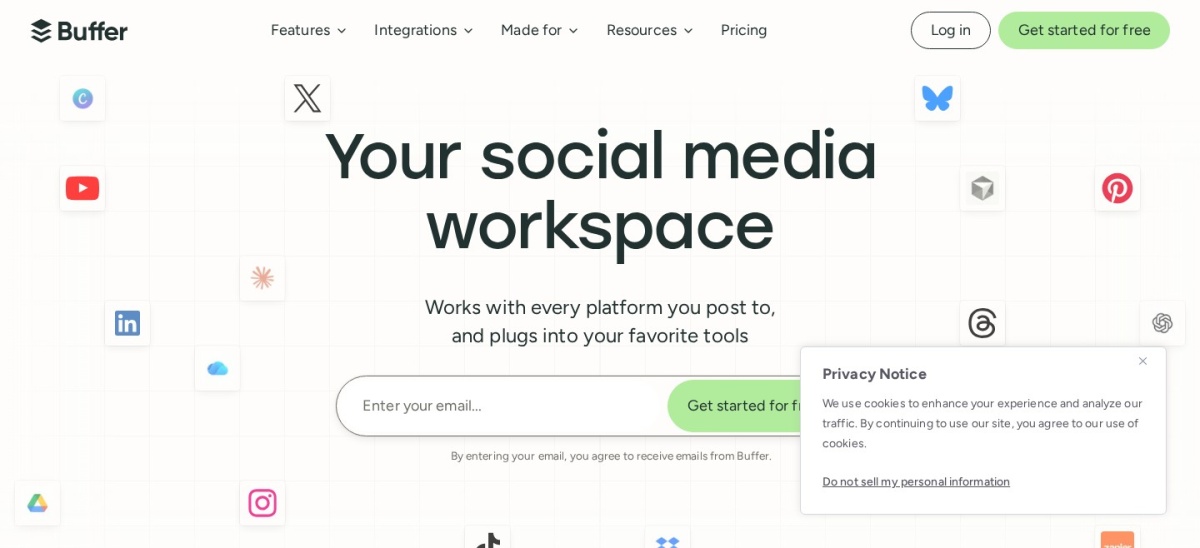
Buffer homepage, captured Nov 2026.
Buffer is a social media scheduling platform for distributing blog links, article summaries and promotional content. Its free plan supports 3 connected channels, 10 scheduled posts per channel and 100 saved ideas. Marketers can create platform-specific messages and organize upcoming content through a straightforward publishing interface.
The trade off is that Essentials costs $5 per channel monthly on annual billing, so managing multiple channels increases the subscription. Advanced approval workflows require Team, and Buffer does not place complete articles on external publisher websites. It suits creators and small businesses that primarily want affordable distribution through their existing social audiences.
What we like
Useful permanent free plan
Affordable entry price for 1 channel
Straightforward scheduling interface
Supports many social publishing destinations
AI assistant and basic insights available
Watch out for
Costs rise as connected channels increase
Team approvals require an upgrade
No dedicated third-party article syndication network
Essentials adds unlimited scheduling, ideas and advanced analyticsVisit buffer.com
Understanding the different types of content syndication
Editorial syndication involves another publisher republishing an article or an authorized version of it. This may help a publication reach new audiences, but it typically requires publisher relationships, permissions and appropriate attribution.
B2B lead syndication distributes content assets such as reports, webinars and white papers to targeted professional audiences. Platforms such as NetLine, TechTarget and DemandScience operate in this category, often using lead-based or negotiated commercial arrangements.
Paid native distribution promotes content through sponsored placements on publisher websites. Taboola, Teads and MGID are examples. These platforms generally charge based on advertising activity rather than a fixed software subscription, so spending depends on campaign settings.
Owned-channel distribution uses social media, connected websites, RSS feeds and automated publishing tools. ContentStudio, Missinglettr, SocialBee and Publer fit this approach. These tools make distribution easier but do not guarantee exposure to an independent publisher's audience.
How content syndication affects SEO
Publishing the same article on multiple websites creates duplicate or substantially similar content. Search engines may select a preferred version for indexing, so syndicated copies do not automatically generate additional search visibility.
When republishing complete articles, coordinate attribution and canonical handling with the receiving publisher. A canonical tag can indicate the preferred source, although search engines treat canonicalization as a signal rather than an absolute instruction.
Social distribution usually works differently. Sharing links, summaries and adapted excerpts generally avoids duplicating the complete article while helping readers discover the original publication.
Measure syndicated campaigns using referral traffic, qualified visitors, conversions and lead quality. Social engagement alone does not establish business value, and paid distribution should be evaluated against its acquisition cost.
How we chose
We reviewed established content distribution platforms with public review histories, actively maintained services and capabilities relevant to article promotion, multi-channel publishing, RSS automation or recurring distribution. We prioritized platforms with transparent entry pricing and practical workflows for content marketers.
Official vendor pricing and public G2 ratings were used, with November 22, 2026 as the editorial reference date. The displayed source information was retrieved on November 23, 2026, so these are not independently verified November 22 snapshots. Regular prices are distinguished from temporary promotions and annual-billing discounts.
We excluded quote-only B2B syndication networks and advertising platforms without a fixed entry subscription because a comparable annual price could not be confirmed. We also excluded tools whose official prices could not be established or whose review evidence was insufficient. No vendor paid for a place, and we do not claim testing for this list.
How to choose the right content syndication platform
Define the audience you want to reach and determine whether your content needs full republication, paid promotion or automated distribution through connected channels.
Choose the distribution model first. Decide whether you need editorial republication, B2B lead generation, native advertising or social distribution. These approaches solve different problems. A social scheduling subscription cannot automatically replace a publisher network or a lead generation campaign.
Match the platform to your content format. Check whether the tool supports complete articles, blog links, RSS feeds, social excerpts or downloadable content assets. ContentStudio supports blog publishing alongside social distribution, while Missinglettr focuses on turning published articles into ongoing promotional campaigns.
Evaluate automation and editorial control. Look for scheduled campaigns, RSS triggers, recurring posts, content queues and review workflows. Automated distribution should still allow editors to correct messaging, avoid repeated promotions and approve sensitive content before publication.
Calculate distribution cost and measure results. Compare subscription prices, connected account limits, workspaces and additional user charges. Track referral sessions, conversions and qualified leads using consistent campaign tagging. Choose the platform that supports measurable outcomes rather than the largest number of scheduled posts.
FAQ
What is the best content syndication platform in 2026?
ContentStudio is the strongest overall choice in this comparison for marketers who need coordinated blog and social distribution. Its Standard plan supports 5 social accounts and unlimited posting. Missinglettr is more suitable for turning blog posts into ongoing campaigns, while SocialBee specializes in recurring content queues.
What is content syndication?
Content syndication is the practice of distributing previously published content through additional outlets or channels. It may involve complete article republication, sponsored recommendations, lead generation campaigns or social sharing. The primary goal is to reach an audience beyond the original publishing destination.
Are there free content syndication platforms?
Free social distribution options include Buffer and Publer. Both support 3 connected social accounts or channels with limited scheduled posts. These services help distribute links and adapted content, but their free plans do not provide guaranteed editorial republication or paid placements on independent publisher websites.
What is the difference between content syndication and guest posting?
Guest posting generally involves creating original material specifically for another publication. Content syndication involves redistributing material that already exists. Both can introduce a brand to new readers, but their editorial agreements, attribution arrangements and search indexing considerations may be different.
Does content syndication help SEO?
Content syndication can introduce articles to additional readers and generate referral traffic, but it does not guarantee ranking improvements or valuable backlinks. When complete articles are republished, publishers should coordinate attribution and canonicalization where appropriate. Sharing adapted excerpts with links to the original article avoids many full-republication issues.
Which content syndication platform is best for B2B marketing?
Dedicated B2B content syndication providers such as NetLine and TechTarget focus on reaching professional audiences and generating qualified leads. Their commercial arrangements differ from the fixed-price software compared here. For distributing B2B articles through owned social channels, ContentStudio or Missinglettr may be a more accessible starting point.
Can I automatically syndicate WordPress articles?
Yes. ContentStudio supports connected blog publishing, while Publer Professional includes RSS feed automation for sharing newly published articles. Missinglettr can transform existing blog content into social promotional campaigns. The exact publishing destinations and automation controls depend on the platform and subscription.
What is the difference between content syndication and social media scheduling?
Content syndication is a broader distribution strategy that may include external publishers, paid recommendation networks and lead generation services. Social media scheduling is one method of distributing promotional messages. Tools such as Buffer and SocialBee mainly support social distribution, while specialized syndication networks provide different audience access.
How much does content syndication software cost?
Entry prices among the listed tools range from $5 per month for one Buffer Essentials channel or a starting Publer Professional account to $33 monthly per Planable Basic workspace. Other platforms charge by account, user or workspace. Enterprise content syndication and native advertising often use variable campaign spending or negotiated rates.
SaaS SEO and WordPress specialist with about 8 years of experience. Rakib compares WordPress plugins, themes, hosting and software using public pricing, documentation and user reviews. See how we rank.