Best Collaboration Software for Small Business in 2026: 7 Tools Compared
WLWPLegible EditorsLast verified 22 Nov 2026How we rank12 min read
★ Short answer
ClickUp is the best collaboration software for most small businesses, combining unlimited free tasks, collaborative documents, boards and team chat in one workspace. Trello is simpler for visual task tracking, while Asana is better for teams managing deadlines and structured projects.
How we make this list: we compare pricing pages, product documentation and public user reviews, then re-check every price before each update. No product paid for a place. Disclosure.
ClickUp offers unlimited tasks and free members, with its paid Core plan regularly priced at $12 per user per month when billed yearly.
Trello Standard costs $5 per user per month annually and adds unlimited boards, custom fields and 1,000 monthly automation runs.
Asana Starter costs $10.99 per user per month annually and includes Timeline and Gantt views for coordinating deadlines.
Notion Plus costs $10 per member per month and combines shared documentation, databases and project organization.
Slack Pro costs $8.75 per user monthly at its standard monthly rate, removing the free plan's 90-day message-history restriction.
Basecamp Freelancer costs $29 per month for up to 5 users and 3 active projects, making its team-based pricing different from per-seat subscriptions.
What small businesses need from collaboration software
Small businesses often manage projects through scattered email threads, spreadsheets, messages and shared folders. Collaboration software brings conversations, responsibilities, files and deadlines into a shared workspace.
The most important feature is task visibility. Everyone should know what needs doing, who owns the work and when it is due. Shared boards, lists and calendars make this easier without constant status meetings.
Communication matters too. Some platforms include team messaging, document comments and video meetings. Others focus on project tracking and work better alongside a dedicated chat application.
Compare the full cost before subscribing. Per-user pricing increases as your team grows, while flat-fee plans can be economical when several employees need access. Check guest access, storage, automation limits and paid feature restrictions.
A small team rarely needs every available feature. Choose software employees can understand quickly, then expand into reporting, workflow automation and more advanced project planning when those needs become real.
The 7 best collaboration software tools for small business
01
ClickUp
4.6/5on G2 (15,879 reviews, checked Nov 2026)
Paid from$12/mo
Best overall for small business collaboration
Free membersUnlimited
Free storage60 MB
Project viewsList, board, calendar and Gantt
Paid planCore, $12/user/mo regular annual rate
clickup.com
ClickUp homepage, captured Nov 2026.
ClickUp is an all-in-one work management platform combining tasks, shared documents, boards, calendars and team communication. Its Free Forever plan includes unlimited tasks, unlimited free members, collaborative documents, Kanban boards, time tracking and 60 MB of storage.
The trade off is complexity and paid feature limits. Core is advertised at $9 per user monthly with annual billing, discounted from its stated regular $12 rate, and adds unlimited storage, Gantt charts, forms and broader automation. It suits small businesses that want project management and communication inside one workspace.
What we like
Unlimited tasks and free members
Combines collaborative documents, chat and task management
Multiple views for different work styles
Built-in time tracking
Paid plans include workflow automation and additional storage
Watch out for
Many settings and features can overwhelm new users
Free workspace storage is limited to 60 MB
Advanced dashboards and resource management require higher plans
Trello is a visual collaboration tool built around boards, lists and movable task cards. Teams can organize assignments, attach files, discuss work and track progress through a simple interface. Its free version supports basic boards and task collaboration.
The trade off is limited project planning depth compared with dedicated work management platforms. Standard costs $5 per user monthly with annual billing, or $6 with monthly billing, and adds unlimited boards, custom fields and 1,000 automation runs per month. It suits small teams managing straightforward, repeatable workflows.
What we like
Straightforward drag-and-drop interface
Easy to organize tasks into visual stages
Affordable Standard subscription
Custom fields and automation on paid plans
Useful templates for common workflows
Watch out for
Less suitable for complex project dependencies
Advanced project views require higher plans
Large boards can become difficult to navigate
Standard adds unlimited boards, custom fields, larger attachments and more automation.Visit trello.com
03
Asana
4.4/5on G2 (14,143 reviews, checked Nov 2026)
Paid from$10.99/mo
Best for structured project coordination
Free planPersonal
Task assignmentYes
Starter viewsTimeline and Gantt
Paid planStarter, $10.99/user/mo annually
asana.com
Asana homepage, captured Nov 2026.
Asana is a work management platform for assigning tasks, coordinating deadlines and tracking projects across teams. Its Personal plan supports basic project organization, while the Starter plan introduces Timeline and Gantt views, broader collaboration and workflow management.
The trade off is that useful planning and reporting capabilities sit behind a subscription. Starter costs $10.99 per user monthly with annual billing or $13.49 when billed monthly. It suits service businesses, marketing teams and operations managers who need clear responsibilities, schedules and progress tracking.
What we like
Clear task ownership and due dates
Timeline and Gantt views on Starter
Useful for coordinating work across departments
Workflow automation on paid plans
Structured interface for recurring project management
Watch out for
Advanced planning features require payment
Per-user costs increase with team size
Not intended to replace dedicated team messaging software
Starter adds Timeline, Gantt, workflow tools and expanded team collaboration.Visit asana.com
04
Notion
4.6/5on G2 (14,021 reviews, checked Nov 2026)
Paid from$10/mo
Best for shared documents and knowledge management
Main featuresPages, databases and docs
Free planYes
Team collaborationShared pages and comments
Paid planPlus, $10/member/mo
notion.com
Notion homepage, captured Nov 2026.
Notion is a flexible workspace for shared documents, company knowledge, meeting notes and project databases. Its free plan includes pages, basic forms, sites and calendar features, although collaborative workspaces with multiple members face content limits.
The trade off is the setup effort needed to create a useful team structure. Plus costs $10 per member monthly on the displayed pricing page and adds expanded team content capabilities, custom forms and sites. It suits businesses that want documentation and lightweight project organization together.
What we like
Combines company documentation and project tracking
Flexible pages and database structures
Useful for building internal knowledge bases
Collaborative editing and shared resources
Templates reduce initial setup work
Watch out for
Requires planning to avoid disorganized workspaces
Free multi-member workspaces have content limits
Dedicated project planning tools may offer deeper scheduling
Plus expands team collaboration and adds custom forms, sites and other workspace features.Visit notion.com
05
Slack
4.5/5on G2 (40,598 reviews, checked Nov 2026)
Paid from$8.75/mo
Best for team messaging and daily communication
Free history90 days
Free app connectionsUp to 10
Free meetings1:1 huddles
Paid planPro, $8.75/user/mo monthly
slack.com
Slack homepage, captured Nov 2026.
Slack is a workplace messaging platform organized around channels, direct messages and team conversations. Its free plan includes 90 days of searchable message history, up to 10 app integrations and one-to-one audio and video huddles with screen sharing.
The trade off is that Slack does not replace a full project management system. Pro has a regular monthly price of $8.75 per user, although a temporary half-price introductory offer may appear. It suits small businesses that prioritize quick communication, searchable discussions and integrations with existing work tools.
What we like
Channels keep conversations organized by topic
Fast direct messaging and group discussions
Free one-to-one huddles
Large directory of application integrations
Paid plans improve access to conversation history
Watch out for
Free searchable history is limited to 90 days
Frequent messages can interrupt focused work
Dedicated task management generally requires another application
Pro expands message history access, integrations and group collaboration.Visit slack.com
06
monday.com
4.7/5on G2 (17,975 reviews, checked Nov 2026)
Paid from$9/mo
Best for customizable business workflows
Free seatsUp to 2
Free boardsUp to 3
Free templates200+
Paid planBasic, $9/seat/mo annually
monday.com
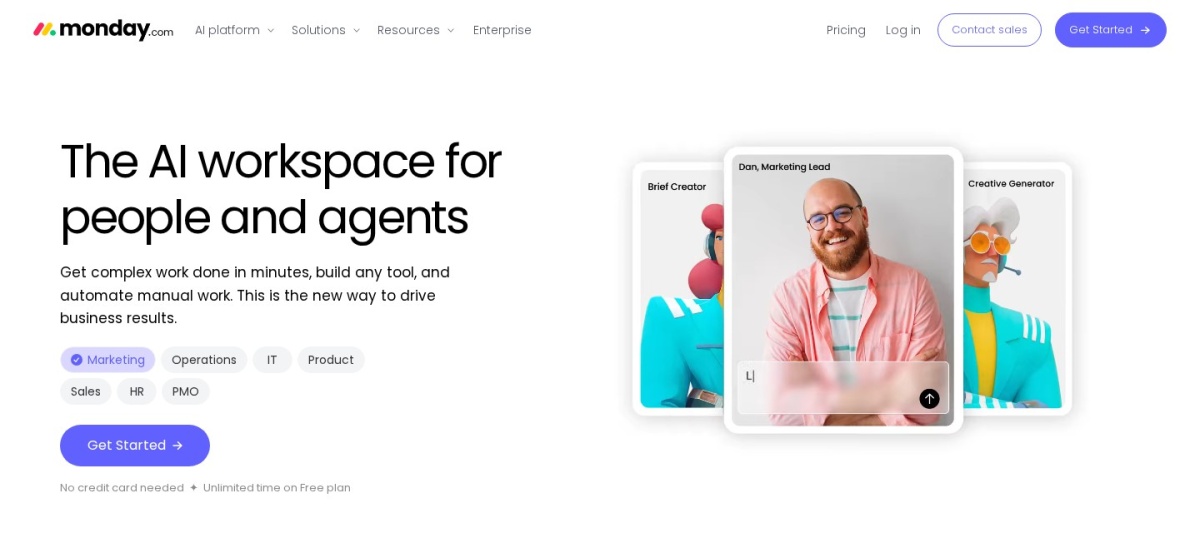
monday.com homepage, captured Nov 2026.
monday.com is a visual work management platform for organizing projects, assignments and operational processes through customizable boards. Its free plan supports up to 2 seats, 3 boards and 3 documents, with access to more than 200 templates.
The trade off is that advanced workflow features and planning views require higher subscriptions. Basic lists at $9 per seat monthly with annual billing, while a separate promotional account discount may appear. It suits small businesses that want customizable tracking across marketing, sales and operations.
What we like
Customizable boards and columns
More than 200 templates available
Clear visual tracking for team assignments
Supports multiple business workflows
Free plan for very small teams
Watch out for
Free plan supports only 2 seats
Basic lacks some advanced planning and automation features
Seat-based billing can become expensive as teams grow
Basic expands boards and storage, while higher plans add more automation and planning views.Visit monday.com
07
Basecamp
4.1/5on G2 (5,490 reviews, checked Nov 2026)
Paid from$29/mo
Best for straightforward client project collaboration
Free plan1 project, up to 3 users
Freelancer projects3 active
Freelancer usersUp to 5
Paid planFreelancer, $29/mo
basecamp.com
Basecamp homepage, captured Nov 2026.
Basecamp is a project collaboration platform combining to-do lists, discussions, schedules and shared files. Its Personal plan supports one project and up to 3 users. Freelancer costs $29 monthly and includes up to 5 users, 3 active projects and 10 GB of storage.
The trade off is that the entry plan restricts active projects and excludes certain advanced capabilities. Freelancer costs $29 monthly without per-user charges for its included seats, while larger business packages cost more. It suits small agencies, freelancers and service teams that want uncomplicated client and project coordination.
What we like
Project discussions and tasks in one place
Flat package pricing instead of charging for every included seat
Simple structure for client collaboration
Schedules, files and communication tools
Free Personal plan available
Watch out for
Freelancer limits teams to 3 active projects
Entry plan excludes templates and time tracking
Less detailed project reporting than specialist platforms
Freelancer adds more projects, users and storage; Pro adds templates and additional project tools.Visit basecamp.com
Free vs paid collaboration software: what changes?
Free collaboration tools can be enough for small teams with simple workflows. ClickUp offers unlimited tasks and members, Trello provides visual task boards, and Slack supports messaging with limited conversation history.
Paid subscriptions usually expand storage, project views, automation, permissions and reporting. These features become more valuable when several departments share workflows or managers need visibility across ongoing projects.
Price structure also matters. Trello and Asana charge per user, while Basecamp Freelancer covers a defined number of users for a flat monthly fee. Compare total workspace costs rather than focusing only on the advertised entry price.
Start with a free plan when possible. Upgrade when a specific restriction prevents your team from doing necessary work, rather than purchasing an expensive subscription for features nobody currently uses.
Which type of collaboration software fits your team?
Project management platforms such as ClickUp, Asana, Trello and monday.com help teams assign responsibilities, manage deadlines and monitor progress. These are a practical starting point when work regularly moves between employees.
Communication platforms such as Slack focus on real-time discussion, quick questions and notifications. They work particularly well alongside task management software when teams need frequent coordination.
Knowledge workspaces such as Notion organize shared documentation, operating procedures and project information. They suit businesses where employees repeatedly consult instructions, meeting notes or internal reference material.
All-in-one project hubs such as Basecamp combine communication and assignments around individual projects. This approach may appeal to teams that prefer a predictable structure without building highly customized workflows.
How we chose
We shortlisted established collaboration platforms used for small business project management, shared documentation, team communication and workflow coordination. We considered functionality, ease of adoption, published limitations and the usefulness of each product for common business needs.
Official pricing pages and public G2 ratings were checked against information available on 22 November 2026. We compared the cheapest published paid plans, annualized the listed charges and distinguished regular pricing from promotional offers where displayed.
We excluded products without a verifiable published entry price, tools with insufficient public review history and services that were not clearly suited to ongoing team collaboration. No vendor paid for a place, and we do not claim testing for this list.
How to choose collaboration software for your small business
Identify the work your team needs to coordinate before comparing features and subscription costs.
Identify your main collaboration problem. If employees miss deadlines, prioritize project tracking through ClickUp, Trello or Asana. If conversations are scattered, consider Slack. If documents and procedures are difficult to find, look at Notion.
Calculate the cost for your whole team. Multiply the published per-user price by the employees who need paid access, and check annual billing requirements. Compare those totals with flat-package options such as Basecamp.
Check how your team shares information. Look for task comments, file attachments, shared documents, guest access, notification controls and integrations with existing services. The right combination depends on whether your work is internal, client-facing or both.
Start with a real team workflow. Set up an actual project using the free plan or available trial. Check whether employees can find assignments, update progress and locate discussions without lengthy instructions before committing to a paid subscription.
FAQ
What is the best collaboration software for a small business?
ClickUp is the strongest overall choice for small businesses that want tasks, project boards, documents and communication together. Its free plan supports unlimited tasks and members, making it practical for teams starting without a software budget. Trello is easier for simple visual workflows, while Asana offers more structured project planning.
What is the easiest collaboration software to use?
Trello is a good starting point for teams unfamiliar with project management software. Its boards, lists and cards make assignments and progress easy to understand. Employees can move tasks between stages without configuring complicated workflows. Teams needing more advanced planning may eventually prefer Asana or ClickUp.
Is there free collaboration software for small businesses?
Yes. ClickUp, Trello, Asana, Notion, Slack and monday.com provide free plans with different restrictions. ClickUp includes unlimited free members and tasks, while monday.com limits its free plan to two seats. Compare storage, user limits, project views and communication features before choosing.
Which collaboration software is best for remote teams?
ClickUp works well for remote teams that need shared tasks, documents and progress tracking. Slack is particularly useful for conversations and quick meetings, while Notion helps organize shared knowledge. Many remote businesses benefit from pairing a project management platform with a communication application.
Can collaboration software replace email?
Collaboration software can reduce internal email by moving task discussions, project updates and shared documents into organized workspaces. However, email remains useful for formal external communication, customer conversations and notifications. Most small businesses should treat collaboration software as a complement to email rather than a complete replacement.
What is the difference between Slack and ClickUp?
Slack primarily organizes workplace communication through channels, messages and meetings. ClickUp focuses on managing work through tasks, documents, boards, deadlines and related communication. Choose Slack when daily conversations are the main concern. Choose ClickUp when assigning and tracking work is more important.
How much does small business collaboration software cost?
Entry prices vary by product and billing arrangement. Trello Standard starts at $5 per user monthly with annual billing, while Asana Starter costs $10.99 on the same basis. Basecamp Freelancer costs $29 monthly for up to five users. Total costs depend on your team size and the features required.
Is Notion or Trello better for small businesses?
Notion is better when your business needs shared documentation, internal guides, databases and lightweight project tracking. Trello is easier for teams managing visual task workflows with boards and cards. Choose according to whether organized information or straightforward task movement is the more important requirement.